
CPI morning often creates the illusion that trading should be simple. Inflation comes in hot, so stocks should fall; inflation comes in cool, so stocks should rise. Sometimes the market behaves exactly that way, which makes the shortcut feel reliable. Then another report arrives, the same apparent logic produces the opposite reaction, and traders who predicted the headline instead of evaluating the transmission are left trying to explain why the market was "wrong."
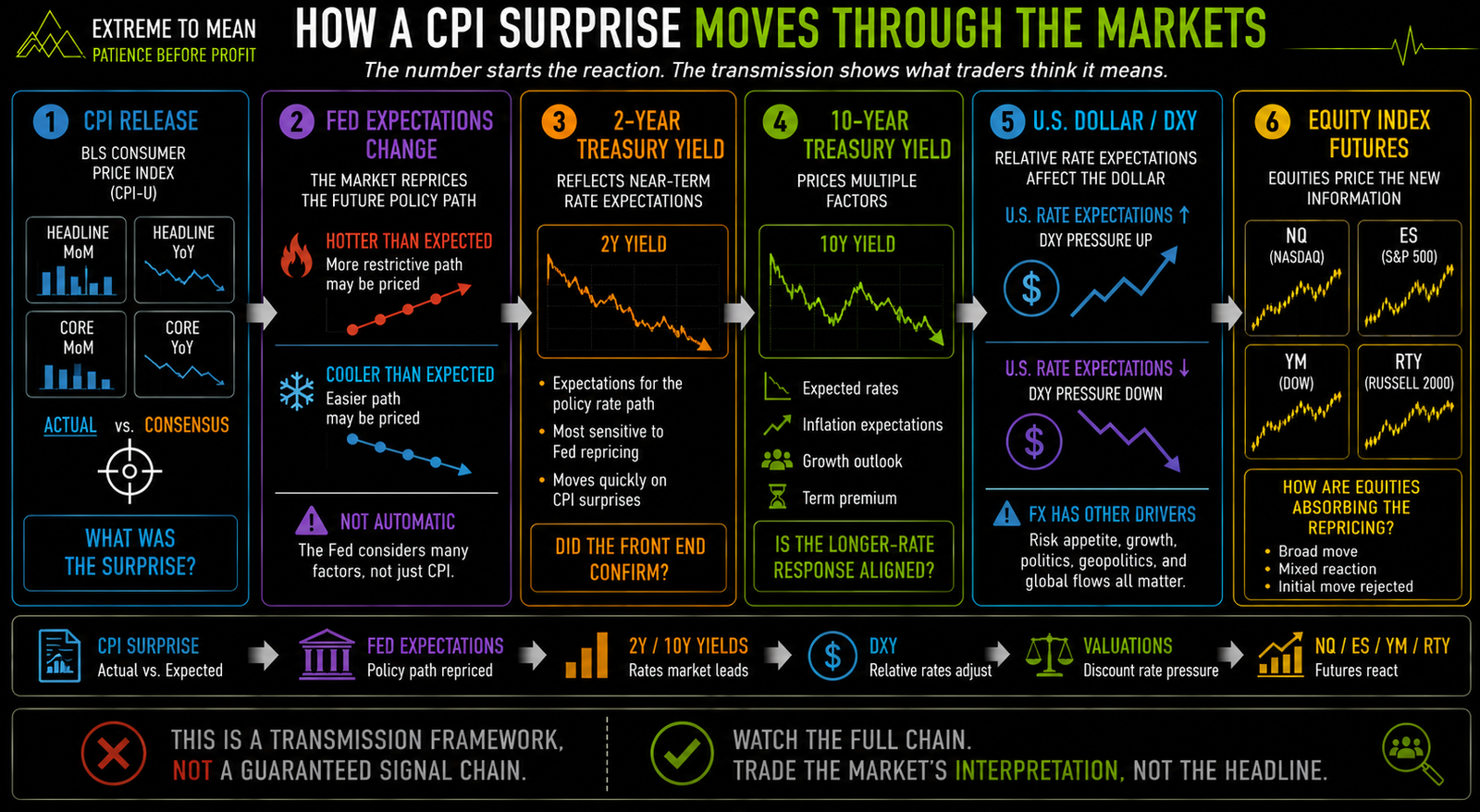
The cleaner approach begins by understanding that economic releases change expectations rather than issuing trading instructions. Inside The Market, CPI is useful because it connects inflation data to Federal Reserve expectations, Treasury yields, currencies, and equity valuations. Those markets begin repricing within seconds of the release, often before a trader has finished reading every component. The job is therefore to understand the chain and then observe which part of it the market is emphasizing.
What CPI Measures in Plain English
The Consumer Price Index measures how prices paid by consumers for a broad basket of goods and services change over time. BLS constructs the CPI from categories that include housing, food, transportation, medical care, recreation, education, and many other consumer expenses. The commonly cited CPI-U covers urban consumers and represents the large majority of the U.S. population. CPI is therefore one widely followed measure of consumer inflation rather than a direct measurement of every price in the economy. (bls.gov)
One distinction matters before going further: the Federal Reserve's formal 2% longer-run inflation objective is measured with the Personal Consumption Expenditures price index, or PCE, rather than CPI. The Fed nevertheless closely tracks CPI because different price indexes contain useful information about inflation and are calculated differently. CPI also arrives on a scheduled release that financial markets follow closely. A trader can therefore respect CPI's market importance without incorrectly saying that the Fed officially targets CPI. (federalreserve.gov)
Headline CPI and Core CPI Are Different Views
Headline CPI includes the full basket, including food and energy. Core CPI removes food and energy, categories that can experience large short-term price swings, and is often watched as another view of underlying inflation pressure. A report can therefore contain a hot headline reading and a softer core reading, or the reverse. Calling the entire report simply "hot" or "cool" can hide that internal disagreement.
That disagreement is one reason the first futures reaction can change quickly. Energy may push headline inflation sharply higher while core inflation behaves more calmly, or core services may remain firm even when falling gasoline prices make headline CPI look benign. Traders are evaluating which components are most relevant to the policy and inflation outlook, not merely which number appears first on a news feed. The full report creates context before the futures reaction can be evaluated properly.
Month Over Month and Year Over Year Answer Different Questions
CPI is commonly discussed through both month-over-month and year-over-year changes. The monthly reading tells traders how prices changed from the previous month, while the 12-month rate compares the index with the same period a year earlier. BLS typically reports the monthly all-items change on a seasonally adjusted basis and the 12-month change before seasonal adjustment. Those measurements can move differently because they describe different horizons. (bls.gov)
The year-over-year number is useful for seeing the broader inflation rate, but it changes partly because old months drop out of the comparison. The monthly rate can provide a more immediate view of current inflation momentum, although any single month can contain noise or unusual category moves. Traders therefore often watch both rather than declaring one automatically more important. The relevant question is what the combination changes about the market's view of inflation persistence.
Consensus Is What Turns a Number Into a Surprise
Financial markets do not wait until release morning to begin thinking about CPI. Economists, banks, traders, and investors form expectations beforehand, and much of that expected information can already be reflected in asset prices. A CPI result that looks high in isolation may create little reaction if it matches what markets expected. A relatively moderate number can create a much larger move when it differs substantially from consensus.
Federal Reserve Bank of San Francisco research describes the inflation surprise directly as the difference between the released core CPI number and the median expectation before the announcement. Its event-study work shows that the sensitivity of 2-year and 10-year Treasury yields to those surprises has changed over time, reinforcing that the same numerical miss can matter differently in different regimes. (frbsf.org) The better question is therefore not merely, "What was CPI?" but, "What was CPI relative to what the market had already priced?"
CPI Changes the Expected Fed Path
A hotter-than-expected inflation report can make traders reassess how quickly the Fed may be able to ease policy or whether policy may need to remain restrictive for longer. A cooler surprise can produce the opposite reassessment if traders believe inflation pressure is becoming less persistent. These are probability changes, not mechanical promises about the next FOMC decision. The guide to FOMC trading and event risk explains how those expectations meet the policy statement and press conference. The Fed evaluates multiple inflation measures, employment conditions, financial developments, and the broader economy rather than responding automatically to one CPI report. (federalreserve.gov)
Market attention also matters. Federal Reserve research found that reactions in bond yields, market-implied inflation expectations, and other asset prices to CPI surprises became substantially stronger during the 2021–2023 inflation surge, when investor attention to CPI was unusually high. (federalreserve.gov) That helps explain why traders should not assume CPI always has the same market impact. The importance of the release changes with the economic problem investors are most focused on.
The 2-Year and 10-Year Yields Help Reveal the Repricing
Treasury yields are one of the most useful places to watch the CPI transmission. The 2-year yield is closely connected with expectations for the path of short-term interest rates, while the 10-year incorporates a longer mixture of expected rates, inflation, growth, and term compensation. San Francisco Fed research has specifically estimated how both maturities react to core CPI surprises. (frbsf.org) A hot surprise accompanied by sharply higher yields is therefore communicating something different from a hot surprise that fails to push yields higher.
The difference between those reactions matters more than memorizing "hot CPI equals yields up." Perhaps the inflation detail was already feared, another component softened the report, positioning was heavily prepared for a worse outcome, or the market's policy interpretation simply changed less than the headline implies. Yields give the trader observable evidence of whether interest-rate expectations are actually repricing. They should be read as part of the reaction rather than assumed before the report arrives.
DXY Adds a Cross-Market Confirmation Layer
Changes in U.S. policy-rate expectations can also affect the dollar because interest-rate differentials influence the relative attractiveness of dollar-denominated assets. Federal Reserve research has found that unexpected increases in U.S. policy expectations have historically been associated with dollar appreciation, while also emphasizing that exchange rates have many additional drivers and that the relationship varies through time. (federalreserve.gov) DXY can therefore confirm part of a CPI interpretation without becoming a required signal.
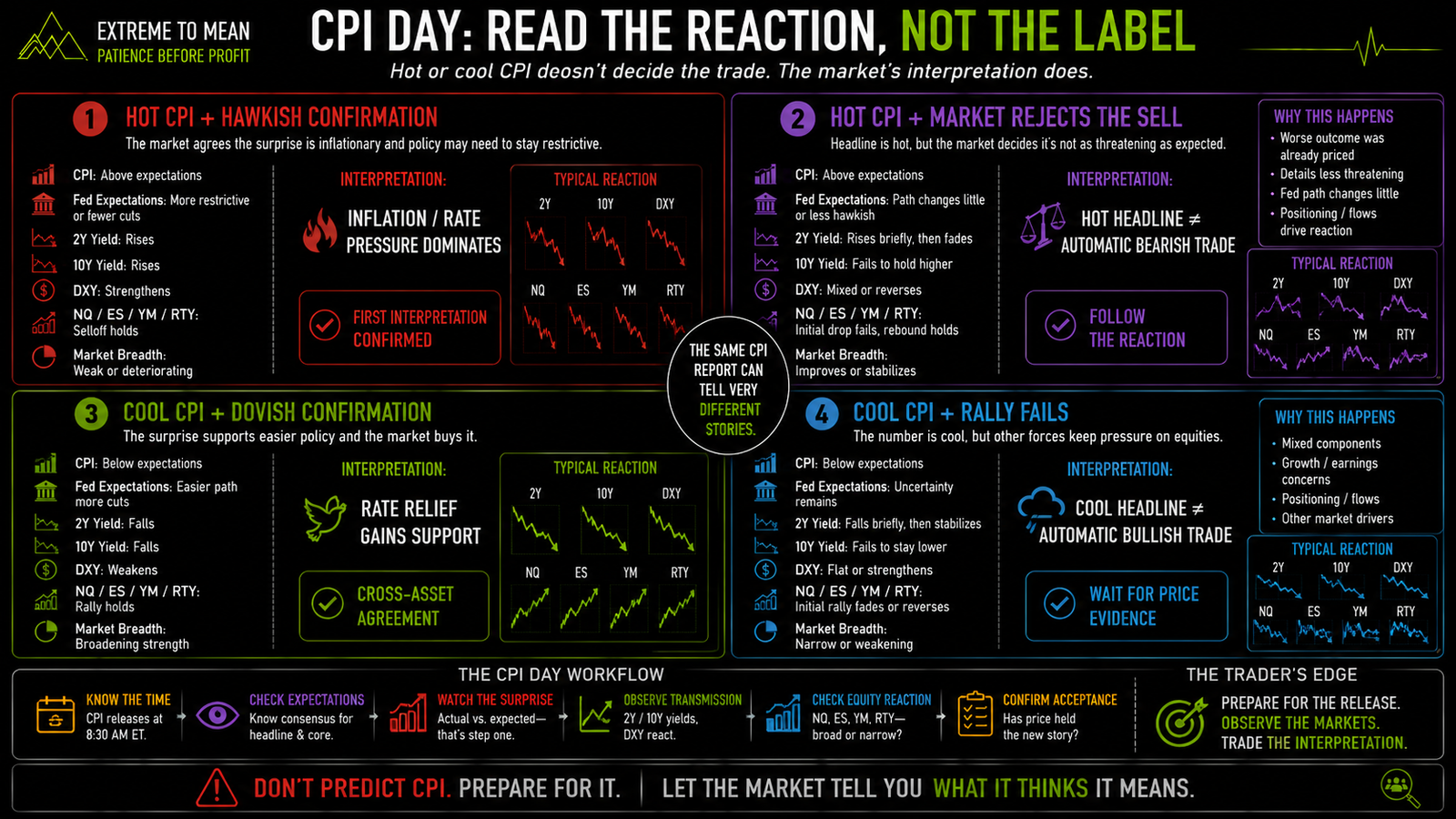
If a hotter CPI surprise pushes yields and expected U.S. rates higher while DXY strengthens, several parts of the transmission are pointing in the same general direction. If yields rise but DXY weakens, or both initially move and then reverse, the market is providing a more mixed message. That disagreement does not have to be solved immediately. It may simply mean the first interpretation has not earned enough confirmation yet.
NQ, ES, YM, and RTY Show How Equities Are Absorbing the News
The next layer is the equity-index response itself. Rather than asking only whether "stocks" rose or fell, traders can compare NQ, ES, YM, and RTY to see whether the reaction is concentrated or broadly shared. A yield-driven repricing can affect different indexes differently because their sector exposures, company characteristics, and sensitivity to changing financial conditions are not identical. The relative response provides information; it does not create a fixed hierarchy that must appear after every CPI release.
For example, futures might initially sell together after a hot surprise and then separate as traders reassess the details. NQ could recover while economically sensitive indexes remain weaker, or RTY could strengthen while mega-cap indexes hesitate, producing a different picture of the market's interpretation. That is why context comes before the candle on CPI morning. The first one-minute spike can be dramatic without becoming the session's final accepted direction.
Why a Hot CPI Can Sometimes Produce a Rally
A hotter-than-expected CPI report does not guarantee lower stock futures. Markets may have positioned for an even worse number, a threatening component may come in softer than feared, previous inflation concerns may already be reflected in yields, or traders may decide the details do not materially change the expected Fed path. If Treasury yields fail to confirm the supposedly hawkish headline and equities reclaim the initial selloff, the market is rejecting part of the simple interpretation. The correct response is not to insist that stocks "should" fall because CPI was hot.
The reverse problem appears with a cooler CPI report. Stocks may rally immediately but fail if yields do not remain lower, if the inflation details are less favorable beneath the headline, or if investors begin connecting weak price pressure with deteriorating economic demand rather than clean disinflation. The same number can also land in a different positioning and macro regime than the prior month's report. Market conditions change the quality of a setup, and they also change the meaning markets assign to economic news.
A Cleaner CPI-Day Process
Preparation begins by knowing exactly when CPI is scheduled rather than discovering the event after volatility appears. BLS schedules CPI releases for 8:30 a.m. Eastern Time, and the official release calendar provides the dates in advance. (bls.gov) Checking the market calendar before the session should therefore be part of preparation, especially because CPI arrives before the U.S. cash-equity open and can create major movement in index futures.
Do not make predicting the number the trading plan. Know the consensus for headline and core readings, understand whether traders are focused on month-over-month or year-over-year inflation, and then let the release expose the actual surprise. Watch the 2-year and 10-year yields, DXY, and the behavior of NQ, ES, YM, and RTY after the first burst. Patience here means giving the cross-market reaction time to show whether the first move is being accepted, rejected, or contradicted.
Better Questions After CPI Hits
A useful CPI process separates three questions: what the report said, what changed relative to expectations, and how markets actually repriced that change. Many bad decisions occur because traders jump from the first question directly to a trade. The transmission through policy expectations, rates, currencies, and equities is the missing middle. The better question is not "Was CPI hot or cool?" but "What did this surprise change, and is the market confirming that interpretation?"
- Was headline CPI above, below, or near consensus?
- Was core CPI above, below, or near consensus?
- What happened month over month?
- What happened year over year?
- Were the important components consistent or mixed?
- Did the surprise materially change expected Fed policy?
- What did the 2-year Treasury yield do?
- What did the 10-year Treasury yield do?
- Did DXY confirm or contradict the rate move?
- Are NQ, ES, YM, and RTY responding broadly or unevenly?
- Did the initial futures move hold, reverse, or remain unstable?
- Has price actually accepted a new direction after the release?
- Am I trading the cross-market evidence or my prediction of what CPI should mean?
These questions also create a better review process after CPI day. A trader can record the surprise, yield reaction, DXY response, relative index behavior, and whether the initial move was accepted rather than reducing the session to "CPI was hot and stocks went up." That turns confusing macro mornings into evidence that can be studied consistently. For a broader framework connecting inflation, yields, the dollar, labor data, and financial conditions, the Macro Playbook is the natural next step.
Final Thought
CPI matters to futures traders because inflation can change the expected path of monetary policy and transmit through Treasury yields, the dollar, equity valuations, and index futures. Headline versus core, monthly versus annual inflation, and—most importantly—the difference between the released number and what markets expected all affect that process. The first reaction can be violent because multiple markets are repricing the same new information almost simultaneously. Yet even a large surprise does not determine the final direction by itself.
Know the release time, know what the market expects, and avoid making your CPI forecast the reason to enter. Once the data arrives, watch the transmission through the 2-year and 10-year yields, DXY, NQ, ES, YM, RTY, and price structure. If those pieces agree, the market's interpretation becomes clearer; if they conflict, waiting is a legitimate decision. The trader's job is to evaluate what CPI changed—not react to whether the number looks hot or cool.
Educational content only. Trading involves substantial risk and is not suitable for everyone.