
Inside The Market, an FOMC decision should be treated as a sequence of new information rather than a single bullish or bearish headline. Traders are comparing what the Federal Reserve actually communicates with what markets had already expected about rates, inflation, growth, employment, and the path ahead. The Fed can do exactly what traders expected today and still completely change what traders expect next.
That is why knowing whether the Fed held, cut, or raised rates is not enough. A trader can correctly predict the decision and still misunderstand the market reaction because the important surprise may be in the statement, projections, Treasury market, or press conference. The job is to evaluate the repricing rather than attach a permanent market direction to one policy action.
FOMC Day Is a Sequence, Not One Announcement
The Federal Open Market Committee holds eight regularly scheduled meetings each year, with additional meetings possible when needed. On scheduled decision days, the current Fed calendar identifies the policy release at 2:00 p.m. ET and the Chair's press conference at 2:30 p.m. ET. In 2026, March, June, September, and December are the meetings associated with a Summary of Economic Projections. (federalreserve.gov)
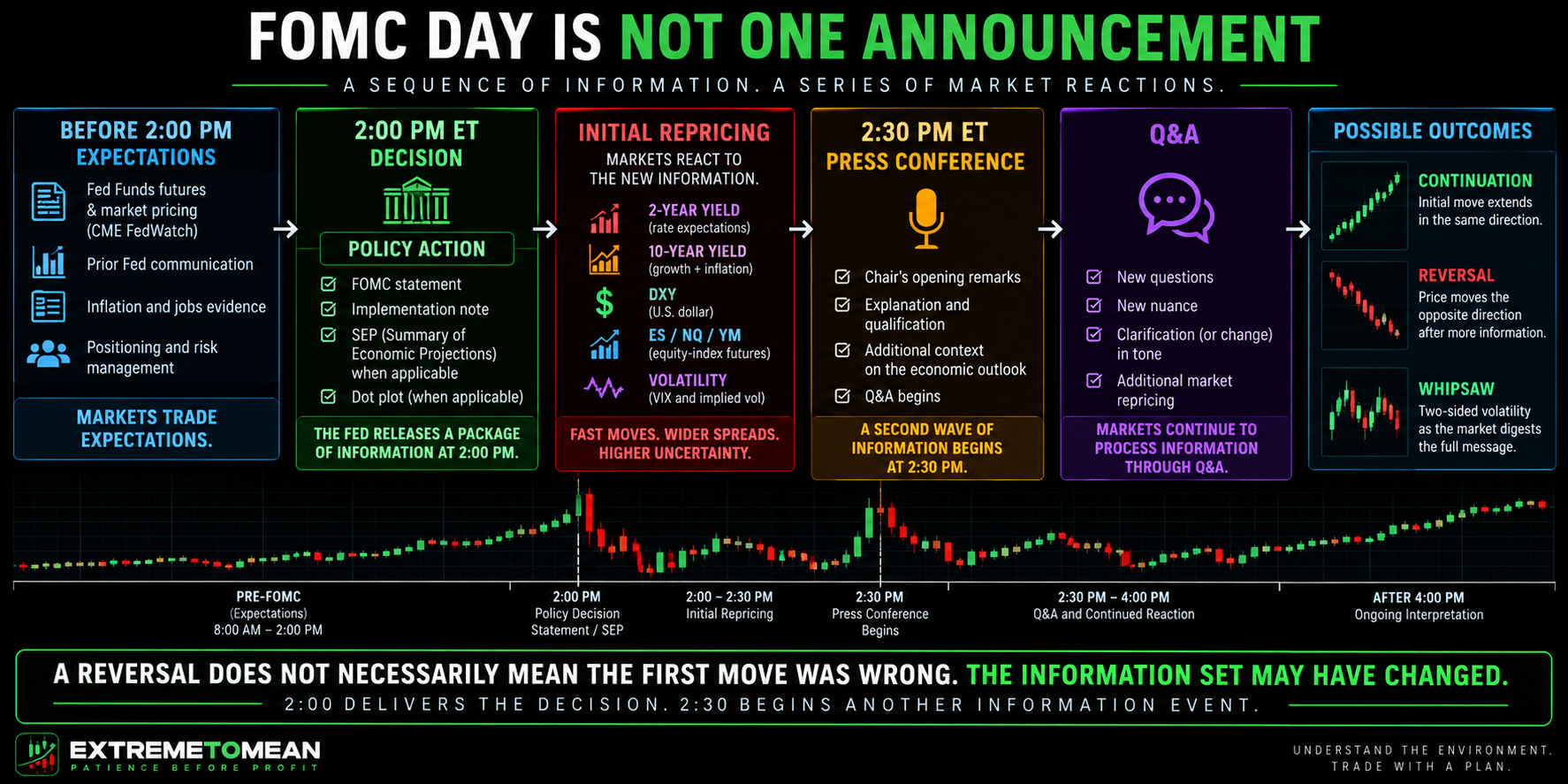
That creates at least two major information windows. At 2:00, markets receive the policy decision and written communication, along with projection materials on applicable meetings; at 2:30, another information event begins as the Chair speaks and answers questions. The information does not stop arriving when the 2:00 candle closes.
The written statement typically addresses the policy action, economic activity, labor conditions, inflation, risks, and the Committee's framing of future policy. Traders should pay particular attention to what changed from the previous statement rather than scanning one sentence for a word that sounds bullish or bearish. Context matters to Fed language just as much as it matters to price.
The Market Is Trading Expectations Before 2:00
Long before the announcement, interest-rate markets already contain expectations about the likely policy decision. CME's FedWatch methodology derives implied probabilities for FOMC outcomes from 30-Day Federal Funds futures, making it useful for understanding what rate traders have priced. It measures market expectations under a defined methodology; it does not reveal what the Fed has secretly decided. (cmegroup.com)
Suppose the market strongly expects a 25-basis-point cut and the Fed delivers exactly that. The headline itself may contain little surprise, but a less-accommodative statement or higher projected policy path can still move Treasury yields and equities sharply. A decision can be expected while the message surrounding the decision is not.
This is also why “priced in” does not mean nothing can happen. The market may have high confidence about today's rate choice while remaining uncertain about the next three meetings, the inflation outlook, labor-market risks, or how long policy will remain restrictive. The decision answers one question while potentially changing several others.
The SEP and Dot Plot Add Another Layer
Four times each year, the Fed publishes its Summary of Economic Projections, covering participants' projections for GDP growth, unemployment, inflation, and what each participant considers an appropriate policy-rate path. The projections also provide information about uncertainty and risks surrounding the outlook. (federalreserve.gov)
The familiar dot plot comes from those individual policy-rate projections. Each dot reflects one participant's assessment of appropriate monetary policy under that participant's economic outlook; it is not one official Committee promise about where rates will definitely be. Even the median dot is a summary of individual projections rather than a binding future rate schedule. (federalreserve.gov)
That distinction matters because traders often convert the dots into appointments on the Fed's calendar. New inflation, labor, growth, and financial-condition information can change future assessments before the next projection round. The dot plot is a snapshot of current projections—not a contract with the future.
Why the 2:30 Move Can Be Different From the 2:00 Move
The Chair's press conference is not merely a ceremonial recap of the statement. Federal Reserve research has found that investors obtain significant additional qualitative information from the press conference beyond the statement and SEP, and that financial markets respond materially during that later window. (federalreserve.gov)
That helps explain why price can move sharply at 2:00 and then reverse, continue, or become violently two-sided after 2:30. A reversal does not necessarily mean the first reaction was “fake”; the first move may have been a rational response to the written information, followed by another rational repricing as the Chair clarified or qualified the message. A reversal can mean the information set changed.
The opposite is equally important. The press conference does not exist to reverse the statement, and sometimes the Chair reinforces the interpretation already visible in yields and equities. Never replace the superstition that the first move is always real with the superstition that the first move is always fake.
Treasury Yields Help Explain What Is Being Repriced
Treasury yields sit closer to monetary-policy expectations than ES or NQ, which makes them useful context around an FOMC decision. Shorter-maturity yields such as the 2-year can respond strongly when markets change their view of the near-term policy path, while longer maturities also incorporate inflation, growth, and term-premium expectations. Rates help reveal the interpretation; they do not dictate what equities must do.
That broader relationship is covered in the 10-Year Treasury Yield lesson. Around FOMC, a rise in yields can accompany equity weakness when discount-rate pressure dominates, but the same yield move can carry a different message when growth expectations are changing. Rates can help explain the equity reaction; they do not become an ES or NQ signal.
DXY and volatility can add another layer. A relatively hawkish surprise may support the dollar or increase equity volatility, yet neither relationship is mechanical because currencies respond to relative global policy and VIX measures expected volatility rather than direction. Cross-asset agreement makes an interpretation more coherent; disagreement is a reason to slow down.
Why FOMC Can Be Difficult to Execute
A high-impact FOMC release can combine enormous trading volume with rapidly changing depth, spreads, and available liquidity. Orders can be canceled, replaced, or consumed quickly as participants reprice risk, so a market can be extremely active and still be difficult to execute cleanly. High volume does not guarantee easy execution.
That matters directly to stops. A stop defines the point where the trader wants the exit process to begin, but fast movement can produce a fill away from the intended trigger price. Your stop defines where you want out; it cannot guarantee where another participant will fill you.
The cleaner response to abnormal event risk is not automatically to pull a structural stop closer so the usual contract count still fits. Wider required structure or greater execution uncertainty may call for smaller exposure, a different event plan, or no position at all. Event risk should change exposure before it changes the logic of invalidation.
Before, During, and After FOMC
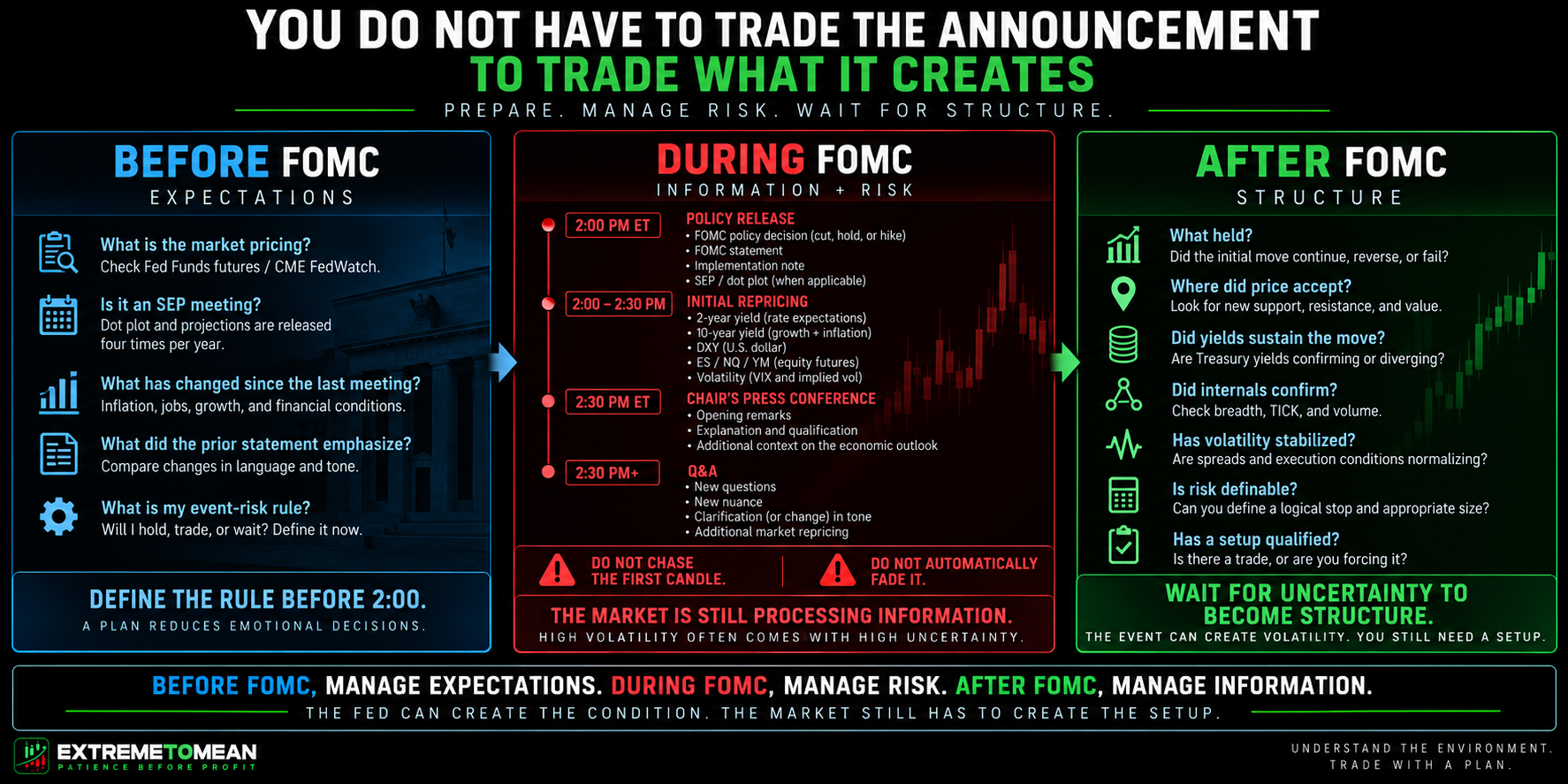
Before the meeting, know what the market currently expects, whether it is an SEP meeting, what the prior statement emphasized, and what major inflation or employment evidence has changed since then.
The lesson on how CPI moves stock futures explains why inflation releases matter without mechanically determining the Fed's choice.
The lesson on how the jobs report moves stock futures applies the same restraint to labor data. Economic data changes the evidence; FOMC reveals how policymakers respond to that evidence.
Most importantly, decide the event-risk rule before the event begins. Your process should already specify whether holding through the release, trading the initial reaction, trading between 2:00 and 2:30, or waiting until the entire communication sequence is finished is permitted. Event rules created during the event are usually emotional reactions disguised as flexibility.
During the event, resist both chasing and automatic fading. The largest candle on the screen may arrive when stop distance, slippage, two-sided volatility, and information uncertainty are at their highest, while the 2:30 press conference is still ahead. The biggest candle on the screen can contain the least usable entry information.
After the event, return to normal market questions. What structure survived, where did price accept or reject, did yields sustain their interpretation, and is the equity move broad enough to receive confirmation from the market internals dashboard? You do not have to trade the announcement to trade what the announcement creates.
FOMC Can Reprice the Mean Itself
FOMC volatility creates visually dramatic extensions, which naturally attracts mean-reversion traders. The danger is assuming that a large move away from VWAP or another balance reference must be an overreaction. During genuine policy repricing, the market may be changing its assessment of fair value rather than temporarily stretching away from an unchanged one.
Suppose NQ falls sharply while short-term yields rise after a materially more restrictive message. Fading the move simply because price is far below a pre-event mean ignores that the information underlying the earlier equilibrium has changed. A large FOMC extension is not automatically an overreaction; sometimes the mean is the thing being repriced.
The same event can eventually produce a trend, a new range, or a later reversion setup. The Fed can create the condition, but the market still has to create the trade. Waiting through the initial uncertainty does not mean missing the market; it means waiting for uncertainty to become structure.
A Practical ETM FOMC Framework
Use Expectation → Decision → Interpretation → Repricing → Structure → Risk → Setup → Decision. This keeps the trader from jumping directly from a headline to an order and forces the market reaction to become understandable enough to define. The framework is deliberately about evaluation rather than prediction.
- Expectation: What did markets already anticipate?
- Decision: What did the FOMC actually do?
- Interpretation: What changed in the statement, SEP, projections, or guidance?
- Repricing: What happened in yields, equities, the dollar, and volatility?
- Structure: What did price actually establish after the first reaction?
- Risk: Can the trade be defined and sized appropriately in the new environment?
- Setup: Has something genuinely qualified?
- Decision: Trade—or wait.
The better question is not “Was the Fed hawkish or dovish?” Ask, “What did the Fed communicate relative to what markets expected, and has that repricing become a trade I can actually define?” Hawkish and dovish only make sense relative to a baseline.
One final distinction also matters: FOMC minutes are not the policy announcement. The Fed generally releases minutes from regularly scheduled meetings three weeks after the decision, providing a more detailed record of the discussion after the fact. (federalreserve.gov)
Final Thought
FOMC day is difficult because the market is not processing one piece of information. It is comparing expectations with the policy decision, statement language, projections when available, Treasury-rate reaction, equity response, and then another round of information beginning with the Chair's press conference. 2:00 delivers the decision; 2:30 begins another information event.
That complexity is why simple rules such as “buy the cut,” “short the hike,” or “fade the first move” are so dangerous. You can correctly predict the Fed, correctly predict the first reaction, and still take a poorly located trade with undefined execution risk. The event being important does not make every reaction tradable.
Know the expectation, know the timeline, define event risk beforehand, and allow the new information to become price structure. Do not trade the Fed headline; trade only when the market reaction becomes a trade you can actually define. Traders who want to connect monetary policy, inflation, yields, the dollar, and broader financial conditions can continue through the Macro Playbook.
Before any scheduled event, use this guide to read an economic calendar before trading futures.
Educational content only. Trading involves substantial risk and is not suitable for everyone.