
The jobs report creates one of the easiest traps in macro trading. A large payroll number looks economically strong, so a trader assumes stocks should rise; a weak number looks bad, so the same trader assumes stocks should fall. Sometimes that first interpretation works, which makes the shortcut feel reasonable. The problem is that financial markets are not grading the economy—they are repricing the future.
That is why employment data belongs inside The Market rather than being treated as a simple news-event setup. Labor conditions affect expectations for economic demand, wage pressure, inflation, corporate earnings, and Federal Reserve policy. Those forces can point in different directions after the same report. The trader’s job is to understand what was released and then evaluate which interpretation the market is actually accepting.
The Jobs Report Is Really Two Surveys
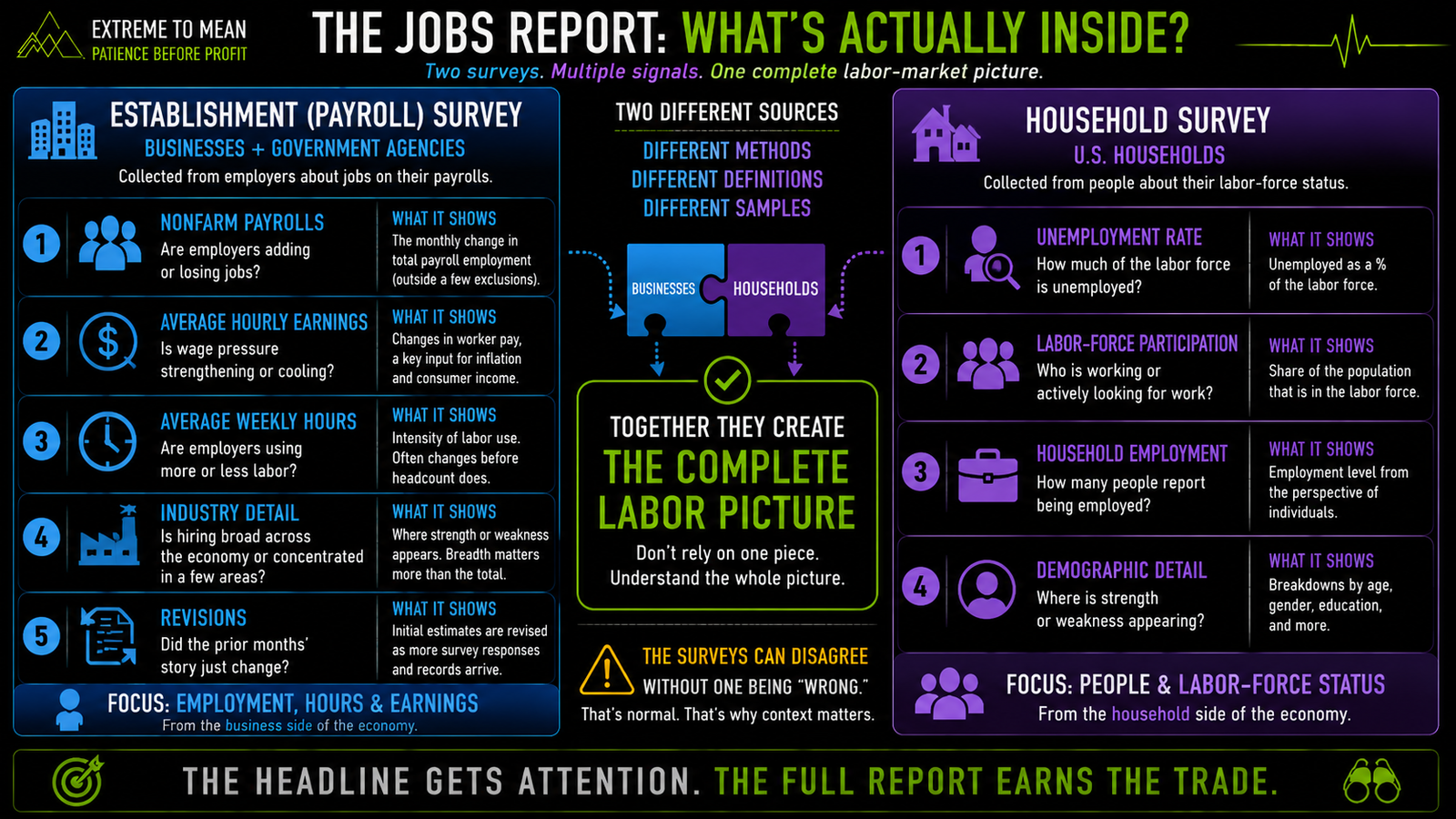
The monthly Employment Situation combines two separate Bureau of Labor Statistics surveys. The establishment survey, also called the payroll survey or Current Employment Statistics survey, measures nonfarm jobs, hours, and earnings using reports from businesses and government agencies. The household survey, or Current Population Survey, measures the labor-force status of individuals and produces statistics such as unemployment and labor-force participation. The surveys use different samples, definitions, and methods, so their employment measures can sometimes move differently.
That distinction matters because the headline number most traders hear first—nonfarm payroll growth—comes from the establishment survey, while the unemployment rate comes from the household survey. A strong payroll number can therefore arrive alongside a rising unemployment rate or weaker household employment. Neither survey automatically invalidates the other because they are measuring the labor market differently. Reading both provides more context than treating one headline as the entire report.
Payrolls Show Where Jobs Are Being Added or Lost
Nonfarm payrolls estimate the number of jobs on employer payrolls outside several excluded categories, including most agricultural employment and the self-employed. Traders watch the monthly change because it provides a timely view of whether businesses are adding workers, maintaining employment, or beginning to reduce jobs. The industry detail matters too because concentrated hiring in one or two areas describes a different labor market from broad job creation across many industries. Payroll strength is therefore more informative when the trader asks where the jobs came from rather than stopping at the total.
The market also cares about the payroll result relative to expectations. If consensus anticipates 100,000 new jobs and the report shows 200,000, the information arriving at release is not simply “200,000 jobs”; it is that employment was much stronger than markets had expected. An apparently weak absolute number can produce the opposite surprise if expectations were even lower. Market repricing is driven by the difference between the new information and the assumptions embedded beforehand.
Unemployment and Participation Add the Household View
The unemployment rate measures unemployed people as a percentage of the labor force, so it cannot be interpreted properly without understanding who is participating in that labor force. The labor-force participation rate measures the share of the civilian noninstitutional population age 16 and older that is either working or actively looking for work. A change in unemployment can therefore reflect both employment conditions and changes in how many people are entering or leaving the labor force. One unemployment number rarely tells the complete story.
Suppose unemployment rises while participation also rises because more people begin looking for work. That is a different development from unemployment rising because employed people are losing jobs while participation remains stagnant. Similarly, a falling unemployment rate can look stronger than it really is if people are leaving the labor force rather than finding work. The cleaner interpretation asks what changed underneath the rate.
July 2026 provided a clean example of why these numbers need to be read together. Nonfarm payrolls fell by 23,000, while the unemployment rate also fell, from 4.2% to 4.1%. That combination looks contradictory until participation is considered: the labor force shrank faster than employment measured by the household survey. The report also revised May payroll growth down by 66,000 and June down by 37,000. The lesson is not that the unemployment rate was “wrong” or payrolls were “right.” The two surveys were describing different parts of the labor market, while the revisions weakened the recent payroll trend. That is why traders need the full report before deciding what the headline actually means.
Wages Matter Because Employment and Inflation Are Connected
Average hourly earnings give traders another view of labor-market conditions. Strong wage growth can support household income and spending, but persistent wage pressure can also affect the market’s inflation outlook when policymakers and investors believe compensation is running faster than productivity and sustainable price stability allow. Slower wage growth can reduce part of that concern without automatically implying economic weakness. The importance of wages changes with the inflation environment surrounding the report.
This is one reason payrolls alone cannot determine whether the report is hawkish or dovish for expected Fed policy. Strong job creation paired with moderate wage growth can communicate something different from strong payrolls accompanied by unexpectedly accelerating wages. A weak payroll report with still-firm wages creates another combination entirely. The market is evaluating how the pieces affect both sides of the economic and policy outlook.
Hours Can Change Before Headcount Does
Businesses do not always respond to weaker demand by immediately firing workers. Companies can reduce overtime, shorten workweeks, slow hiring, or rely less on temporary labor before making larger changes to permanent staffing. Average weekly hours can therefore add useful information about how intensely existing labor is being used. A decline does not predict recession, but it can provide context when other labor measures are softening.
The same logic works during improvement. Companies can increase workers’ hours before committing to larger permanent payrolls, particularly when management is uncertain whether stronger demand will last. Hours should not be treated as a standalone leading signal. They are another piece that helps the trader determine whether the labor story is broadening or contradicting the payroll headline.
Revisions Can Change the Story
The first payroll estimate is not final. BLS incorporates additional survey responses after the initial release and revises the estimate in each of the next two monthly reports, while annual benchmarking later re-anchors the series using more complete employment records. A current payroll gain can therefore arrive beside large upward or downward revisions to previous months. Those revisions can materially change the trend a trader thought was developing.
Imagine the newest report beats expectations by 50,000 jobs but the prior two months are revised downward by a combined 120,000. The immediate headline says “beat,” while the broader three-month labor picture may actually have weakened. The reverse can also occur when a current miss arrives alongside substantial upward revisions. A cleaner read includes the history that was just rewritten.
Expectations Turn the Data Into Market News
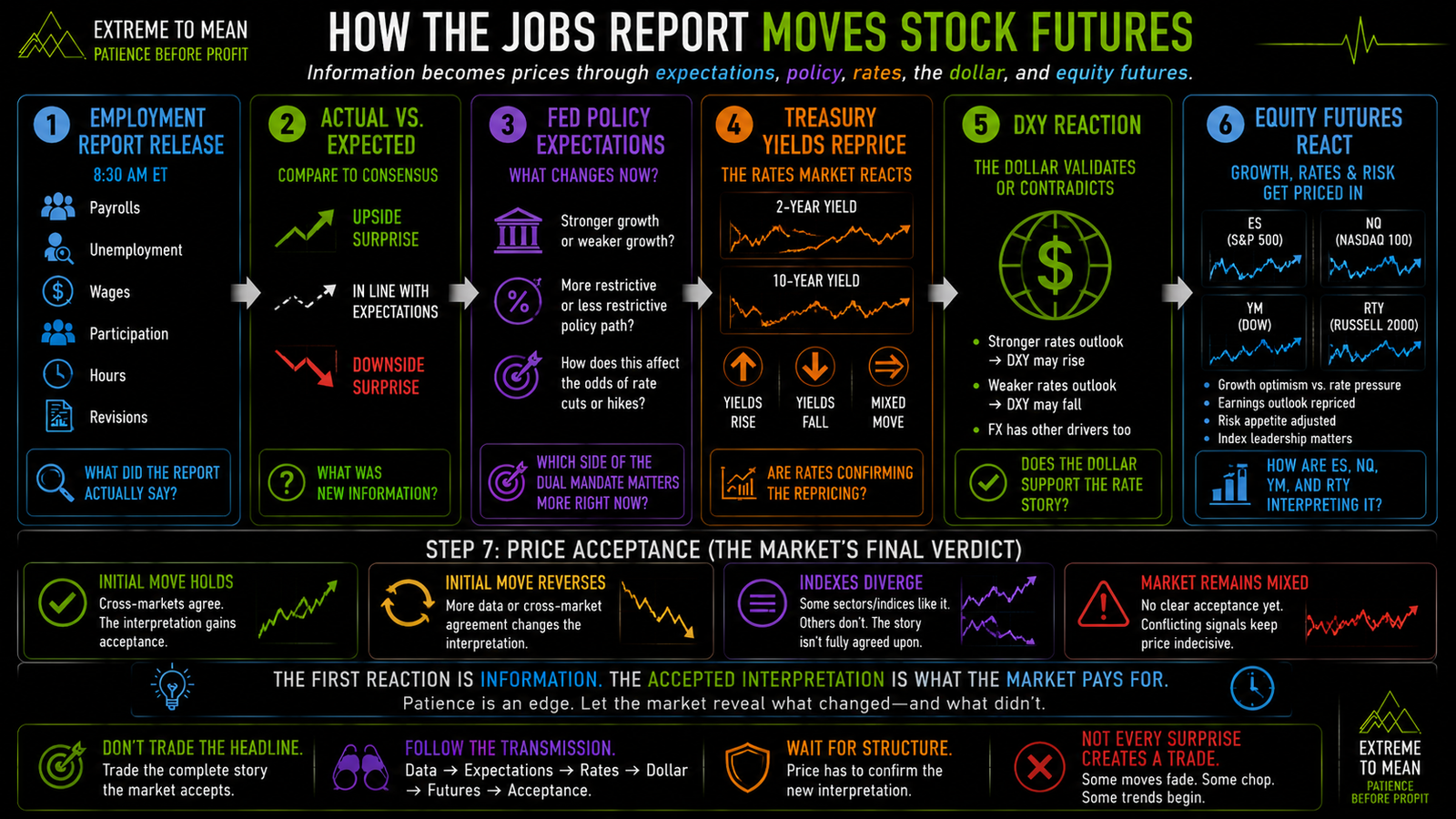
Economic data becomes market-moving information when it differs from what investors had already expected. That applies not only to payrolls but also to unemployment, wages, and other details in the report. Federal Reserve research examining employment releases measures surprises using components including nonfarm payrolls, average hourly earnings, and unemployment because those unexpected differences help explain rapid changes in Treasury yields. The surprise matters because anticipated information should already be reflected, at least partly, in market prices.
This also explains why identical payroll numbers can produce different futures reactions in different months. A 150,000 payroll gain can be a major upside surprise in one environment and a disappointing miss in another. Positioning, inflation conditions, recession concern, and expectations for Fed policy can also change between releases. The report must be compared with the market that existed before 8:30 a.m. ET, not with an arbitrary definition of what a “good” number looks like.
Employment Data Can Reprice the Fed Path
The Federal Reserve is tasked with pursuing maximum employment and stable prices, so labor-market information is directly relevant to monetary-policy expectations. The Fed does not follow a mechanical rule in which one payroll or unemployment number determines the next interest-rate decision. Policymakers assess a broad range of labor, inflation, economic, and financial information. Markets nevertheless change the probabilities they assign to future policy as new employment evidence arrives.
A stronger labor report can sometimes push expected rates higher when traders believe economic strength gives the Fed less reason to ease or raises concern about persistent wage and inflation pressure. A weaker report can sometimes produce the opposite repricing if it increases expectations for policy relief, which is one reason stocks can rise after a bad jobs report. Yet those same reports also contain growth information, which means the equity interpretation can become more complicated. Strong employment can be supportive because growth looks resilient, while weak employment can become negative when investors begin worrying about recession rather than celebrating easier policy.
Treasury Yields Help Reveal What Changed
Treasury yields are one of the most useful places to observe the first stage of that policy repricing. Federal Reserve and San Francisco Fed research has documented significant yield responses to nonfarm-payroll surprises, with sensitivity changing over time as investors place different weight on employment within the Fed’s mandate. Shorter and intermediate maturities can react strongly because they incorporate expectations about the future path of short-term policy rates. A payroll surprise therefore becomes more informative when the trader watches what the rates market actually does with it.
Consider a weak payroll report followed by sharply falling Treasury yields. That tells the trader that rates markets are repricing something, but it does not by itself reveal whether the dominant story is healthy policy relief or worsening growth fear. Equities help answer the next part of that question. The transmission must be followed rather than stopped at the first confirming asset.
DXY Adds Another Layer of Confirmation
Changes in expected U.S. interest rates can affect the dollar because relative interest-rate expectations influence the attractiveness of dollar-denominated assets. Federal Reserve research has found that unexpected changes in U.S. monetary-policy expectations can produce meaningful currency moves, while also emphasizing that exchange rates have many additional drivers. DXY should therefore be treated as contextual evidence rather than a required jobs-report signal. The trader is looking for agreement or disagreement across markets.
If a strong employment surprise sends yields higher and DXY strengthens, the rates and currency markets may both be reinforcing a more restrictive expected policy path. If yields move but DXY does not confirm—or reverses quickly—the cross-market interpretation is less clean. That disagreement does not mean one market is wrong. It means the trader has less reason to rush from a headline into a confident narrative.
ES, NQ, YM, and RTY Show How Equities Interpret the Report
Equity futures add the final major layer because the indexes reflect the balance among growth expectations, discount rates, earnings prospects, and risk appetite. ES, NQ, YM, and RTY can react together or diverge as investors decide which part of the jobs report matters most. Federal Reserve event-study work explicitly uses S&P 500 futures around employment releases because equity prices respond immediately while the cash market is still closed. The relative response across indexes gives traders additional evidence about how broadly the interpretation is being accepted.
That is why context comes before the candle on employment-report mornings. The first futures spike can be a genuine repricing, a temporary liquidity move, a response to one headline before other details are processed, or the beginning of a larger directional move. A one-minute candle cannot tell the trader which one it is. Subsequent structure and cross-market confirmation matter.
The First Reaction and the Deeper Interpretation Are Not Always the Same
News algorithms and traders can respond to payrolls within moments, but the report contains enough moving parts that the first reaction does not always survive deeper evaluation. Markets may initially trade a payroll miss and then reverse after noticing stronger wages, favorable revisions, or a lower unemployment rate. A strong headline can similarly lose its first reaction when revisions, participation, or other details weaken the broader picture. The first move is evidence, not a command.
The next several minutes and hours reveal whether the repricing gains acceptance. Are yields holding their move? Is DXY confirming it? Are ES, NQ, YM, and RTY maintaining structure or retracing the first impulse? Market conditions change the quality of a setup, and the same employment surprise can create very different trading conditions depending on what the broader market fears or values at that moment.
A Cleaner Jobs-Report Process
Preparation begins before the scheduled release. Know the consensus for payrolls, unemployment, and wages; know whether revisions have recently been important; understand whether the market is focused primarily on inflation risk, growth risk, or both; and check the market calendar. BLS Employment Situation releases are scheduled for 8:30 a.m. Eastern Time, which means equity-index futures can reprice substantially before the U.S. cash-equity session opens. Preparation should make the reaction easier to interpret, not encourage the trader to gamble on the number.
Once the report arrives, separate report → surprise → transmission → acceptance. Read the payroll headline, unemployment, participation, wages, hours, and revisions, then watch how Treasury yields and DXY respond before evaluating the structure in ES, NQ, YM, and RTY. If the pieces agree, the market’s interpretation becomes clearer; if they conflict, patience is a legitimate response. The setup still has to earn risk after the macro information arrives.
Better Questions After the Jobs Report
The most useful question is not, “Was the jobs report good or bad?” That framing assumes economic strength and stock-market strength are always the same thing. A cleaner question is, “What changed relative to expectations, and what is the market repricing because of it?” That keeps the decision focused on evidence rather than the emotional tone of the headline.
- Were payrolls above, below, or near consensus?
- Which industries created or lost jobs?
- What happened to the unemployment rate?
- Did labor-force participation change?
- What happened to average hourly earnings?
- Did average weekly hours strengthen or weaken?
- Were prior payroll months revised materially?
- Does the full report look stronger or weaker than the headline suggests?
- Did expected Fed policy change?
- What happened to Treasury yields?
- Did DXY confirm or contradict the rate move?
- Are ES, NQ, YM, and RTY responding consistently?
- Is the first futures move being accepted or rejected?
- Am I trading the report itself, or the market’s interpretation of the report?
These questions also create a better review process after the session. Instead of recording that “payrolls beat and NQ fell,” the trader can identify whether the move came through rate expectations, growth concerns, wages, revisions, or a combination of factors. That builds a repeatable framework for comparing future employment releases without assuming the same relationship must appear every month. The Macro Playbook is the natural next step for organizing labor data alongside inflation, yields, DXY, growth, and financial conditions.
Final Thought
The monthly jobs report matters because it provides several different views of the labor market at once. Payrolls show employer job counts, unemployment and participation provide the household perspective, wages and hours add information about labor demand and inflation pressure, and revisions can change the trend investors thought they understood. The market then compares all of that with expectations. The headline is only the beginning of the analysis.
For traders, the important transmission runs from labor-market information into expected Fed policy, Treasury yields, DXY, and ultimately ES, NQ, YM, and RTY. Sometimes strong employment is treated as healthy growth; sometimes it creates rate pressure. Sometimes weak employment creates rate relief; sometimes it increases recession fear. The trader’s job is not to memorize one jobs-report reaction—it is to evaluate what the report changed and whether the market continues accepting that interpretation.
Educational content only. Trading involves substantial risk and is not suitable for everyone.