
One of the strangest market reactions for a newer trader is seeing weak employment data followed by a rally in stock futures. Payroll growth disappoints, unemployment rises, or previous job estimates are revised lower, yet ES and NQ move higher instead of falling. The reaction can look irrational if economic news is divided into a simple good-news/bad-news framework. Markets are doing something more complicated: repricing what the number changes about the future.
That makes employment data an important lesson inside The Market. The report matters not only because it describes the labor market, but because employment affects expectations for economic growth, inflation pressure, Federal Reserve policy, Treasury yields, the dollar, and corporate earnings. Those relationships compete with one another after every release. The trader's job is to determine which interpretation the market is emphasizing now.
The Jobs Report Is More Than One Number
The monthly Employment Situation combines information from two different Bureau of Labor Statistics surveys. The establishment survey provides nonfarm payroll employment, hours, and earnings, while the household survey produces measures including unemployment and labor-force participation. That means a single report can contain mixed evidence rather than one unified bullish or bearish message. A payroll miss can arrive alongside falling unemployment, firm wage growth, or other details that change the interpretation. (bls.gov)
Revisions complicate the picture further because traders are not responding only to the newest payroll headline. Previous months can be revised, wage data can alter inflation expectations, and the unemployment rate can move differently from payroll employment because it comes from a separate survey. Reading only the largest number on the screen can therefore hide important information. This is one reason understanding how the stock market actually moves requires thinking in terms of changing expectations rather than isolated headlines.
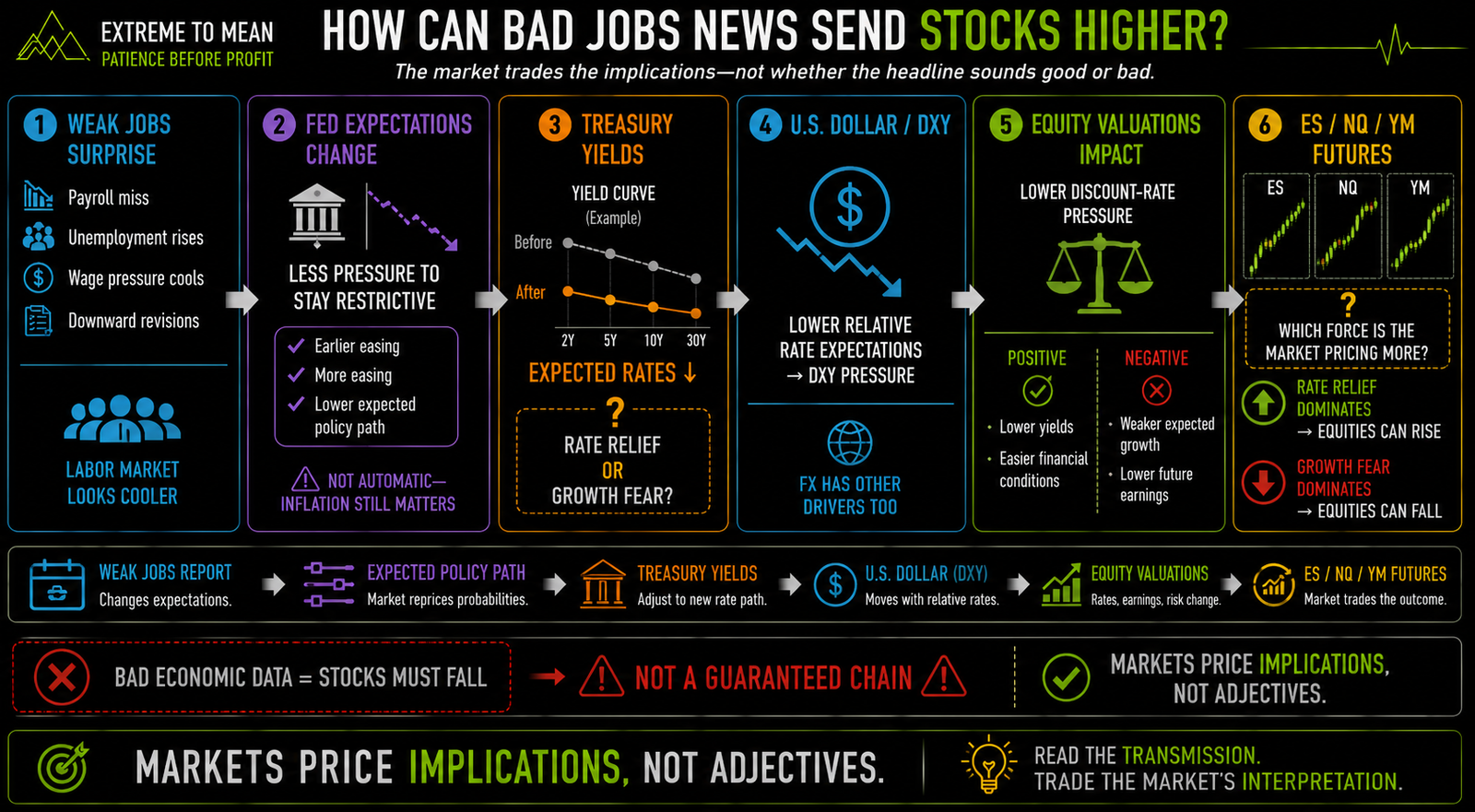
How Bad Jobs News Can Become Rate Relief
The Federal Reserve is responsible for pursuing both maximum employment and stable prices, so labor-market information can affect expectations for monetary policy. If employment cools enough to reduce concerns about an overheated economy while inflation remains sufficiently contained, traders may conclude that the Fed has less reason to maintain restrictive policy. The weak report is economically negative in one sense but potentially supportive for financial conditions in another. That is the foundation of the phrase "bad news is good news." (federalreserve.gov)
The important word is potentially. A weak report does not mechanically cause rate cuts, and the Fed considers a broad range of employment, inflation, and financial information rather than following one number. The market is instead changing the probability it assigns to future policy paths. If investors move toward expecting lower future policy rates, that repricing can immediately travel through bonds, currencies, and equities before the Fed changes anything.
Treasury Yields Are Often the First Major Clue
Employment releases can move Treasury yields quickly because the bond market is constantly pricing expected short-term rates, inflation, growth, and term compensation. Federal Reserve event-study research specifically finds that surprises in nonfarm payrolls, average hourly earnings, and unemployment help explain movements in the 10-year Treasury yield around employment-report releases. Current Fed reporting likewise shows that changes in the expected path of the federal funds rate can materially affect Treasury yields, particularly at shorter maturities. (federalreserve.gov)
Suppose payroll growth is weaker than expected and Treasury yields immediately fall. One interpretation is that traders now expect a less restrictive policy path or weaker future growth, and the distinction between those explanations matters. Falling yields can initially relieve pressure on equity valuations because future cash flows are being discounted at lower rates. The trader should therefore observe the yield move but continue asking why yields are falling.
The Dollar Adds Another Piece of the Transmission Chain
Changing policy expectations can also reach the foreign-exchange market. Federal Reserve research finds that unexpected changes in U.S. policy-rate expectations and interest-rate differentials can produce meaningful movements in the dollar, while emphasizing that exchange rates are also driven by many other forces. When expected U.S. rates fall relative to foreign rates, the dollar can come under pressure. DXY can therefore become another useful piece of evidence after a labor-market surprise rather than a mechanical confirmation signal. (federalreserve.gov)
Lower yields and a softer dollar can create a more supportive financial backdrop for equities, particularly when investors still believe economic activity can remain resilient. Federal Reserve research on monetary policy and stock prices identifies changes in yields, equity risk premia, and expected corporate cash flows as important channels through which policy information reaches stocks. Lower discount rates can support valuations, but that benefit can be outweighed if investors become sufficiently worried about earnings or economic contraction. The market reaction tells the trader which side of that trade-off is currently stronger. (federalreserve.gov)
ES, NQ, and YM Help Reveal the Market's Interpretation
After the report, the relative behavior of ES, NQ, and YM can add useful context. If yields fall and NQ leads a broad equity rally while ES participates, traders may be emphasizing the discount-rate benefit of easier expected policy. If YM and other cyclical areas participate as well, the market may be showing greater confidence that weaker employment does not yet imply severe economic deterioration. These are observations about participation, not fixed rules about how each contract must react.
The opposite pattern can be informative too. Yields may collapse while equities struggle, NQ may fail to hold an initial rally, or YM may weaken as economically sensitive shares come under pressure. That is why context comes before the candle even on a major data morning. The first futures spike tells you less than the relationship among rates, the dollar, index structure, and subsequent acceptance.
When Bad Jobs News Becomes Bad News Again
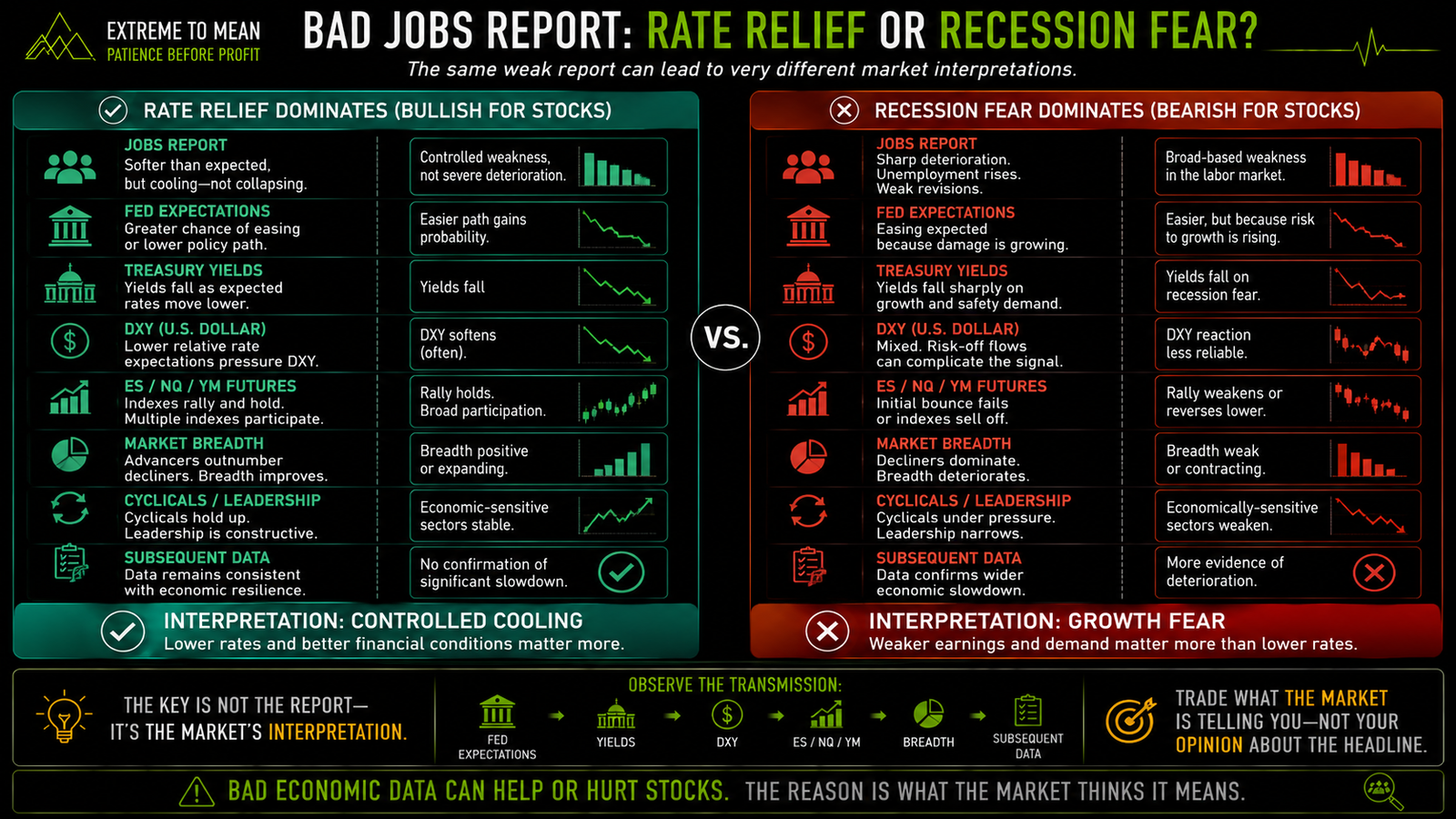
The "bad news is good news" relationship has limits because lower rates are only one part of equity valuation. Federal Reserve research examining real-time price discovery has found that the stock response to macroeconomic news changes across economic regimes, consistent with discount-rate and cash-flow effects carrying different importance at different times. When recession risk is low, weaker data can sometimes help stocks through lower expected rates. When contraction risk dominates, weak economic news can instead reinforce concerns about future activity and profits. (federalreserve.gov)
Imagine payroll growth collapsing, unemployment rising materially, prior months being revised sharply lower, and other indicators already pointing toward broad deterioration. Treasury yields might still fall because policy easing is expected, yet investors may decide that easier policy is arriving because the economy is becoming substantially weaker. Lower rates no longer look primarily like relief; they look like a response to damage. In that regime, stocks can fall alongside yields because growth and earnings concerns outweigh the valuation benefit.
The Same Yield Move Can Mean Two Different Things
This creates an important diagnostic problem for traders. Falling Treasury yields can accompany a bullish equity response when the market sees controlled labor cooling and increased policy flexibility, or a bearish response when the market sees recessionary deterioration. The bond move alone cannot tell you which story is dominant. The answer has to be inferred from the broader cross-market reaction.
Watch whether ES, NQ, and YM hold their initial response, whether DXY confirms the change in rate expectations, and whether stock-market participation broadens or contracts. A rate-relief rally that gains acceptance across indexes and sectors communicates something different from an early NQ bounce that fails while economically sensitive shares remain weak. The same economic release can therefore generate different trading environments depending on what investors believe the weakness means. Markets trade interpretation, not vocabulary.
Breadth Helps Separate Relief From Fragility
Market breadth can become particularly useful after a confusing macro release. If the major indexes rise while many stocks and sectors participate, the rally has broader internal support than one driven by a small number of rate-sensitive leaders. If index futures rise but breadth remains weak, the move may still continue, but the internal evidence is narrower. Breadth should help describe the rally rather than predict when it ends.
Subsequent economic data matters for the same reason. One employment report is an estimate, and BLS labor-market measures come from separate surveys with different methodologies and later revisions. Traders should therefore avoid turning one weak report into an immediate recession declaration or one strong report into proof that economic risk has disappeared. Market conditions change the quality of a setup, and the macro interpretation can evolve as new evidence arrives. (bls.gov)
A Cleaner Process on Jobs-Report Morning
Start by knowing what the market expects before the release. Then read more than the payroll headline: unemployment, wages, revisions, participation, and the relationship among the report's major components can materially change the interpretation. Use the market calendar to know when the release is due and whether additional major data or Fed events could affect the same session. Preparation makes the immediate market reaction easier to evaluate without requiring the trader to predict it.
After the number hits, watch the transmission rather than chasing the first futures candle. Ask how Treasury yields respond, whether expected Fed policy appears to be repricing, what DXY does, and whether ES, NQ, and YM accept their initial move. Then check whether participation supports the index reaction and whether price holds important structure after the first burst of volatility. The setup should earn attention through the market's response, not through the trader's opinion about the headline.
Better Questions After a Weak Jobs Report
The cleanest question is not, "Was the jobs report bad?" The better question is, "What does the market believe this report changes?" That wording forces the trader to distinguish controlled cooling from economic deterioration and rate relief from recession fear. It also keeps the decision anchored to observable cross-market behavior instead of an economic opinion formed before price reacts.
- Was the report actually weaker than expected, or merely weak in absolute terms?
- Which parts were weak: payrolls, unemployment, wages, hours, participation, or revisions?
- Did expected Fed policy move toward easier conditions?
- Did Treasury yields fall, and where along the curve?
- Did DXY weaken with the change in rate expectations?
- Are ES, NQ, and YM confirming the same interpretation?
- Is the equity rally broad, or concentrated in a narrow group of leaders?
- Are economically sensitive stocks behaving as though growth risk is increasing?
- Did the initial futures move hold after the first reaction?
- Is price accepting the new information or reversing the first interpretation?
- Does later economic evidence support controlled cooling or broader deterioration?
- Am I trading what the headline sounds like, or what markets are actually pricing?
These questions make post-event review much more useful than labeling a session irrational. A trader can record whether yields, DXY, index futures, breadth, and structure behaved consistently with rate relief or with growth fear. When the relationships disagree, the cleaner response may be to wait rather than force one narrative onto a mixed market. The Macro Playbook is a natural next step for organizing those cross-market relationships into a repeatable context process.
Final Thought
Stocks can rise after a bad jobs report because weak employment data can change the expected path of monetary policy, push Treasury yields lower, pressure the dollar, and reduce part of the discount-rate burden on equity valuations. That transmission is most supportive when investors believe the labor market is cooling without the economy falling into a much more serious contraction. The weak headline has not become economically "good." Its implications for financial conditions have temporarily become more important than the weakness itself.
The relationship reverses when the weakness becomes large or persistent enough that recession, earnings, and cash-flow concerns dominate. That is why traders should never memorize "bad jobs = stocks up" any more than they should assume "bad jobs = stocks down." Watch yields, DXY, ES, NQ, YM, breadth, structure, and subsequent data to see which interpretation the market is accepting. The trader's job is to react to the market's interpretation—not demand that price agree with the headline.
Educational content only. Trading involves substantial risk and is not suitable for everyone.