
A broker may technically let someone trade a futures contract with an account far smaller than another trader would consider sensible. Both facts can be true, because “What is the minimum?” and “What is enough?” are not the same question.
Margin tells you whether you can open the trade. It does not tell you whether you can afford the trade.
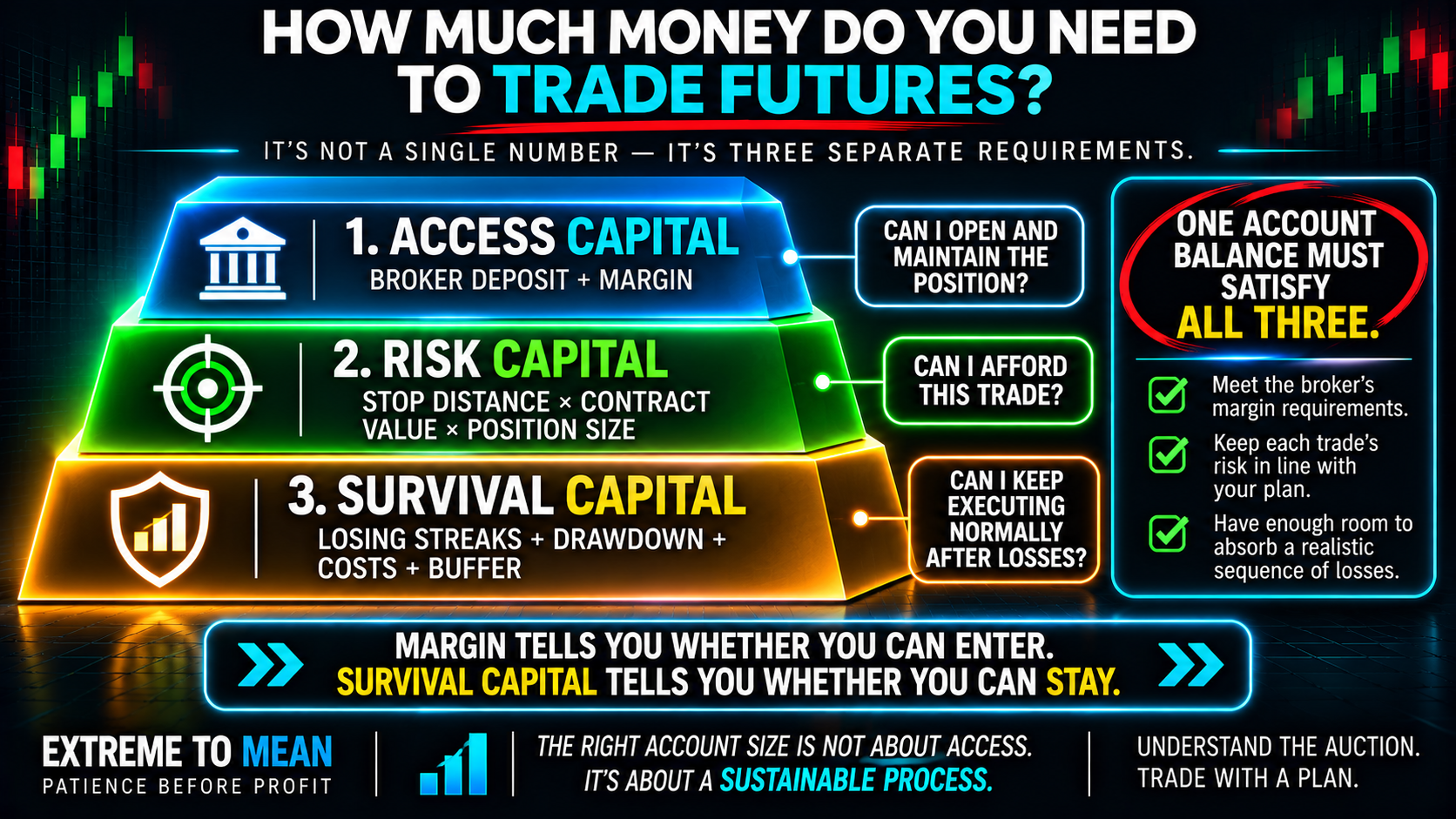
There is no universal dollar minimum that responsibly answers how much money someone needs to day trade futures. That is why this lesson belongs inside The Basics. A useful answer separates access capital for opening the position, trade risk for the dollars exposed before invalidation, and survival capital for absorbing losses while continuing to execute normally.
The Minimum Required to Enter Is Not the Minimum Required to Survive
Beginners often encounter a broker's intraday-margin number first, so it is natural to treat that figure as the answer to “How much do I need?” The number appears beside the order ticket and may be low enough to make a leveraged futures position look surprisingly accessible. But accessibility and adequacy are different questions. The broker is deciding whether the account satisfies the requirements to carry the position. The trader still has to decide whether the position's actual dollar risk belongs in the account.
Intraday margin is a gate—not a bankroll recommendation. The minimum required to enter the market is not necessarily the minimum required to survive it. That distinction is the starting point for every capital decision that follows.
Layer One: Margin Is Access Capital
Futures margin, sometimes called a performance bond, is capital required to open or maintain a futures position. Requirements vary with product, volatility, and broker policy. Margin is an access requirement—not a stop loss. A low margin number does not cap the position's possible loss or make the contract small. The broker defines required collateral; price movement determines the position's gain or loss.
That distinction matters because futures are leveraged. A trader may control exposure much larger than the cash posted as margin. You are not buying an account-sized position; you are controlling a leveraged contract.
Layer Two: Convert the Setup Into Dollar Risk
The capital question becomes useful once it starts with the trade rather than the broker. First ask where the setup is actually wrong, then convert the distance from entry to invalidation into dollars. The trade defines the risk before the account defines the size.
A simple estimate is:
Trade Risk = Stop Distance × Dollar Value per Point × Number of Contracts
Then allow for commissions, fees, slippage, and imperfect fills. This is why the trade is not ready until the risk is clear: knowing that you can margin the contract is not the same as knowing what the trade means for the account. Consider MES and ES. MES is $5 per S&P 500 index point, while ES is $50 per point. If the setup requires a 20-point invalidation, one MES represents about $100 of price risk before costs, while one ES represents about $1,000 over the same move.
The market idea did not change; the contract did. The same chart setup can require radically different account risk depending on the contract used. The point is not that one contract is inherently better, but that contract size changes the financial meaning of the same chart decision.
Smaller Contracts Improve Sizing Precision, Not Safety
The same principle applies to Nasdaq futures: MNQ uses a $2 Nasdaq-100 multiplier while NQ uses $20. Micro E-mini contracts are one-tenth the size of their E-mini counterparts, giving traders a finer unit for sizing risk. Smaller contracts change the exposure—not the underlying market.
Micros are still leveraged futures, and several contracts can quickly create substantial exposure. Smaller units can make responsible sizing easier. They do not make poor risk management harmless.
Same Margin, Very Different Risk
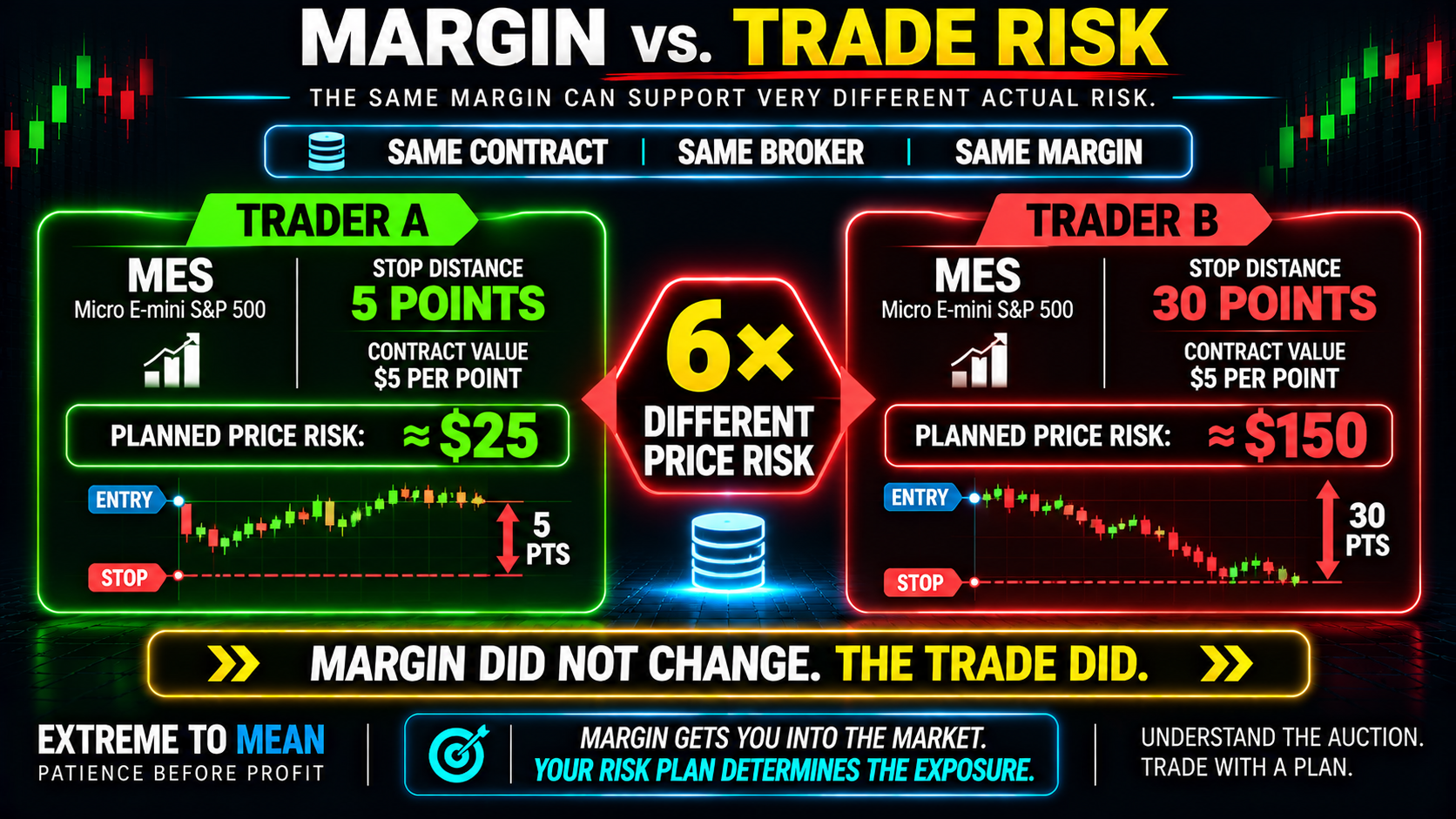
Imagine two traders using the same broker and trading one MES contract. Trader A's setup is invalidated five points away, while Trader B's setup needs a 30-point stop. Their margin requirement may be identical, but their planned price risk is not.
At $5 per point, five MES points represent about $25 before costs and 30 points represent about $150. Margin may be identical while trade risk is completely different. The broker can tell you how many contracts it permits; only the risk plan should tell you how many the trade should use.
Derive Capital From the Risk Policy
Suppose one MES trade carries $100 of planned price risk before costs. If a trader independently decides that $100 represents 1% of the account, the implied account size is $10,000; if the trader's own policy makes it 2%, the implied size is $5,000. Those are illustrations, not recommendations. Extreme to Mean should not replace one magic account minimum with one magic risk percentage. The useful relationship is Required Capital = Planned Dollar Risk ÷ Chosen Account-Risk Fraction.
Start with the risk policy, then derive the capital requirement. A trading plan made before the session is where that policy belongs. The desired account size should not manufacture a risk rule.
Layer Three: Can the Account Survive the Strategy?
Affording one stop is not the same as funding a strategy. A method can experience losing streaks, drawdowns, slippage, difficult sessions, and changing volatility even when it remains valid. The account has to survive the strategy's losses, not merely its first position.
After several ordinary losses, can the trader still take the next qualified setup at normal size, use the correct stop, and follow the plan without financial pressure forcing a change in behavior? If not, the approach may be structurally undercapitalized for that trader. Single-trade affordability is not strategy affordability.
Historical drawdown and losing streaks provide context when enough data exists, but they are not promises about the worst future outcome. Future drawdown can exceed what a backtest or live record has already shown. Capital is not only money for today's trade; it is room for tomorrow's decision.
Risk Capital Is Also a Life Question
An account can be mathematically large enough for a strategy and still use money that should not be exposed to futures risk. NFA guidance describes risk capital as money that can be lost without jeopardizing necessities, emergencies, savings, or long-term objectives. If a normal trading loss threatens essential obligations, capital may be sufficient for the strategy and still unsuitable for the trader's life.
Undercapitalization can then become a behavioral problem: the trader tightens stops artificially, exits early, skips valid setups, or chases recovery because each loss feels too important. If the account cannot support the stop the setup requires, shrinking the stop does not make the setup safer. If the trade does not fit the account, the trade does not fit.
Margin Is Not Permanent
Exchange margin can change with volatility and product risk, while brokers can maintain their own restrictions or require more capital for overnight positions. Traders coming from stocks also should not use a securities day-trading threshold as the answer to a futures-capital question. The relevant questions remain contract exposure, stop risk, account survival, and the broker's current requirements.
Two Traders, Same Setup, Different Capital Logic
Trader A begins with the broker screen. The platform shows enough intraday buying power to control five MES contracts, so the trader concludes the account is large enough. With a 20-point invalidation, five contracts create roughly $500 of price risk before costs and slippage.
Trader B begins with the setup. The same stop means about $100 of price risk per MES, so the trader compares that with a predefined risk policy and survival room. Maybe one contract fits; maybe none does. Only afterward does Trader B check current margin.
Trader A asks what the broker will permit. Trader B asks what the account can survive. One begins with permission; the other begins with risk.
The Futures Starting-Capital Check
Before funding or sizing a futures account, ask:
- Which contract will I trade, and what is its dollar value per point or tick?
- What stop distance does the actual setup require?
- What is the dollar risk per contract before costs?
- How many contracts fit my predefined risk policy?
- What are my broker's current margin and account requirements?
- Can the account absorb a plausible losing sequence rather than only one stop?
- Have I included commissions, fees, slippage, and imperfect fills?
- Is this genuinely risk capital that can be lost without harming essential financial needs?
- After a drawdown, can I still execute the next valid trade normally?
If those questions show that the account cannot support the correct stop or a realistic losing sequence, the answer is not to squeeze the trade into the account. Use a smaller contract, fewer contracts, or no trade. Traders who repeatedly enter without defining these numbers should start with having clear risk before taking the trade.
The ETM Contract → Invalidation → Risk → Buffer → Margin Framework
Use CONTRACT → INVALIDATION → RISK → BUFFER → MARGIN. Start with the instrument and its multiplier, determine where the trade is actually wrong, convert that distance into dollar risk, and ask whether the account has enough survival room for repeated losses and costs. Only then check whether the broker permits the position.
Notice where margin appears: last. Margin is necessary, but it should not define the trade. Build the account around the risk. Do not build the risk around the margin.
Final Thought
There is no single dollar amount that tells every trader how much money they need to day trade futures. The broker's margin requirement answers whether a position can be opened and maintained; it does not tell you what the trade can lose, whether the required stop fits the account, or whether the account can survive a normal run of losing trades. Start with the contract. Determine where the trade is actually wrong, convert that distance into dollars, decide how much of genuine risk capital that loss is allowed to represent, and ask whether the account can absorb a realistic drawdown while still letting you execute the next qualified trade normally. Only then compare the result with the broker's current margin requirements.
Margin gets you into the market. Risk capital and survival room determine whether you should be there. That is the difference between being able to place one futures trade and being adequately capitalized to follow a trading process.
Educational content only. Trading involves substantial risk and is not suitable for everyone.