
The central lesson is not that traders should ignore account constraints. Those constraints are real, and they matter, but they should be treated as information rather than an excuse to abandon standards. A constrained account becomes useful when it helps you see which parts of your process cannot yet tolerate slow progress, normal losses, or limited room.
That is why this lesson belongs inside the broader Trader curriculum. The market still determines whether a setup exists, but the account can reveal how you respond when the result you want is not arriving quickly enough. The better question is not, “Why is this account making me trade badly?” but, “What behavior becomes visible when I have less room to make mistakes?”
A Small Account Is a Magnifying Glass
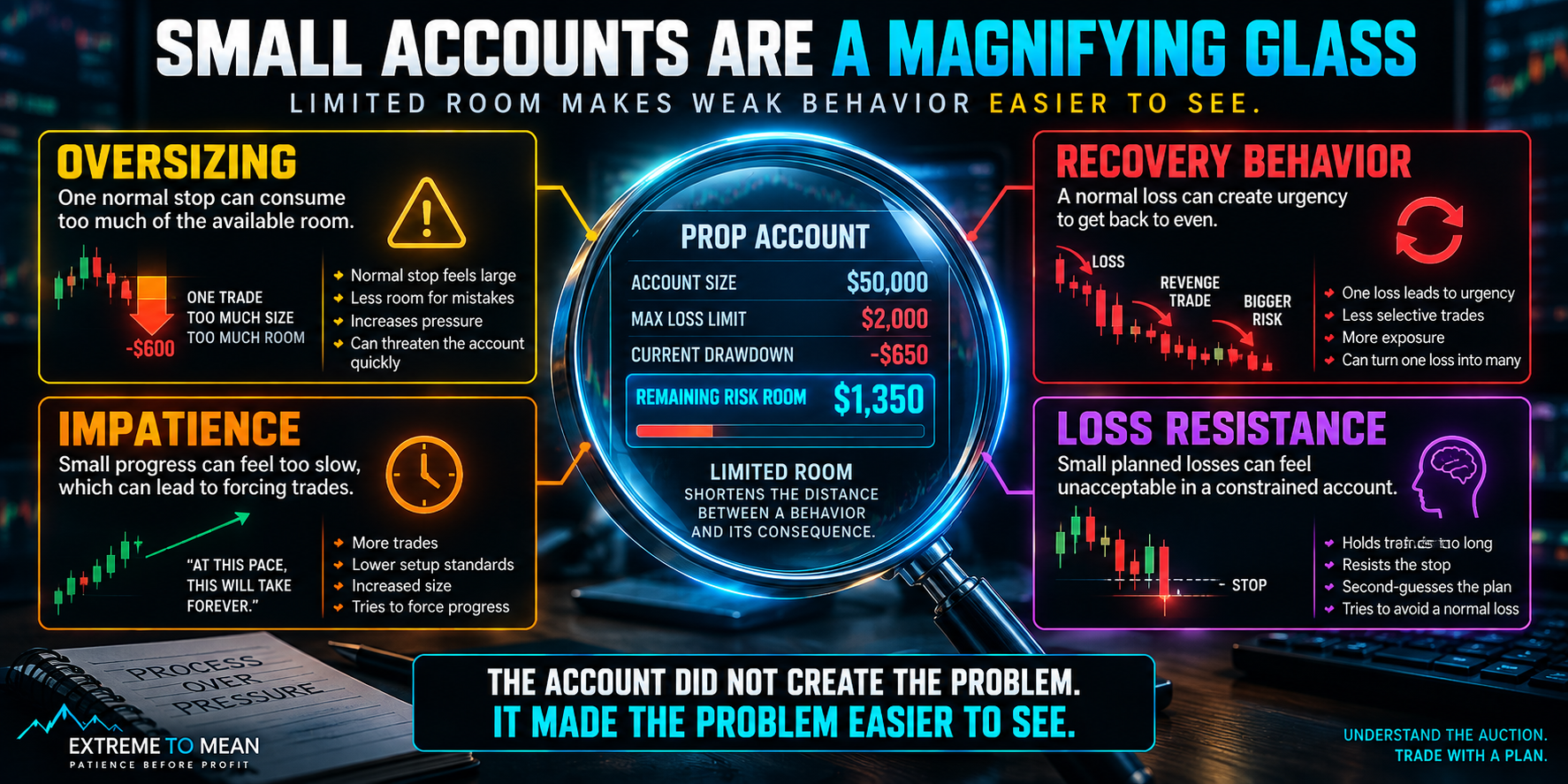
Think of a small or tightly constrained prop account as a magnifying glass. A habit that might survive several sessions inside a larger cushion can create an obvious problem much sooner when the room is limited. Small accounts compress the distance between a bad habit and its consequence.
Oversizing becomes expensive faster, impatience creates unnecessary exposure faster, and recovery behavior has less space to unfold before it threatens the account. None of that means the account manufactured those behaviors. It means the feedback loop is shorter, so the trader gets a clearer view of what was already there.
This distinction matters because blaming the account can prevent improvement. If the conclusion is simply “I need a bigger account,” the trader may carry the same behavior into a larger one and repeat the problem with bigger numbers. A larger cushion can hide a weak habit longer, but it cannot turn the habit into a good one.
The Headline Balance Is Not Your Real Trading Room
Prop accounts are often described by a headline balance, but that number is not the same thing as usable risk room. What matters operationally is the amount of room available before the account reaches whatever loss boundary applies to that specific provider, account type, and stage. The advertised size can sound large while the practical room for mistakes remains much smaller.
That does not make the account unfair; it changes how the trader should think about exposure. Instead of asking, “How big is this account?” ask, “How much room does this account actually give my strategy to operate?” That question keeps attention on risk capacity rather than on a marketing number.
The same logic connects to clear risk before a trade is ready. If one normal stop would consume an uncomfortable amount of available room, the issue may not be that the setup is bad. The issue may be that the planned size and the account do not fit each other.
Why Oversizing Becomes Obvious Fast
A constrained account exposes oversizing with very little delay. One position can look harmless because the contract count seems normal, but the relevant question is how much of the account’s usable room the actual risk consumes. When that relationship is poor, the account tells you quickly.
The trader may respond, “This account is too small for how I trade.” Sometimes that is a legitimate conclusion about product fit, but sometimes the more useful answer is, “I am trying to trade too much size for the room available.” Those are very different diagnoses, and only one of them is solved by changing the account.
This is where protecting the next decision matters more than defending the last one. A trader who sees that size is creating too much pressure can reduce exposure, wait for a cleaner opportunity, or decide the trade does not fit. That is far stronger than using the account constraint as permission to stretch the risk.
When Slow Progress Creates Impatience
Appropriately smaller positions usually create smaller dollar swings. For a trader focused on reaching a target quickly, that can make disciplined trading feel painfully slow even when the process is working as designed. The thought becomes, “At this pace, this will take forever.”
That thought can quietly change the entire session. Size increases, more trades start looking acceptable, setup standards soften, and the trader begins using activity to force progress. The account did not create the impatience; it revealed that the trader was measuring success by speed instead of execution.
A useful check is to ask, “Am I trading the setup, or am I trying to make the account grow faster?” If the market has not changed but your willingness to trade has increased because the P&L feels too quiet, the pressure is coming from the account goal rather than from the opportunity. More trades do not make a small account bigger; they simply create more exposure.
Why Small Losses Can Trigger Big Reactions
A planned small loss is still a loss, and the goal is not to pretend it does not matter. The problem begins when the loss becomes emotionally large enough to change the next decision. In a constrained account, every dollar can feel more important because the remaining cushion is finite and visible.
That can lead to holding too long, resisting an exit, immediately searching for another trade, or feeling that the loss must be recovered before the session ends. The trader may understand intellectually that losses are part of trading while still reacting as though one normal losing trade created an emergency. The account is exposing a gap between what the trader knows and what the trader can actually tolerate.
This is why protecting your next decision is so important after a loss. The next trade should earn its place independently rather than inherit the job of repairing the previous one. The urge to recover a loss is information about the trader, not information about the market.
The Recovery Spiral
Consider a trader who takes one properly planned trade in a constrained prop account and loses. The setup was qualified, the risk was known, and nothing unusual happened. The strategy did not suddenly fail; one trade simply ended in a normal loss.
Now the trader thinks, “I am already down, and I cannot afford another slow day.” A weaker second setup appears and gets taken anyway because the hidden objective is no longer to execute well; it is to get back to even. When that trade also loses, the pressure increases and the third decision becomes larger, faster, or less selective.
The first loss was manageable, but the reaction to it changed the account. What began as one normal outcome became a chain of lower standards, extra exposure, deeper drawdown, and greater urgency. This is the point where a constrained account makes recovery behavior impossible to hide for very long.
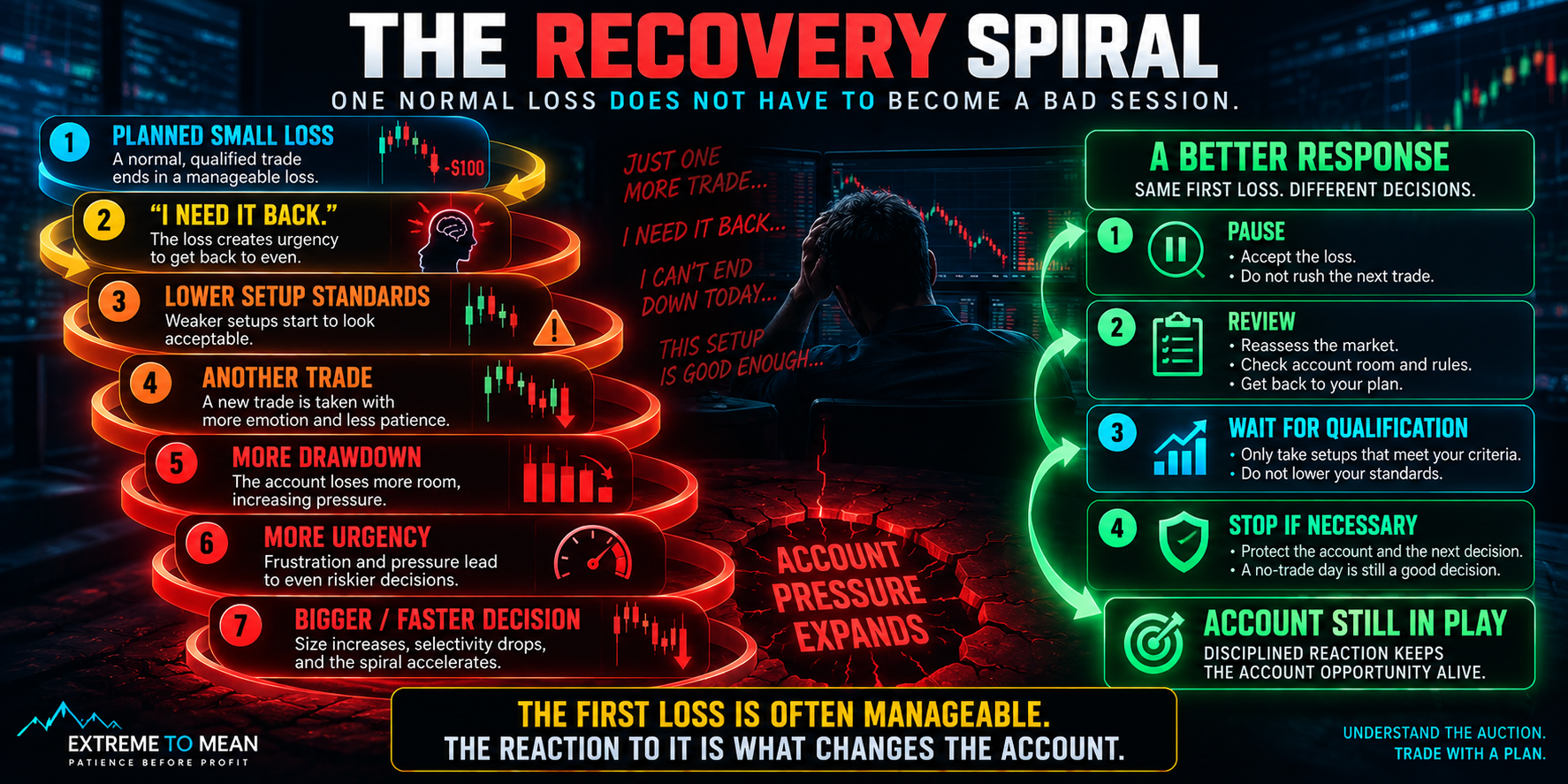
Run the same first trade again, but change the response. The trader records the loss, reassesses the market, waits for another qualified setup, and stops if none appears. The account remains just as constrained as before, but the behavior around the constraint is completely different.
That comparison is the heart of the lesson. The first trader treated the loss as something that had to be erased immediately, while the second treated it as one completed decision. The account did not change between the two versions; the trader’s response did.
What the Account Is Trying to Show You
A small account can become a diagnostic tool if you stop treating every constraint as an enemy. When pressure appears, ask what behavior keeps surfacing because the room is limited. The answer may be size, frequency, inability to stop, weaker setup selection, poor loss acceptance, or unrealistic expectations about how quickly progress should happen.
One strong review question is, “If I had ten times more account room, would I still believe this was a good trade?” If the answer is no, then the market may not be driving the decision at all. The account may be creating urgency, but urgency is not qualification.
Another useful question is whether trading still feels worthwhile when the P&L is boring. Can you tolerate small wins, small losses, flat sessions, slow progression, and days when nothing happens? If not, the constrained account is showing you that dramatic movement in the account has become part of the reward you are seeking.
That is also why doing nothing is still a trading decision. A trader does not need to manufacture action simply because the account is small and progress feels slow. The account is constrained; your standards do not need to be.
The ETM Small-Account Discipline Framework
Use the account as feedback rather than as a reason to improvise. The practical sequence is simple. It turns pressure into something you can review instead of something you have to obey.
- CONSTRAINT — What happened inside the account?
- REACTION — How did I respond to the limited room?
- BEHAVIOR — Did I oversize, overtrade, chase, recover, or resist a normal loss?
- CONSEQUENCE — What did that behavior do to the account and my decision quality?
- DIAGNOSIS — What weakness did the account expose?
- ADJUSTMENT — What process rule or operating choice needs to change?
The adjustment does not need to be dramatic. Depending on the situation, the answer may be keep size, reduce size, wait, or stop. The point is to correct the process that produced the pressure rather than trying to force the account to behave like a larger one.
When the urge to trade comes from frustration with the account rather than from a qualified setup, trading too much becomes the more important problem to solve. Frequency can feel like a way to speed up progress, but it also multiplies the number of decisions exposed to error. A small account does not need more activity; it needs decisions that fit the available room.
Final Thought
A small prop account can be frustrating because there is less room to hide poor decisions. That is also what makes it useful: oversizing becomes visible faster, impatience has consequences sooner, recovery behavior compresses into fewer trades, and resistance to normal losses becomes harder to ignore. Constraint can become feedback if you are willing to study your reaction to it.
The goal is not to make a small account feel like a large one through more size, more trades, or more urgency. The goal is to identify what your process still cannot tolerate and adjust before the same weakness becomes more expensive. When the account feels too small, ask whether the real problem is the account—or what you are demanding from it.
Educational content only. Trading involves substantial risk and is not suitable for everyone.