
Prop accounts are rarely threatened only by spectacular mistakes. More often, trouble begins with something manageable: one extra contract, one unnecessary re-entry, a stop given more room, or one trade taken after frustration builds.
The first mistake may be small. The chain it starts may not be.
A small prop-account mistake often has two costs. The first is direct: the immediate P&L impact or rule deviation. The second is less visible: less remaining room, more pressure, more urgency, and a greater chance that the next decision will be made differently.
That is why this lesson belongs inside The Trader. Prop-account damage often compounds through behavior before it compounds through dollars. The sharper question is not only, “What did this mistake cost?” but, “Did the mistake end with that trade, or did it change the conditions for every decision that followed?”
Why Small Mistakes Matter More in Prop Accounts
A prop account operates inside explicit constraints around drawdown, eligibility, position limits, and program rules. That means a small deviation can consume a meaningful share of the trader's remaining flexibility even when the immediate dollar loss looks ordinary. A small mistake matters more when the account has less room to absorb it.
The exact mechanics vary by provider and program, so the principle stays conceptual. Not every small mistake threatens the account immediately, but less room can make repeated deviations matter faster.
The first mistake also tends to feel harmless. Nothing dramatic may happen, the account may remain inside official limits, and the trade may even win. The danger is that a small exception can make the next exception feel smaller.
The First Exception Rarely Feels Dangerous
Suppose the normal plan calls for two contracts, but the trader takes three because the setup looks especially strong. The trade wins, no official rule is broken, and the extra size appears to have helped. The lesson absorbed may be, “That was not a big deal.”
But the rule has changed psychologically even if it has not changed on paper. The next time the trader feels confident, frustrated, or close to a target, three contracts no longer feels like a deviation; it feels familiar. The first exception does not have to hurt financially to weaken the boundary that made it an exception.
This is why your trading plan is a promise made before the open. A predefined standard exists partly because judgment changes once money, confidence, frustration, and account pressure enter the decision. The problem is not change itself; it is unplanned change driven by pressure.
Slightly Too Much Size Can Create Much More Pressure
A little more size can look like a small decision at entry. Once price moves against the position, P&L changes faster, the loss feels larger, and the trader has less room than expected. A little more size can create a lot more urgency.
The key is not a universal sizing rule but the sequence: unplanned oversizing changes the conditions for the next decision. If the larger trade loses, recovery pressure may appear even though the market itself has not changed.
How One Extra Trade Becomes Two
The phrase “one more trade” sounds contained. A trader takes a marginal setup after the planned opportunities are gone, loses, and then thinks, “I do not want to finish on that.” Now the first extra trade has created a reason for another.
The dangerous trade is often not the first extra trade; it is the trade taken because the first extra trade existed. What began as a small exception becomes a sequence because the trader is no longer evaluating each opportunity independently. The account records the combined damage, not which trade originally seemed harmless.
This is where trading too much becomes relevant. Extra activity can begin as a tiny departure from the plan and turn into repeated attempts to repair the emotional or financial consequence of that departure. One extra trade can become a problem because it changes the purpose of the next one.
Why Moving a Stop Changes the Entire Decision
A trader enters with a defined invalidation level, price approaches it, and the thought appears: “Give it a little more room.” If that change was already part of a defined trade-management plan, it may be legitimate. The problem is unplanned movement created by discomfort with taking the loss.
Once the stop moves emotionally, risk is larger, the original agreement with the trade has changed, and the trader is now managing the desire to avoid being wrong as well as the market itself. When the stop moves, the trade may stop being the trade the trader originally agreed to take. A small stop adjustment can become a large change in decision quality.
The Prop Account Mistake Multiplier
Small mistakes become dangerous when they recruit different mistakes behind them. Slight oversizing creates a larger-than-planned loss, the loss creates frustration, frustration creates a fast re-entry, and the second loss reduces remaining room. Reduced room then makes a later setup feel more urgent.
That sequence explains why trading spirals often look ordinary at the beginning. There may be no giant reckless bet, only several small deviations that change the conditions for the next decision. The first mistake is small; the chain is what makes it expensive.
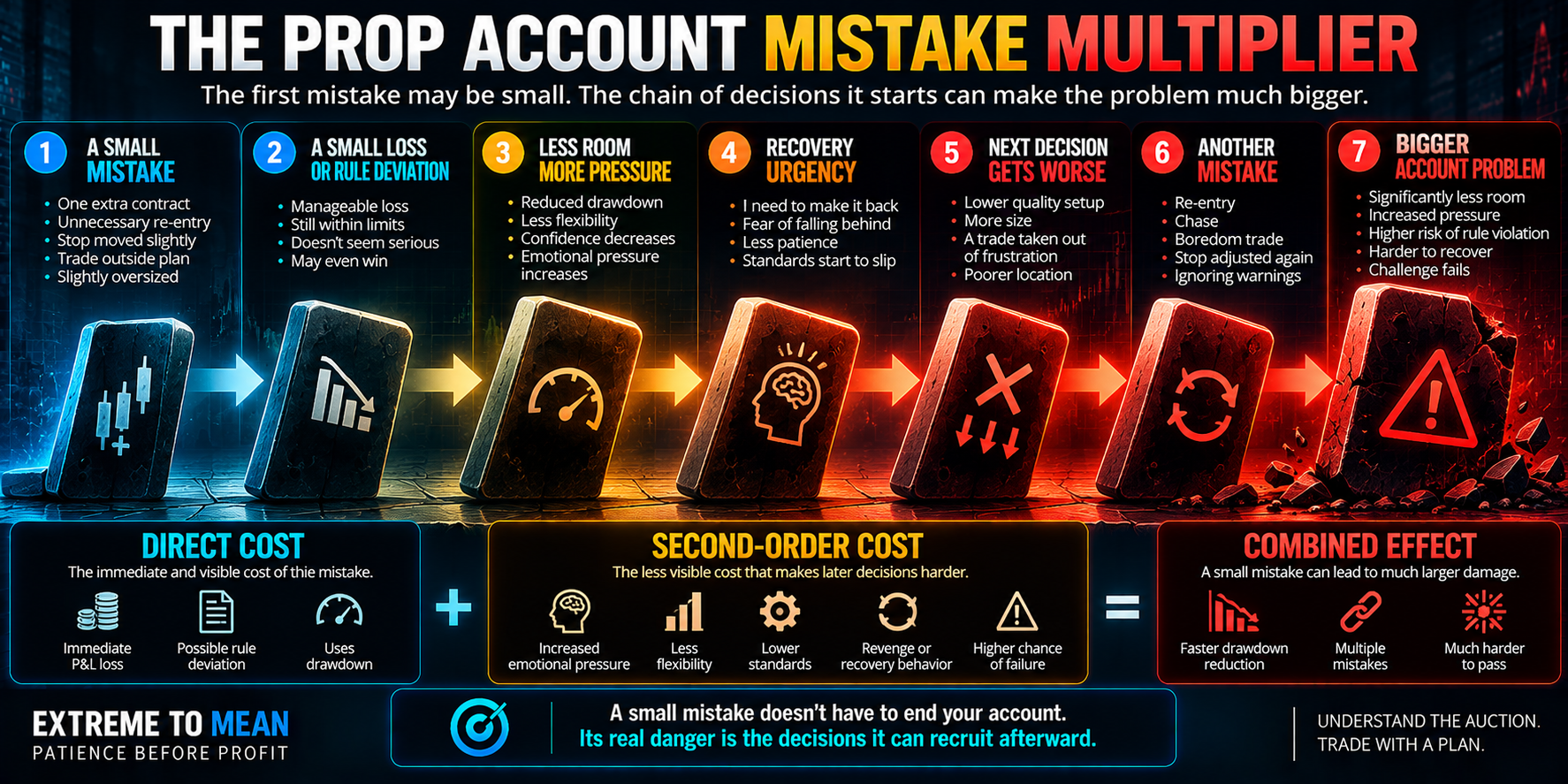
Imagine a trader who begins the session calm and plans to trade two contracts. The trader takes three, loses more than expected, re-enters too quickly when price moves back toward the original idea, then gives a later trade “a little more room” because the account is already down. By the fourth decision, the trader is thinking more about repairing the account than about setup quality.
The account was not damaged by one giant mistake. It was damaged by repeated attempts to repair the first small one. That is the behavioral compounding this article is meant to expose.
Why Winning Mistakes Can Be Even More Dangerous
A losing mistake creates obvious feedback because the trader feels the financial cost. A winning mistake can be more deceptive because it rewards the deviation. The trader takes more size than planned, wins, and begins to believe the original limit was too conservative.
The next time, the same behavior feels justified rather than exceptional. If the larger position then loses, the response may be stronger because the trader had already started treating the deviation as normal. A losing mistake costs money; a winning mistake can teach you to repeat it.
The Firm's Maximum Is Not Your Operating Target
Prop traders can confuse what the account permits with what their process should routinely use. A provider may allow more size, loss, or activity than the trader's plan calls for. Staying inside an official boundary does not automatically make the decision disciplined.
A risk ceiling is not a recommended cruising altitude. The firm's maximum defines a program boundary; the trader's operating discipline determines what is appropriate for the current setup and account state. A trader does not need to wait until an official limit is nearly broken before recognizing decision drift.
Contain the Mistake Before Trying to Recover It
The first job after a mistake is not recovery. It is containment. A small loss can change the account state, emotional state, or both, and the trader should identify those changes before allowing the next opportunity to become a repair mission.
Once the goal becomes “fix the account,” the next setup receives a job it was never designed to do. Recovery pressure gives the next trade a purpose that came from the previous mistake rather than from current market evidence. The next trade is no longer independent.
This is where protecting the next decision becomes critical. The next setup should still have to qualify as though the mistake had never happened. The mistake is allowed to teach the next decision; it is not allowed to choose it.
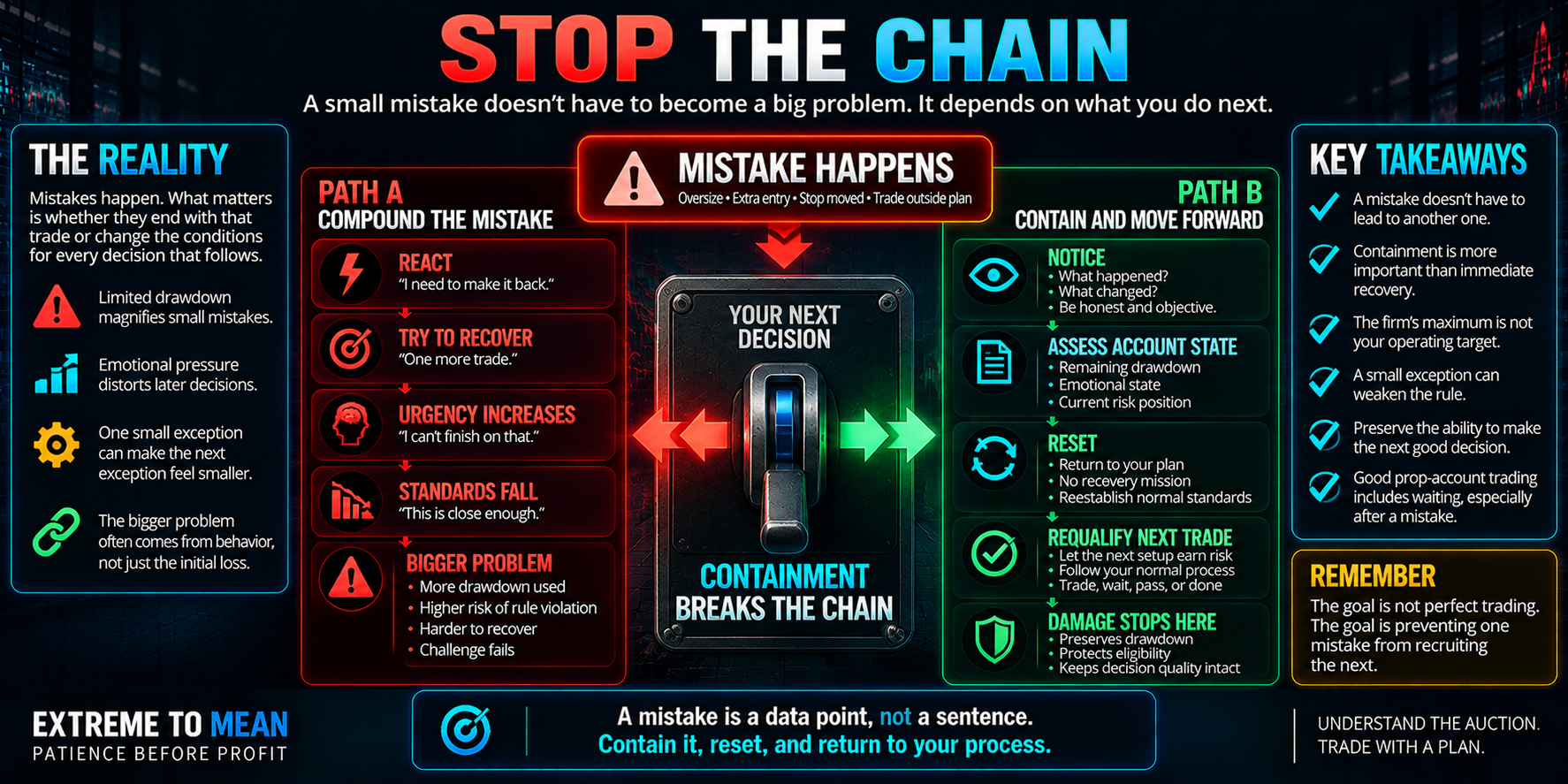
The Prop Mistake Containment Check
After any mistake, ask:
- What exactly happened?
- Did the account's risk position change?
- Did my emotional state change?
- Am I trying to recover the mistake?
- Would I take the next trade if the mistake had never happened?
- Has my normal size or setup standard changed?
- Am I using the firm's maximum as permission to keep pushing?
- Does the next trade still earn risk on its own?
- Do I need to reduce participation, wait, or stop under my existing plan?
- How do I stop this mistake from recruiting another one?
The purpose is not to dramatize every deviation or demand perfect trading. Traders will misread setups, click incorrectly, miss entries, and make judgment errors. The goal is not to eliminate every mistake; it is to stop one mistake from recruiting the next.
A pause can be useful when it follows an existing plan rather than becoming a universal rule. Doing nothing is still a trading decision when the trader needs to reassess risk, emotional state, and whether the next setup independently deserves participation. Containment should restore decision quality, not punish the trader.
The ETM Notice → Contain → Reset → Requalify → Protect Framework
Use NOTICE → CONTAIN → RESET → REQUALIFY → PROTECT. Notice the mistake without drama, contain the behaviors that could compound it, and reset to the current account state and original standards. Then require the next trade to qualify independently before new risk is taken.
Protect what remains: drawdown, eligibility, flexibility, and decision quality. The choices are still trade, wait, pass, or done according to the trader's existing plan. After a mistake, the first objective is containment—not recovery.
Final Thought
Most prop-account problems do not need to begin with spectacular recklessness. One extra contract, one unnecessary re-entry, one emotional stop adjustment, or one frustrated trade can be financially small while changing the pressure surrounding everything that follows. That is where the real danger begins.
A small mistake does not automatically become a big problem, and making a mistake does not mean the account is doomed. The larger problem develops when the trader tries to repair the lapse immediately and lets that pressure lower the quality of the next decision. Recognize the deviation, reassess the account, reset the standard, and force the next trade to earn risk on its own.
The first mistake may be small. What matters is whether the damage stops there.
Educational content only. Trading involves substantial risk and is not suitable for everyone.