
A futures watchlist can make the trading day more organized, but it can also create a subtle problem. Once a contract earns a place on the screen, traders often begin feeling as though they are supposed to find a trade in it. The watchlist quietly changes from a tool for directing attention into a list of markets that feel obligated to produce action.
A market earns attention before it earns risk.
A futures watchlist should answer, “Where should I pay attention today?” It should not answer, “What am I going to trade today?” Those questions sound similar, but separating them can prevent movement, excitement, and sunk attention from turning into forced setups.
That distinction belongs inside the broader Setup curriculum because market selection happens before trade qualification. The cleaner sequence is UNIVERSE → WATCHLIST → CANDIDATE → TRADE, with each stage requiring more evidence than the stage before it. A watchlist is permission to observe—not permission to enter.
A Watchlist Is an Attention List, Not an Order List
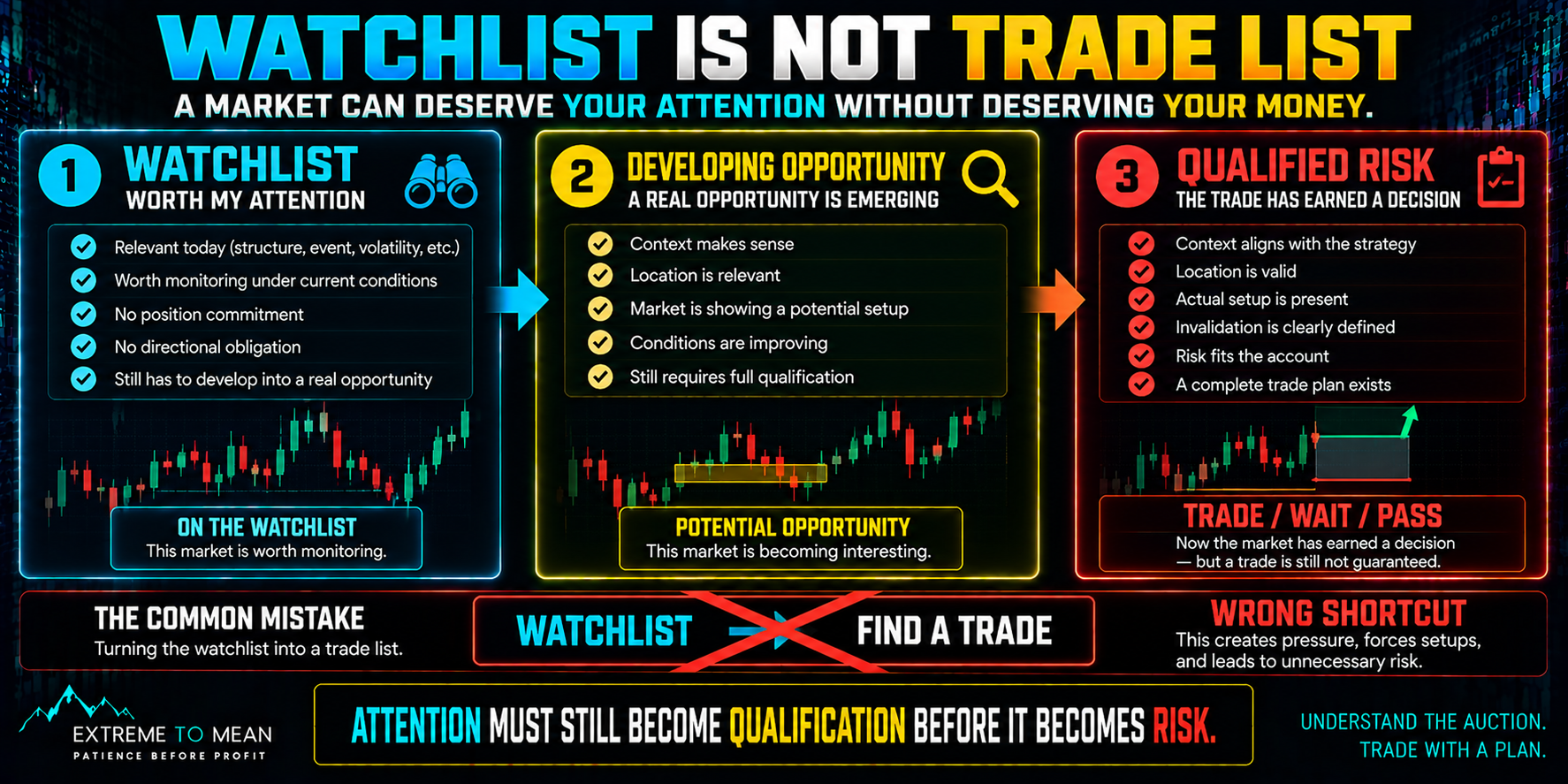
Putting MES, MNQ, gold, crude oil, or any other futures contract on the morning list should mean only one thing: this market is worth monitoring under today's conditions. It does not mean you are bullish, bearish, or committed to participating. The market still has to develop into something your process actually knows how to trade.
The common mistake is collapsing observation and execution into one decision. A trader adds MNQ because it looks active, then spends the next hour searching for reasons to justify a trade because MNQ was already selected. The watchlist has now created confirmation pressure rather than reducing decision noise.
A better process keeps the stages separate. WATCH means the market deserves attention, INTEREST means a possible opportunity is developing, and QUALIFIED RISK means context, location, setup, invalidation, and risk finally meet the plan. WATCH ≠ WANT ≠ TRADE.
Start With a Futures Universe You Actually Understand
Before building today's list, define the broader universe of futures markets you understand well enough to monitor. That universe might include equity indexes, metals, energy, rates, currencies, agriculture, or other contracts, but there is no reason to include every market that happens to exist. The goal is a group you understand, not a catalog of everything available.
Basic familiarity should include the symbol, tick value, contract size, normal session behavior, important scheduled events, and general risk characteristics. Liquidity matters too; common clues include volume, open interest, bid/ask spread, and order-book depth. A market can be highly active while still being a poor fit for your experience, account, available hours, or strategy.
This creates an important distinction between eligible market and tradeable right now. Liquidity can help qualify a contract for your broader universe because it affects the practicality of entering, managing, and exiting positions. Liquidity can qualify the market; it cannot qualify the trade.
Watch Fewer Markets Better
Opening more charts can feel like creating more opportunity. In practice, it can also create more alerts, more movement demanding attention, more missed moves, more conflicting information, and less familiarity with what any individual market is doing. Adding markets has a cost because attention itself is limited.
There is no universal correct number of futures contracts to watch. The right amount depends on experience, strategy, screen setup, session, market conditions, and how quickly the instruments move. The goal is the smallest list that provides enough legitimate opportunity without overwhelming your ability to evaluate it well.
A useful test is simple: Why is this market on my screen? If you cannot give a clear answer beyond “it moves a lot” or “I always watch it,” the market may not deserve active attention today. The fastest market on the screen is not automatically the cleanest market on the screen.
Separate Your Core Universe From Today's Watchlist
Your core universe should change slowly. These are markets you understand and are generally prepared to trade when the right circumstances appear. The daily watchlist is a smaller subset that has a particular reason to matter today.
That reason might be meaningful prior structure, a scheduled economic event, unusual overnight movement, compression, elevated volatility, a developing range, or a location worth monitoring. Market conditions change the quality of a setup, so today's relevant contracts may be different from yesterday's even though the broader universe has not changed. The watchlist should be built from relevance—not excitement.
Only later does a market become an actual trade candidate. It must reach meaningful location, develop the trader's setup, provide clear invalidation, and offer risk the account can reasonably carry. A contract can pass the universe filter and the morning watchlist filter while still never passing the trade filter.
Watch for Conditions, Not Directions
A weak watchlist often looks like this: MNQ — LONG, MGC — SHORT, MCL — LONG. The trader may believe they are preparing, but they have already turned observation into directional commitment. Once “MNQ — bullish” is written down, bullish evidence becomes easier to notice and conflicting information becomes easier to dismiss.
A stronger watchlist describes what is happening and what would make the market more interesting. MNQ might be approaching meaningful location; watch the response, gold might be active around scheduled macro context; no setup yet, and crude might show strong overnight movement; watch whether continuation persists or stabilizes. Write down what would make the market interesting—not what you need the market to do.
This is where location being the first filter becomes useful. A market may deserve observation because it is approaching an area where your process could eventually become relevant, but reaching that area still does not create the trade. The watchlist should describe scenarios rather than commitments.
Movement Does Not Automatically Create Opportunity
The biggest mover of the morning often attracts the most attention. Strong volatility may create opportunity, but it can also mean poor location, wider structural risk, event-driven disorder, increased slippage, or a move that has already traveled too far for the intended setup. Movement attracts attention; it does not automatically create opportunity.
This distinction becomes especially important when a watched market starts running without you. Because the market was already on the list, the trader may feel they predicted the move and therefore deserve participation. That is when monitoring can turn into chasing the trade.
The contract being on the watchlist does not change the rules. If the setup did not form, risk became unattractive, or the useful location passed without offering entry, the correct status can still be PASS. Attention spent watching a market is not a reason to risk capital in it.
Every Watchlist Entry Needs a Reason to Leave
Traders often define why a market enters the watchlist but forget to define when it should come off. That allows a contract to consume attention long after the original reason for watching it has disappeared. A market does not earn permanent attention because you gave it attention earlier.
The location may already have passed, the scheduled event may be over, price may have moved too far, conditions may become disorganized, or the available risk may no longer make sense. Another market might also begin offering cleaner information. The watchlist should be able to shrink as the session develops.
A useful morning question is therefore paired with an equally useful exit question: “Why am I watching this?” and “What would make me stop watching it?” Removing a contract is not admitting the original idea was wrong; it is acknowledging that the reason for active attention no longer exists.
A Good Watchlist Can Produce Zero Trades
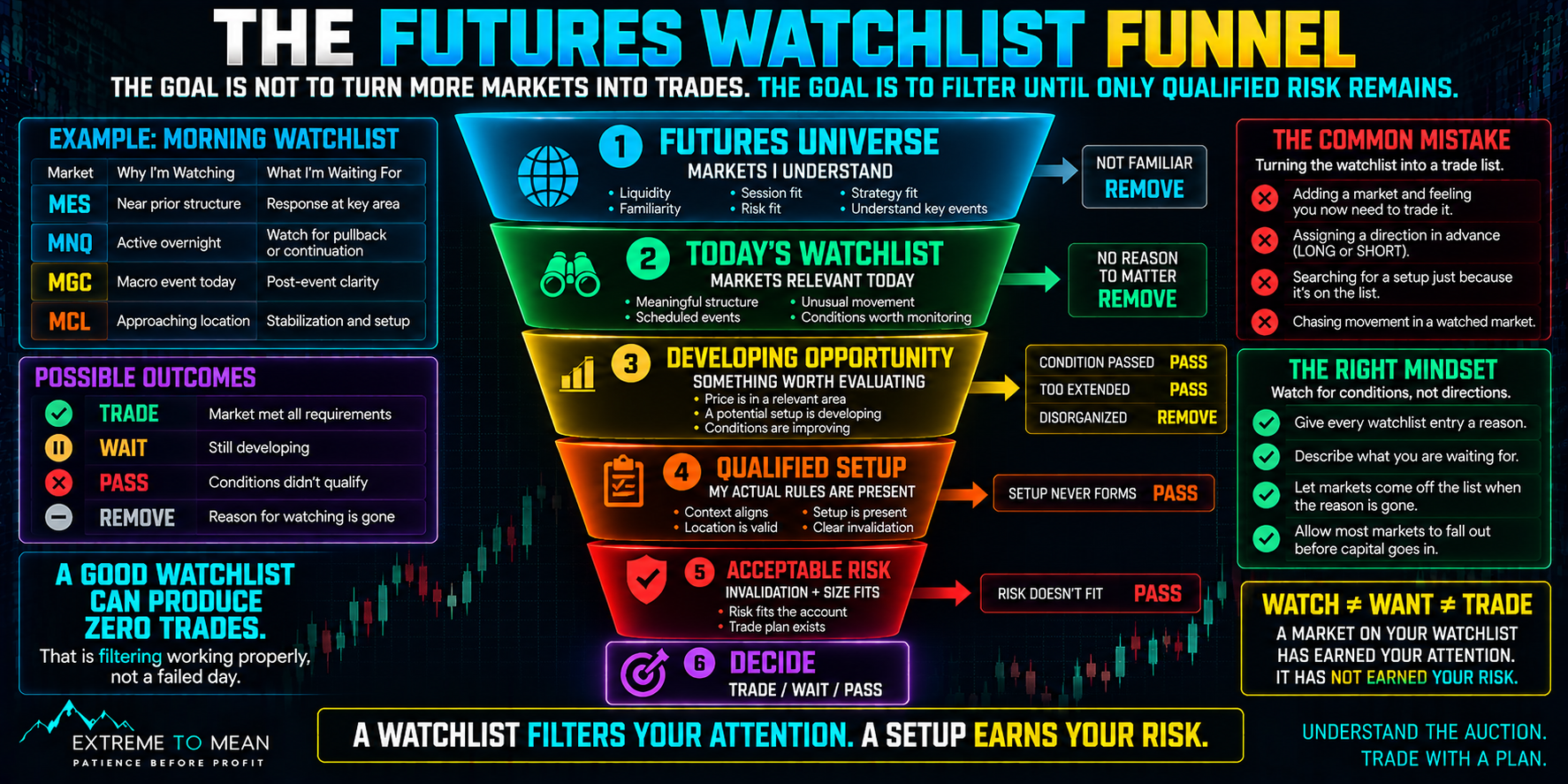
Suppose a trader begins with four markets: MES near meaningful prior structure, MNQ active overnight but already extended, MGC ahead of an important macro event, and MCL approaching an area the trader wants to observe. Each contract has a specific reason for being monitored. None has been promised a trade.
MES never reaches the planned area, so the result is PASS. MNQ keeps running while extended and creates the temptation to chase, but watchlist status meant observe rather than enter; MGC becomes disorderly after the event and is REMOVED. MCL finally reaches its area, behavior stabilizes, the actual setup develops, invalidation becomes clear, and risk fits—only then does it become a TRADE CANDIDATE.
Four markets entered the morning watchlist, but only one reached trade qualification. That is not a failed watchlist; that is filtering working properly. The purpose of a watchlist is not to produce trades—it is to make sure your attention is in the right places if a trade develops.
Attention, Interest, and Qualified Risk Are Different Commitments
Think of market selection as three levels of commitment. Level 1 — Attention: the market is worth watching, but no risk commitment exists. Level 2 — Interest: something potentially useful is developing, but the market still has not earned an order.
Level 3 — Qualified Risk is different. Context, location, actual setup, invalidation, and account risk now align well enough for the trader to make an execution decision. The trade is not ready until the risk is clear, no matter how interesting the chart looked earlier.
This hierarchy prevents the watchlist from becoming a trading quota. You do not need one trade because you watched one market, four trades because you watched four markets, or any trade merely because preparation took time. The watchlist organizes attention; the setup qualifies risk.
The ETM Watchlist-to-Trade Framework
Use this sequence:
- UNIVERSE — Is this a market I understand and am prepared to trade?
- RELEVANCE — Why does it deserve attention today?
- WATCH — What specific condition or location am I monitoring?
- QUALIFY — Did an actual setup form?
- RISK — Is invalidation clear and acceptable?
- DECIDE — TRADE / WAIT / PASS / REMOVE
The watchlist itself can remain simple:
| Market | Why I'm Watching | What I'm Waiting For | What Removes It | Status |
|---|---|---|---|---|
| Market A | Relevant location | Specific response/setup | Moves too far | WATCH |
| Market B | Event/context | Post-event clarity | Remains disorderly | WAIT |
| Market C | Developing opportunity | Full qualification | Structure invalidates | WATCH |
Notice what is missing from the status column: TRADE. A trade happens only after the market leaves the watchlist process and passes the separate qualification and risk decision. Most markets should fall out before capital goes in.
The same process also helps with pre-market preparation. A trading plan made before the open becomes more useful when you are planning scenarios for markets that have already earned attention rather than trying to prepare equally detailed plans for every contract on the board. Preparation should narrow decisions, not create more obligations.
Final Thought
A futures watchlist is a tool for allocating attention, not capital. Start with markets you actually understand, narrow them to the contracts that have a genuine reason to matter today, define what you are waiting for, and allow them to disappear from the list when that reason no longer exists. A good watchlist becomes more selective as the session unfolds.
Most importantly, do not reward a market with risk simply because you rewarded it with attention. Being on the watchlist means watch this; it does not mean find a trade here. A market earns attention before it earns risk, and most markets should fall out before capital goes in.
Educational content only. Trading involves substantial risk and is not suitable for everyone.