
Trading education can be useful, overpriced, well taught, badly taught, honestly marketed, or built around claims that are much stronger than the evidence supporting them.
Do not buy the story. Audit the claim.
A trading course, mentor, signal service, or packaged system should not be evaluated first as simply LEGIT or SCAM. Start by identifying what is being sold, what is being claimed, what evidence supports it, what incentives exist, and what the full terms and costs are. The sharper ETM question is: If I removed the marketing, what independently verifiable value would still be left?
That belongs inside The Trader because the buying decision is still a trading-process decision. Marketing can control the presentation, but the buyer controls whether money moves before the evidence is examined. The more extraordinary the claim, the stronger the evidence should have to be.
Don't Ask “Is This Guru Legit?”—Ask What You Can Verify
The binary question feels attractive because it promises a fast answer: trustworthy or untrustworthy, buy or avoid. The problem is that a product can be legitimate yet poor value, useful yet overmarketed, taught by a skilled trader who is a poor teacher, or taught by a strong educator who makes no exceptional performance claim. RED FLAG ≠ PROOF OF FRAUD, and lack of evidence is not proof of deception; unsupported claims should simply remain unsupported.
Turn broad marketing into specific statements that can be examined. “85% win rate,” “our students become profitable,” “verified results,” and “proven system” are different claims, so they should not receive one type of proof. A claim becomes easier to evaluate once it is specific enough to be falsifiable.
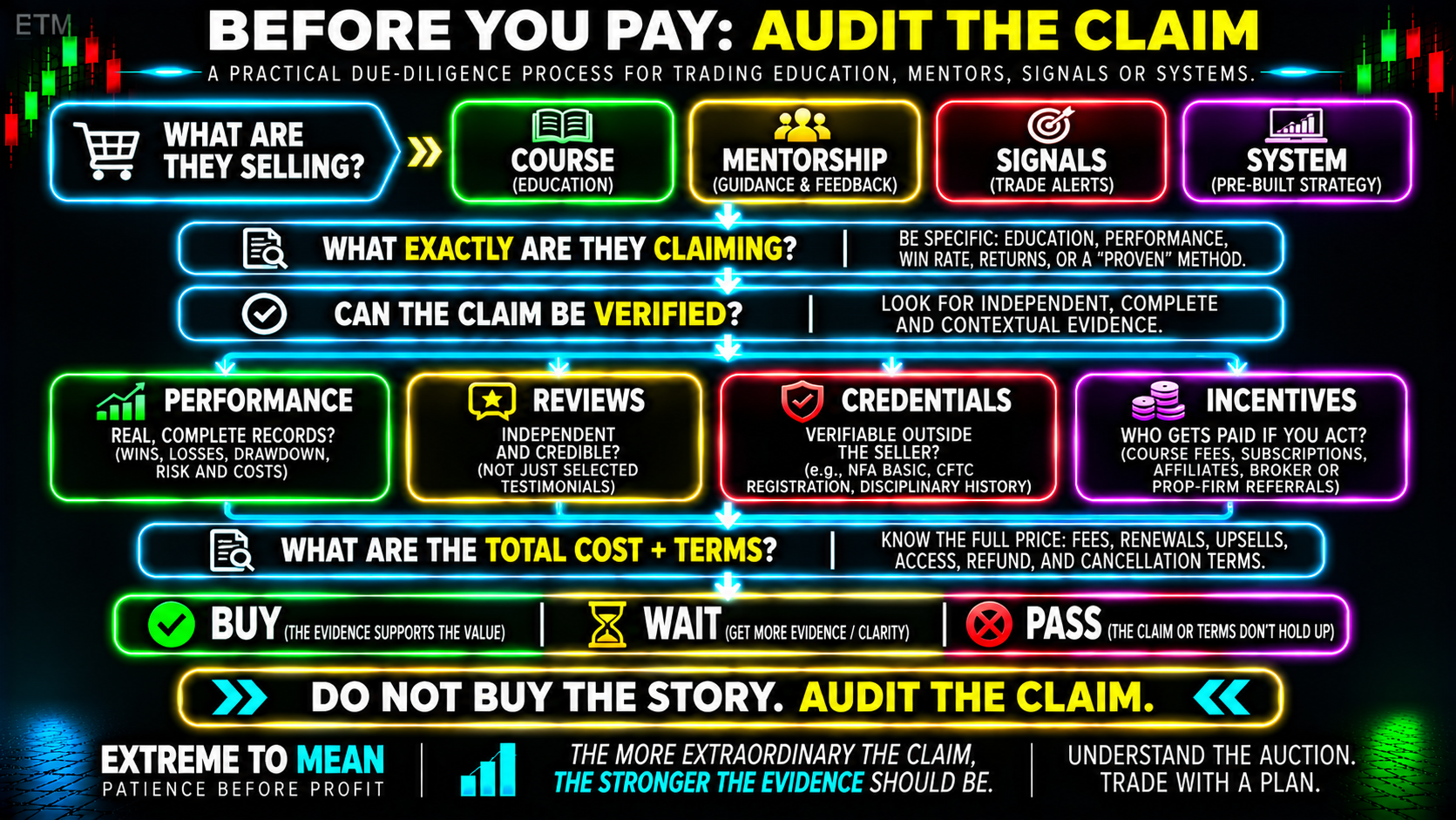
First Identify What You're Actually Buying
A course primarily sells education, so evaluate curriculum, clarity, structure, sample lessons, and learning outcomes. Mentorship adds access and feedback, so understand who responds and what is included. Signals and pre-built systems make stronger performance claims, so complete history, execution realism, costs, and risk matter more.
This distinction keeps the evidence test proportional. A teacher selling basic futures education and a signal seller advertising a 75% win rate are making different claims. EDUCATION CLAIM ≠ PROFIT CLAIM, and trading skill and teaching skill are different things.
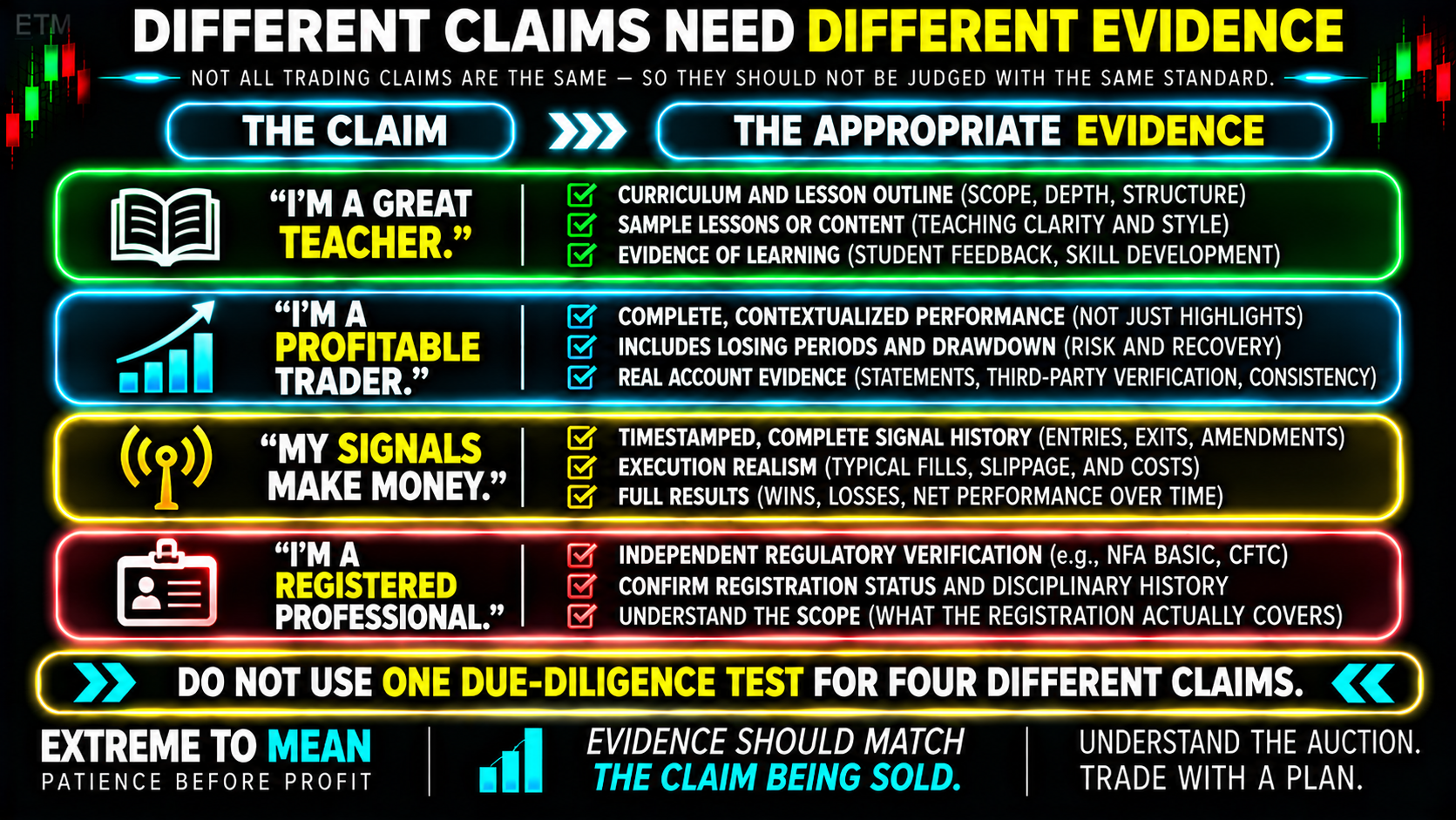
Match the Evidence to the Claim
A claim of teaching quality can be supported by curriculum, sample lessons, clear explanations, and evidence students understood the material. A profitability claim requires contextualized performance, while a signal claim requires timestamped calls, executable prices, losses, amendments, and full history. The evidence required should match the claim being sold.
This is where understanding what an edge actually is helps. A claimed edge should be judged through expectancy, payoff, risk, costs, and the conditions under which it is supposed to work—not a label such as “institutional” or “high probability.” Win rate without payoff is incomplete, and profit without the risk required to produce it is incomplete too.
Screenshots, Backtests and “Verified” Results
Screenshots are weak evidence because they usually show a selected moment rather than a complete record. A P&L image may be genuine while omitting losses, deposits, withdrawals, account ownership, leverage, other accounts, or the risk required to produce the result. SCREENSHOT ≠ TRACK RECORD, and one winning day is evidence of one winning day.
Backtests can support a strategy-research claim, but they should be labeled honestly. Historical and simulated results are not live trading records because actual fills, market conditions, margin pressure, and execution decisions are not reproduced perfectly. LIVE RESULT ≠ BACKTEST.
“Verified” also needs a definition. Ask who verified the result, what period was reviewed, whether costs are included, and whether weak periods are visible. Authentic documents can still tell an incomplete story when the seller controls which pieces you see.
Losing periods show what the claimed edge looks like under stress. Ask about drawdowns and weak periods instead of evaluating only the best screenshots. If someone wants you to trust the upside, they should discuss what the process looks like when it loses.
Testimonials, Reviews and Financial Incentives
Testimonials can show that successful students or satisfied customers exist, but they do not show how typical those outcomes are. Ten impressive students could come from ten customers or ten thousand, and the marketing page rarely shows the denominator. TESTIMONIAL ≠ TYPICAL OUTCOME.
Reviews are useful, but star count should not end the investigation. Look for independent sources, recent and specific comments, a believable mix of experiences, and disclosures when reviewers have material relationships or incentives. Reviews are strongest when the seller does not control who gets heard.
Then follow the money. Revenue may come from course fees, recurring communities, premium mentorship, software, signals, broker referrals, prop-firm referrals, or affiliate relationships; none automatically implies misconduct. DISCLOSURE ≠ ABSENCE OF CONFLICT, so a disclosed relationship should still be considered when weighing the recommendation.
Calculate total cost rather than the headline price. A low-priced course can become a larger commitment once software, data, premium access, mentorship, or signals are added. Read refund, renewal, cancellation, and access terms before paying, and save the sales claims because pages can change.
Signal Services and Pre-Built Systems Need Extra Scrutiny
A signal service has an execution problem that a screenshot cannot solve. If the seller records an ES entry at one price but subscribers receive the alert after price has already moved, the published result and the subscriber's executable result are different. A signal is only as tradable as the price available when the subscriber actually receives it.
Ask whether calls are timestamped, whether original messages and amendments remain archived, and whether losing calls remain visible. A history that can be edited or deleted after the market moves cannot be reconstructed reliably. If the service disappeared tomorrow, also ask what knowledge or process you would retain.
Pre-built systems require a transferability test. Results may depend on a particular broker, cost structure, market, execution style, size, or discretion not captured in the rules. A strategy is not transferable merely because its rules can be downloaded.
Registration and Background Checks: Useful, but Not Universal
When a seller claims to be a registered futures professional, CTA, or NFA member, verify that claim independently. NFA BASIC provides registration, membership, and regulatory-action information for relevant derivatives firms and individuals. REGISTRATION ≠ GUARANTEE OF QUALITY, but a claimed credential should be checkable outside the seller's own website.
Registration status is not a universal legitimacy test. Certain standardized, non-tailored commodity trading advice can qualify for exemptions from CTA registration, while personalized advice or account direction can raise different requirements. “Not registered” and “fraudulent” are therefore not synonyms; the question is whether registration is required for the service actually being offered.
A disciplinary record also needs context. Examine what happened, when, who was involved, and the outcome. Background checks add evidence; they do not replace reading the evidence.
Red Flags Are Reasons to Investigate, Not Verdicts
Guaranteed profits, “virtually no risk,” secret formulas, extraordinary returns with minimal downside, and artificial urgency deserve skepticism because trading outcomes cannot be guaranteed. Marketing that describes winners in detail while discussing losses only in fine print deserves additional scrutiny too. A red flag is a reason to investigate—not automatically proof of fraud.
Mystique should not substitute for explanation. Proprietary details may stay private, but the buyer should still understand what the method targets, when it should struggle, and what risk it takes. If the only usable explanation is “trust the algorithm,” the buyer cannot meaningfully evaluate the risk.
The cleaner process is deliberately slower than the sales process. Protecting your next decision means refusing to let urgency or screenshots decide before the evidence is complete. A purchase can end in BUY / WAIT / PASS without requiring a moral verdict about the seller.
The Pre-Purchase Trading Education Checklist
Before paying, ask:
- What exactly am I buying: education, mentorship, signals, software, or a system?
- What exactly is being claimed: a learning outcome, trading result, credential, or all three?
- Are performance results live, simulated, or backtested?
- Can the important claims be checked independently?
- Are losses, drawdowns, costs, and weak periods shown alongside winners?
- What affiliate relationships, recurring subscriptions, and upsells exist?
- Are reviews independent, specific, recent, and informative?
- What is the total cost once software, data, communities, and renewals are included?
- What do the refund, cancellation, access, and renewal terms say?
- If regulated credentials are claimed, can they be verified independently?
- Can I explain what the method is trying to do and where it can fail?
- Will this purchase increase my ability to make decisions—or my dependence on the seller?
The checklist is not designed to prove that every seller is dishonest. It slows the buyer down until the marketing claim survives contact with independent evidence. The better question is: If the sales page disappeared tomorrow, what evidence and value would still remain?
The ETM Define → Verify → Follow the Money → Read the Terms → Decide Framework
Use DEFINE → VERIFY → FOLLOW THE MONEY → READ THE TERMS → DECIDE. DEFINE what is actually being sold and claimed; VERIFY what can be checked independently; FOLLOW THE MONEY through subscriptions, referrals, affiliates, and upsells. READ THE TERMS before paying, then DECIDE whether the expected educational or operational value justifies the cost and dependency.
Good education should increase independence—not manufacture dependence. The ETM free tools can help structure review, but due diligence means refusing to let your money move faster than your evidence. Spend only after the claim, incentives, terms, and expected value are clear.
Final Thought
A trading course, mentor, signal service, or packaged system should not be accepted or rejected because the marketing feels impressive or because the internet has already chosen a side. Separate educational claims from profit claims, screenshots from track records, testimonials from typical outcomes, live performance from backtests, and disclosure from the absence of conflicts.
Then verify what can actually be verified. Look at losing periods as well as winners, follow the financial incentives, read the full cost and exit terms, and check claimed regulatory credentials independently when those credentials are relevant. Lack of evidence is not proof of deception—but it is a reason not to treat the unsupported claim as established.
The purpose of due diligence is not to prove that everyone selling trading education is dishonest. It is to decide what value remains when urgency, personality, screenshots, and storytelling are removed. Do not buy the story. Audit the claim.
Educational content only. Trading involves substantial risk and is not suitable for everyone.