The TraderPatience, Discipline & Emotional Control7–8 min read
How to Handle a Winning Streak Without Getting Reckless
Winning can create trading problems that losing never had a chance to create. After several clean trades, the market may begin to feel easier, risk may feel smaller, and setups that once looked mediocre can suddenly seem good enough. The danger is not the winning streak itself; it is allowing recent success to quietly change how the next decision is made.
Key Idea
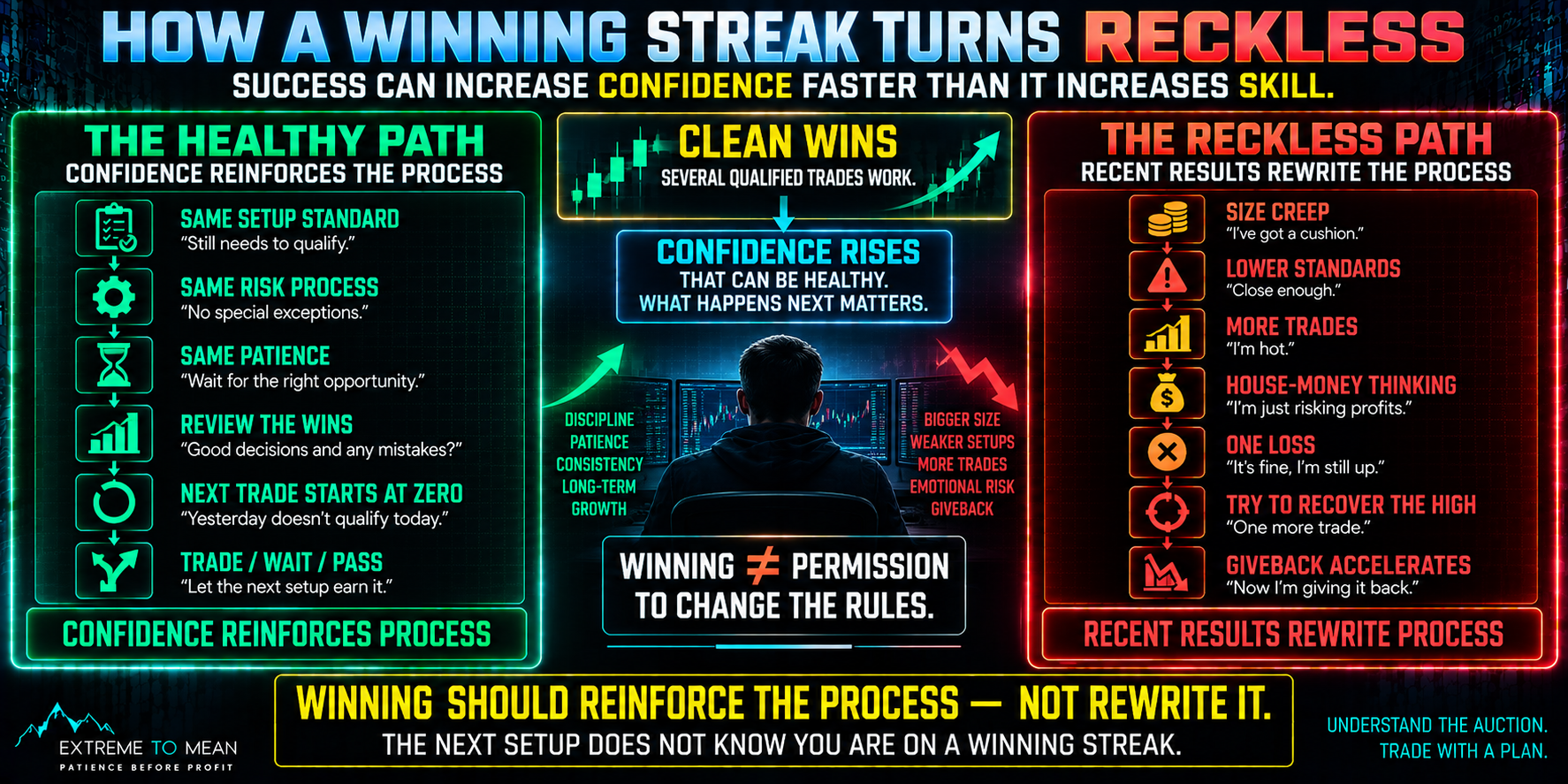
Winning should reinforce the process—not rewrite it.
A strong run can increase confidence faster than it increases actual skill. Some of that confidence may be deserved because execution improved, discipline was strong, or the trader's strategy fits the current environment particularly well. But the streak can also contain favorable conditions, normal clustering of outcomes, and luck, so several winners do not automatically mean the probabilities of the next trade have changed.
The practical question is not, “Am I allowed to feel confident?” You should be able to enjoy trading well and recognize a strong run without minimizing it. The better question is: “Did my skill change—or did my willingness to take risk change because I just won?”
Winning Can Be Dangerous in a Different Way Than Losing
Losses naturally invite investigation. A trader sees red P&L and asks what went wrong, whether the setup was valid, whether the entry was premature, or whether risk was managed correctly. A winner often ends the investigation with one word: worked.
That can hide important information because winning trades can still contain poor decisions. A trader can oversize, enter before qualification, move a stop badly, break a rule, or survive a weak setup through nothing more than favorable movement. Losses expose mistakes. Wins can hide them.
This is why protecting your next decision also means reviewing success honestly. If bad behavior repeatedly gets followed by profit, the account may reward a decision the process should reject. A winning result deserves acknowledgment, but it should not receive automatic authority over the next trade.
A Streak Can Increase Confidence Faster Than Skill
Suppose you take four trades and all four win. Trade five now appears, but the fifth setup does not inherit quality from the first four; it still needs context, location, qualification, invalidation, and acceptable risk. The next setup does not know you are on a winning streak.
That sounds obvious until the trader starts thinking, “I'm seeing the market really well right now.” That feeling can be partly accurate, especially when execution has improved or conditions fit the strategy unusually well, but it can also inflate certainty beyond what the evidence supports. A streak may tell you something useful about the past several trades; it does not issue a guarantee for the next one.
Healthy confidence keeps the process intact. Overconfidence starts giving the process exceptions because recent outcomes have been good: slightly weaker location becomes acceptable, one missing qualification stops mattering, or another trade feels justified simply because the previous ones worked. Yesterday's good decisions cannot qualify today's mediocre trade.
Profits Can Start Feeling Like House Money
After a profitable morning, a trader may say, “I'm just risking today's profits.” Mathematically, they may indeed remain above where the session began even after another loss, but psychologically that framing can change how seriously the new risk is evaluated. Money earned this morning is still account equity even when it feels easier to give back.
Behavioral research sometimes describes this kind of mental accounting through the house-money effect, where gains may feel psychologically cheaper to risk than starting capital. The evidence is context-sensitive rather than universal, so it would be wrong to say profits automatically make traders reckless. The useful lesson is narrower: profits can feel cheaper to risk without actually becoming less valuable.
Imagine the trader makes $400 and considers risking $150 on another setup while thinking, “Worst case I'm still up $250.” That arithmetic can be completely true while hiding the more important question: Would this trade deserve $150 of risk if the first $400 had never happened? Profit creates financial capacity, but it does not automatically create trade quality.
A cushion in the account is not a cushion in the setup. If the trade did not deserve the risk before the winning streak, the week's P&L should not manufacture missing evidence. The market still has to earn the next dollar of exposure.
Watch for Size Creep, Lower Standards, and More Trades
Position size is often one of the first visible signs of behavioral drift. One contract becomes two because the trader is ahead, the next setup looks “even cleaner,” or the account has a cushion, and soon size has changed without any formal change to the risk framework. Legitimate increases can follow account growth, tested parameters, or a deliberate risk-plan update, but those are different from increasing size simply because recent P&L improved confidence.
A useful diagnostic is: Would I use this position size if my previous three trades had been losses? If the answer is no, the streak may be influencing size more than the risk plan. A trading plan made before the open is valuable precisely because sizing rules are easier to respect when they were established before the trader started feeling unusually capable.
Setup quality can drift the same way. Before the streak, the trader needed A + B + C; after several winners, A + B suddenly feels close enough because they are “in sync” and less afraid of being wrong. Ask: Has the setup improved—or has success made me easier to convince?
Trade frequency can expand too. Feeling hot can make “one more trade” sound like exploiting momentum rather than lowering selectivity, even though the market may not have produced any additional qualified opportunities. When recent success creates permission for extra activity, trading too much can begin while the trader still feels disciplined.
How a Winning Streak Turns Reckless
Imagine Trader A begins the week exactly as planned. Monday produces two fully qualified winners, and Tuesday produces a third; each trade used normal size, followed the rules, and deserved to be taken. By Wednesday morning, the trader feels as though they are seeing the market perfectly.
A mediocre setup develops that Trader A would normally pass. This time it becomes “close enough,” and the trader doubles size because the week is already strongly profitable; the trade loses, but there is no serious damage yet. Instead of resetting, Trader A thinks, “One loss isn't going to end this streak,” and takes another mediocre setup.
The second weak trade loses too. Now the goal shifts from evaluating the market to recovering the week's high-water mark, and what began as three clean wins has become lower standards + larger size + more frequency. The winning streak did not mechanically cause the losses; it changed the trader's behavior.
Winning becomes dangerous when confidence stops reinforcing the process and starts granting exceptions to it.
Trader B experiences the exact same first three winners. Before Wednesday's next decision, the questions remain unchanged: Did anything about my risk plan change because I won? Does this setup meet the same standard it needed to meet Monday morning? The answer to both is no, so Trader B passes.
Trader B did not protect the winning streak. Trader B protected the process that created it. That difference matters because a streak is merely a retrospective statistic; you cannot trade “three wins in a row,” but you can evaluate the next setup.
Sometimes the Market Got Easier
A strong run can contain useful information. Perhaps the trader is executing better, identifying opportunities more clearly, or becoming more consistent with a tested process. But favorable market conditions can also make a particular strategy look unusually easy for a while.
Imagine a trend trader performing extremely well during a clean directional session. The trader concludes, “I've finally figured this out,” increases size the next day, and trades with the same aggression even though the market has turned overlapping and choppy. The trader's skill may not have disappeared overnight; the environment changed.
This is why market conditions change the quality of a setup. Sometimes the trader got better. Sometimes the market simply got easier for that trader's process. A short run of success does not require an immediate verdict about which explanation deserves all the credit.
Success is worth reviewing rather than dismissing. Ask what part of the streak was repeatable process, what part was particularly favorable market fit, and where good outcomes may have hidden imperfect decisions. The purpose is not to become suspicious of every winner; it is to avoid treating recent results as permission to rewrite the framework.
Giving Back Some Profit Is Not the Same as Getting Reckless
A trader is up $600 and then takes a completely qualified trade using normal size and normal risk. The trade loses $100, leaving the session or week at +$500. Nothing about that sequence automatically represents a discipline failure.
Trading includes losing outcomes even after a run of winners. A planned loss after a winning streak is not recklessness. An unplanned change in standards is. The problem is not simply that P&L declined from its high-water mark; the problem begins when recent profit causes decision quality to deteriorate.
This distinction also prevents an overcorrection. Some traders become so focused on protecting the green day that they reject a completely valid later trade simply because losing would spoil the record. The answer to reckless winning is not becoming afraid of losing a dollar of profit.
A clean loss can actually be the healthiest next trade after five winners. If the setup qualified, normal size was used, risk fit, and execution followed the process, the streak simply ended. The trader's objective was never to preserve the sequence; it was to keep making qualified decisions.
Do Not Manage the Streak—Manage the Next Decision
A streak exists only because several completed trades are being grouped together after the fact. It can create pressure to continue the sequence through extra aggression, but it can also create pressure to protect the sequence by becoming overly defensive. Both reactions give the streak influence over a decision it did not earn.
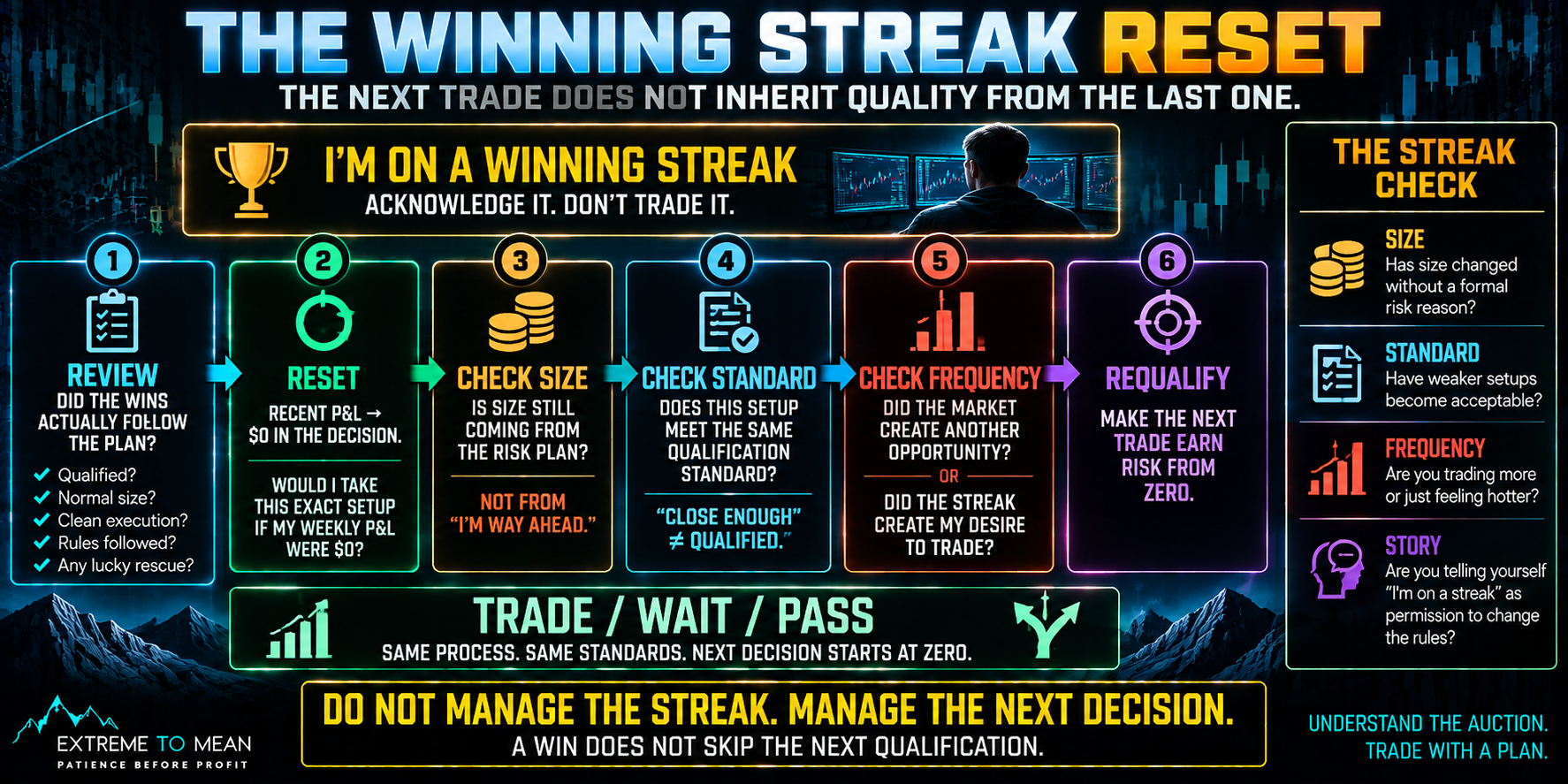
The next trade should begin at zero. Yesterday's profits do not improve today's location, and four successful setups do not make the fifth setup more complete. Do not manage the streak. Manage the next decision.
That principle also removes the need to decide immediately whether the streak came from skill, favorable conditions, or luck. Review what can be reviewed, keep what was repeatable, and let longer-term evidence answer the larger performance questions. The immediate job is simpler: prevent recent outcomes from changing the rules casually.
The Winning Streak Check
Before each trade during an unusually strong run, ask:
WOULD I TAKE THIS TRADE IF MY WEEKLY P&L WERE $0?
IS MY POSITION SIZE DIFFERENT? If yes, what formal risk reason changed?
HAS MY SETUP STANDARD CHANGED? Would this trade have qualified before the streak?
AM I TRADING MORE FREQUENTLY? Did the market create more opportunities—or do I simply feel hotter?
AM I CALLING PROFITS “HOUSE MONEY”? If yes, reset to actual account risk.
AM I TRYING TO EXTEND THE STREAK?
AM I TRYING TO PROTECT THE STREAK?
WHAT WOULD I DO IF THE LAST THREE TRADES HAD LOST?
The point is not to force identical behavior regardless of account conditions forever. Risk plans can change, size can increase, and strategies can evolve, but those decisions should happen deliberately rather than because the last several trades happened to be green. If the reason for changing the rule is the winning streak itself, pause before calling the change risk management.
The ETM Winning Streak Reset
After an unusually strong run, use this reset:
WIN — Acknowledge the result. You traded well, benefited from favorable conditions, received favorable outcomes, or some combination.
REVIEW — Did the trades actually follow the plan? Look for good decisions and mistakes that profit may have hidden.
RESET — Do not spontaneously change size, setup standards, loss limits, or trade frequency.
REQUALIFY — Make the next setup earn attention and risk from zero.
RISK — Use the existing sizing and risk framework rather than the emotional size of the streak.
DECIDE — TRADE / WAIT / PASS
The essential loop is:
WIN → REVIEW → RESET → REQUALIFY → RISK → DECIDE
A win does not skip the next qualification. The same market conditions, location, setup quality, invalidation, and risk questions still apply whether the last three trades were winners, losers, or a mixture.
The next setup must earn risk independently; recent wins should not grant it easier qualification or larger size.
A second compact check is SIZE / STANDARD / FREQUENCY / STORY. Has size changed without a formal reason, have weaker setups become acceptable, are you finding more trades than the market is actually offering, or are you telling yourself “I'm hot” as though the next outcome now owes the streak something? Those four categories expose much of the behavioral drift P094 is designed to prevent.
Final Thought
A winning streak is not something to fear. Several strong trades can reflect better execution, favorable market conditions, legitimate process improvement, fortunate outcomes, or some combination, and a trader should be able to recognize success without immediately distrusting it. The skill is letting confidence rise without letting the standard fall.
The next setup has not changed merely because the last few trades worked. Keep risk independent, keep qualification intact, review winners as seriously as losers, and allow a completely valid losing trade to end the streak if that is what the market produces. Winning should reinforce the process—not rewrite it.
Do not force the streak to continue, and do not become afraid to lose because you want to preserve it. Reset the next trade to zero and make it earn its place on its own evidence. You protect a winning streak best by protecting the process that made the streak possible in the first place.
Educational content only. Trading involves substantial risk and is not suitable for everyone.