
A Pre-Market Plan Is Not a Prediction
The purpose of planning before the open is not to correctly guess the direction of the entire session. It is to reduce the number of decisions you have to invent under pressure by identifying the locations, conditions, and possible behaviors that could matter. A plan is useful precisely because the future is uncertain.
This lesson belongs in the Setup curriculum, where planning helps the trader decide whether a setup deserves risk rather than defend a forecast.
That fits the broader ETM principle that the market comes first. The weaker process starts with “I think ES is going higher today” and then interprets every move through that opinion. The stronger process starts with what the market has already done and asks what evidence would make different responses reasonable.
A pre-market thesis therefore has to remain conditional. You can believe one scenario currently looks more plausible without treating it as something price owes you after the bell. Plan the response, not the prediction.
Start With What the Market Already Did
The regular trading session does not begin on a blank chart. Futures have already been trading overnight, which means price may have built a range, broken from prior structure, rejected an area, moved sharply away from yesterday’s close, or arrived near an important level before you ever sit down. That information should influence the context you carry into the open.
Start with facts rather than conclusions. Where are the overnight high and low, how wide was the overnight range, where is current price relative to recent structure, and has the market already made a significant directional move? Those observations tell you what exists without requiring you to predict what comes next.
Scheduled events belong in that factual layer too. A major economic release shortly after the open may change how much confidence you place in a quiet pre-market structure, while unusual volatility can change what kind of movement is reasonable to expect. As market conditions change the quality of a setup, the plan should acknowledge the environment without assuming that the environment cannot change once regular trading begins.
Mark the Few Locations That Could Matter
A planning chart covered with fifteen horizontal lines does not necessarily contain more useful information. The goal is to identify the few areas where the market could force a meaningful decision: prior structure, an important high or low, established support or resistance, a meaningful reference area, or another location justified by your strategy. Every line should have a reason to exist.
The useful question is: “If price reaches this area, why do I care?” If the answer is unclear, the level is probably not improving the plan. More markings can create the illusion of preparation while making the actual decision points harder to see.
This is why location is the first filter. The level does not tell you to buy or sell; it tells you where you should become more attentive to what the market does next. A level is a decision area, not an order instruction.
Turn Levels Into Scenarios, Not Orders
Suppose futures traded higher overnight and are approaching a resistance area that mattered previously. The weak pre-market plan says, “Short resistance.” That statement assumes both the reaction and the trade before the market has supplied either one.
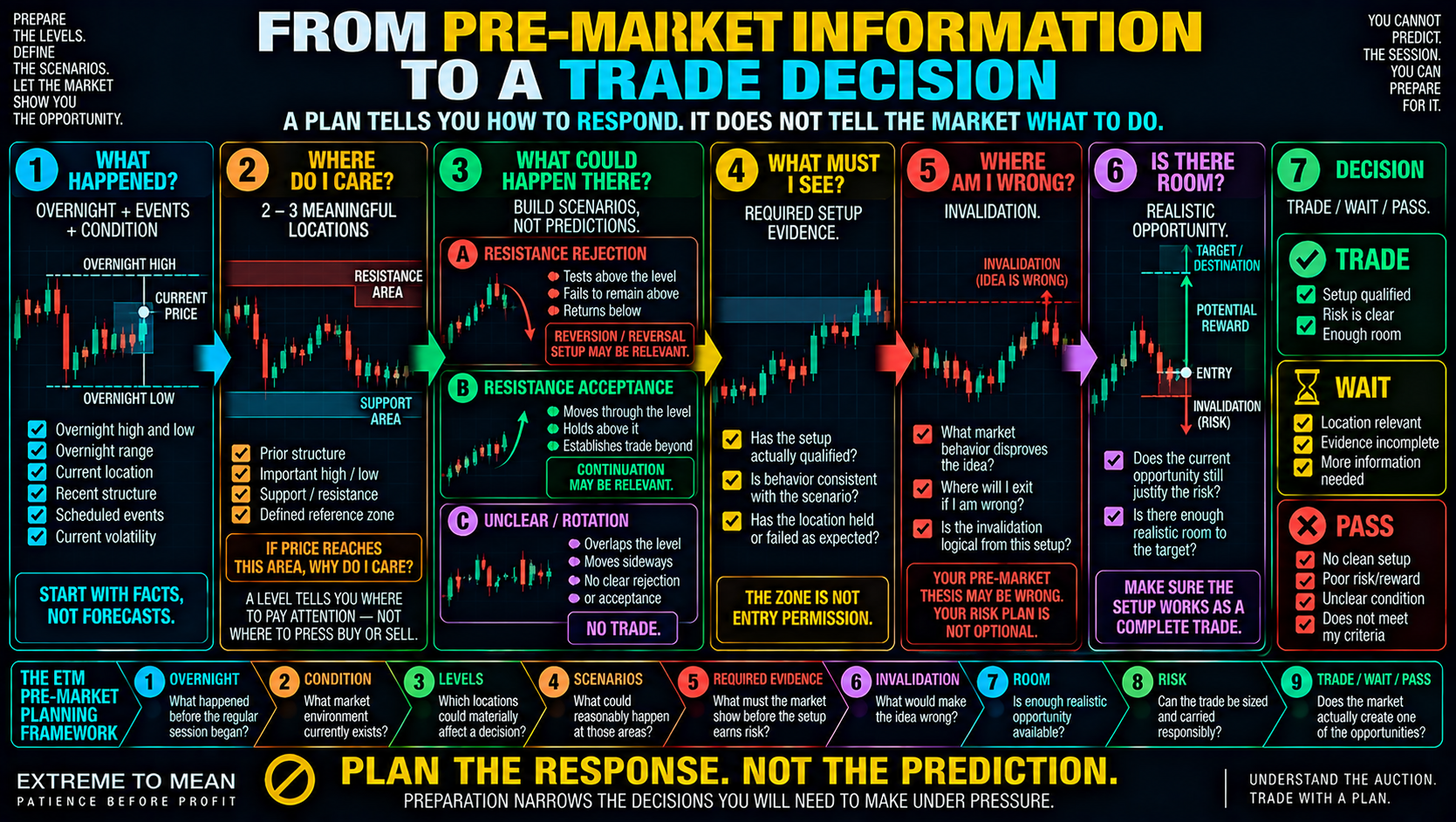
A stronger plan prepares multiple responses. If price reaches the area, trades above it briefly, cannot remain there, and begins showing meaningful rejection, a reversal or reversion setup may become interesting. If price moves through the area, holds above it, and establishes acceptance, the original fade thesis is no longer valid and a continuation opportunity may eventually become relevant.
There is also a third scenario traders often forget: price can simply chop around the area without showing meaningful rejection or acceptance. In that case, there may be no trade at all. The trader has not predicted the open, but already knows where attention belongs, what behaviors matter, and what would keep them out.
Define What Must Happen Before Risk Is Earned
A pre-market zone identifies where the trader should watch more closely, not where the trader should automatically enter. Once price reaches the area, the market still has to provide whatever evidence your setup requires. Planning therefore separates the location you care about from the behavior that must appear before risk is justified.
This prevents one of the easiest pre-market mistakes: turning preparation into a collection of pending trades. Marking resistance does not mean you are already short in your head, just as identifying support does not make every touch a long. The plan should tell you what has to happen at the location before the location becomes part of a qualified setup.
That evidence should remain strategy-specific rather than becoming a universal candle or indicator trigger. The important question is simply: “What must the market show me before this idea earns risk?” Until the answer appears, the plan remains a scenario rather than a trade.
Define Invalidation, Room, and Risk Before You Need Them
Once a scenario is clear enough to become a possible trade, the next planning question is where the idea would be wrong. The trader does not need to know an exact future fill price before the open, but should understand what structural behavior would invalidate the scenario. Otherwise, the stop is likely to be invented after entry when money and emotion are already involved.
That is why the trade is not ready until the risk is clear. A resistance-rejection scenario might look attractive until the available entry leaves too much distance to valid invalidation, while a breakout scenario might have clear risk but very little room before the next meaningful obstacle. The setup still has to work as a complete trade.
The same applies to the destination. Planning should identify where a realistic opportunity might exist without manufacturing a target simply to produce attractive math. Your pre-market thesis is allowed to be wrong; your risk plan is not optional.
A Good Plan Includes a Path to No Trade
A pre-market plan is incomplete when every branch eventually leads to an entry. Some sessions remain trapped in an unclear middle, some become too volatile around scheduled events, and some simply never produce the setup the trader expected to see. The plan should make those outcomes legitimate before the pressure of live trading begins.
This is important because doing nothing can otherwise feel like failing to execute the plan. In reality, a scenario that says “if neither rejection nor acceptance becomes clear, I stay out” is being followed perfectly when the market remains messy. The absence of a qualified trade is information.
A good plan also allows the original context to change. If the open produces evidence that contradicts the pre-market read, the job is not to defend the morning notes; it is to update the plan. The preparation should make adaptation cleaner, not make the trader loyal to a forecast that no longer fits the market.
Preparation Narrows the Decisions You Make Under Pressure
The practical benefit of planning is not that you can anticipate every possible path. It is that you can reduce an open-ended live problem into a small number of decisions you have already thought through. When price reaches an important area, you are not starting from zero.
That changes the quality of the question. Instead of asking, “What should I trade right now?” you can ask, “Which of my planned scenarios, if any, is the market actually showing?” The second question is calmer because it forces observation before action.
The plan also protects you from emotional improvisation. A trader who already knows the conditions for rejection, acceptance, invalidation, and no trade has less need to create explanations after a fast move begins. Preparation narrows the decision tree before urgency gets a vote.
The ETM Pre-Market Planning Framework
A useful session plan can be built from a simple sequence. Start with what happened while you were away, identify the environment you are walking into, mark only meaningful locations, and then define the scenarios and evidence that would make action reasonable. Risk comes after the market earns the setup.
- Overnight — What happened before the regular session began?
- Condition — What market and volatility environment currently exists?
- Levels — Which two or three locations could materially affect a decision?
- Scenarios — What could reasonably happen if price reaches those areas?
- Required evidence — What must the market show before the setup earns risk?
- Invalidation — What would make the idea wrong?
- Room — Is enough realistic opportunity available from the entry?
- Risk — Can the trade be sized and carried responsibly?
- Trade / wait / pass — Does the market actually create one of the planned opportunities?
The condensed framework is Overnight → Condition → Levels → Scenarios → Required Evidence → Invalidation → Room → Risk → Trade / Wait / Pass. Its purpose is not to create a rigid checklist where enough boxes automatically produce a trade. It is a map for responding to live information without improvising the entire decision after the market starts moving.
The better question is not, “What do I think will happen today?” Ask, “What would I do if this happens?” That shift turns the morning from prediction into preparation.
Final Thought
A useful pre-market plan does not need twenty indicators, fifteen levels, or a confident directional forecast. It needs enough context to identify where decisions may matter and enough structure to define what the market would have to show before you act. The goal is to arrive at the open prepared, not convinced.
Some mornings the market will reject the level you expected to matter. Other mornings it will accept beyond it, invalidate the original idea, or do nothing clean enough to trade. The plan succeeds when each of those outcomes already has a reasonable response.
Plan the response, not the prediction. Know where you care, what you need to see, where the idea is wrong, whether enough room exists, and when doing nothing is the correct decision. That is how the broader Extreme to Mean system turns preparation into a decision process rather than another opinion about where the market should go.
Educational content only. Trading involves substantial risk and is not suitable for everyone.