
A newer trader can look at a “high impact” row and start trying to predict the number, the direction, and the trade before the release has even happened. That feels like preparation, but it often confuses preparation with prediction. The cleaner job is to identify what is coming, when it arrives, what the market broadly expects, and what your own process allows around that window.
That makes the calendar one piece of understanding the market before the trade. It does not tell you whether ES or NQ should rise or fall, and it does not replace context or risk. It shows when the market’s information may change.
An Economic Calendar Is a Risk Schedule, Not a Crystal Ball
Before a session begins, the calendar should answer a practical question: When might the information environment change? A scheduled inflation report, employment release, growth figure, or Federal Reserve announcement can introduce new information at a known time. You do not know the number in advance, but you can know the event is coming.
That distinction matters because event risk can affect decisions before the release arrives. A trader may have one rule during an ordinary period and another when a major report is minutes away. The calendar identifies that window; the trading plan determines what to do with it.
This fits the broader ETM principle that context comes before the candle. A chart pattern appearing ten minutes before a major scheduled release does not exist in the same environment as the identical pattern on a quiet morning. The setup may look the same while the surrounding risk is very different.
Start With the Event and Exact Release Time
The first thing to read is not the forecast. It is the time. Confirm when the information is scheduled to arrive, and make sure the calendar is displaying the timezone you think it is.
An 8:30 a.m. release shown in Eastern Time can become a serious planning mistake if you read it as another timezone. Release time belongs in pre-market preparation, not something you notice only after volatility increases. The calendar is most useful when it removes surprises from the schedule.
Next, read the event name broadly instead of trying to memorize every economic series. CPI belongs to inflation, the Employment Situation belongs to labor, GDP belongs to growth, and an FOMC decision belongs to monetary policy. At this stage, orientation matters more than macro mastery.
What Actual, Forecast, and Previous Really Mean
Most economic calendars display three fields that confuse beginners: Previous, Forecast, and Actual. Previous is the value reported for the prior period, forecast or consensus is what economists broadly expect the new release to show, and actual is the newly released number once the report becomes public. Before the release, the actual field is usually blank.
The forecast matters because markets do not approach a release with zero expectations. If consensus expects 0.2% and the actual number is 0.2%, that specific number contains less surprise than if the actual prints 0.5%. That does not tell you what futures must do; it tells you that the new information differed more from what had been expected.
Previous values can also be revised. A number you remember from the last release may later appear differently if the earlier estimate was updated. Read the current calendar row rather than assuming the previous column is permanently fixed.
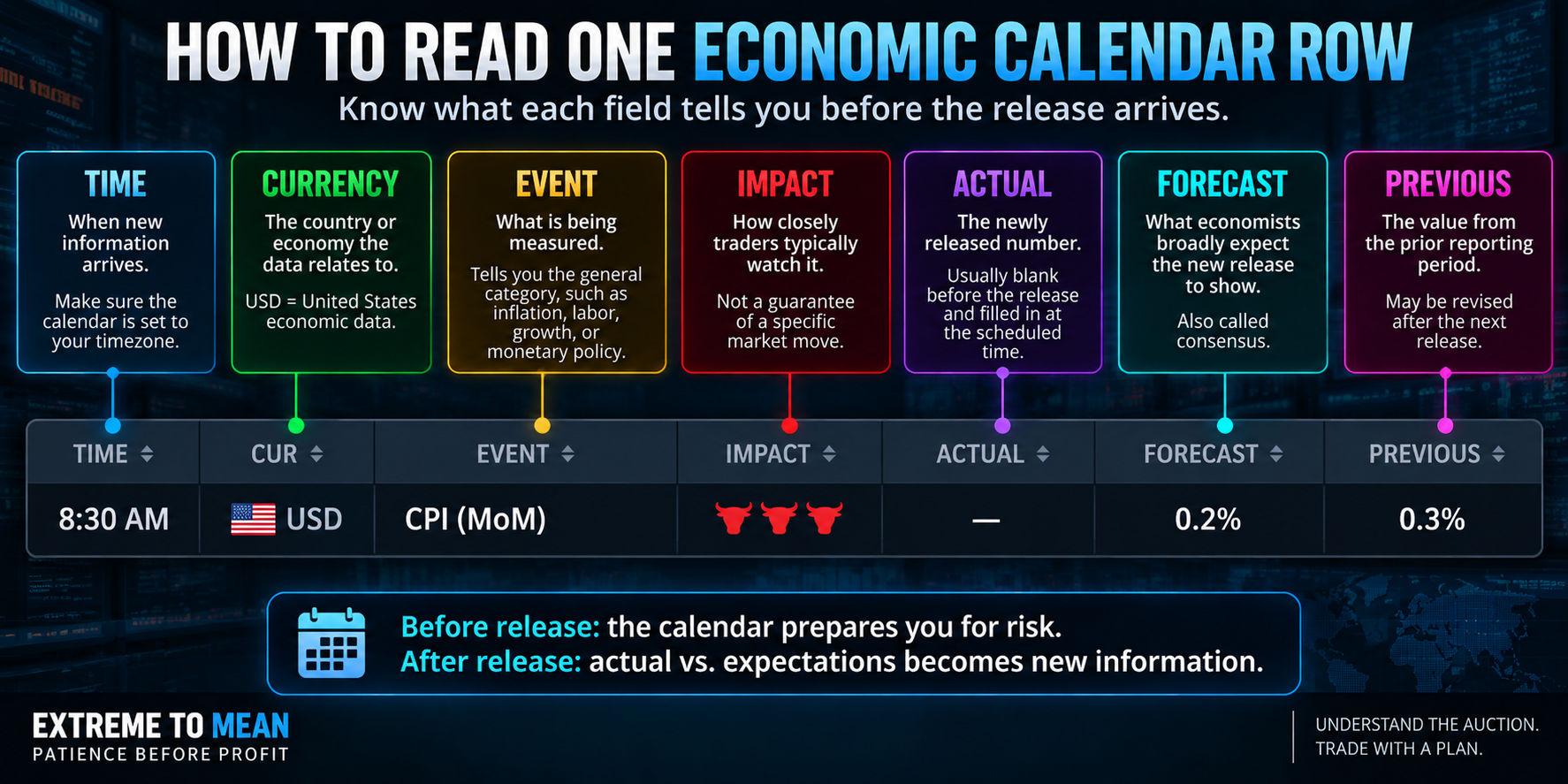
A useful mental model is: forecast is expectation; actual is new information; previous is the earlier reference point. The market then decides how much the difference matters in the current environment. The calendar organizes the numbers, but price still has to show how participants respond.
Use Impact Ratings as a Filter, Not a Signal
Commercial calendars often label events low, medium, or high impact. Those labels help traders prioritize a crowded schedule, but they are not promises about how much the market will move. “High impact” means an event is typically watched closely, not that a large move is guaranteed.
A low-impact label does not prove nothing can happen, and market conditions can change what traders care about. Use impact as a reason to pay attention, not as permission to trade. The label is a filter, not a signal.
A better question is not, “Will this high-impact event create a big move?” It is, “Does this event deserve a specific risk plan because the information arriving may change market behavior?” That keeps the calendar in its proper role.
Green and Red Numbers Are Not Buy and Sell Buttons
Some calendars color actual data green when it is above forecast and red when it is below, or use similar visual cues. A beginner can easily translate that into “green means bullish” and “red means bearish” when trading equity-index futures. That interpretation is too simple.
A higher number is not automatically positive for stocks, and a lower number is not automatically negative. Higher-than-expected inflation can mean something very different from higher-than-expected growth, while weaker labor data can be interpreted differently depending on whether traders are focused on growth concerns or interest-rate relief. Calendar colors compare numbers; they do not tell you what ES or NQ should do.
That is why market conditions change the quality of a setup. The same surprise can be received differently when inflation is the market’s main concern than when growth or financial stress dominates attention. The calendar gives you the release; the market tells you how participants are interpreting it.
One Timestamp Can Contain More Than One Story
Scheduled information does not always arrive one report at a time. Several releases, subcomponents, or revisions can hit at the same timestamp, which means the first headline you see may not explain the full market reaction. One number can beat expectations while another misses.
That can create movement that looks contradictory if you assume there was only one piece of information. The market may be weighing several components at the same time. One timestamp can contain more than one story.
This is why reacting instantly to the first visible number can be dangerous. You do not need to decode every report in real time, but you should recognize that the market may be processing more information than one colored cell suggests. When the reaction is unclear, waiting remains a valid decision.
Know Your Event-Risk Rule Before the Number Arrives
Before the event, know what your trading plan permits around scheduled risk: holding a position, entering shortly before the release, trading the initial reaction, waiting, or avoiding the window. Different traders and strategies can reasonably use different rules. The important part is deciding before the event.
The calendar tells you when risk may change; your trading plan tells you what you do about it. Deciding beforehand prevents the trader from inventing a rule in the middle of fast movement. It also reinforces the ETM principle that the market comes first.
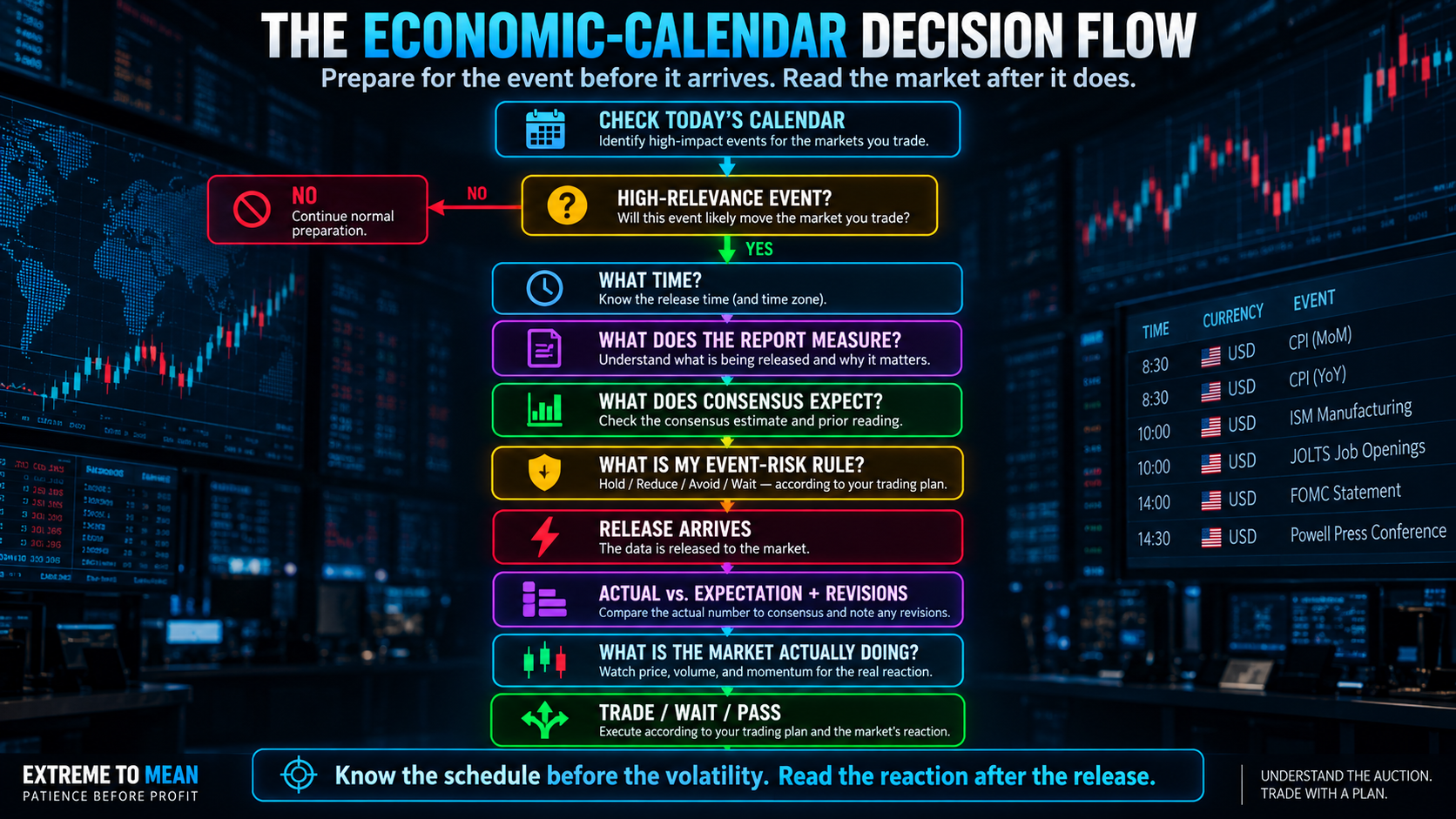
Consider a trader preparing to trade NQ who sees an 8:30 a.m. CPI release marked high impact. The row shows Previous 0.3%, Forecast 0.2%, and Actual blank because the report has not yet been released. The inexperienced response is to guess that inflation will come in cool and NQ will rally; the prepared response is to note the time, category, expectation, and personal event rule.
What to Do After the Release
Once the release arrives, the calendar’s pre-market job is largely complete. The actual number can be compared with expectations and previous or revised data, but the trader still should not jump directly from “actual” to “trade.” The next question is: What is the market actually doing with the new information?
Price may accelerate, reverse, hesitate, or produce conflicting movement. The initial reaction is not automatically the “correct” reaction, and a fast first move does not create an obligation to participate. The trader’s job remains to evaluate rather than react.
You can know what was scheduled, recognize that the number surprised consensus, and still decide the response is too unstable or unclear for your process. The calendar prepares you for the moment; it does not force you to trade it. Patience still belongs in the decision.
The ETM Economic-Calendar Routine
A practical routine is WHEN → WHAT → EXPECTED → SURPRISE → RISK → REACTION. Before the session, identify the time, understand what kind of information is being released, note what consensus expects, and decide what your process allows around the event. After the release, compare the new information with expectations and revisions, then watch what the market actually does.
Use these questions before the session:
- What important events are scheduled today?
- What exact time do they occur in my timezone?
- What does each report measure broadly?
- What does consensus currently expect?
- Could the previous number be revised?
- Are multiple releases occurring at the same time?
- Does my strategy permit exposure through this event?
- Do I need to hold, reduce, avoid, wait, or simply be aware?
After the number arrives, simplify the review again: What surprised the market, and what is price actually doing with that surprise? From there, the decision remains trade, wait, or pass. The goal is not to become an economist before the open; it is to stop being surprised by information that was scheduled in advance.
The ETM Market Calendar is a practical place to use this process. Identify the events relevant to your session, confirm their timing, understand the basic fields, and establish event-risk rules before trading. That turns a crowded calendar into a usable risk map.
Final Thought
The economic calendar does not tell you what to trade. It tells you when the market may receive information capable of changing the trade, which gives you the chance to prepare before the environment shifts.
Use the calendar to remove surprises from the schedule, not uncertainty from the market. Know what is coming, know when it arrives, understand what the columns mean, decide your risk rules beforehand, and let the actual market response determine what happens next.
Educational content only. Trading involves substantial risk and is not suitable for everyone.