
Trading creates an unusual psychological trap because activity looks and feels like work. Scanning, entering orders, managing positions, and watching price all produce feedback, while waiting can feel as though nothing is being accomplished. The cleaner process is to let opportunity determine activity rather than letting activity manufacture a reason to participate.
What Overtrading Actually Means
Overtrading is continuing to participate after the quality, rules, market conditions, or risk plan no longer justify participation. It is not automatically scalping, trading every day, taking more than three trades, or trading again after a loss. Two traders can take the same number of trades while only one has abandoned the process.
The useful question is not simply how many trades were taken. Ask, "How many of those trades independently satisfied the process I claimed I was following?" That keeps the focus on decision quality rather than a magic number.
Why Overtrading Feels Productive
A trader is at the screen to trade, so inactivity can feel like failure to do the job. Marking levels, reacting to movement, entering orders, and managing P&L create the sensation of progress because something visible is happening. By contrast, waiting for a location or setup to qualify produces very little immediate feedback.
That creates a dangerous inversion: doing something can feel productive even when doing nothing is still a trading decision. The trader's job is not to maximize clicks or screen engagement; it is to filter market information and participate only when the opportunity earns attention. Patience is active when it protects that standard.
There Is No Correct Number of Trades Per Day
A legitimate trade count depends on strategy, instrument, timeframe, session, market conditions, setup frequency, and tested rules. A high-frequency process can produce many valid trades, while a selective process can produce one or none. Frequency alone therefore cannot define overtrading.
Qualified opportunities should determine the number of trades, rather than a desired number of trades determining what gets labeled an opportunity. A trader who expects to "get five trades in" has already created pressure for the market to provide something it may not provide. Trade count should follow the process, not lead it.
The Five Common Paths Into Overtrading
Boredom creates pressure when nothing clean is happening; FOMO turns movement into a disappearing opportunity; revenge makes the next entry feel like a chance to repair P&L. Overconfidence after a strong trade can lower skepticism, while daily-target pressure can make a session feel incomplete because a desired result has not been reached. These paths look different, but they all push the trader toward the same outcome: a lower qualification threshold.
Behavioral-finance research supports treating overconfidence as one possible contributor without making it a universal explanation. Barber and Odean found that a group predicted to be more overconfident traded more frequently in their stock-investor sample, consistent with models linking overconfidence and excess trading. That does not mean every active trader is overconfident or establish an optimal frequency for futures trading.
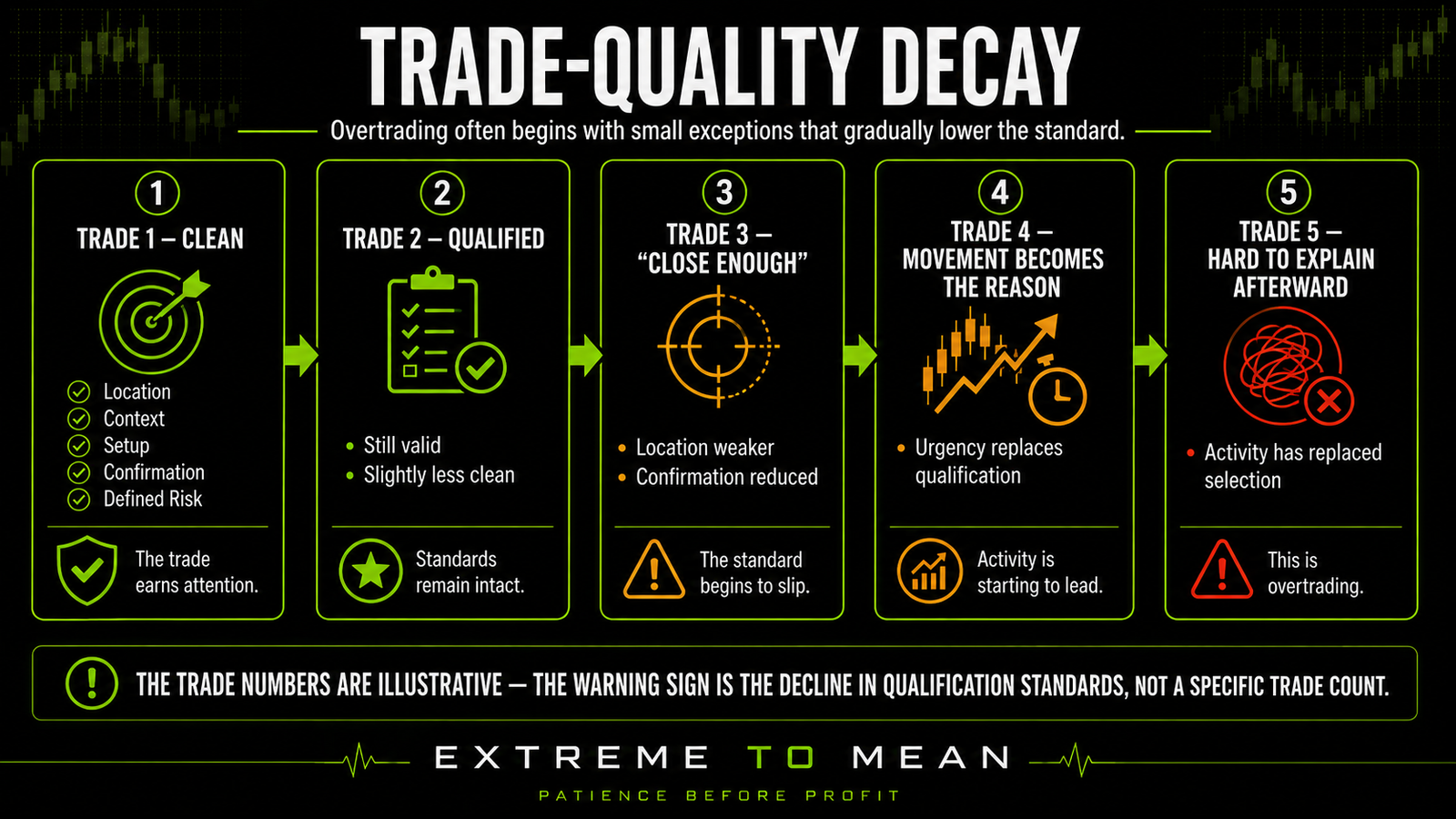
Overtrading Usually Happens Through Trade-Quality Decay
Overtrading often develops as a sequence of small exceptions rather than one obviously bad decision. Trade 1 may have clean location, context, confirmation, and risk; Trade 2 may still qualify but be less clean; by Trade 3, "close enough" begins replacing the original standard. Later, movement and urgency can become the reason for entry even though the trader would struggle to explain the setup afterward.
This is trade-quality decay. Each decision is only slightly weaker than the one before it, which makes the deterioration hard to notice in real time and obvious in hindsight. The principle is closely related to protecting your next decision: one action should not degrade the standard carried into the next one.
Every Extra Trade Has Costs
Every additional trade adds more than market risk. Commissions, exchange fees, bid-ask spread, slippage, additional exposure, execution risk, and another management decision all have to be justified by an actual opportunity. The point is not that active trading is inherently unprofitable; it is that additional activity is not free.
Barber and Odean studied 66,465 household brokerage accounts from 1991 through 1996 and found a negative relationship between trading intensity and net performance after costs; their most active investors fared worst on a net basis. Their sample consisted of individual stock-investing households, not intraday futures traders, so it does not tell a futures trader how many trades to take. It supports only the narrower point that more trading should not be assumed to add value.
SEC guidance likewise emphasizes the expenses and leverage risk involved in short-term day trading.
A Winning Morning Can Create Overtrading Too
Losses are not the only path into excessive participation. A strong morning can create confidence, a feeling of financial cushion, and the belief that "one more trade" is harmless, allowing size or setup standards to drift. The standard for a later trade should not change merely because earlier trades went well.
How Market Conditions Create Overtrading Traps
Slow ranges, chop, repeated false breaks, low follow-through, and long periods without a qualified setup can make activity pressure more intense. Fast movement after extended inactivity can create the opposite problem by making waiting suddenly feel expensive. The market does not force overtrading, but some environments make movement easier to mistake for opportunity.
This is where The Trader still has to respect market context. A session can contain plenty of motion without producing the specific condition, location, and setup the trader is supposed to trade. If the market has stopped matching the planned environment, more effort does not manufacture a better setup.
Build a Trade Qualification Gate
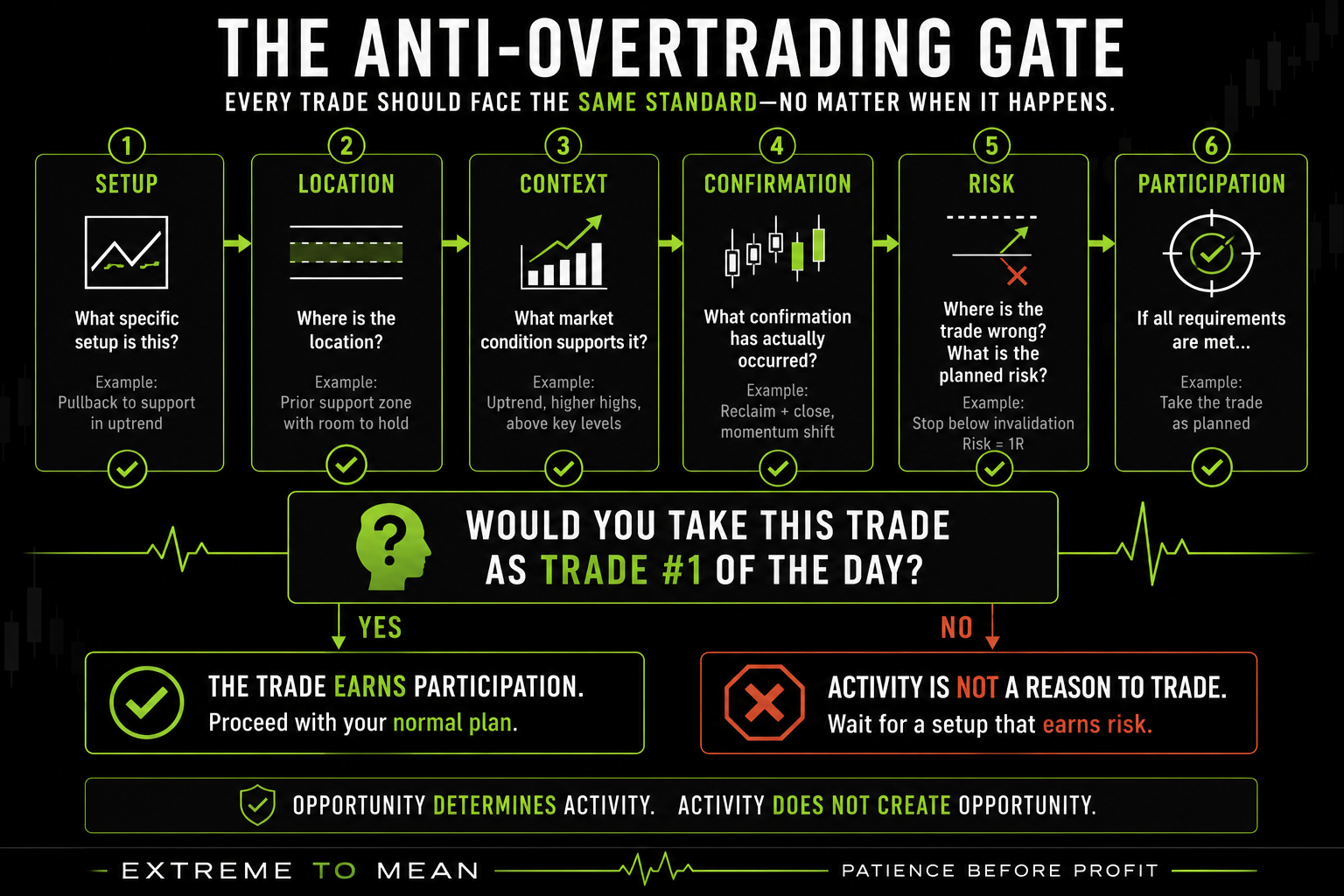
The solution is not "try harder to trade less." Require every entry to pass the same gate: What setup is this, where is the location, what market condition supports it, what confirmation occurred, where is the trade wrong, and what is the planned risk? The final check is especially useful: Would I take this trade if it were my first trade of the day?
If Trade 6 would not survive the standards applied to Trade 1, something has changed. This is the same logic behind how good traders disqualify bad trades: a qualification gate removes marginal opportunities before desire turns them into trades. The setup must earn participation independently.
Use Stop Conditions, Not Just a Maximum Trade Count
A maximum trade count can be useful if it belongs to a tested personal process, but it is not a universal solution. Stronger stop conditions identify evidence that decision quality itself is deteriorating: repeated rule violations, trades outside written criteria, inability to explain the next setup, elevated frustration or urgency, poor concentration, or a market that no longer matches the planned environment. A daily loss limit can be one stop condition without becoming the definition of overtrading.
These conditions should be established before the session. Once the trader already wants another entry, the temptation is to reinterpret the rule or grant an exception. Good process reduces the amount of willpower required when pressure is highest.
Make Low-Quality Trades Harder to Take
Structural friction can make unnecessary trades less convenient. A written checklist, alerts instead of constant chart watching, stepping away when no planned location is nearby, or hiding P&L when it changes decisions can create separation. The principle is to make the intended process easier to follow than the impulse.
Review the Sequence, Not Just Individual Trades
For overtrading, reviewing the sequence is often more useful than grading every trade alone. Find the first trade that fell below normal standards, then ask what happened before it: a win, loss, missed move, boredom, a particular time of day, shorter spacing between decisions, or a change in size. The useful discovery is the transition point where activity began replacing selection.
That pattern should come from the trader's own records rather than a universal cutoff. Review is useful when it identifies the first repeatable sign of quality decay. The trigger may differ from one trader to another.
Separate Opportunity Frequency From Activity Frequency
The market controls how many valid opportunities appear; the trader controls how many actions are taken. Some sessions may produce several qualified setups, one setup, or none, and those outcomes do not need to satisfy a daily activity target. Opportunity frequency and activity frequency are different things.
A zero-trade day can represent excellent process execution when nothing qualified. Opportunity → Qualification → Participation → Review is a cleaner sequence than Screen Time → Boredom → Movement → Justification → Trade. A patient process allows opportunity quality to determine action.
A Practical Anti-Overtrading Filter
Before another entry, require the opportunity to survive the same questions you would ask early in the session. The goal is not to suppress legitimate activity; it is to identify whether the desire for another trade has started lowering the standard. If the opportunity cannot survive the filter, activity has probably replaced selection.
- Can I name the exact setup?
- Is the location still meaningful?
- Are current market conditions appropriate for it?
- Is this setup as good as something I would take early in the session?
- Has my required confirmation changed?
- Has my risk or size changed because of today's P&L?
- Am I trading because an opportunity exists—or because I want to keep trading?
- If I skip this trade, am I violating my plan or following it?
The better question is not, "How many trades am I allowed to take today?" Ask: "Has this trade independently earned participation, or am I lowering my standards because I want another trade?" Then add the most useful final test: "Would this still qualify if it were my first trade of the day?"
Final Thought
Overtrading is not a magic number. It begins when activity continues after the process, market conditions, setup quality, or risk rules no longer justify the next entry. Counting trades can provide useful review data without defining the problem.
The trader does not need to make waiting feel exciting. The job is to let opportunity determine participation and preserve the same qualification standard from the first decision to the last. That active form of patience is one of the larger ideas developed in The Patience Principle.
Educational content only. Trading involves substantial risk and is not suitable for everyone.