
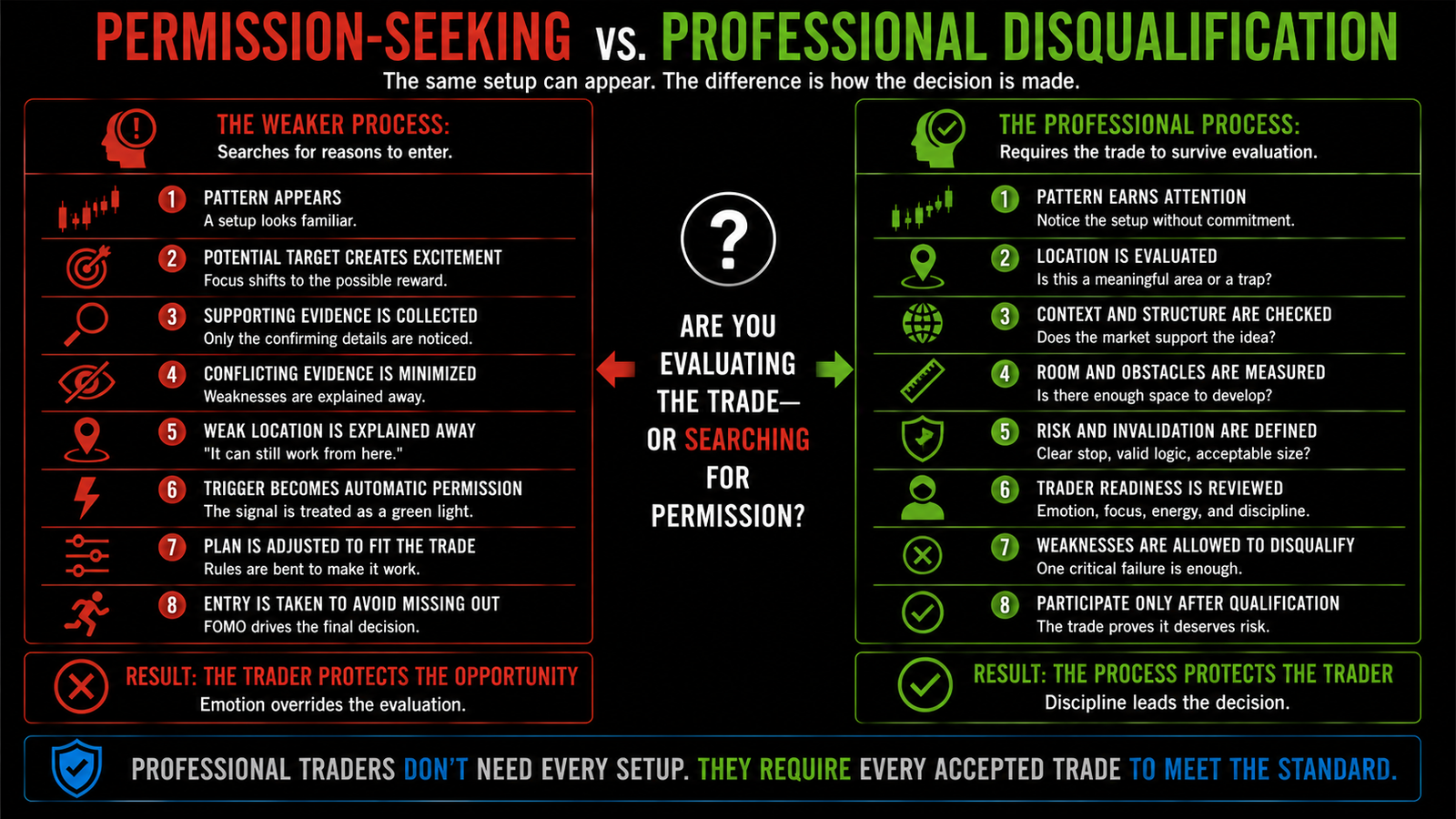
Many traders approach the chart as though their job is to find a trade. Once a familiar pattern appears, they begin collecting reasons that support participation and minimizing evidence that argues against it. The setup feels more convincing with every confirming detail they notice. By the time the order is considered, the decision may already feel emotionally complete.
The lessons in The Trader category emphasize that the trader’s job is to evaluate rather than react. Evaluation includes recognizing when an opportunity does not meet the complete standard for participation. A trade can look interesting without being acceptable, and a setup can be technically present without earning risk. Disqualification is the process that protects that distinction.
Disqualification Is Part of Trade Selection
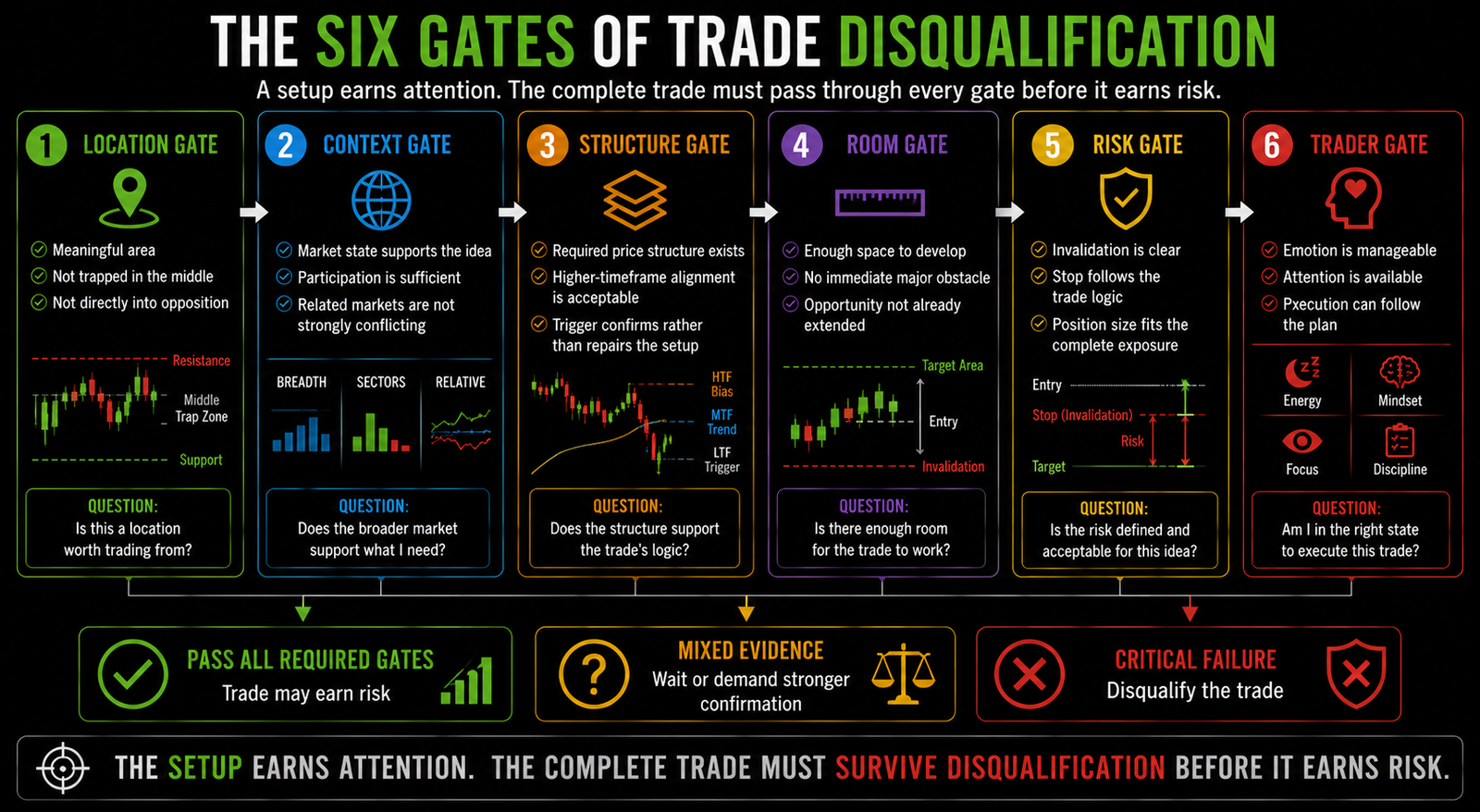
Disqualifying a trade means identifying a condition that prevents the idea from meeting the plan’s standards. The problem may involve poor location, weak context, conflicting structure, limited room, unclear invalidation, excessive exposure, or the trader’s current emotional state. The trader does not need to prove that the trade will fail. The trader only needs to recognize that the idea is incomplete or unsuitable.
This process is different from searching for certainty. No trade can be guaranteed, and a fully qualified setup can still produce a loss. Disqualification asks whether the known weaknesses are serious enough to reject the opportunity before risk is accepted. It improves the quality of the decision without pretending to control the outcome.
Why Traders Look for Reasons to Participate
A visible setup creates a sense of progress. The trader has waited, recognized something familiar, and may feel that the market is finally offering a reward for paying attention. Rejecting the opportunity can feel like wasting that effort. Participation therefore begins to feel like the natural conclusion of the analysis.
The desire to avoid regret adds more pressure. A trader may imagine the move developing without them and believe that passing will feel worse than taking a manageable loss. That calculation gives the potential missed opportunity more emotional weight than the actual weaknesses in the trade. The trader starts defending against future regret instead of evaluating present conditions.
Location Can Disqualify a Good Pattern
A pattern can be clean while appearing in the wrong place. A bullish setup may form directly beneath resistance, after an extended move, or in the middle of a range where neither side has a clear advantage. A bearish setup may appear directly above support or after most of the available downside has already been traveled. The structure of the pattern does not repair the weakness of the location.
Good location gives the trade a logical reason to begin and enough space to develop. Poor location often forces the trader to accept a distant invalidation, a nearby obstacle, or an entry based mainly on momentum. The principle that a trading plan is a promise made before the open requires the trader to respect location standards even when the pattern looks attractive. A setup that appears outside the approved area can be disqualified before the trigger creates urgency.
Context Can Work Against the Setup
The broader market may also disqualify an otherwise recognizable opportunity. A long setup can appear while participation is narrowing, related markets are weakening, and higher-timeframe structure remains bearish. A short setup can develop while the market continues accepting higher prices and selling pressure receives little follow-through. The local pattern may exist inside an environment that does not support what the trade requires.
Context does not need to align perfectly across every instrument and timeframe. Markets often contain mixed evidence, rotation, and temporary disagreement. The question is whether the conflict is manageable or whether it removes the logic behind the trade. When the idea depends on continuation but the market repeatedly rejects directional progress, the setup may not deserve risk.
Structure Must Support the Trade’s Logic
A trade should be based on a specific expectation about market behavior. A breakout requires acceptance beyond the prior boundary, while a pullback requires the broader structure to remain intact. A reversal requires evidence that the existing pressure is weakening and that the opposing side is beginning to respond. When the required structure is absent, the setup may be recognizable without being complete.
Traders sometimes substitute the trigger for the missing structure. One candle, cross, arrow, or indicator event becomes sufficient because it provides a clear moment to act. The trigger can confirm a qualified idea, but it cannot create the context that the idea requires. If the surrounding structure does not support the trade, the signal should not override the disqualification.
Limited Room Can Make the Trade Unacceptable
A trade needs enough available room to develop before meeting meaningful opposition. A long entry directly beneath a major high may have little space before sellers are likely to respond. A short entry directly above support may face the same limitation. The setup can move in the expected direction and still offer an unattractive decision because the nearby obstacle restricts the opportunity.
Room should be evaluated relative to the invalidation and the market’s normal movement. A wide stop combined with a nearby destination may create exposure that does not fit the plan. Pulling the stop closer does not create more room or improve the location. When the complete trade cannot fit inside acceptable risk, the professional response is to disqualify it rather than force the numbers.
Unclear Risk Is a Disqualifier
A trader should know what market behavior would make the idea wrong. Without that boundary, the stop becomes an emotional estimate rather than a consequence of the setup’s logic. Position size cannot be calculated honestly when the invalidation remains vague. The trade is incomplete before it begins.
A logical invalidation may also reveal that the required exposure is too large. The correct stop could be farther away than the trader expected, making the preferred size unacceptable. The cleaner choices are to reduce size, wait for a better entry, or reject the trade. Changing the boundary merely to preserve participation weakens the decision instead of solving the problem.
The Trader’s Condition Can Disqualify the Opportunity
A technically qualified trade may still be unsuitable for the person who must execute it. Fatigue, frustration, distraction, recent losses, overconfidence, or financial pressure can change how evidence is interpreted and how closely the plan is followed. The trader may see urgency where none exists or accept weaknesses that would normally be obvious. Personal readiness is therefore part of trade qualification.
This does not mean every uncomfortable emotion requires abandoning the session. The trader may be able to reduce size, delay participation, demand stronger confirmation, or observe without trading. The adjustment should reflect the actual effect of the condition on execution. Ignoring the condition and hoping discipline appears after entry is not a reliable process.
Disqualify the Trade Before the Trigger
Disqualification works best when it occurs before the setup becomes urgent. Once price begins moving, the trader may feel that there is no longer enough time to evaluate location, room, context, and risk carefully. The trade can shift from optional to emotionally necessary in a few fast candles. Preparation prevents that time pressure from lowering the standard.
The trader should identify the conditions that would automatically reject the idea before the entry is available. These may include entering from the middle of a range, trading directly into opposition, fighting higher-timeframe structure, accepting unclear invalidation, or participating while emotionally unsettled. The standards should be specific enough to use without negotiation. A rule that can always be reinterpreted will not protect the decision when urgency appears.
Skipping a Trade Is a Professional Decision
Passing on a setup is often treated as the absence of a decision. In reality, the trader reviewed the opportunity, compared it with the plan, identified a weakness, and withheld risk. That is a complete decision process. The lack of an order does not make the work less real.
The principle that doing nothing is still a trading decision is especially important when a setup looks almost acceptable. The trader may be tempted to participate because only one condition is missing or because the potential move appears unusually attractive. Professional standards matter most when breaking them feels easy to justify. A disciplined pass protects the integrity of the complete process.
Use a Trade-Disqualification Filter
Before approving a trade, the trader can move through a short disqualification process. The purpose is not to build an impossible standard that rejects every uncertain situation. It is to identify known weaknesses before emotional commitment causes them to be minimized. One serious failure may be enough to reject the trade even when several other elements look strong:
- Is the setup forming at a meaningful location or in the middle of unclear structure?
- Does the broader market context support what the trade requires?
- Is the trade aligned with the relevant higher-timeframe structure?
- Is there enough room before meaningful opposition?
- Is the invalidation clear and based on the trade’s logic?
- Can the full position be sized within the accepted risk?
- Is current pressure receiving participation and follow-through?
- Is the setup complete, or am I relying on the trigger to repair missing evidence?
- Is my emotional and physical state suitable for executing the plan?
- What specific fact would disqualify this trade immediately?
- Am I evaluating the opportunity or searching for permission?
- Would I still approve the trade if I could not see its possible target?
The better question is not, “Can I find enough reasons to take this trade?” It is, “What has this trade done to prove that it should not be rejected?” That reversal places the burden on the opportunity rather than on the trader’s ability to justify participation. The setup must survive evaluation before risk is allowed.
This process also supports protecting the next decision. A trade rejected for valid reasons does not consume capital, attention, or emotional stability. Those resources remain available when a better opportunity appears. Disqualification protects more than the current position because it preserves the quality of the decisions that follow.
Review the Trades You Did Not Take
Trade review should include opportunities that were considered and rejected. The trader can record the setup, the disqualifying condition, and what happened afterward without using the later outcome to rewrite the original decision. A rejected trade may work, and an accepted trade may fail. Neither result automatically proves that the qualification process was wrong.
Reviewing passes helps the trader identify whether the standards are useful or unnecessarily restrictive. Repeatedly rejecting trades for poor location may reveal that patience is protecting the process, while rejecting every setup for vague reasons may reveal fear disguised as discipline. The distinction becomes clearer when the reason is documented before the outcome is known. Good disqualification is specific, repeatable, and connected to the plan.
Traders who repeatedly find reasons to participate despite several weaknesses may need to examine the broader problem of trading too much. Excess activity often begins before the entry, when the trader lowers the standard to keep an opportunity alive. Improving discipline after entry will not solve a qualification process that approves too many weak ideas. The correction begins with rejecting trades earlier.
Final Thought
Good traders do not avoid every losing trade, and they do not wait for perfect conditions. They develop a professional ability to recognize when an opportunity lacks the location, context, structure, room, risk clarity, or personal readiness required by the plan. The setup may still look attractive, and the market may still move without them. Those possibilities do not remove the value of a disciplined rejection.
The goal is to make participation something the trade must earn. A pattern earns attention, but the complete opportunity earns risk only after serious weaknesses have failed to disqualify it. Skipping the trade is not a missed professional duty. In many cases, it is the clearest evidence that the trader performed that duty correctly.
Those disqualification questions can be organized into a simple day trading checklist that keeps the same standards visible before entry.
When time is short, the 60-second trade readiness check offers a compact version of the same decision discipline.
Educational content only. Trading involves substantial risk and is not suitable for everyone.