
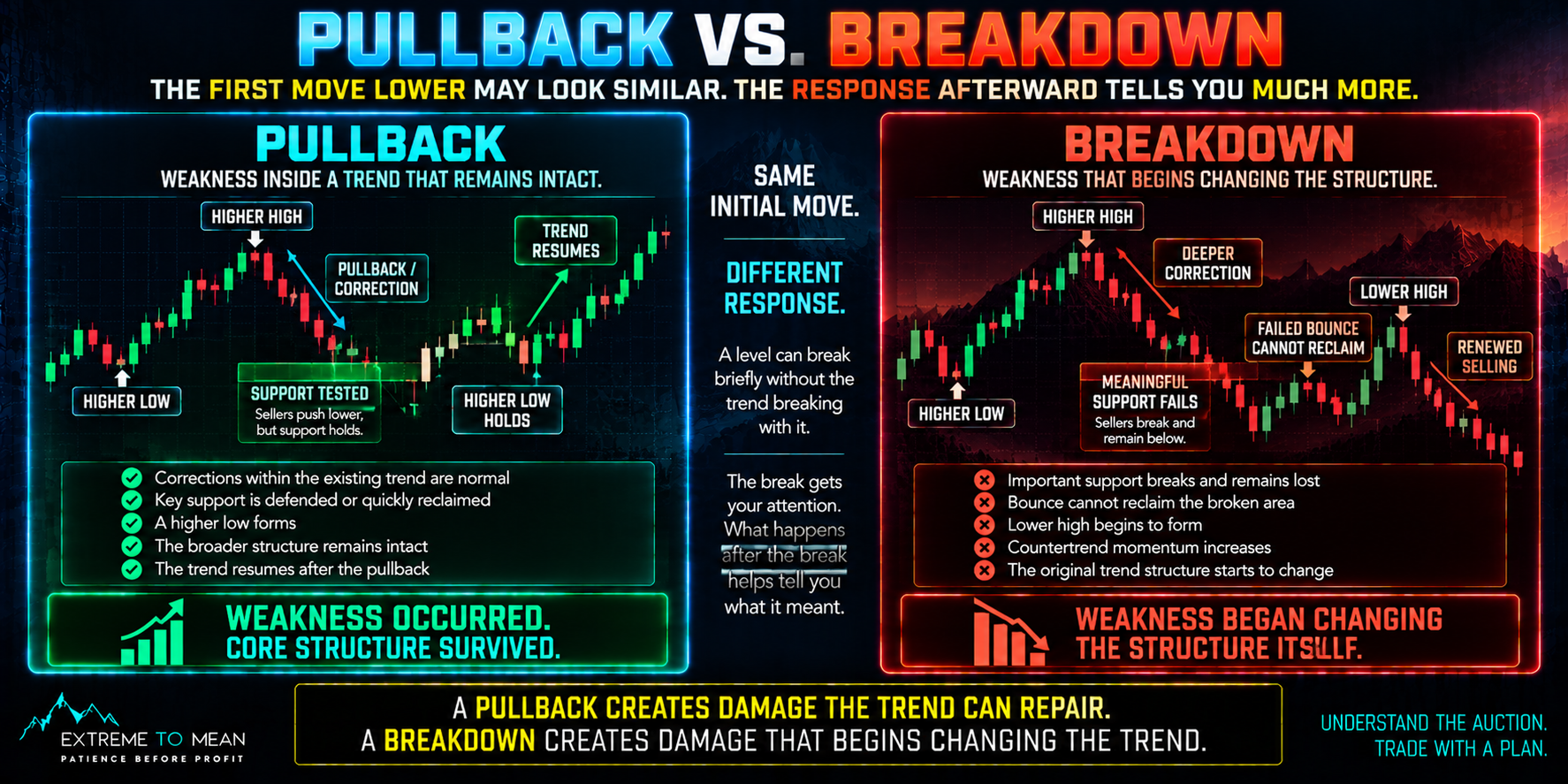
A pullback and a breakdown can look almost identical when they begin. Both may start with several hard candles against the trend, a broken short-term level, or momentum that suddenly feels uncomfortable. The trader’s job is not to label the first move perfectly—it is to watch what that move actually changes.
The question is not simply how far price pulled back. The question is what changed while it was pulling back.
A pullback is weakness inside a structure that still has a reasonable case for continuation. A breakdown is weakness that begins changing the structure that made the original trend trustworthy. Learning to separate those two situations belongs naturally inside the broader Setup curriculum because recognizing the pattern is only the beginning; the trader still has to decide whether the setup deserves confidence, patience, or no trade at all.
Neither classification should come from one candle. Price can break a minor low, accelerate briefly against the trend, or trade through support without automatically destroying the larger structure. The evidence becomes more useful when you evaluate context, depth, levels, response, momentum, and whether the original trend can still continue.
A Pullback and a Breakdown Often Look the Same at First
Imagine an established uptrend suddenly printing several red candles. Price leaves the recent high quickly, breaks a minor swing low, and approaches an area that previously supported the advance. That can feel like a breakdown even though all that has happened so far is a countertrend move.
A pullback interrupts direction without necessarily changing direction. Price can move lower, retrace a meaningful part of the prior advance, test support, slow momentum, or temporarily damage short-term structure while the larger trend remains intact. The important question is whether the trend can absorb that damage and eventually rebuild.
A breakdown requires more than discomfort. It involves increasing evidence that the structure supporting the prior move is no longer being defended effectively, such as meaningful levels staying lost, recovery attempts weakening, or the market beginning to build new structure in the opposite direction. A level can break briefly without the trend breaking with it.
Start With the Trend That Existed Before the Decline
Before asking whether the current move is a pullback or breakdown, ask what kind of trend existed before the decline began. A clean sequence of higher highs and higher lows with orderly continuation deserves more benefit of the doubt than a market that was already failing to extend, becoming choppy, or repeatedly losing momentum. A pullback deserves more benefit of the doubt inside a healthy trend than inside a trend that was already deteriorating.
This is why context comes before the candle. Three bearish candles mean something different inside a strong directional auction than they do after an uptrend has already spent an hour failing to make meaningful progress. The countertrend move should be interpreted relative to the quality of the structure it is challenging.
Timeframe matters just as much. A move can be a breakdown on a one-minute chart while remaining only a pullback on a fifteen-minute structure, and neither description has to be wrong. Structure can fail on one timeframe while remaining intact on another.
That makes statements such as “price made a lower low, so the trend is broken” incomplete. The better question is: lower than what, inside which structure, and on which timeframe? Classification becomes more useful when the trader knows exactly which trend they are describing.
Depth Matters, but Distance Alone Cannot Decide
A shallow correction is usually easier to treat as a routine pullback than a very deep retracement. As price travels farther against the original trend, more of the prior directional structure may come under pressure, so deeper movement deserves closer investigation. But there is no universal retracement percentage that suddenly converts a pullback into a breakdown.
Depth has to be interpreted relative to volatility, location, previous corrections, timeframe, and the structure itself. A move that appears unusually deep in one environment may be ordinary in another. A deep pullback is evidence to investigate—not an automatic verdict.
Which level broke is usually more informative than the simple fact that something broke. Markets constantly trade through tiny swing lows, prior candle lows, and short-term support while larger structure remains intact. “Price broke support” is incomplete; the real question is which support, inside which structure, on which timeframe.
That is also why location is the first filter. A minor intraday level in the middle of an established move should not carry the same structural weight as a prior low that repeatedly defined the trend. The market does not assign equal importance to every horizontal line on the chart.
Reclaim vs. Acceptance: What Happens After the Break
Suppose price reaches an important support area in an uptrend. Pullback-like behavior might include selling slowing, buyers responding, price stabilizing, and the market beginning to rebuild upward structure. Breakdown-like behavior looks different: little defense appears, price remains below the area, and attempts to recover become weak.
A level matters less because price touched it and more because of what price does there. Markets can briefly trade through support because of volatility, liquidity testing, stops triggering, or ordinary auction behavior without establishing sustained trade below it. Where price trades matters; where price can stay often matters more.
One useful distinction is TEST → RECLAIM versus BREAK → ACCEPT BELOW. A quick recovery of the broken area does not automatically prove the move was only a pullback, but it weakens the argument that meaningful structural failure has already occurred. Likewise, sustained trade below the area deserves more attention than a single excursion through it.
Failed bounces can be even more informative than the initial break. If support fails and the next rally cannot reclaim the old area, stalls underneath it, forms a weaker high, and attracts renewed selling, the structure is revealing more damage. A breakdown often becomes clearer not on the first selloff, but on the bounce that cannot repair the damage.
Momentum Helps, but Continuation Tells You More
A pullback can have strong momentum. One large red candle or a burst of aggressive selling does not by itself mean the larger uptrend has failed. Momentum matters most when you compare the countertrend pressure with the broader trend and ask whether control is beginning to change.
Watch whether downside movement starts expanding while bullish responses become shorter and weaker. Also ask whether continuation is becoming easier in the new direction while the original trend increasingly struggles to recover meaningful levels. Momentum does not classify the move alone, but it can help reveal which side is beginning to control the auction.
The original trend eventually has to prove it can still perform its basic job. In an uptrend, buyers do not need every pullback to be shallow, but they eventually need to resume progress, recover structure, and create meaningful continuation. A healthy trend does not need every pullback to be shallow; it eventually needs continuation.
This connects directly to how market conditions change the quality of a setup. A trend that repeatedly fails to resume should not receive the same assumption of continuation simply because it was strong earlier in the session. The trader should update as evidence changes rather than defending the original label indefinitely.
Use Pullback → Questioned → Breakdown Instead of a False Binary
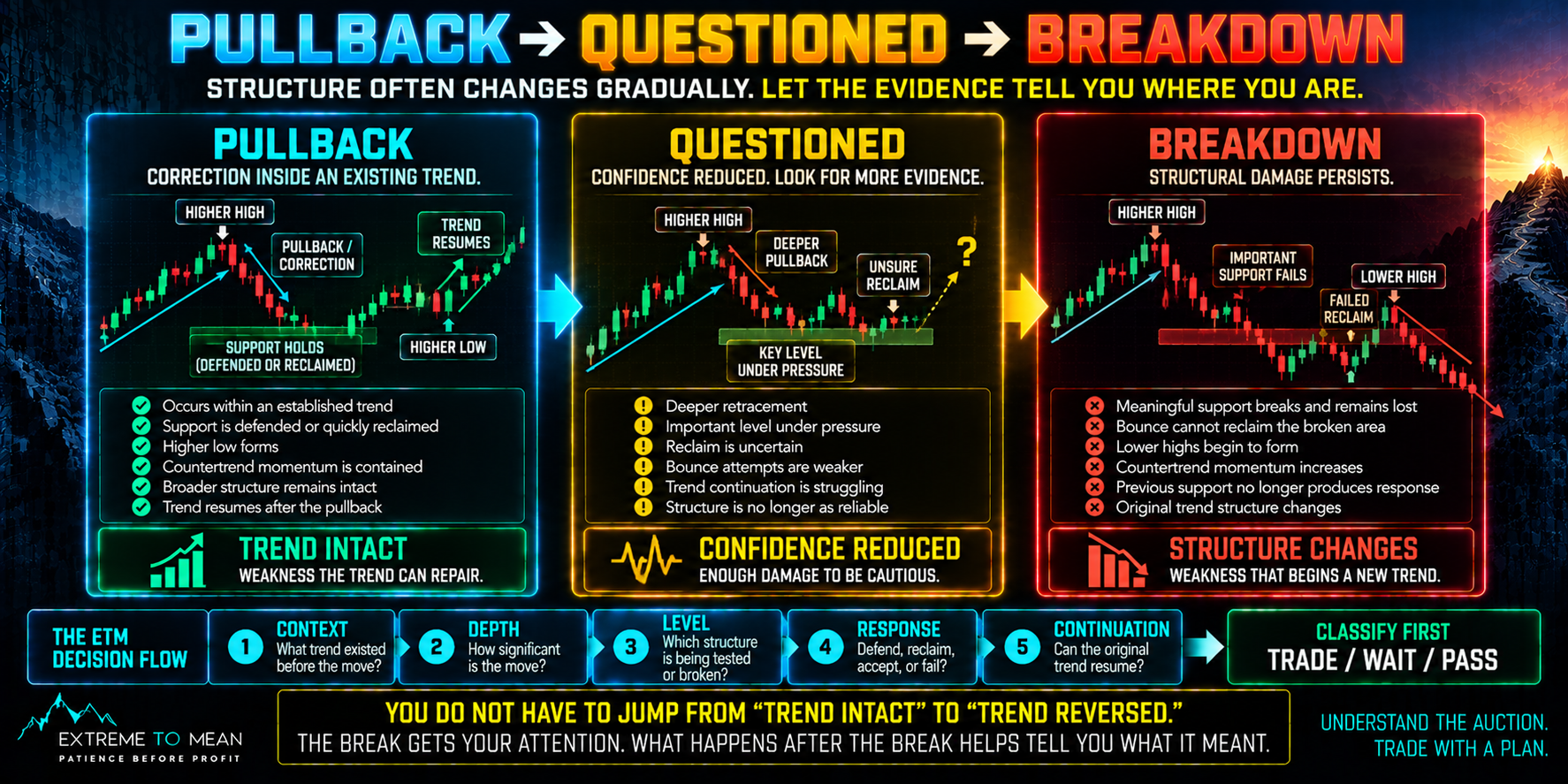
Traders often create unnecessary pressure by demanding one of two answers: still a pullback or definitely a breakdown. Real-time structure often spends meaningful time between those states, where enough damage has occurred to reduce confidence in continuation but not enough evidence exists to assume a new trend. That middle state deserves a name: QUESTIONED.
The progression can therefore be PULLBACK → QUESTIONED → BREAKDOWN. Pullback means the broader trend remains reasonably supported; questioned means meaningful evidence has deteriorated and continuation deserves less trust; breakdown means enough structural evidence has accumulated that the old trend thesis no longer deserves the same assumption of continuation. “I don’t know yet” is a legitimate structural read.
That middle state also prevents another common mistake: immediately reversing the directional thesis. When an uptrend loses important support, the first clean decision may simply be to stop assuming the next dip is a long opportunity. You can stop trusting the long before you have enough evidence to trust the short.
Avoid Both Traps: Buying Every Dip and Calling Every Dip a Reversal
One trap develops after a trend has rewarded dip buying repeatedly. Each correction has bounced, so the trader becomes conditioned to view deeper weakness as a better discount instead of asking whether the underlying structure has changed. The habit that worked during the trend can become the reason the trader misses the breakdown.
The opposite trap is declaring every uncomfortable correction a new trend. Several red candles, one minor support break, or a short burst of countertrend momentum can make the trader abandon the larger structure and immediately trade the other direction. Not every uncomfortable pullback is evidence of a new trend.
The cleaner process is patient in both directions. Do not keep buying simply because buying previous dips worked, and do not short simply because the newest pullback feels worse than the previous one. Let price show whether structural damage is being repaired or whether damage is beginning to accumulate faster than the trend can repair it.
Recognizing deterioration also does not create automatic trade permission. Even when a breakdown becomes increasingly likely, an actual trade still requires location, setup qualification, invalidation, risk, and enough room for the idea to make sense. If the trade is not ready until the risk is clear, correctly labeling the structure does not override that requirement.
One NQ Trend, Two Very Different Declines
Imagine NQ has been producing clear higher highs and higher lows through the morning. After a new session high, price begins falling and breaks a small short-term swing low, which makes Trader A immediately declare a breakdown and short. The broader support structure remains intact, price stabilizes, reclaims the minor break, forms a higher low, and resumes upward.
The first decline changed price, but it did not materially change the larger evidence. Short-term structure weakened temporarily while the broader trend absorbed the correction and repaired itself. What looked frightening on the first move became an ordinary pullback once the market demonstrated recovery and continuation.
Later, another decline develops. This time a meaningful prior structural low fails, selling remains firm through the area, and the next bounce stalls beneath the broken support instead of reclaiming it. The rebound forms a lower high, renewed selling pushes lower, and the evidence is now materially different.
The trader does not need to predict a new bear market. They simply need to stop calling every decline “another dip” when the trend is no longer repairing the damage in the same way. The first decline changed price; the second sequence changed the evidence.
A false breakdown can produce the opposite lesson. Price may trade sharply beneath support, look terrible for several minutes, then snap back above the area, hold the reclaim, and prevent sellers from regaining control. A breakdown that cannot stay broken deserves skepticism.
Pullback vs. Breakdown Comparison
No single row in this table should be treated as a mechanical signal. The classification comes from the weight of evidence, not from checking one box and declaring the answer.
| Question | Pullback-like evidence | Breakdown-like evidence |
|---|---|---|
| Prior trend | Still structurally healthy | Already weakening or failing |
| Depth | Manageable within context | Increasingly damages structure |
| Important levels | Defended or quickly reclaimed | Break and remain lost |
| Countertrend momentum | Corrective or contained | Expanding or persistent |
| Bounce quality | Reclaims and rebuilds | Weak and stalls below broken area |
| Trend continuation | Returns after correction | Repeatedly fails to return |
| Structure | Broad structure survives | Broad structure begins changing |
| Trader response | Monitor continuation | Reduce trust and reassess |
This comparison becomes especially useful when the first move against the trend is ambiguous. One red candle cannot tell you whether the trend can repair itself, but the combination of location, structural damage, response, reclaim behavior, bounce quality, and continuation begins creating a much stronger read. The goal is not perfect prediction; it is better classification as evidence accumulates.
The Pullback-or-Breakdown Check
When price begins moving against an established trend, ask:
- WHAT TREND STRUCTURE EXISTED BEFORE THE MOVE? — Was the trend genuinely healthy before the correction began?
- HOW DEEP IS THE CORRECTION RELATIVE TO NORMAL MOVEMENT? — Compare it with structure, volatility, and prior pullbacks rather than a fixed percentage.
- WHAT LEVEL ACTUALLY BROKE? — Minor structure or something genuinely important?
- WAS THE BROKEN AREA RECLAIMED? — Quick reclaim or sustained trade beyond it?
- HOW STRONG IS THE COUNTERTREND MOMENTUM? — Temporary pressure or expanding control?
- WHAT HAPPENS ON THE BOUNCE? — Can price repair the damaged structure?
- IS THE ORIGINAL TREND STILL PRODUCING CONTINUATION?
- WHICH TIMEFRAME AM I DESCRIBING?
Then classify:
PULLBACK / QUESTIONED / BREAKDOWN
The classification itself is market information, not a complete trading setup. If the evidence remains mixed, the correct answer can still be QUESTIONED, and the corresponding action can simply be to wait while the market reveals more. A trader does not improve decision quality by forcing certainty before enough evidence exists.
The ETM Context → Depth → Level → Response → Continuation Framework
Use this sequence:
- CONTEXT — What trend existed before the correction?
- DEPTH — How significant is the move relative to normal market behavior?
- LEVEL — What meaningful structure is being tested or broken?
- RESPONSE — Does price defend, reclaim, accept beyond the area, or fail to bounce?
- CONTINUATION — Can the original trend actually resume?
Then classify:
PULLBACK / QUESTIONED / BREAKDOWN
Only after that should the separate trading decision become:
TRADE / WAIT / PASS
Another useful way to think about the process is damage versus repair. Every pullback creates some amount of structural damage, and the trader's job is to see whether the original trend can repair that damage through defense, reclaim, and continuation. Breakdowns become clearer when structural damage accumulates faster than the trend can repair it.
If repeated losses or uncertainty are also making it difficult to define where a trade thesis is actually wrong, having unclear risk becomes a separate problem worth addressing. Structural classification tells you what may be happening in the market; it does not remove the need to know where your own idea fails. Market information and trade permission remain separate decisions.
Final Thought
A pullback and a breakdown usually do not announce themselves differently on the first move against the trend. Both can begin with a sharp correction, a broken minor level, or uncomfortable momentum, which is why reacting immediately to the first sign of weakness creates so many poor decisions. The distinction becomes clearer by asking what the move is doing to the structure around it.
Watch whether meaningful support is defended or quickly reclaimed, whether price can remain beyond a broken area, whether the bounce repairs the damage, and whether the original trend can still produce continuation. If important levels remain lost, recovery attempts weaken, and new countertrend structure begins developing, the evidence has changed. The break gets your attention; what happens afterward helps tell you what it meant.
Do not force the answer before the market gives you enough evidence. A pullback is weakness the trend can repair, while a breakdown is weakness that increasingly changes what the trend is. When the evidence sits between those two states, QUESTIONED is a perfectly valid place to wait.
Educational content only. Trading involves substantial risk and is not suitable for everyone.