
Trading can make inactivity feel like failure. You are watching the market, money is moving, and every minute without a position can create the feeling that you are wasting the session. But being flat is not automatically passive; sometimes it is the cleanest execution of the plan.
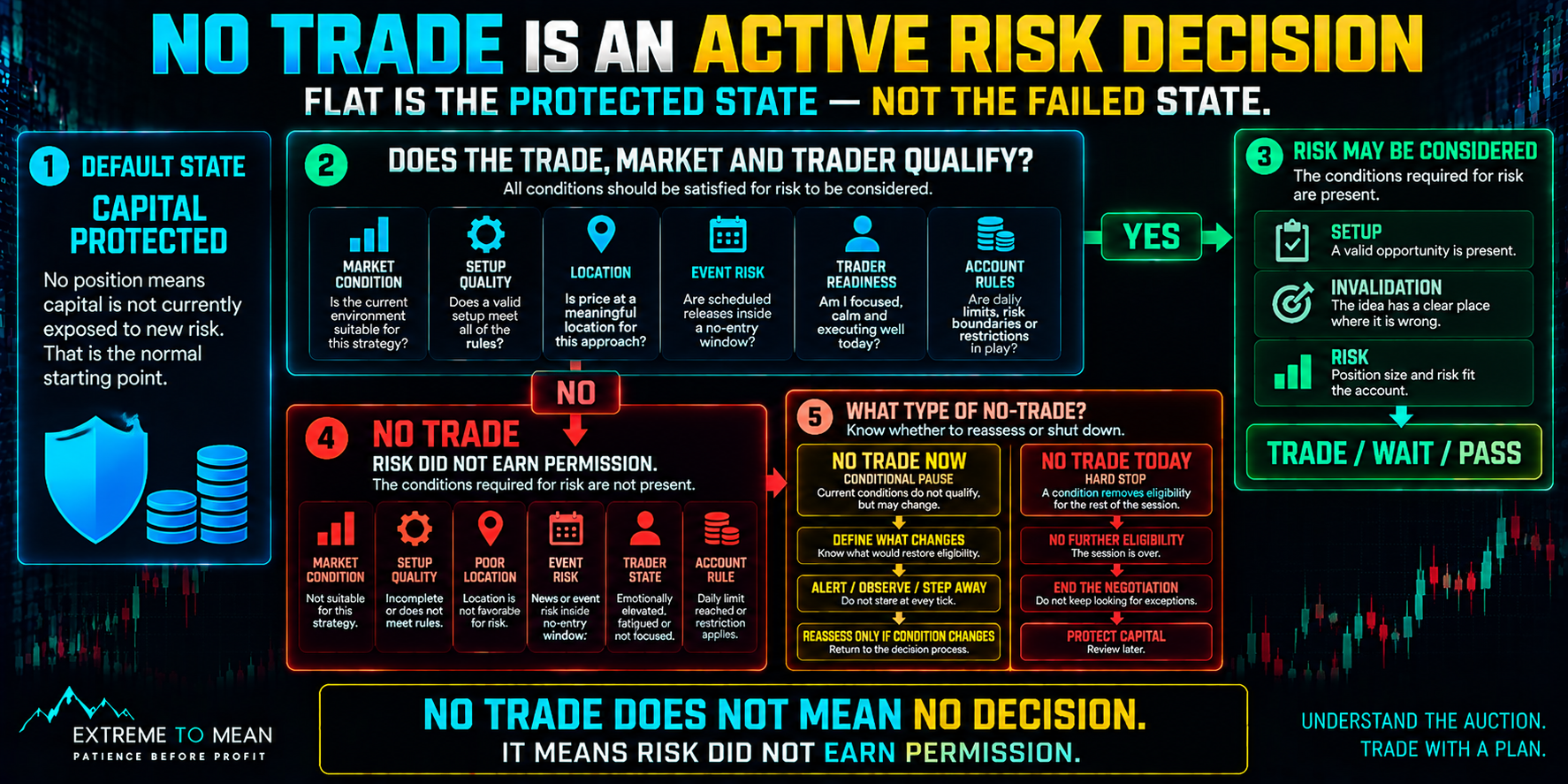
No trade does not mean no decision. It means risk did not earn permission.
A trader usually thinks of execution as BUY or SELL, but a complete decision process needs more outcomes than that. It should also be capable of producing WAIT, PASS, and sometimes DONE. If every analysis eventually becomes a trade, the process is not doing much filtering.
That distinction matters inside the broader Trader curriculum. The trader's job is not to stay active; it is to decide whether current conditions deserve capital. A decision process that cannot say no is not much of a decision process.
No Trade Is Still a Position on Risk
The default state of a trading account is capital not currently exposed to a new trade. A trader changes that state only after the market, setup, risk, and personal conditions satisfy whatever standards the process requires. Seen that way, entering a trade is not the default action; it is a deliberate decision to turn risk on.
That changes the meaning of staying flat. Instead of thinking, “I am not doing anything,” the trader can say, “I evaluated the opportunity and the conditions required for risk are not present.” Market condition, location, setup quality, scheduled events, account rules, or the trader's own readiness can all legitimately keep the risk gate closed.
This is closely related to why doing nothing can still be a trading decision, but P088 goes one step further. Once the process says NO TRADE, the trader still needs to know what that status means operationally. No position does not mean no process.
Why Doing Something Can Feel More Productive
Action creates visible evidence that something happened. You clicked, entered, managed, exited, and can point to a result, while staying flat may leave nothing more than a blank trade log. That makes activity feel productive even when the activity itself added no decision quality.
The market reinforces that feeling because price keeps moving whether you participate or not. A trader can watch a twenty-point rally while flat and begin thinking, “Why am I even here if I am not trading?” The emotional temptation is to convert movement into obligation.
The better question is not, “Should I be doing something?” Ask, “Has anything changed that actually makes risk appropriate?” If the answer is no, creating a position simply to feel involved does not make the session more productive.
No Trade Now Is Different From No Trade Today
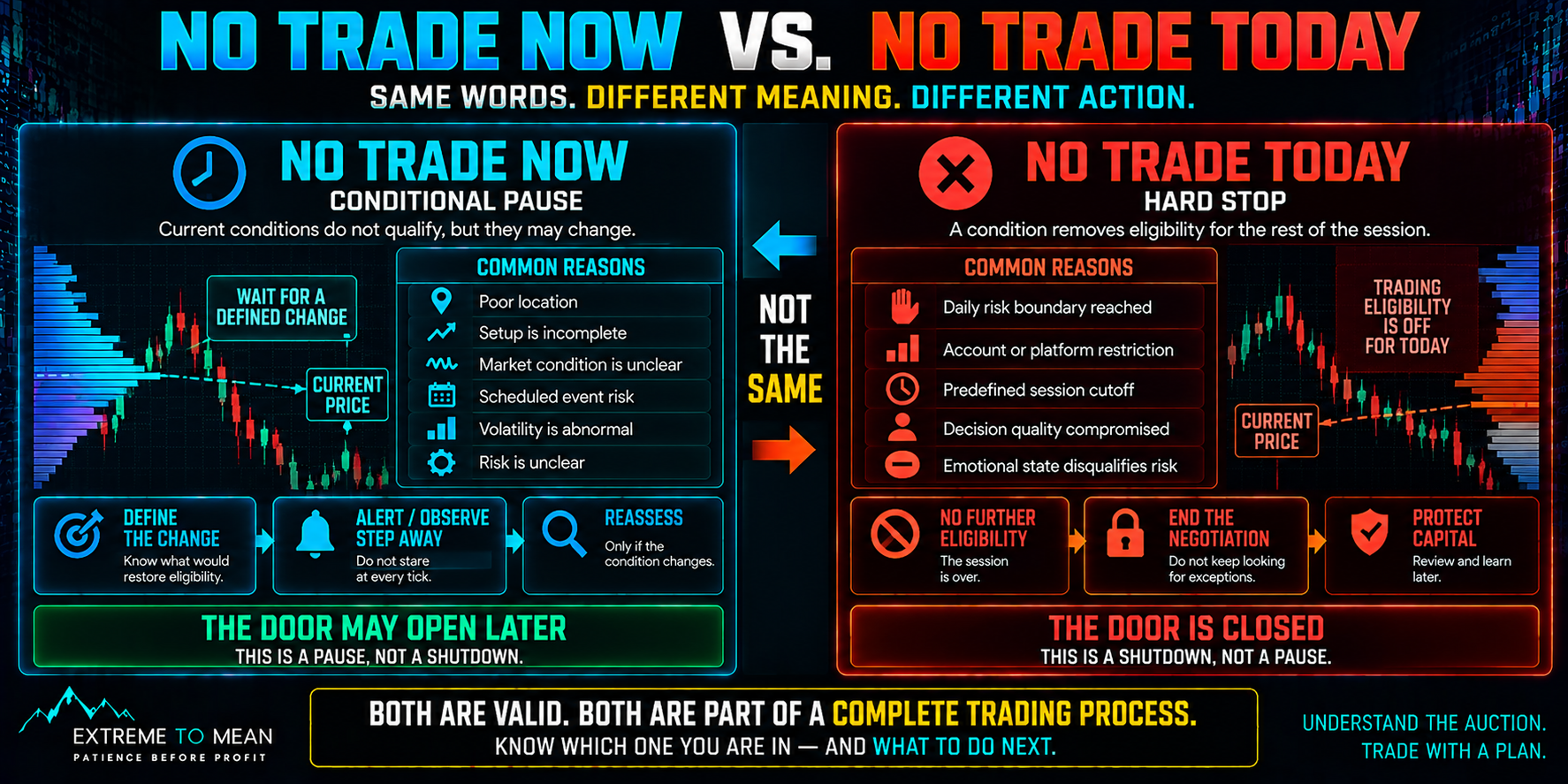
Some no-trade rules are temporary. NO TRADE NOW means current conditions do not qualify, but a defined change could make another look appropriate later. Poor location, an incomplete setup, approaching event risk, abnormal volatility, or unclear structure can all create a temporary pause.
Other rules close the door. NO TRADE TODAY means a hard stopping condition has removed eligibility for the rest of the session, perhaps because a daily risk boundary was reached, a predefined cutoff passed, an account restriction applies, or the trader's decision-making state has deteriorated enough that the plan requires shutdown. Those conditions are not invitations to keep checking every candle for an exception.
The distinction matters because indefinite waiting creates unnecessary internal negotiation. Some no-trade rules close the door. Others tell you when to check the door again. The trader should know which type has been triggered before deciding what to do next.
Give Every No-Trade Decision a Specific Reason
“I just don't like it” is usually not enough. A useful no-trade decision should be connected to a recognizable condition such as the risk is unclear, the market is too disorganized for this approach, a scheduled release is inside the no-entry window, or the account has already reached its stopping rule. The reason turns a vague feeling into a process decision.
A good practical habit is finishing the sentence: “I am not trading because ______.” The answer does not need to be complicated, but it should be specific enough that the trader knows what was disqualified. If the reason cannot be explained, it becomes difficult to distinguish discipline from hesitation or avoidance.
This is why a trading plan made before the open matters so much. Rules defined before urgency arrives are easier to follow than rules invented after a trade begins looking attractive. A no-trade rule should come from the process, not appear spontaneously whenever risk feels uncomfortable.
If the Condition Can Change, Know What Earns Another Look
A temporary no-trade rule is incomplete if the trader has no idea what would restore eligibility. Saying “conditions are unclear” may be accurate, but what would make them clearer? Price may need to reach meaningful location, leave the middle of a range, complete a setup, move past scheduled news, or produce structure that can actually be defined.
That gives the trader a reassessment condition rather than an endless stare at the screen. Set an alert, update the scenario, or step away until something material changes. If the condition can change, know what earns another look.
Active does not mean busy. Sometimes the correct action is literally to close the platform and walk away until the alert fires, because watching every tick adds nothing to the decision. The no-trade state remains active because the trader already knows what would justify returning.
A Winning Missed Trade Does Not Rewrite the Rule
The hardest no-trade rule to trust is often the one followed immediately before price moves exactly where you hoped. Suppose an NQ setup is rejected because one required condition is missing, and price then rallies seventy points. The natural reaction is, “See? I should have taken it.”
But the market outcome does not travel backward through time and repair missing qualification. If the rule was valid before the move, the later rally does not automatically make the earlier decision wrong. A trade does not retroactively qualify because price later moved in the direction you wanted.
This is where protecting your next decision becomes important. The purpose of a no-trade rule is not to identify which rejected trades will lose; some rejected trades will win beautifully. A no-trade rule is judged by whether it protected the standard—not whether the rejected trade later won.
Consider a morning when NQ spends forty minutes chopping in poor location without producing the trader's setup. The trader declares NO TRADE NOW, sets alerts near areas where the market could become relevant, and steps away; twenty minutes later NQ rallies sixty points without ever producing the planned setup. The rule did not keep the trader out of the market—it kept the trader out until the process had something worth evaluating.
Some No-Trade Rules Disqualify the Market; Others Disqualify the Trader
Not every no-trade decision is about market structure. Suppose a trader takes two impulsive trades, becomes angry, and notices they are actively trying to make the money back. Their predefined rule says that when revenge behavior appears, trading ends for the session.
Later, the market presents a beautiful setup and it wins without them. That does not make the shutdown wrong because the rule was not predicting whether the next setup would succeed. It was protecting the account from the trader's current decision-making state.
This distinction is useful because it broadens the idea of qualification. Sometimes the market does not qualify; sometimes the trader does not qualify; sometimes an account rule removes eligibility regardless of both. The correct question is always what condition caused risk to be turned off.
A Hard No-Trade Rule Should End the Negotiation
One of the purposes of a written rule is to remove repeated decision-making from the emotional moment. If the rule says no new trades after the daily stopping boundary, reaching that boundary should not begin an hour-long internal debate about whether the next setup looks unusually good. The decision was already made when the rule was written.
That is why hard stops and conditional pauses should feel different. A conditional pause says, “Wait for X and reassess.” A hard stop says, “Trading eligibility is over.”
The value of the rule is partly that you do not have to keep deciding the same thing under pressure. Constantly reopening a settled decision turns the rule into a suggestion and gives emotion another opportunity to negotiate. A hard no-trade rule should end the negotiation.
The ETM Active No-Trade Framework
When the process says NO TRADE, use five steps:
- DISQUALIFY — What currently makes risk inappropriate?
- CLASSIFY — Is this NO TRADE NOW or NO TRADE TODAY?
- DEFINE — If temporary, what exact change restores eligibility for review?
- ACT — Observe, set an alert, step away, or end the session.
- REASSESS — Only reconsider the trade when the condition actually changes.
Then the next output becomes TRADE / WAIT / PASS / DONE. A conditional pause might move from NO TRADE → ELIGIBLE TO DECIDE once the market reaches better location or an incomplete setup finishes forming. A hard stop remains DONE unless the rule itself explicitly says otherwise.
A useful review question after price moves without you is: “Did the disqualifying condition actually change, or did the outcome simply make me dislike the rule?” That question keeps hindsight from silently lowering tomorrow's standard. If a missed move creates pressure to manufacture a new opportunity, trading too much can quickly replace deliberate risk deployment.
Final Thought
A no-trade rule is not punishment, and it is not an admission that you do not know what to do. It is one of the outputs a complete trading process must be able to produce when the conditions required for risk are not present. Know why risk is off, know whether the restriction is temporary or final, and know exactly what would justify another look when reassessment is appropriate.
Then stop negotiating with a rule that has already made the decision. Trading is not measured by how often you put a position on, and flat is not a failed state waiting to be corrected. Sometimes the cleanest execution of the plan is keeping capital exactly where it is.
Educational content only. Trading involves substantial risk and is not suitable for everyone.