
A directional bias can make trading easier because it narrows what deserves attention. The problem begins when “I currently favor higher prices” quietly becomes “the market is going higher.” One is a working read built from evidence; the other can become a prediction the trader feels obligated to defend.
A useful bias organizes evidence. A married bias argues with evidence.
A trading bias should be provisional: given the structure, context, and information available now, one direction currently appears more plausible than another. That view can help the trader prepare scenarios and focus attention, but it should remain subordinate to whatever the market shows next. Bias should help you prepare for the market—not require the market to cooperate with your preparation.
That distinction belongs inside the broader Trader curriculum because the goal is not to trade without opinions. Traders can make legitimate directional assessments, sometimes with strong supporting evidence. The discipline is to hold conviction in proportion to that evidence and remain willing to update when the evidence changes.
A Trading Bias Is a Working Read, Not a Promise
Suppose your current bias is bullish. Ideally, that means the market's structure and context currently favor higher-price scenarios, so qualified longs deserve more attention than they otherwise would. It does not mean every dip is a buy, price must eventually rally, or contradictory evidence can be ignored until the original thesis comes back.
A bias tells you what currently seems more plausible. It does not tell you what must happen. That keeps directional analysis probabilistic rather than turning it into a forecast the trader is emotionally required to defend.
This article uses bias to mean a market-direction working hypothesis. That is different from cognitive bias, which refers more broadly to psychological tendencies that can distort judgment. A directional view does not automatically create a cognitive error; the problem begins when the trader becomes unable to test or update the view honestly.
Use Bias to Guide Attention—Not Grant Permission
A bullish bias can tell you to watch favorable long locations, continuation scenarios, constructive pullbacks, or evidence that buyers remain in control. That can make preparation more efficient because the trader is not treating every theoretical outcome as equally likely. But bullish bias does not equal long signal.
An actual trade still has to earn risk through context, location, setup quality, qualification, invalidation, and acceptable risk. The directional read is one input in that process rather than a substitute for the rest of it. Bias can tell you what to look for. It cannot tell you that what you are looking for has arrived.
This is closely related to how market conditions change the quality of a setup. A trader may have a legitimate bullish read while the available long entry is poorly located, already extended, or structurally incomplete. Being right about direction does not make every trade in that direction correct.
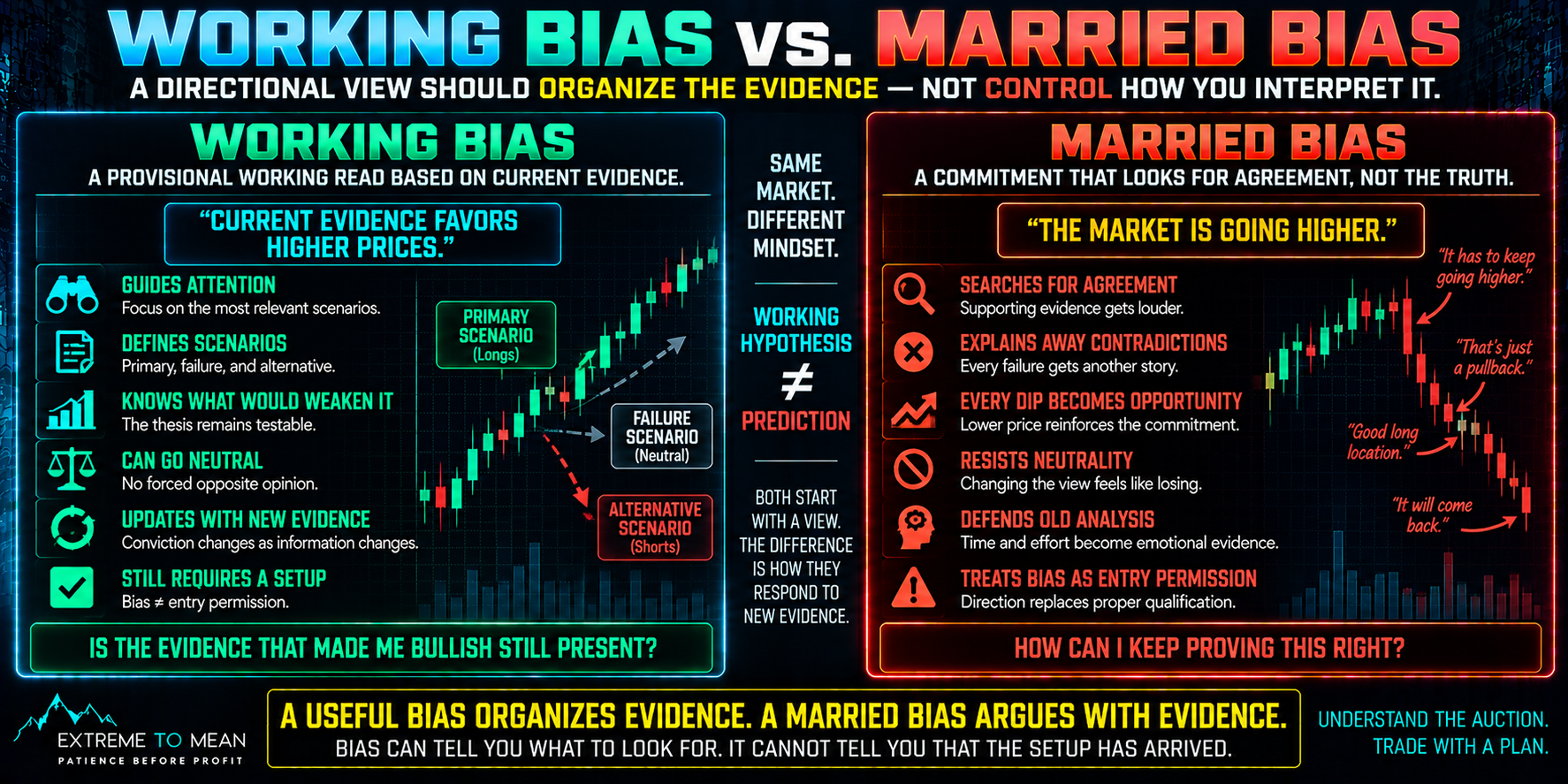
The Problem Starts When the Bias Becomes Yours to Defend
There is a meaningful difference between “I am currently bullish” and “I am a bull today.” The first describes the evidence as you currently understand it; the second can begin to describe commitment or identity. Once the view feels personally owned, contradictory price action becomes harder to treat as neutral information.
The trader starts translating every development back into the original story. A rally is strength, a selloff is a healthy pullback, a support break is a stop hunt, and a second support break is a deeper shakeout. At some point, every possible market outcome has become evidence for the same thesis.
That is where the working hypothesis stops being testable. If every price move confirms your bias, your bias has stopped being falsifiable. Protecting your next decision sometimes means allowing the old directional story to expire before it begins controlling every new observation.
Every Bias Needs Evidence That Could Weaken It
It is not enough to know what supports your bias. A trader should also know what would make the view less useful: structure changing, an important location failing, expected continuation repeatedly failing, acceptance developing the other way, or broader context changing. The exact criteria depend on the strategy, but the principle does not.
If you cannot explain what would change your bias, you do not have a working hypothesis. You have a belief. That does not mean one red candle should erase a bullish thesis or one green candle should erase a bearish one. It means the evidence that created the view should also provide a way to recognize when that view has materially weakened.
Premarket analysis deserves special caution here because effort itself can create attachment. You may have spent an hour studying overnight action, drawing levels, and writing bullish scenarios before the opening bell, but the regular session is free to produce different information. Premarket work should prepare you to respond—not obligate the regular session to follow your script.
The same principle applies to time already invested in a thesis. Several trades, an hour of analysis, or even publicly discussing the idea does not strengthen the market evidence supporting it. The market does not owe your thesis extra time because you spent extra time building it.
You Can Stop Being Bullish Without Becoming Bearish
Many traders treat directional bias as a switch with only two settings: bullish or bearish. That false binary makes updating difficult because abandoning one view feels as though it requires immediately embracing the opposite one. In reality, neutral is a legitimate market state.
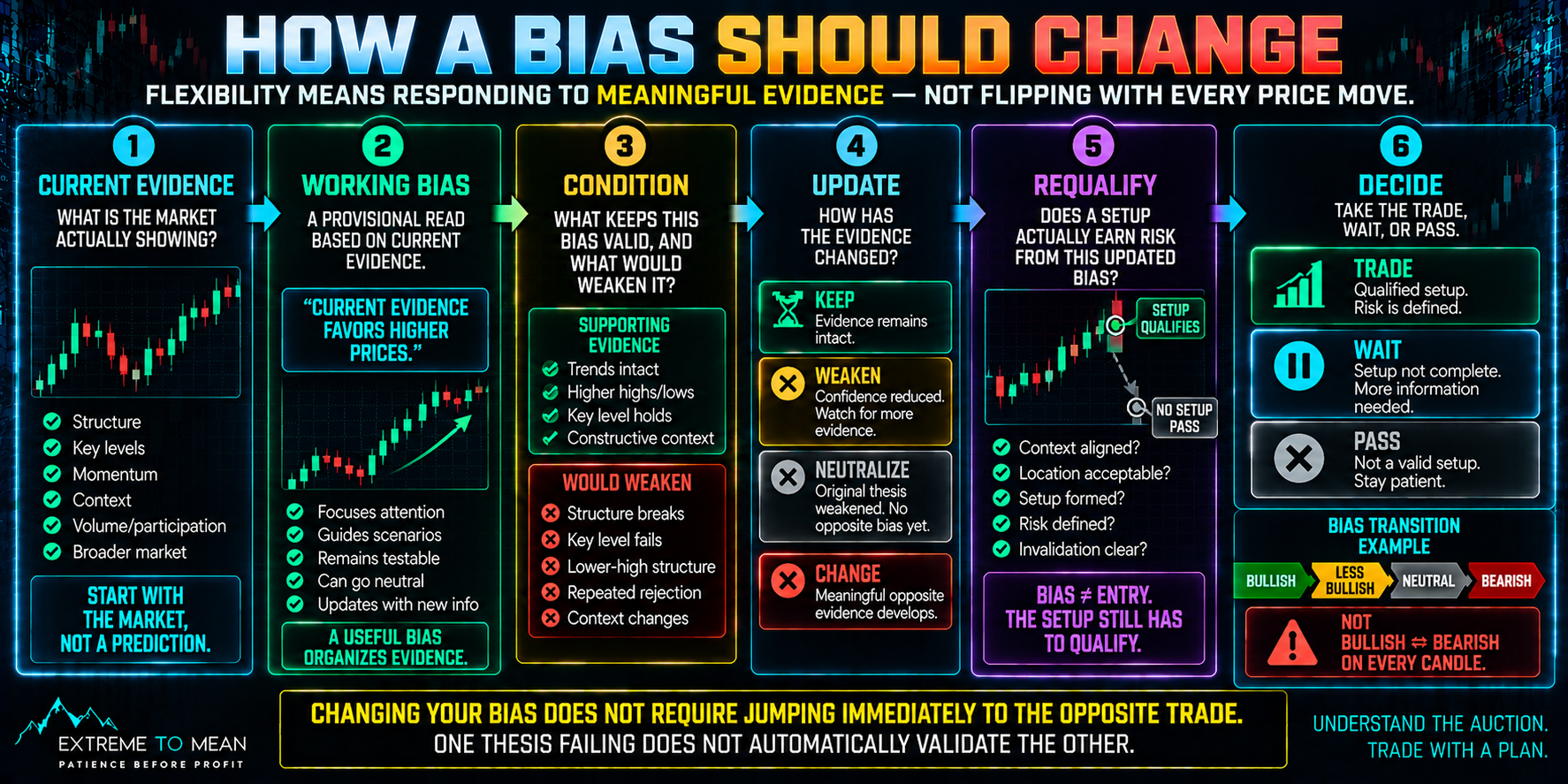
A more realistic progression may be BULLISH → LESS BULLISH → NEUTRAL → BEARISH as evidence develops. The old bullish thesis can weaken before a bearish thesis has earned support of its own. You can stop being bullish without becoming bearish.
This matters because one thesis failing does not automatically validate the opposite thesis. A failed support area may tell the trader to stop prioritizing longs under the old idea, but the short side still needs context, location, setup, invalidation, and risk. The market can invalidate your bias without giving you a trade.
Neutral does not mean indecisive or fearful. Sometimes structure is mixed, the market is transitioning, or the old thesis has failed while the next directional read is not yet established. Not knowing the direction is sometimes the most accurate directional read available.
Confirmation Bias Can Turn Every Move Into the Same Story
Once a preferred view exists, supporting evidence can become easier to notice while contradictory evidence receives increasingly creative explanations. This is one way confirmation bias can appear in trading, although having a market bias does not guarantee that this distortion will occur. The warning sign is not conviction itself; it is the loss of a meaningful way for the thesis to be wrong.
Imagine a bullish trader watching support fail repeatedly. The first failure is called noise, the second a stop hunt, the third an even better long location, and every lower price becomes another reason the market should soon rally. The market is no longer informing the thesis; the thesis is deciding how every market event must be interpreted.
Good bias narrows the decision tree. Bad bias deletes every branch except the one you want. A better preparation model keeps a primary scenario, a failure scenario, and an alternative scenario alive. Bias simplifies attention without pretending that alternative outcomes have stopped existing.
Responsive Does Not Mean Reactive
Flexibility does not mean changing your directional opinion every few minutes. A trader who flips bullish on one green candle, bearish on the next red candle, and bullish again because P&L improved is not updating from meaningful evidence. The goal is responsive, not reactive.
Bias should change because the evidence supporting it materially changed, not because one candle was uncomfortable or another trader posted a different opinion. Flexibility means responding to meaningful evidence—not surrendering your view to every price fluctuation. Updating a bias does not require replacing one certainty with another.
This is where a trading plan made before the open can help. Defining the reasons for your initial thesis, the evidence that would weaken it, and the conditions that would make you neutral reduces the temptation to improvise a new directional story every time price moves. The plan does not freeze the bias; it defines how the bias is allowed to evolve.
Trader A Marries the Bias; Trader B Uses It
Imagine NQ enters the session with constructive overnight structure and broader context that supports higher prices. Both traders begin with the same reasonable bullish working bias and plan to favor qualified long scenarios while the evidence supporting that read remains intact. Price initially pushes higher, so the bias continues doing its job.
Then continuation repeatedly fails, important structure begins deteriorating, and the market starts accepting lower prices. Trader A says, “This is just a deeper pullback,” then “Great long location,” and eventually “Even better price.” Every bearish development becomes a reason to stay bullish, and several weak long attempts follow.
Trader B asks a different question: “Is the evidence that made me bullish still present?” As that evidence deteriorates, the bias moves from bullish to neutral, and Trader B stops prioritizing longs without immediately taking a short. If sufficient bearish evidence later develops and a qualified short eventually earns risk, that trade can be evaluated then; otherwise, no trade may occur.
The distinction is simple: Trader B used the bias until the market stopped supporting it. Trader A used the market to keep supporting the bias. That is the difference between directional preparation and directional attachment.
A second example shows why directional correctness is not enough. A trader can be bullish for the day, take two premature longs from poor location, lose twice, and then watch the market rally one hundred points. The bias may have been correct while the trades were still poor because directional correctness cannot rescue weak execution.
The opposite can happen as well. A reasonable bullish bias can produce a fully qualified long, the market can later change, and the trade can stop out before the session ultimately becomes bearish. A bias can become wrong without having been unreasonable when it was formed.
The Bias Update Test
When a directional view has been in place for a while, ask:
- WHAT MADE ME BULLISH OR BEARISH IN THE FIRST PLACE? — State the actual evidence.
- IS THAT EVIDENCE STILL PRESENT? — Not “Do I still feel bullish?”
- WHAT HAS CHANGED? — Identify new information.
- WHAT WOULD MAKE ME WEAKEN THE BIAS?
- WHAT WOULD MAKE ME GO NEUTRAL?
- WHAT WOULD IT TAKE TO FAVOR THE OPPOSITE DIRECTION? — Failure of the old thesis alone may not be enough.
- AM I EXPLAINING AWAY CONTRADICTORY EVIDENCE?
- IF I HAD JUST OPENED THE CHART RIGHT NOW, WOULD I FORM THE SAME BIAS?
The final question is especially powerful because it strips away sunk analysis, prior trades, old predictions, and the desire to recover from an existing position. It forces the trader to evaluate the current market rather than the history of their relationship with the idea. If the fresh read would be different, the existing bias deserves review.
The ETM Read → Bias → Condition → Update → Qualify Framework
Use this sequence:
- READ — What is the market currently showing?
- BIAS — What direction, if any, does that evidence currently favor?
- CONDITION — What keeps that bias valid, and what would weaken it?
- UPDATE — As new information arrives, choose KEEP / WEAKEN / NEUTRALIZE / CHANGE.
- QUALIFY — Only after the updated bias, ask whether an actual setup earns risk.
Then the trade decision remains:
TRADE / WAIT / PASS
Bias has a useful job description. It can organize attention, prioritize scenarios, frame questions, and improve preparation; it cannot guarantee direction, excuse weak setups, override invalidation, ignore new information, or dictate entry. Bias is an assistant to the decision—not the boss of the decision.
If capital is already attached to the bias, updating becomes harder because changing the view may imply closing a losing position. That is one reason clear invalidation matters, but P095 is not a stop-placement lesson. The broader point is that observation and defense become harder to separate once money is involved, so unclear risk makes directional attachment even more difficult to manage.
Final Thought
A market bias can be useful. It can organize what you see, focus preparation, prioritize scenarios, and help you avoid treating every possible direction as equally likely. The goal is not to erase directional judgment; it is to keep that judgment provisional, evidence-based, and updateable.
Know why you are bullish or bearish, and know what evidence would make that view weaker. Let neutral be a legitimate answer when the original thesis has failed but the opposite one has not yet earned support. Changing your bias is not inconsistency when the evidence changed first.
Most importantly, keep the market in charge of the update. A useful bias organizes evidence. A married bias argues with evidence. Hold the opinion loosely enough that the market is still allowed to teach you something.
Educational content only. Trading involves substantial risk and is not suitable for everyone.