
Traders usually notice the attractive part of a setup first. Price reaches an interesting area, a candle forms, momentum shifts, or the market begins moving in the direction they expected. The opportunity feels visible, so attention naturally moves toward where price could go and how much the trade might make.
The harder question is where the idea stops making sense. Traders often postpone that question because defining invalidation introduces doubt at the exact moment they want confidence. It forces them to accept that the setup may fail, even when the chart appears ready to move.
Risk does not become clearer after entry; in most cases, it becomes more emotional. The broader setup and risk lessons are built around a simple principle: a trade must be evaluated as a complete decision. Location, confirmation, direction, and target all matter, but none of them can replace a clear answer to the question, “Where is this idea wrong?”
A Setup Is More Than a Reason to Enter
A signal gives the trader a possible reason to act, while a setup organizes the complete logic of the trade. That distinction matters because traders often call something a setup when they have only identified one favorable condition, such as support, a moving-average turn, a reversal candle, an oversold reading, a breakout, or a directional bias. Each observation may deserve attention, but none defines the complete decision by itself.
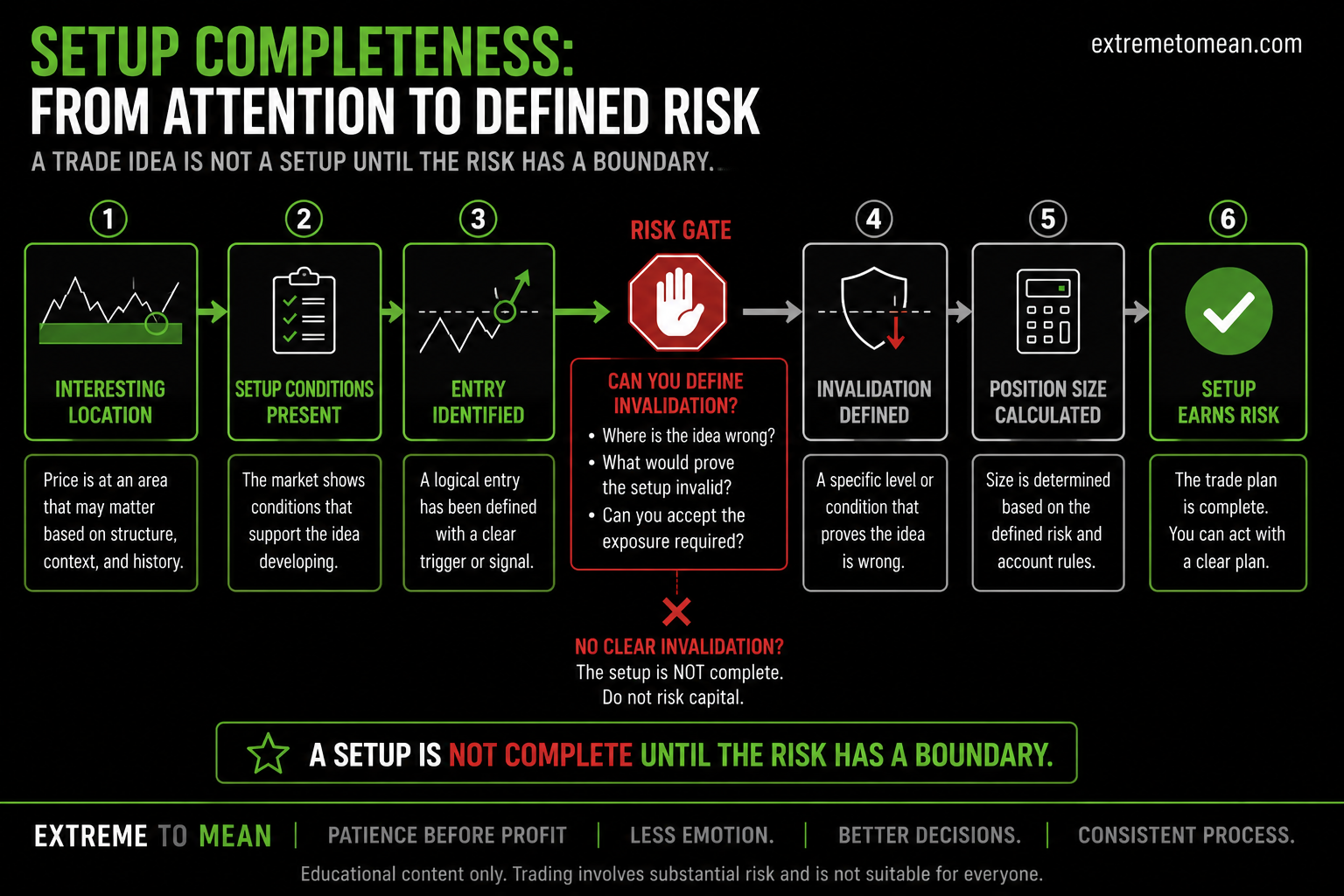
A qualified setup should explain why the location matters, what market condition surrounds it, what behavior would confirm the idea, where the entry makes sense, and where price could reasonably travel. It must also define what would invalidate the idea and how much exposure the trader can accept if that invalidation occurs. Until those elements work together, the trader has an interesting observation rather than a trade-ready plan.
Without invalidation, the setup has no boundary. The trader knows why they want to enter, but not what would require them to leave. That is why a setup is not a signal: a signal may begin the evaluation, but the complete structure of the decision determines whether the idea has earned risk.
Invalidation Comes Before Stop Placement
Invalidation is the market condition that tells the trader the original trade idea is no longer valid. A stop loss is the order or exit mechanism used to act on that conclusion. The two are connected, but they are not identical, and confusing them often leads to stops that reflect discomfort instead of market logic.
Imagine a trader considering a long trade because price has reached meaningful support and buyers are beginning to respond. The invalidation may be a decisive break below that support, a failure of the expected reaction, or a structural change showing that sellers remain in control. The stop should then be placed according to that logic, with enough room for ordinary volatility rather than at an arbitrary dollar amount chosen only because it feels comfortable.
Most invalidation conditions fall into a few practical categories:
- Price invalidation: Price moves beyond a structural level the setup required to hold.
- Behavioral invalidation: The expected response fails to appear, or the opposing side continues showing control.
- Structural invalidation: The sequence of highs, lows, support, resistance, or trend behavior changes against the trade.
- Time invalidation: The expected move does not develop within the period that made the opportunity relevant.
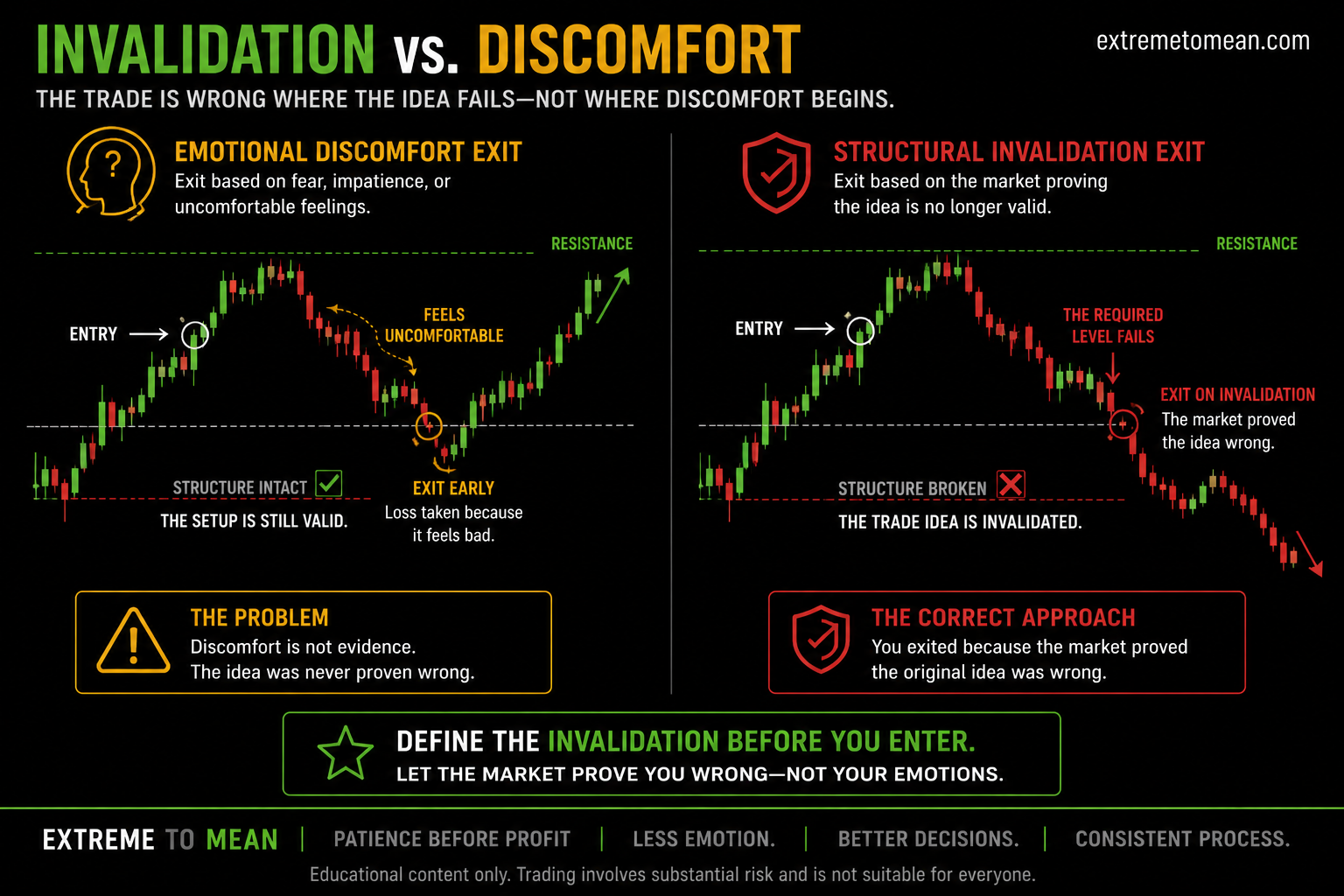
Not every trade needs all four forms of invalidation, but the trader should know which one matters before entering. A stop placed without that logic is often just a pain threshold. It tells the trader where the loss becomes uncomfortable, not where the market has disproved the idea.
Why Traders Postpone the Risk Decision
Waiting to define risk until after entry can feel reasonable in the moment, especially when price is moving quickly. The trader may believe that pausing to calculate exposure will cause them to miss the trade, so they plan to “see how it reacts” after entering or assume they can exit manually if the market turns. A small position can create the same false comfort because the trader assumes the exact invalidation point matters less when the exposure appears limited.
Bias makes the problem worse. Once a trader has decided that price should move higher or lower, defining invalidation can feel like arguing against the idea. Instead of asking what would prove the trade wrong, the trader begins searching for more reasons it could still work.
The mistake is understandable because entry creates the possibility of reward, while invalidation introduces the possibility of loss. Ignoring that second possibility does not remove it; it only removes the plan for handling it. When risk is still undefined after entry, the trader must make the decision while watching open profit and loss change, and the answer becomes influenced by fear, hope, urgency, and the desire to avoid being wrong.
Undefined Risk Changes the Entire Trade
Risk is not a separate detail added after the setup is found because it affects every other part of the decision. Without a clear invalidation point, the trader cannot determine position size correctly. A position that appears reasonable with a five-point stop may be completely inappropriate if the market structure actually requires fifteen points of room.
The target also becomes difficult to evaluate. A trade may appear to offer an attractive reward, but that comparison means little when the potential loss has not been defined. The stop may then be placed too close to reduce the dollar loss, pushed too far away to avoid exiting, or changed repeatedly as price moves against the position.
Undefined risk also encourages traders to choose size before understanding the required stop distance, add to a losing position without recalculating total exposure, or allow a quick setup to become an unplanned longer-term hold. The trader may eventually be correct about direction, but that does not make the original decision well structured. Being right later cannot make earlier exposure acceptable.
This is why location is the first filter, but not the last. Better location can create clearer invalidation and cleaner trade structure, yet the trader must still convert that location into a defined plan. Good analysis cannot repair an exposure decision that was never completed.
The Market Decides Whether the Idea Is Wrong
A trader should not exit merely because normal price movement feels uncomfortable, but discomfort should not become an excuse to ignore structural failure. The goal is to separate emotion from evidence. Statements such as “I cannot watch this loss get larger,” “I will give it a little more room,” or “I will exit when I get back to breakeven” describe the trader’s changing feelings rather than the market’s behavior.
Structural invalidation sounds different because it is tied to the original setup. The trader may conclude that a prior low failed to hold, the expected buyer response never appeared, price accepted below a range instead of rejecting it, or a pullback became a breakdown. In each case, the exit decision comes from the logic of the trade rather than from a shifting emotional threshold.
This does not mean every structural stop will produce a perfect exit. Markets can move quickly, gaps can occur, and actual fills may differ from the requested price. A stop is a risk tool, not a guarantee of an exact outcome.
Defining risk means creating a reasonable boundary and planning exposure around it. It does not mean the market has agreed to honor that boundary perfectly. The trader’s responsibility is to decide in advance what evidence ends the idea and how much capital can be placed at risk before that evidence appears.
A Better Pre-Trade Risk Filter
Before entering, the trader should be able to explain the complete decision without relying on a complicated story. The following questions create a practical filter because they connect the setup, invalidation, position size, and target before the open position introduces pressure:
- What exactly is the trade idea? State the location, expected behavior, and reason the opportunity deserves attention in one or two clear sentences.
- What specific evidence would prove the idea wrong? Identify the price level, failed reaction, structural change, or time condition that invalidates the trade.
- Is the invalidation based on the market or on my comfort? Emotional discomfort should influence position size, not rewrite the setup after entry.
- How far is the entry from invalidation? That distance determines potential loss and whether the trade offers acceptable structure.
- What position size keeps the planned exposure acceptable? Size should be chosen after the entry and invalidation are understood, not before.
- Does the potential target justify the structure? The target should be realistic and leave enough room before opposing structure becomes a likely obstacle.
- What will I do if the trade behaves differently than expected? Decide in advance whether the plan allows an early exit, partial exit, stop adjustment, or no intervention.
The better question is not simply how much the trade could make. It is whether the trader knows what would have to happen for the setup to become invalid and whether the exposure required to reach that conclusion is acceptable. That shift in framing is the same one behind learning how better questions produce better trades in general.
What would have to happen for me to admit that this setup is no longer valid, and can I accept the exposure required to reach that conclusion?
When that answer is unclear, the setup may deserve more observation, but it does not yet deserve risk.
Risk Clarity Makes the Decision Cleaner
Defining risk does not make a trade safe, predictable, or certain; it makes the decision complete. The trader enters knowing what the market must continue doing for the idea to remain valid, while position size reflects the distance to invalidation and the target can be judged against a real risk boundary. Trade management begins from a plan instead of from emotion.
This clarity also makes it easier to accept a loss when the setup fails. The loss may still be disappointing, but it was connected to a known condition rather than a decision invented under pressure. That separation helps the trader review the execution honestly instead of confusing a losing outcome with a poor process.
Clear risk protects more than the current position. It helps protect the trader’s next decision by reducing the confusion, frustration, and emotional spillover caused by unmanaged exposure. A defined loss can be processed; an improvised loss often follows the trader into the next trade.
For the complete framework connecting invalidation, stop placement, and position size, see risk-first trading.
Final Thought
A setup is incomplete when it explains why to enter but not why to exit. Location may make the idea interesting, a signal may improve timing, and bias may provide a directional framework, but none of those answers where the market proves the trade wrong.
Risk definition is not paperwork added after the opportunity is found. It is part of the opportunity’s qualification. Before taking the trade, define the invalidation, calculate the exposure, and decide whether the structure is acceptable.
When that cannot be done clearly, the cleaner decision is to wait. Traders who struggle to establish that boundary can begin with the guidance on having unclear risk before placing capital behind another incomplete setup.
Educational content only. Trading involves substantial risk and is not suitable for everyone.