
Wait for the setup to finish forming explains why recognizing a setup beginning is not yet enough to justify risk.
Many traders get into trouble because they confuse recognition with permission. They see a pattern, a candle, a pullback, a moving average touch, a breakout, a divergence, or a reversion idea, and they treat that setup as if it is telling them to act immediately. The chart appears to be giving them something familiar, so the decision feels justified.
That is where the mistake begins.
A setup is not a signal by itself. A setup is only one piece of information. It tells the trader that something may be worth watching, not that a trade must be taken. The difference is important because most poor trades do not come from total randomness. They often come from taking a valid idea in the wrong place, without enough structure, or with risk that does not make sense.
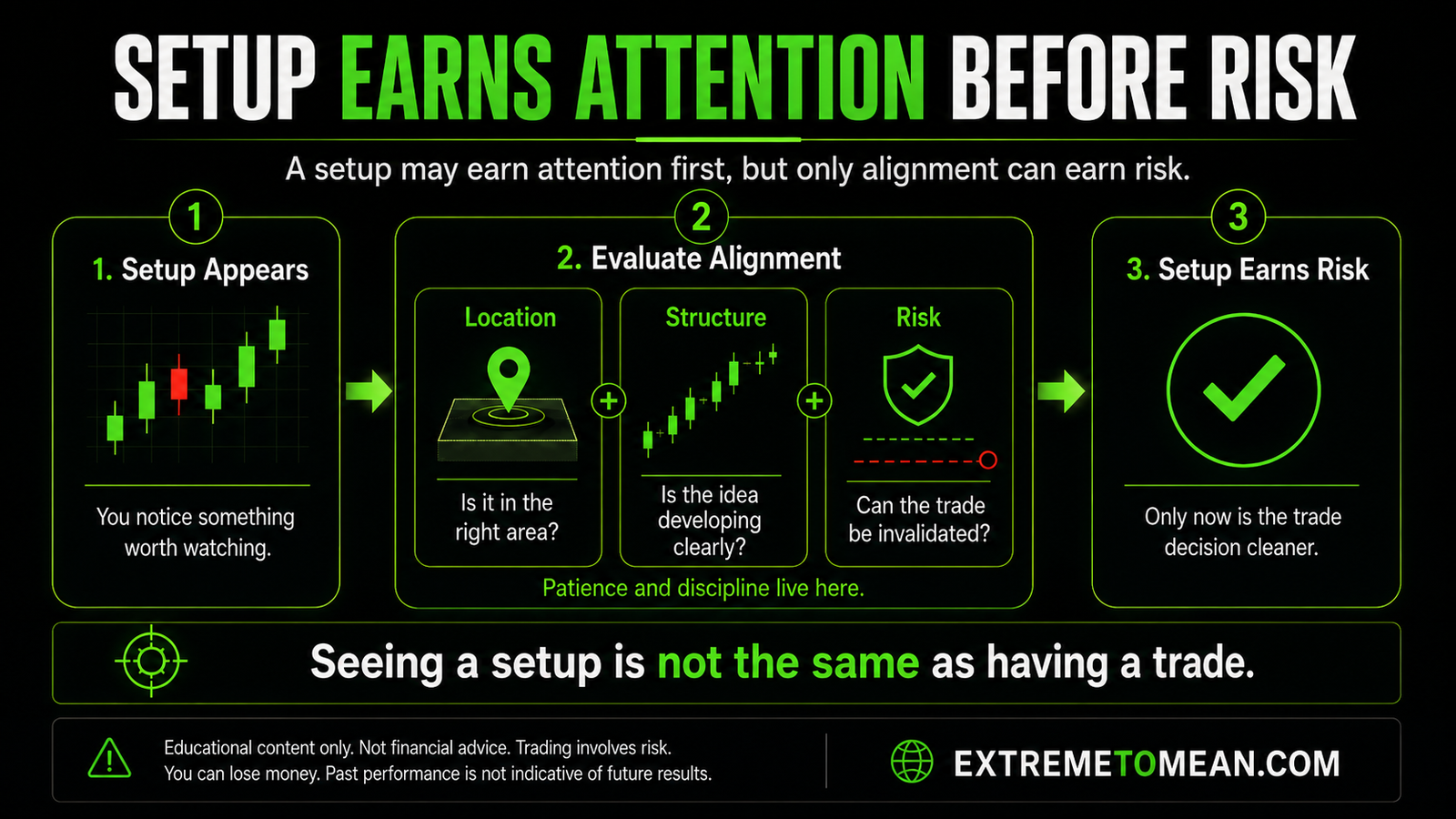
This is where patience comes in. Patience is not sitting on your hands because you are afraid. It is waiting until the trade has enough pieces in alignment to support a cleaner decision. Discipline is not forcing yourself to be inactive forever. Discipline is knowing the difference between “I see something” and “this has earned risk.”
At Extreme to Mean, this distinction matters because better trading is built on process, not prediction. The setup and risk lessons reinforce the same goal: evaluate whether the conditions in front of you are clean enough to justify a decision.
A Setup Only Earns Attention First
A setup is simply a recognizable condition on the chart. It might be a pullback into a moving average, a price extension into a reversion zone, a break of structure, a retest, a reversal candle, or a liquidity sweep. These things matter because they help organize what the trader is seeing.
But recognition is not execution.
A setup first earns attention. That means the trader becomes alert, starts observing more closely, and asks better questions. It does not mean the trader clicks immediately. When a setup appears, the job is to evaluate whether the broader conditions support the idea.
This is one of the hardest lessons for developing traders because setups are easy to see after they form. A candle closes. A level breaks. Price tags a zone. An indicator flashes. The trader feels like the market has finally provided something actionable. In that moment, waiting can feel like hesitation.
But waiting is often the disciplined action.
The trader who waits is not ignoring the setup. They are asking whether the setup has enough support around it. Where is price located? What structure has formed? Where would the trade be wrong? Is the entry close enough to the idea, or has price already moved too far? Is the trader responding to the chart, or reacting to pressure?
A setup that only earns attention can still become a trade later. It may need confirmation that answers a specific missing question. It may need a better entry. It may need price to return to structure. It may need the trader to pass completely because the risk is not clean. That is not indecision. That is process.
Location Gives the Setup Meaning
The same setup can mean very different things depending on where it appears. A reversal candle near an extreme may deserve attention. The same candle in the middle of a range may be less useful. A breakout from a tight base may be cleaner than a breakout after a long emotional push. A pullback into structure may be different from a pullback into random noise. That is how market context changes what a setup actually means.
Location is the first filter because it gives the setup meaning.
This is why traders cannot evaluate setups in isolation. A candle pattern is not automatically bullish or bearish. A moving average touch is not automatically an entry. A support or resistance level is not automatically a trade. That is why context comes before the candle: it determines whether the setup is appearing in a place where the decision can be more clearly defined.
For Extreme to Mean, location is especially important because the brand’s core teaching is built around understanding where price is trading relative to extremes, means, and structure. A trader should care not only that a setup exists, but where it exists. A setup near an important area can create a cleaner decision because the trader has something to measure against.
For example, if price is stretched far from a short-term mean and begins to stall near a known level, that may be useful information. If price pulls back toward a structured area after a directional move and holds, that may also be useful. But if price is sitting in the middle of a messy range, far from a clear level, and the trader is only seeing a candle pattern, the decision may be weaker. This is why where you enter matters more than what you predict.
The better question is not, “Do I see a setup?”
The better question is, “Is this setup appearing in a location where the trade idea can be clearly evaluated?”
That question slows the trader down. It forces the trader to consider the map before acting on the signal. Without location, a setup can become a reason to force action. With location, the setup becomes part of a larger decision.
Structure Tells You Whether the Idea Is Developing
Location tells you where the setup is happening. Structure tells you whether the idea is actually developing.
Structure is the way price organizes itself around an area. It can show up through higher lows, lower highs, compression, failed breakdowns, failed breakouts, retests, rejection, consolidation, or controlled rotation. Structure does not guarantee anything, but it gives the trader something more useful than a single candle.
Many traders enter too early because they see the first sign of a possible move and assume the rest will follow. A market taps a level, prints a reversal candle, and they enter. A breakout occurs, and they jump in. A pullback touches a moving average, and they assume the trend will continue.
Sometimes that works. Often, it creates unnecessary stress because the idea has not fully developed yet.
Structure helps separate a developing trade from a random reaction. If price pushes into a level and immediately rejects, that is information. If price rejects, retests, and fails to reclaim the area, that may be stronger information. If price pulls back into a zone and starts forming higher lows, the trader may have a clearer way to understand whether buyers are defending the area. If price is chopping back and forth with no clean response, the structure may not be good enough.
This is where discipline becomes visible. Discipline is not only following a stop. It is also refusing to enter before the chart provides enough structure. The trader who waits for structure may miss some moves. That is part of trading. The point is not to catch everything. The point is to avoid turning every hint into a trade.
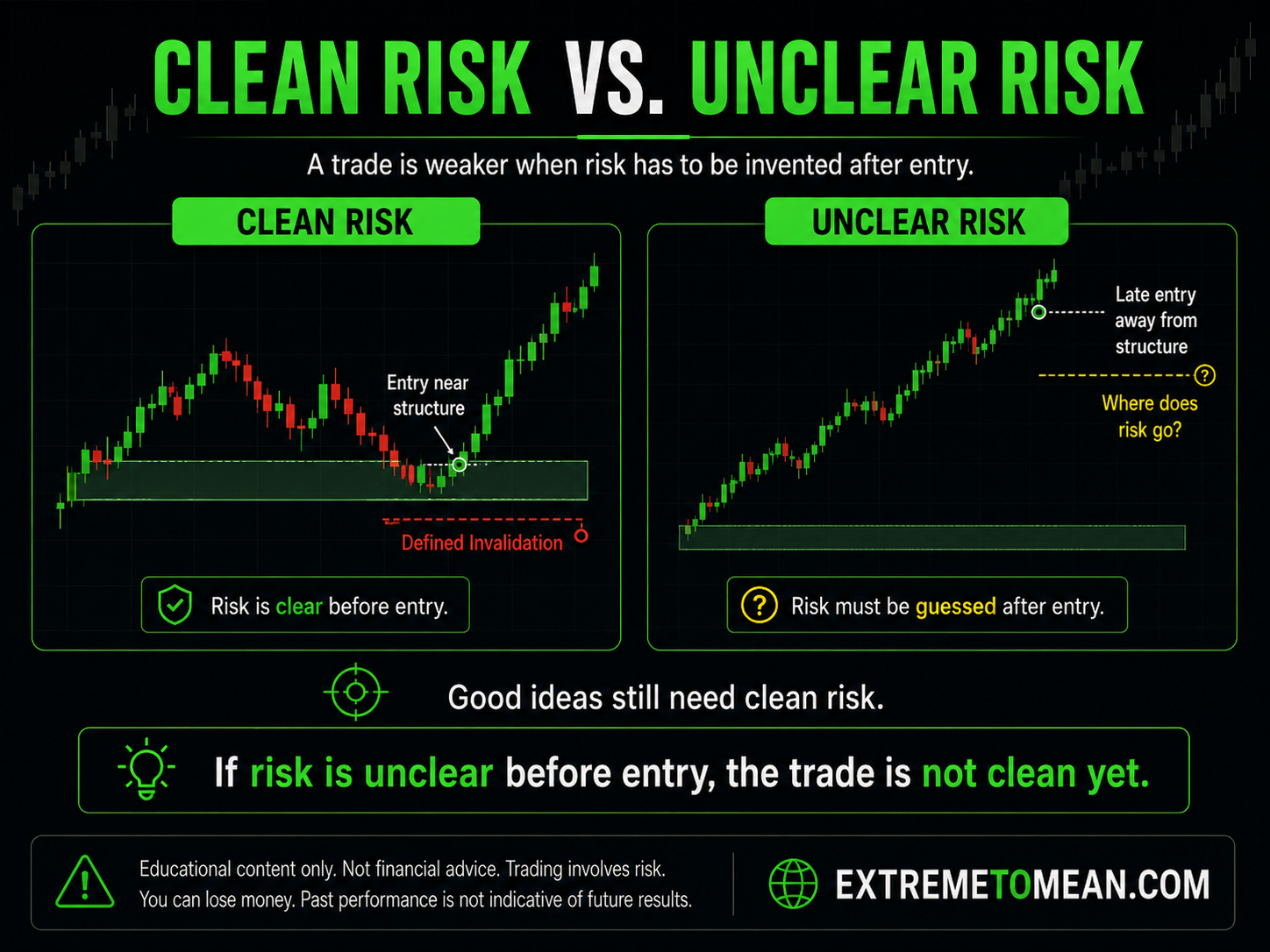
A setup without structure often leaves the trader guessing after entry. A setup with structure gives the trader a better framework. They can explain what they are seeing, where the idea is forming, and what would make the idea weaker.
Risk Must Be Defined Before the Trade
Risk is the final piece that many traders treat as an afterthought. They see the setup, feel the urgency, enter the trade, and only then begin deciding where the stop should go. That order is backwards.
Risk must be defined before the trade.
If the trader cannot identify where the idea is wrong, the trade is not ready until the risk is clear. That does not mean the trader needs a perfect stop or a guaranteed outcome. It means the trader needs a logical invalidation point. The invalidation point is the place where the original reason for the trade no longer makes sense.
This matters because entries taken without defined risk often become emotional management problems. If price moves against the trader, they start adjusting the story. A short-term trade becomes a “bigger picture” idea. A planned stop becomes a suggestion. A small decision becomes a larger problem because the trader entered before the risk was clear.
The mistake feels reasonable in the moment because the setup may look strong. The trader may believe they need to act quickly or the opportunity will be gone. But if the risk cannot be measured, the trader does not really know what they are accepting.
Risk is not only about how much money is at stake. It is about decision quality. A trade with clean risk allows the trader to know where the idea fails. A trade with unclear risk forces the trader to improvise under pressure.
That is not a strong position to be in.
When location, structure, and risk align, the trade becomes easier to evaluate. It still may not work. No setup guarantees a result. But the decision is cleaner because the trader knows why the trade is being considered, where it is being considered, and what would invalidate the idea.
The Process Breakdown: Treating Familiarity as Confirmation
One of the most common trading mistakes is treating something familiar as something complete. The trader recognizes a pattern and feels confidence because they have seen it before. That confidence may feel like confirmation, but it is often only familiarity.
This happens with all kinds of setups. A trader who studies breakouts may see every move above resistance as actionable. A trader who studies reversion may see every extension as ready to fade. A trader who uses moving averages may treat every touch as meaningful. The problem is not the tool. The problem is using the tool without enough context.
Familiarity can be dangerous because it makes the decision feel faster than it should be. The trader skips steps. They stop asking whether the setup is in the right location. They ignore whether structure has developed. They accept messy risk because the pattern looks recognizable.
This is why a process must be stronger than the trader’s desire to act. The trader needs a way to separate attention from risk. They need to be able to say, “I see the setup, but it is not complete yet.” That sentence is one of the clearest signs of discipline.
It is also one of the hardest things to say in real time.
Markets pressure traders into premature decisions. A setup begins to form, and the trader starts thinking about the missed profit before the trade even exists. But the trader’s job is not to protect themselves from missing every move. The trader’s job is to make decisions they can explain simply before, during, and after the trade.
A Better Question Before Acting
Before taking a trade, the trader should slow the decision down enough to test the quality of the setup. This does not need to be complicated. A simple question stack can prevent a lot of reactive trades.
Ask:
- Location: Is this setup happening at a meaningful area, or am I trading in the middle of noise?
- Structure: Has price shown enough behavior to support the idea, or am I entering on the first hint?
- Risk: Do I know where the trade idea is wrong before I enter?
- Timing: Am I early, late, or close to the area where the decision makes sense?
- Emotion: Am I taking this because the setup is clean, or because I do not want to miss the move?
The most important better question is this:
“Has this setup earned risk, or has it only earned attention?”
That question keeps the trader honest. It acknowledges that seeing something is not the same as having a trade. It also reinforces what patience actually looks like in practice. Patience is not passive. Patience is active evaluation. Building a fuller sequence of questions like this one is exactly what it means to ask the kind of questions that create better trades.
If the setup has only earned attention, the trader can watch. If the setup improves, the trader can reassess. If the setup stays messy, the trader can pass. There is no need to force action simply because the chart produced something recognizable.
Cleaner decisions usually come from alignment. Location gives the idea meaning. Structure shows whether the idea is developing. Risk defines the cost of being wrong. When those pieces are missing, the setup may still be interesting, but interesting is not enough.
Final Thought
A setup is not a signal. It is a reason to pay attention.
The better trader does not act simply because something familiar appears on the chart. The better trader evaluates location, waits for structure, defines risk, and then decides whether the setup has earned more than attention.
This is what patience looks like. This is what discipline looks like. Not dramatic, not exciting, not forced. Just a cleaner process that helps the trader avoid reacting before the decision is ready. The next step is to learn the full TMT System.
Patience Before Profit.
That distinction becomes clearer in the difference between seeing movement and seeing opportunity.
For the full standard, study what makes a trading setup actually tradable.
A practical starting framework is the three parts every trade must have.
The setup also needs a boundary, which is why the setup needs a clear risk boundary.
For reversion traders, that qualification process is easier to see when it is organized through the full anatomy of a reversion setup.
The same filters can be turned into a repeatable decision process with a simple day trading checklist.
Educational content only. Trading involves substantial risk and is not suitable for everyone.