
Money discussions become confusing quickly because several different concepts can produce effects that look related. Prices may rise, a currency may lose value against another currency, the money supply may expand, or a government may change the official exchange rate. Those events can influence one another, but they are not interchangeable. A cleaner framework starts by identifying exactly which event is being described.
That distinction matters for traders because monetary language often enters market commentary as explanation rather than observation. A headline may call higher consumer prices “debasement,” describe a falling exchange rate as “inflation,” or assume that an increase in money automatically tells us why every price moved. As part of understanding The Market, the better approach is to separate the mechanism from the outcome before building a market narrative. Precision improves context even when the eventual market response remains uncertain.
Five Terms That Answer Different Questions
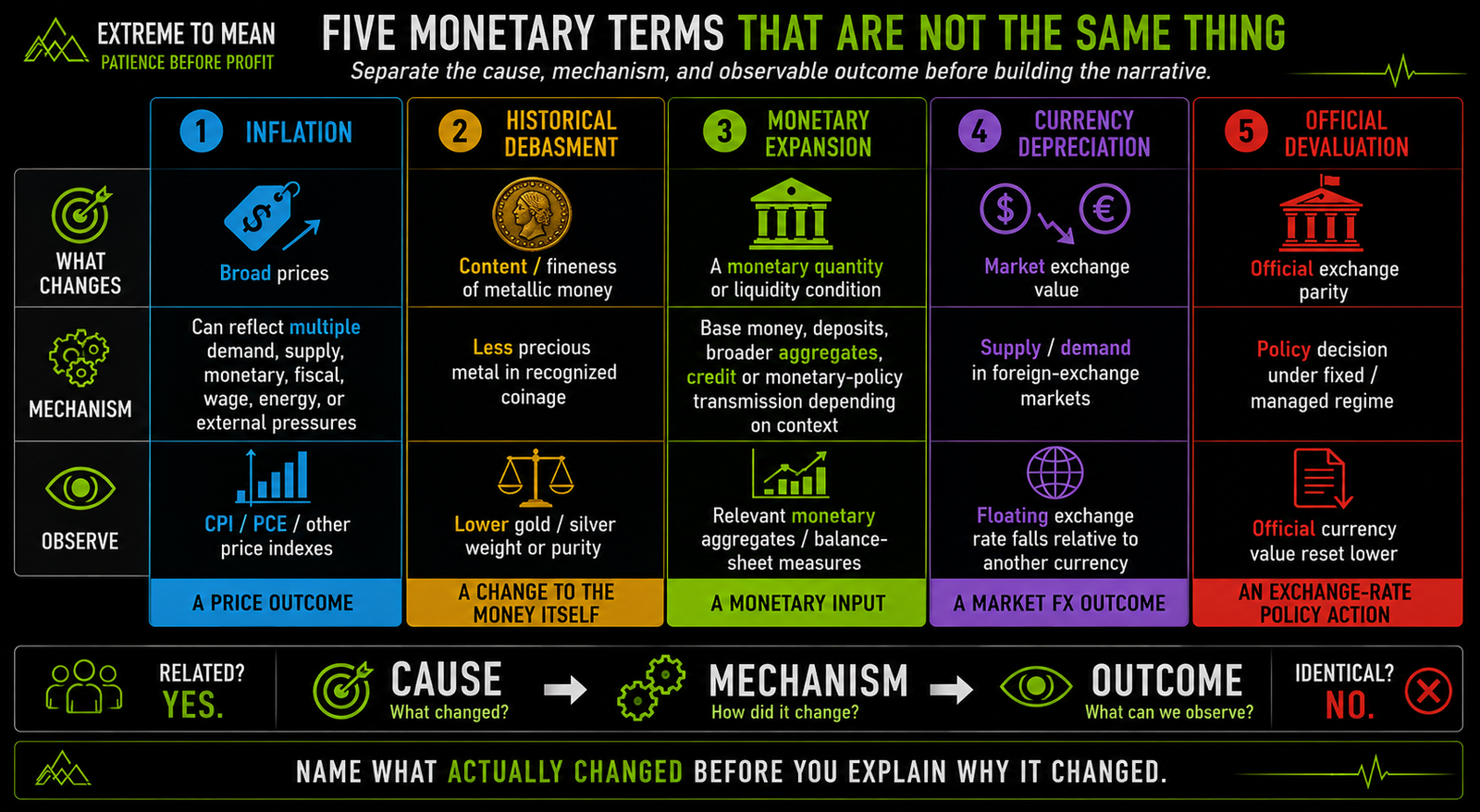
Inflation describes a broad rise in the prices of goods and services over time rather than the alteration of the currency unit itself. In the United States, measures such as the Consumer Price Index track changes in the prices consumers pay for a representative basket, while other indexes measure different parts of the price system. Inflation therefore answers a price-level question: are prices across the economy generally rising, and at what rate? It does not by itself identify the single cause of those increases. (bls.gov)
Historical currency debasement answers a different question. In metallic monetary systems, authorities could reduce the precious-metal content or fineness of coins while continuing to issue them as recognized currency; England's Great Debasement provides a documented example in which silver fineness was deliberately reduced. The mechanism was tangible: less precious metal stood behind or inside a coin of a recognized denomination. Modern fiat currencies do not operate through that same physical mechanism. (royalmintmuseum.org.uk)
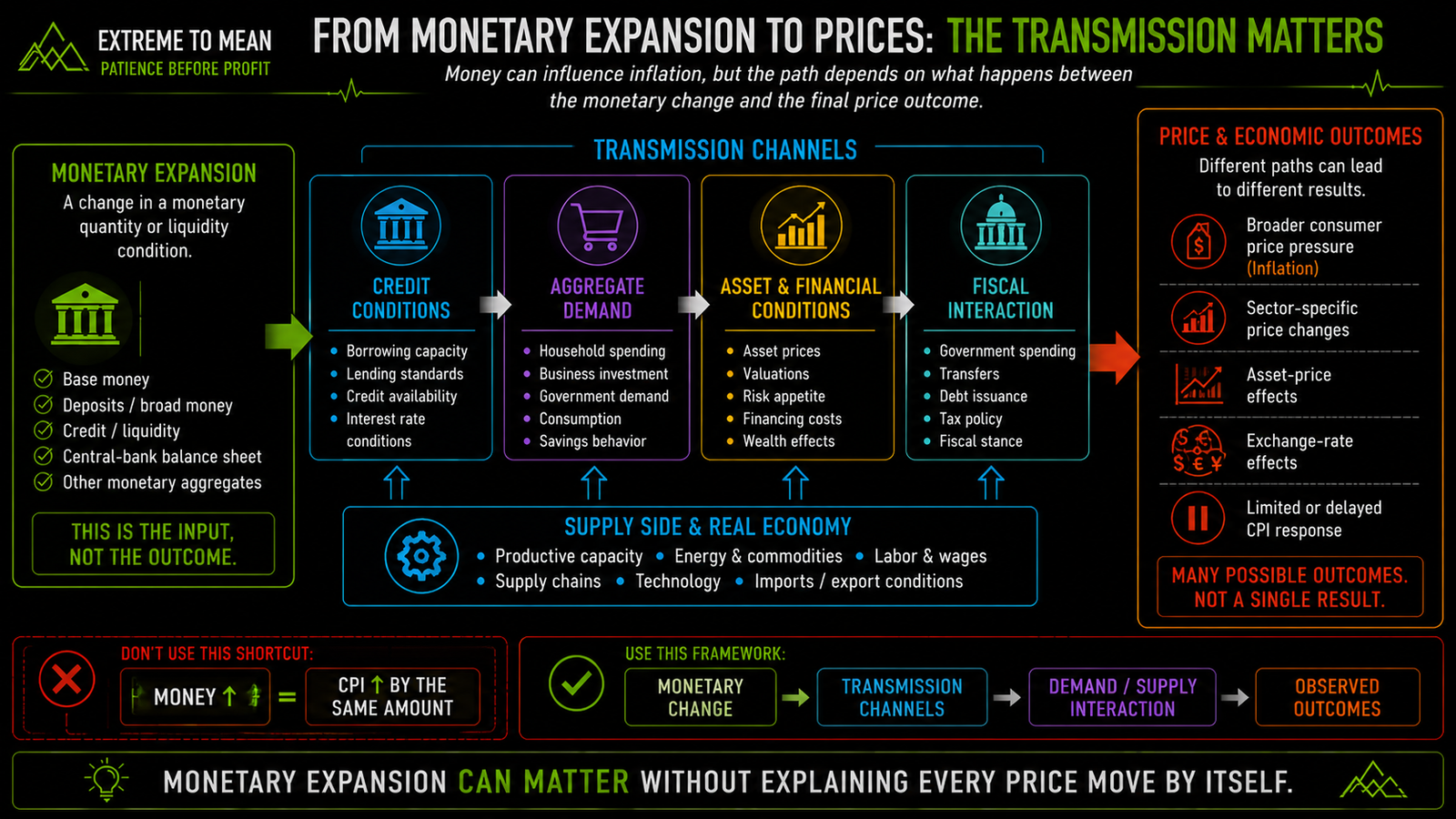
Monetary expansion refers broadly to an increase in some measure of money or monetary liquidity, although the exact measure matters. Depending on context, analysts may be discussing central-bank money, commercial-bank deposits, broader aggregates such as M2, credit conditions, or central-bank balance-sheet policies. Those measures are connected but not identical, which is why saying simply that “the money supply increased” can hide important differences. Monetary expansion describes a monetary-system change rather than a consumer-price outcome. (imf.org)
Currency depreciation describes a decline in one currency's exchange value relative to another under a market-driven or flexible exchange-rate system. Official devaluation, by contrast, refers to a deliberate downward adjustment in the official value of a currency within a fixed or managed exchange-rate framework. Both concern the currency's external exchange value, not directly the domestic price level measured by CPI or similar indexes. Keeping depreciation and devaluation separate prevents two different exchange-rate mechanisms from being treated as synonyms. (imf.org)
Inflation Is an Outcome, Not a Complete Explanation
When consumer prices rise broadly, inflation has occurred by the ordinary statistical meaning of the term. That observation still leaves the causal question open. Inflation can reflect strong aggregate demand, supply constraints, energy shocks, wage and production-cost pressures, changes in fiscal or monetary conditions, exchange-rate effects, or combinations of several forces. The importance of each factor can also change across time and across inflation episodes. (imf.org)
This is why identifying inflation and explaining inflation are two different analytical tasks. A rise in the price of one scarce product is not automatically evidence that every price in the economy is experiencing the same pressure, while a broad inflation episode cannot automatically be reduced to the price of one input. The BLS itself maintains different price measures because different indexes answer different questions about where price changes are occurring. Good analysis begins with the observable price behavior and then investigates the mechanisms behind it. (bls.gov)
Historical Debasement Was a Specific Monetary Mechanism
Traditional debasement is easiest to understand when the currency itself contains valuable material. If a silver coin once contained a particular fineness of silver and the issuing authority reduced that fineness while continuing to produce the denomination, the composition of the money had been debased. Historical records from the Royal Mint show this process directly in Tudor England, including substantial reductions in silver quality during the Great Debasement. The word therefore has a precise historical meaning before it becomes a modern metaphor. (royalmintmuseum.org.uk)
Modern commentary often uses “debasement” more broadly to describe a perceived decline in fiat money's purchasing power. That analogy can communicate an idea, but it should not erase the mechanical difference between reducing metal content in coinage and expanding or managing a modern monetary system. One physically changes the material composition of money; the other works through monetary policy, banking, credit, fiscal interaction, expectations, and financial markets. Calling both debasement without explaining the difference can make a historical analogy sound like an identical monetary process.
Monetary Expansion Can Matter Without Explaining Everything
There is a substantial economic tradition connecting money growth with the price level, particularly over longer horizons. Federal Reserve research has found meaningful relationships between money growth and inflation, while IMF educational material notes that persistent high inflation can arise when money grows too rapidly relative to the economy's capacity to produce goods and services. That gives monetary expansion an important place in inflation analysis. It does not turn every change in a monetary aggregate into a one-for-one short-run forecast of consumer prices. (federalreserve.gov)
The empirical relationship itself can vary. IMF research examining the United States and euro area found that the relationship between money growth and inflation has changed materially over time, while Federal Reserve history notes that unstable relationships between monetary aggregates, inflation, and economic activity complicated earlier money-growth targeting frameworks. Financial structure, money demand, credit creation, economic slack, velocity, and the nature of the shock can affect the transmission. “Money increased, therefore this exact amount of inflation must follow” is much stronger than the evidence supports. (imf.org)
Depreciation Is About Exchange Value
Suppose the dollar falls against the euro. That is an exchange-rate movement: fewer euros can be obtained for a given amount of dollars, depending on how the rate is quoted. Under a floating system, this type of decline is generally described as currency depreciation rather than official devaluation. It tells us how the currency changed relative to another currency, not directly how the entire domestic consumer-price basket changed. (elibrary.imf.org)
Depreciation can still interact with domestic inflation. Imported products, commodities, intermediate goods, or other foreign-priced inputs may become more expensive in domestic-currency terms, and some of those changes may eventually pass into consumer prices. The size and timing of that transmission depend on economic conditions rather than a fixed rule. A weaker exchange rate can therefore become one inflationary influence without being identical to inflation itself.
Devaluation Requires a Different Currency Regime
Official devaluation belongs primarily to fixed or tightly managed exchange-rate systems. Instead of the exchange value simply falling because buyers and sellers reprice the currency in the foreign-exchange market, the government or monetary authority deliberately lowers its official value or parity. IMF educational material distinguishes this official adjustment from depreciation under floating exchange rates. The mechanism matters because one is a policy change to an official rate while the other is a market movement. (imf.org)
That distinction is easily lost when market commentary uses “devalued” as a general description for any currency that has become worth less. In casual language the meaning may be obvious, but educational analysis benefits from greater precision. Ask whether an official exchange-rate commitment was actually changed or whether the currency simply declined in open trading. The same observed loss of external value can arrive through different institutional mechanisms.
Cause, Mechanism, and Outcome Keep the Terms Clean
A useful way to organize all five concepts is to ask three questions. First, what changed: consumer prices, monetary quantities, the metal content of historical coinage, a market exchange rate, or an official currency parity? Second, what mechanism produced that change? Third, what outcome can actually be observed rather than assumed?
That framework prevents causality from being smuggled into terminology. Inflation tells you prices rose broadly; it does not automatically tell you why. Monetary expansion tells you a monetary quantity or liquidity condition expanded; it does not tell you exactly which prices must respond or when. Depreciation tells you a currency lost external value relative to another currency; it does not by itself tell you the domestic inflation rate.
Why the Distinction Matters to Traders
Macro narratives can become especially dangerous when the terminology already assumes the conclusion. A trader who hears “debasement” may immediately expect gold, Bitcoin, yields, the dollar, and equities to behave according to a familiar monetary story, even though the actual event may be an inflation report, a central-bank liquidity change, a floating exchange-rate move, or something else entirely. This is where the principle that the market comes first remains useful. The narrative should be tested against the actual mechanism and current market response.
The same restraint applies once price begins moving. Correctly identifying monetary expansion does not determine the day's equity direction, and correctly identifying inflation does not guarantee the response of bonds, currencies, commodities, or Bitcoin. Positioning, expectations, what was already priced, policy reaction, and changing economic conditions all affect market behavior. That is why context comes before the candle, even when the macroeconomic story appears straightforward.
Better Questions for Monetary Headlines
The cleaner process is to slow down before turning one monetary term into a complete market thesis. Identify exactly what the data or policy change measures, distinguish the mechanism from the outcome, and then evaluate how markets are responding. This approach does not require denying relationships between money, inflation, and exchange rates. It requires being precise about which relationship is actually under discussion.
- Am I describing a price-level change, a monetary change, or an exchange-rate change?
- Is “debasement” being used historically or metaphorically?
- Which measure of money is actually expanding?
- Is the currency depreciating in the market or being officially devalued?
- What other supply, demand, fiscal, energy, wage, or external forces may be affecting prices?
- Am I observing causation or assuming it from correlation?
- What mechanism connects the cause I am discussing to the outcome I am observing?
- Has the market confirmed the narrative, or am I reacting to the terminology?
These questions make macro review more useful because they force the explanation to become specific. Instead of recording that “debasement caused inflation,” a trader can identify the monetary change, the relevant price data, the exchange-rate behavior, and the other forces operating at the same time. That creates a clearer record of what was known and what was inferred. Better terminology does not guarantee a better trade, but it does improve the quality of the analysis supporting the decision.
Final Thought
Inflation, historical debasement, monetary expansion, currency depreciation, and official devaluation belong in the same monetary conversation, but they should not be collapsed into one definition. Inflation describes a broad price outcome; historical debasement altered the monetary content of coinage; monetary expansion changes monetary quantities or liquidity; depreciation changes a currency's market exchange value; and devaluation changes an official exchange value under an applicable currency regime. Understanding those differences makes monetary discussions clearer before any market conclusion is drawn.
The better question is not simply, “Is the currency being debased?” Ask what changed, how it changed, and what evidence shows the outcome. For a deeper examination of how money, purchasing power, monetary institutions, and alternative monetary systems fit together, The Monetary Revolution is the natural next step. Precision in the language leads to precision in the analysis, while the trader still has to evaluate what the market actually does with that information.
Educational content only. Trading involves substantial risk and is not suitable for everyone.