
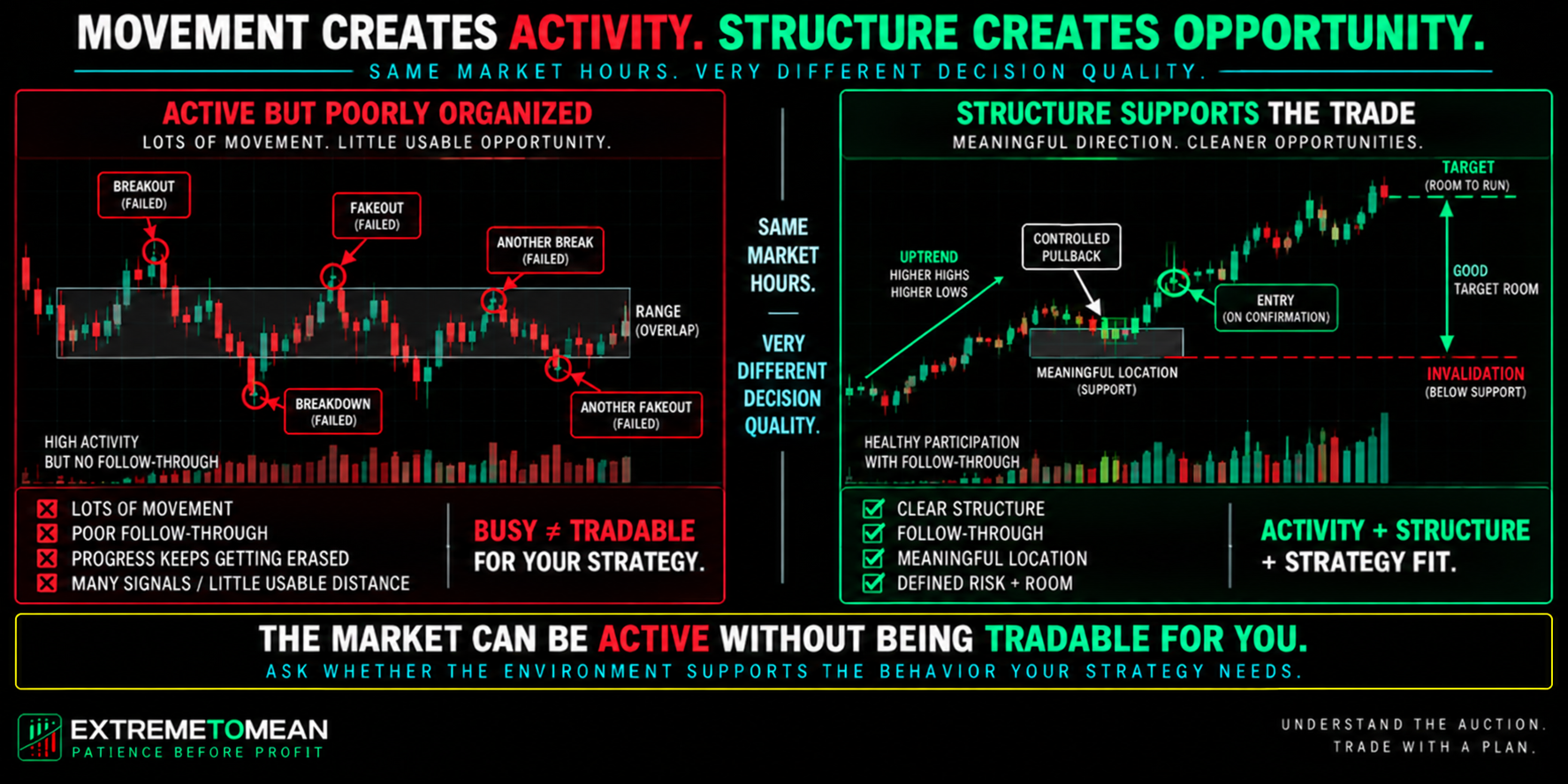
Inside The Market, the first decision is not which setup to take but what kind of environment is developing. A trader can see large candles, frequent breakouts, heavy volume, and constant movement while still having no clean way to define the opportunity. The market can be active without being tradable for you.
That distinction matters because traders often sit down expecting participation. When nothing clean appears, a session can begin to feel wasted, so ordinary movement gets studied harder until something finally earns the label “setup.” The better process accepts that correctly rejecting poor conditions can be productive trading work.
“Bad Market” Is Usually the Wrong Question
Markets are not universally good or bad because different strategies need different behavior. Tight rotation may frustrate a breakout trader while offering useful structure to somebody with a tested range approach, and a powerful trend may suit pullback participation while punishing an early mean-reversion attempt. There are fewer universally bad market conditions than there are bad matches between a strategy and its environment.
That is the practical extension of putting the market before the setup. Instead of asking whether ES or NQ looks good today, ask whether the behavior actually present supports the trade you are trying to build. The market does not need to be good; it needs to be good for what you are trying to do.
A no-trade condition is also different from a no-movement condition. Quiet markets can sometimes produce clearly defined opportunities, while fast two-sided markets can generate enormous movement without producing stable structure or usable risk. The hardest market to avoid is often the busy market that keeps looking almost tradable.
Structure and Follow-Through Tell You Whether Movement Is Usable
Start with structure because a trade needs a market story that can remain coherent long enough to define risk. You do not need to explain every candle, but you should be able to describe whether price is trending, balancing, transitioning, or behaving too inconsistently for the strategy. If your description changes from bullish to bearish to breakout to range every few candles, the environment may not be providing enough stability for a clean thesis.
The three market states are useful here because they organize behavior without pretending the label predicts what comes next. A trend should generally produce some directional progress, while organized balance can have recognizable boundaries and rotation. Messier conditions appear when boundaries keep shifting, directional pushes are immediately erased, and neither side preserves much of what it gains.
Follow-through is especially important because one failed trade tells you very little about the entire market. A breakout can fail normally, but repeated breaks of highs and lows that immediately return inside the prior area suggest a condition in which directional commitment is not being rewarded. One failed setup is a trade outcome; repeated failure to follow through may be a market condition.
The same test applies beyond breakouts. Do impulses extend, do pullbacks actually resume, and do reversal attempts produce meaningful movement, or does every apparently strong idea stall almost immediately? A break tells you price crossed a boundary; follow-through tells you whether the break actually changed anything.
Overlap, Location, and Timeframes Can Expose Weak Conditions
Heavy candle overlap is one clue that price keeps undoing its own progress. Overlap is not automatically bad because organized ranges can be legitimate environments, but it becomes a problem when a continuation strategy repeatedly requires movement the market refuses to preserve. A market can offer plenty of signals while offering very little usable distance.
Poor location creates a similar problem. When price lives between meaningful areas, traders often compensate by demanding more from candles, indicators, or order flow because nothing about the location itself deserves much attention. “Middle” is not a fixed coordinate on the chart; it describes a place where the proposed trade has weak location relative to what the strategy needs.
Timeframe disagreement also requires nuance. A bullish thirty-minute trend with a bearish five-minute retracement may be perfectly coherent for a pullback strategy, so the charts do not need to vote unanimously. Different timeframes become a problem when the trade requires them to tell incompatible stories rather than perform different jobs inside one thesis.
If the trader needs a five-minute breakout, a one-minute reversal to improve the price, and a thirty-minute support level to justify staying in when the breakout fails, the trade is no longer becoming clearer. The trader is borrowing separate pieces of information to keep one weak idea alive. A coherent setup should still be explainable without changing the role of each timeframe whenever price becomes uncomfortable.
Participation and Volatility Must Fit What the Trade Needs
Thin participation matters when the strategy depends on execution quality or follow-through that the market is not currently providing. Lower-than-normal activity, sluggish transaction flow, unstable depth, or weak continuation can all matter, but there is no universal volume level below which trading becomes invalid. Volume is context—not a permission switch.
Volume and liquidity should not be treated as identical, either. Volume measures contracts traded, while liquidity also involves available depth, spreads, price impact, and the ease with which orders can transact. A market can be busy without being especially stable, just as a liquid market can remain directionally uninteresting.
Low volatility becomes a problem when the trade requires movement the market is not demonstrating an ability to produce. If ordinary swings are small while the setup needs substantially more room to reach its objective, the pattern may exist while the economics do not. Compression can still be useful because it may precede expansion, but useful information is not the same thing as an immediate trade.
High volatility creates the opposite issue. Large movement can produce opportunity, but disorderly movement can also widen structural stops, increase execution uncertainty, reduce appropriate size, and reverse direction before either side establishes control. The problem is not high volatility; the problem is high volatility combined with poor structure.
A Textbook Setup Can Still Belong to the Wrong Environment
A setup can look familiar while the market around it violates the assumptions that make the setup useful. A trend pullback without an established trend, a breakout after repeated failed expansion, or a mean-reversion attempt while directional repricing is still accelerating can all look technically recognizable. A setup can look textbook and still be misplaced.
This is why market conditions change the quality of a setup even when the visible pattern barely changes. A bullish candle at support inside an organized trend is not the same decision as the same candle appearing in unstable chop after several failed directional attempts. Patterns repeat; context determines whether they deserve the same interpretation.
Known catalysts can temporarily change those assumptions as well. A technically clean setup shortly before CPI, payrolls, or an FOMC decision may be developing inside an environment that is about to reprice abruptly, especially if the trader's normal strategy was not designed around event risk. News risk becomes dangerous when the trade is pretending the event is not part of the environment.
This does not create a universal rule against trading around scheduled events. Some strategies explicitly account for those conditions, while others are built around more normal liquidity and volatility behavior. The important question is whether the strategy actually incorporates the catalyst rather than simply hoping the existing chart structure survives it.
More Confirmation Cannot Repair the Wrong Environment
Poor conditions often tempt traders to add more information. When breakouts keep failing, they add CVD, tape, breadth, another candle close, and another timeframe in an attempt to make the next setup more convincing. You cannot confirm your way out of a bad market-strategy fit.
That matters because extra confirmation can make a poor environment appear sophisticated without changing its basic behavior. Indicators may be flashing constantly precisely because price is reversing constantly, and order flow may explain the two-sided struggle without turning the struggle into a clean directional opportunity. When the market is indecisive, indicators can become more active without becoming more useful.
The same distinction separates this lesson from the problem of confirmation timing. Tougher conditions may justify greater selectivity, but selectivity should begin by asking whether the strategy belongs in the environment at all. Adding an infinite approval committee to a strategy whose assumptions are already failing only delays recognition of the actual problem.
Conditions Can Improve—and They Can Deteriorate
Recognizing a poor environment at 10:00 does not require declaring the entire day untradeable. Morning chop can later develop into genuine expansion, participation can increase, a boundary can become clear, and a new condition can emerge. No trade is a decision about current conditions—not a sentence for the rest of the session.
The reverse is equally important. A clean opening trend can deteriorate into overlap and repeated failed breaks, yet a trader who made money during the first hour may continue applying the same playbook because the earlier read worked. The fact that the market deserved participation earlier does not mean it still deserves it now.
This is why market assessment needs to remain conditional rather than becoming a fixed morning prediction. You do not need to decide at 9:29 whether the entire session will be choppy; you need to recognize when current evidence supports participation and when that evidence changes. Conditions are allowed to change faster than your confidence does.
The ETM Market-Condition Filter
Use Structure → Follow-Through → Participation → Volatility → Strategy Fit → Trade Geometry → Catalyst → Decision. This is not a score in which six good answers can outvote one fatal problem, because unclear structure or impossible risk can disqualify a trade regardless of how many other boxes look acceptable. A checklist can organize the decision; it cannot vote a bad environment into becoming tradable.
- Structure: Can I clearly describe whether the market is trending, balancing, or transitioning?
- Follow-Through: Are directional attempts preserving progress, or is every move being erased?
- Participation: Is activity and execution quality sufficient for what this strategy requires?
- Volatility: Is movement appropriate for the stop, target, and behavior the trade needs?
- Strategy Fit: Does this setup actually belong in the current environment?
- Trade Geometry: Can I define reasonable invalidation, target room, and position size?
- Catalyst: Is a known event about to change the assumptions behind the trade?
- Decision: Trade eligible, wait, or no trade.
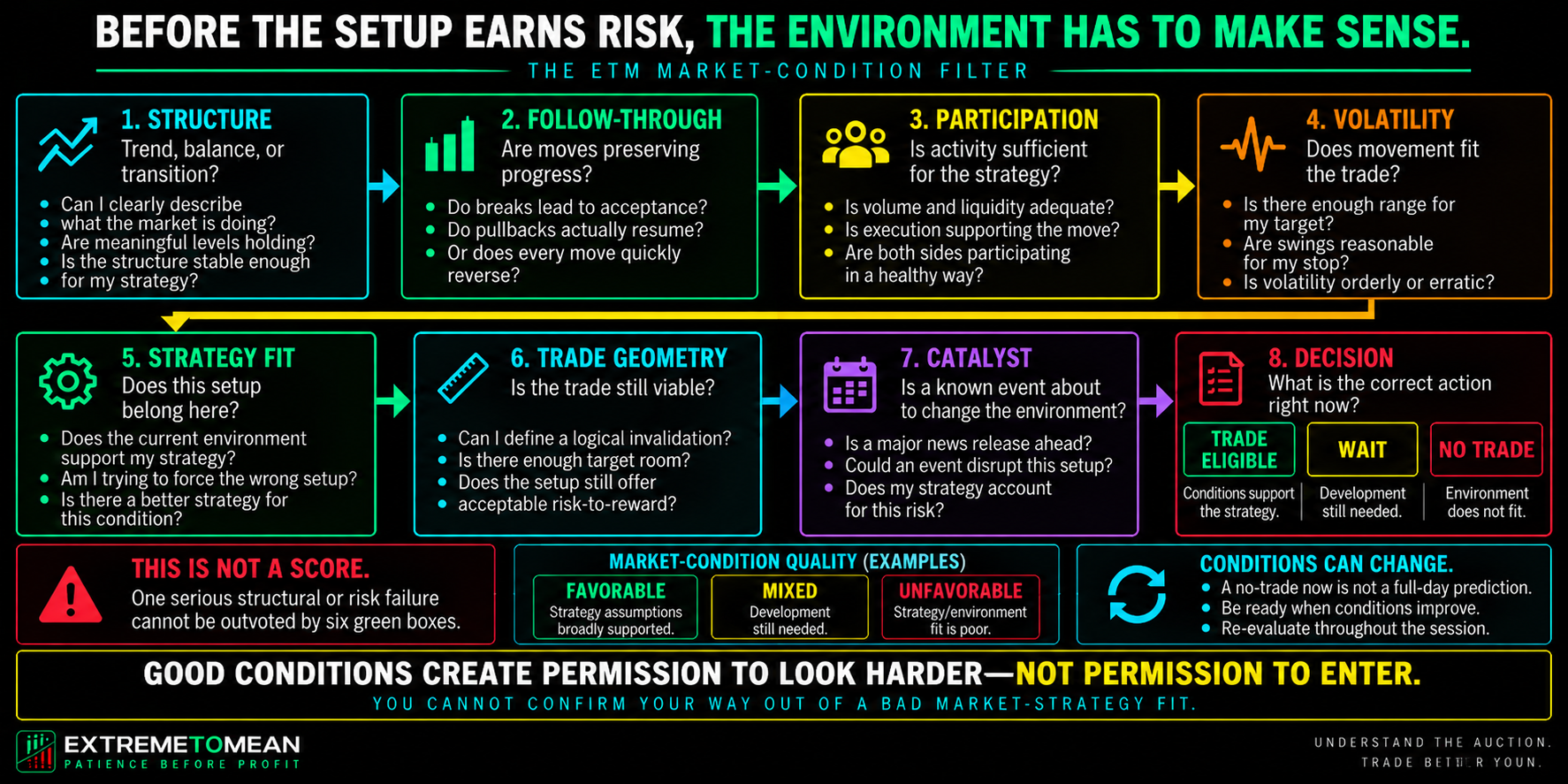
Trade eligible does not mean enter. It means the environment is sufficiently coherent that a specific setup may now deserve closer evaluation, while wait means conditions are still developing and no trade means the current idea does not fit what the market is offering. Good conditions create permission to look harder—not permission to enter.
The better question is not “Is this market bad?” Ask, “Does the current environment support the behavior my strategy needs, and can that behavior still produce a trade with clear invalidation and enough room?” If the answer is unclear, uncertainty itself is useful information rather than a problem that must immediately be solved.
Common Market-Condition Mistakes
Poor-condition trading usually begins when the trader assumes that showing up creates an obligation to participate. The market then gets interpreted through that expectation rather than evaluated on its own terms, and movement gradually becomes confused with opportunity. Common examples include:
- Equating a busy market with a tradable market.
- Calling a market “bad” simply because one preferred strategy is struggling.
- Treating all ranges as chop or all chop as universally untradeable.
- Assuming a strong trend must automatically offer a usable entry.
- Fading an accelerating trend simply because price looks extended.
- Trying to trade breakouts after repeated expansion attempts have failed.
- Ignoring heavy overlap and repeated loss of directional progress.
- Forcing setups in poor location and compensating with more indicators.
- Requiring every timeframe to agree instead of giving each timeframe a coherent role.
- Treating low volume as an automatic no-trade signal or high volume as automatic opportunity.
- Confusing volume with liquidity.
- Assuming high volatility is always favorable or low volatility is always useless.
- Ignoring a scheduled catalyst that can materially alter the environment.
- Using more confirmation to repair a strategy-environment mismatch.
- Continuing to trade because the morning was good even after conditions deteriorate.
- Writing off the entire session because the first hour was poor.
- Forcing a trade because a personal trading window is almost over.
- Treating several supportive observations as a mechanical score that overrides one serious structural or risk problem.
Final Thought
Knowing when not to trade is not about becoming afraid of difficult markets. It is about recognizing that every strategy depends on certain market behaviors, and those behaviors are not present with the same quality every hour of every session. Standing aside can be the successful result of reading the market correctly rather than evidence that the trader failed to find something to do.
A difficult market often convinces traders they need better prediction when what they really need is a higher rejection rate. When structure is unclear, follow-through repeatedly disappears, participation no longer supports the strategy, volatility becomes disorderly, or the setup simply belongs to another kind of market, forcing another trade does not create clarity. The cleaner decision is to wait until conditions provide something the process was actually built to evaluate.
Your trading session is not measured by whether an order was placed. It is measured by whether the decisions matched what the market actually deserved, including the decision to do nothing when nothing qualified. That commitment to patience, context, and selective participation is part of the broader process developed throughout The Patience Principle.
For the behavioral side of standing aside, see how to use a no-trade rule without feeling passive.
Educational content only. Trading involves substantial risk and is not suitable for everyone.