
Markets can spend hours or days behaving as though the same playbook should keep working, then change character enough that yesterday's best idea suddenly becomes a poor fit. The reason is not mysterious: price does not move through one permanent environment. It shifts between periods of balance, directional repricing, slowing momentum, and renewed imbalance. Market phases give traders a practical language for describing those changes without pretending they can forecast every turn.
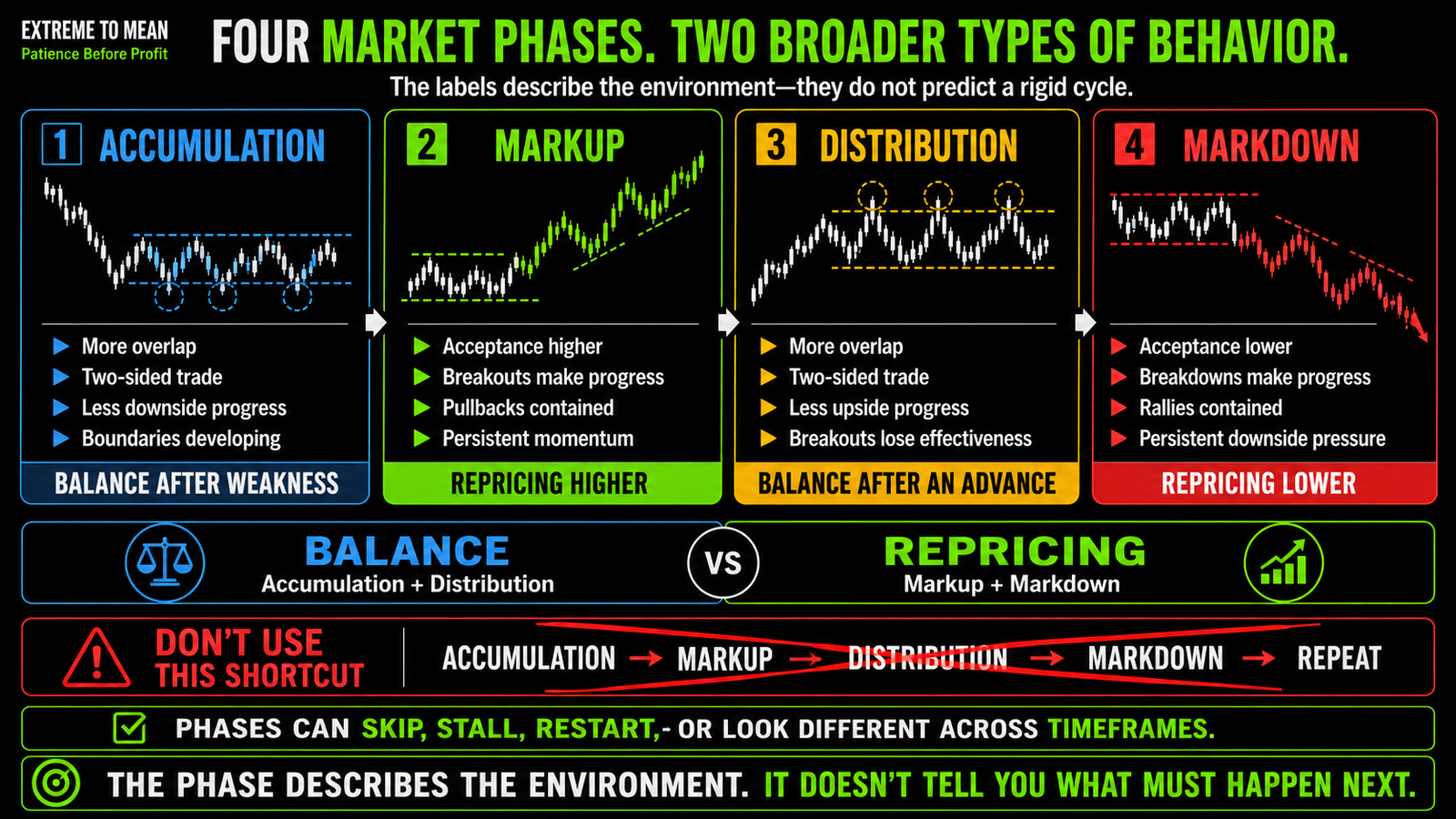
The classic four-phase framework is Accumulation, Markup, Distribution, and Markdown. In simple terms, accumulation is balance developing after weakness, markup is sustained repricing higher, distribution is balance developing after an advance as buying becomes less effective, and markdown is sustained repricing lower. As a foundational way to read The Market, the framework helps describe how price character changes across a broader sequence. It becomes dangerous only when traders treat those labels as a rigid cycle that must appear in perfect order.
Accumulation: Balance After Weakness
Accumulation is usually associated with a market that has stopped falling cleanly and has begun spending more time in two-sided trade. Downside attempts may still occur, but they produce less progress, recover more quickly, or repeatedly fail to sustain trade below the range. Overlap increases, boundaries begin to matter, and the market may rotate rather than trend. None of that proves a future markup; it simply describes an environment in which the prior markdown is no longer behaving with the same efficiency.
The word "accumulation" can also tempt traders into inventing a story about who is buying and why. The chart does not usually tell you with certainty which participants are building positions or what their intentions are. A cleaner use of the term is behavioral: weakness has stopped producing the same directional progress, balance is developing, and the market is testing whether lower prices will continue to be accepted. That keeps the analysis focused on observable structure instead of imagined motives.
Markup: Sustained Repricing Higher
Markup begins when price stops merely rotating inside balance and starts gaining acceptance at higher levels. Breakouts make progress, pullbacks tend to remain contained, and the market spends more time building structure above old boundaries instead of repeatedly returning through the middle. Ranges may expand and momentum may become more persistent. The important feature is not that every candle is green, but that upward attempts are producing sustained repricing.
A healthy markup can still contain sharp pullbacks and failed pushes. Directional phases are not straight lines, and a single countertrend move does not automatically end the environment. The better question is whether the pullback is being absorbed without meaningfully reclaiming the structure that supported the advance. This is where understanding the three market states helps because the trader is evaluating whether directional behavior remains intact or is beginning to transition.
Distribution: Balance After an Advance
Distribution often appears after an advance when higher prices stop producing the same clean progress. Price may continue making marginal highs, but breakouts can fail more often, overlap increases, and two-sided trade begins to replace persistent directional acceptance. The market may spend more time rotating around a developing range while attempts to extend above it become less effective. That change matters because the playbook that worked during markup can become less reliable even before a clear markdown begins.
Like accumulation, distribution should not be treated as proof that a decline is coming next. Sideways trade after an advance can resolve higher, expand the existing trend, or remain balanced much longer than expected. The useful observation is that the character of the advance has changed and buyers are no longer producing the same efficient repricing. Calling the phase correctly matters less than recognizing that the old directional assumptions may need to be re-evaluated.
Markdown: Sustained Repricing Lower
Markdown is the downside counterpart to markup. Price begins gaining acceptance at lower levels, breakdowns produce follow-through, rallies struggle to reclaim lost structure, and directional pressure becomes more persistent. Countertrend bounces may still be violent, but they tend to occur inside an environment where lower prices continue to be accepted. The trader should focus on that persistent structural behavior rather than assume every oversold reading or sharp bounce signals the end of the decline.
This distinction connects directly to Reversion Is Not Reversal. A markdown phase can contain many temporary mean-reversion moves without producing a genuine phase change. Likewise, a markup phase can pull back toward a mean while the broader directional environment remains healthy. The phase tells you what kind of environment surrounds the move; the setup tells you what is happening inside that environment.
Two Broader Behaviors: Balance and Repricing
A useful simplification is to separate the four labels into two broader behaviors: balance and repricing. Accumulation and distribution often contain more overlap, failed breaks, rotation, and two-sided negotiation, while markup and markdown tend to show stronger directional acceptance and more persistent movement away from prior structure. That does not make accumulation bullish or distribution bearish by definition. It simply helps the trader notice whether the market is currently negotiating value or actively repricing it.
The Hardest Part Is Recognizing the Transition
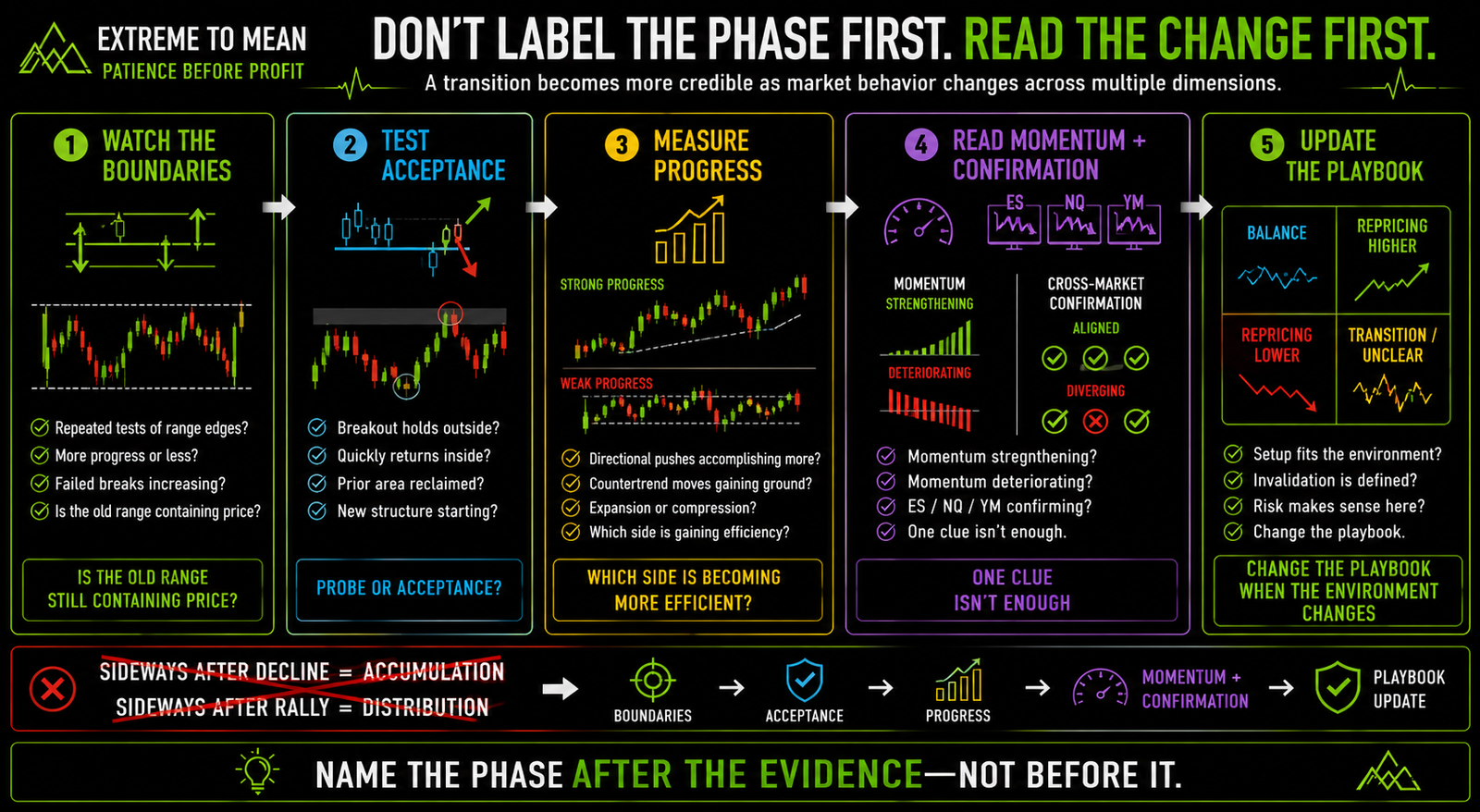
The hardest part is not memorizing the four names. It is recognizing when the market is actually transitioning from one type of behavior to another. A trader can see sideways price after a decline and immediately declare accumulation, or see a stalled rally and label it distribution, but those conclusions may arrive long before the evidence supports them. The labels become useful only when they summarize observed behavior instead of replacing it.
Start with boundaries and acceptance. Ask whether repeated tests of a range edge are producing real progress, whether breakouts can hold outside the range, and whether failed breaks are becoming more common. A market transitioning toward markup should begin showing stronger acceptance above balance, while one transitioning toward markdown should begin accepting lower prices rather than only probing them. If each breakout quickly returns inside, the market may still be balanced no matter how convincing the first candle looked.
Then watch momentum and efficiency. During healthy repricing, directional pushes tend to accomplish more than countertrend responses, while a maturing move may require increasing effort to achieve less progress. Momentum deterioration does not prove a phase change, but it can support the idea that the current environment is losing efficiency. Related markets such as ES, NQ, and YM can add another layer when they broadly confirm or contradict the developing transition.
The Same Setup Changes With the Phase
One of the most practical uses of market phases is deciding which behavior deserves attention. A mean-reversion idea generally makes more conceptual sense inside balance than while price is aggressively repricing away from the mean. A pullback-continuation idea fits more naturally when markup or markdown remains healthy than when the market has entered mature two-sided trade. The same pattern can therefore carry very different meaning depending on the phase surrounding it.
This is why market conditions change the quality of a setup. A breakout pullback inside fresh directional acceptance is not the same decision as an identical-looking pullback inside a distribution-like range filled with failed extensions. Likewise, fading an extreme in established balance is different from fading a market that is still repricing efficiently. Phase analysis helps the trader choose a playbook that matches the environment instead of demanding that the environment fit the preferred setup.
A Cleaner Phase-Identification Process
A cleaner phase-identification process begins by describing observable behavior before choosing a label. Is price overlapping or progressing, are boundaries holding or breaking, are directional moves being accepted, and are countertrend moves changing structure or merely interrupting it? Once those observations are clear, a phase label can summarize the environment. Starting with the label encourages confirmation bias because the trader begins searching for evidence that supports a story already chosen.
This is another expression of the principle that the market comes first. The trader does not need to perfectly name every transition in real time to benefit from the framework. The practical goal is to notice when the market's behavior has changed enough that the previous playbook may no longer fit. That improves preparation and decision quality without pretending that the next phase is known in advance.
Better Questions Before Choosing the Playbook
Before applying a setup, ask questions that force the phase judgment back toward observable evidence. The purpose is not to create a rigid checklist that must produce one of four labels. It is to determine whether the environment is balanced, repricing, or transitioning, and whether the setup being considered is compatible with that behavior. If the evidence is mixed, "transition" or "unclear" can be more useful than forcing certainty.
- Is price primarily overlapping or making sustained directional progress?
- Are breakouts being accepted or repeatedly failing?
- Are pullbacks contained, or are they reclaiming important structure?
- Are repeated tests of a boundary producing more progress or less?
- Is momentum strengthening, stable, or deteriorating?
- Are ES, NQ, and YM broadly confirming the same environmental change?
- Does the current setup fit balance, repricing, or transition?
- What evidence would tell me the previous phase assumption no longer fits?
These questions also create a cleaner trade-review record. Instead of writing only "I thought the market was in markup," the trader can record the observable evidence that supported that conclusion and what later changed. That makes it easier to identify whether the setup failed inside an appropriate environment or whether the environment had already stopped supporting the setup. The benefit is better evaluation, not certainty about what phase must come next.
Final Thought
Market phases are useful because they remind traders that price behavior is conditional. Accumulation, markup, distribution, and markdown provide a simple vocabulary for balance, directional repricing, and the transitions between them. The framework becomes most useful when it stays descriptive and flexible rather than becoming a prediction machine. Markets can skip apparent stages, transition unevenly, and look different depending on the timeframe being observed.
The larger lesson is to identify the environment before deciding which behavior you want to trade. A setup that fits one phase may become a poor match in another even when its visual pattern looks nearly identical. For a deeper framework on reading structure, context, and market behavior together, Decode the Market is the natural next step. The trader does not need to predict the next phase perfectly; the job is to recognize when the current one has changed enough that the old playbook deserves another look.
Educational content only. Trading involves substantial risk and is not suitable for everyone.