
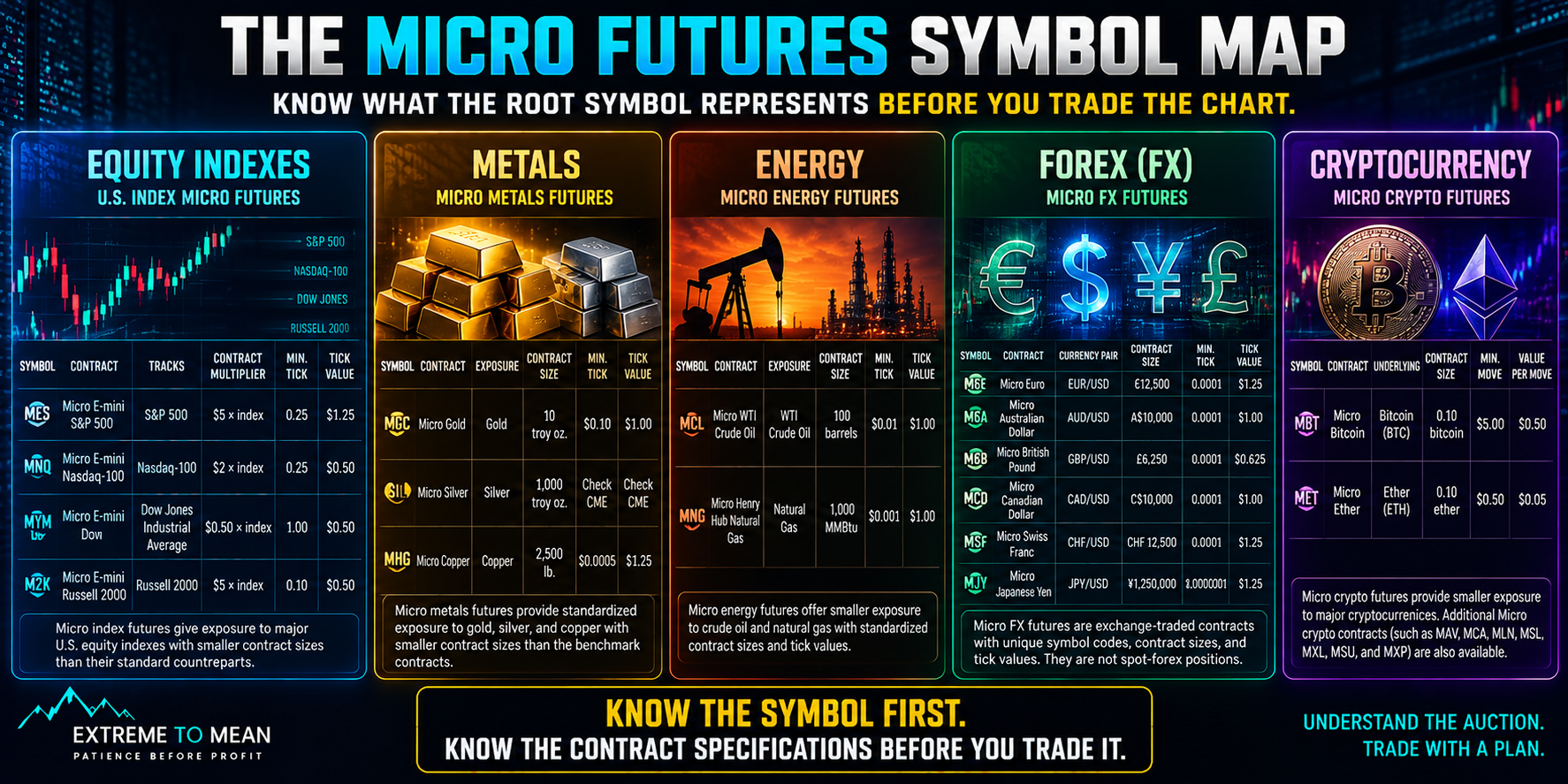
Before worrying about whether a chart has a setup, you should know what the symbol on that chart actually represents. The root symbol identifies the product family, while the contract specifications tell you how that product behaves financially. That makes symbol recognition one of the most basic pieces of futures literacy.
This guide is designed as a reference you can return to as you move through the broader ETM lesson library. It is not a guide to trading gold, oil, Nasdaq, currencies, or crypto, and it will not tell you which Micro contract is “best.” Its job is simpler: SYMBOL → MARKET → SIZE → TICK → CONTRACT → RISK.
What a Micro Futures Symbol Actually Tells You
A futures root such as MNQ identifies a particular standardized futures product. It tells you that you are looking at Micro E-mini Nasdaq-100 futures rather than MES, which represents Micro E-mini S&P 500 futures, or MCL, which represents Micro WTI crude oil. Those contracts may all be called “Micro,” but they are financially very different instruments.
The word Micro is relative. It generally means the contract provides smaller exposure than a related benchmark contract, but there is no rule saying every Micro future is exactly one-tenth the size of its larger counterpart. Micro Silver, for example, is one-fifth the size of benchmark Silver futures, while many other Micro products use different relationships.
That is why the shortcut “it starts with M, so it must just be the little version” is unreliable. Some Micro symbols do not even follow a simple `M + standard ticker` pattern, especially in FX. Learn the actual product root instead of trying to reverse-engineer every abbreviation.
Micro Equity Index Futures Symbols
These four are likely to be the most familiar Micro contracts for beginning U.S. index-futures traders.
| Root | Contract | Tracks | Contract Multiplier | Minimum Tick | Tick Value |
|---|---|---|---|---|---|
| MES | Micro E-mini S&P 500 | S&P 500 | $5 × index | 0.25 point | $1.25 |
| MNQ | Micro E-mini Nasdaq-100 | Nasdaq-100 | $2 × index | 0.25 point | $0.50 |
| MYM | Micro E-mini Dow | Dow Jones Industrial Average | $0.50 × index | 1 point | $0.50 |
| M2K | Micro E-mini Russell 2000 | Russell 2000 | $5 × index | 0.10 point | $0.50 |
Notice that even inside one asset category, the dollar math is different. A one-point move in MES is worth $5 per contract, while a one-point move in MNQ is worth $2 and a one-point move in MYM is worth $0.50. “One point” is therefore not a universal dollar unit in futures.
Tick size and tick value are also different ideas. Tick size is the smallest quoted price movement the contract normally makes, while tick value is what that movement changes the value of one contract by. For MNQ, a 0.25-point minimum move equals $0.50 per contract.
Micro Metals Futures Symbols
Metals make the meaning of “Micro” even clearer because the standardized exposure is expressed in physical units such as troy ounces or pounds.
| Root | Contract | Exposure | Contract Size | Basic Outright Tick |
|---|---|---|---|---|
| MGC | Micro Gold | Gold | 10 troy oz. | $0.10/oz. |
| SIL | Micro Silver | Silver | 1,000 troy oz. | Verify current CME spec |
| MHG | Micro Copper | Copper | 2,500 lb. | $0.0005/lb. |
For MGC, a $0.10-per-ounce minimum price move across 10 ounces changes one contract by $1. For MHG, the $0.0005-per-pound minimum fluctuation across 2,500 pounds equals $1.25 per contract. The numbers look completely different because the underlying standardized exposures are completely different.
Micro Silver is an especially good reminder to verify the current exchange specification rather than relying forever on a saved table. Exchange specifications and presentation can change, and even current CME reference materials may display certain details differently across pages. The stable lesson is that 1,000 ounces of silver and 10 ounces of gold are not comparable merely because both products contain the word Micro.
Micro Energy Futures Symbols
Energy futures use yet another type of underlying unit.
| Root | Contract | Exposure | Contract Size | Minimum Tick | Tick Value |
|---|---|---|---|---|---|
| MCL | Micro WTI Crude Oil | WTI crude oil | 100 barrels | $0.01/barrel | $1 |
| MNG | Micro Henry Hub Natural Gas | Natural gas | 1,000 MMBtu | $0.001/MMBtu | $1 |
MCL is one-tenth the size of the standard CL crude-oil contract, while MNG is one-tenth the size of standard NG. Both happen to have a $1 minimum tick value, but that similarity does not make them interchangeable. One represents barrels of crude oil and the other represents natural-gas energy measured in MMBtu.
This is where a beginner should stop thinking of futures prices as ordinary stock prices. If MCL moves one quoted dollar, the financial effect comes from its 100-barrel contract size; if MES moves one index point, its dollar effect comes from its index multiplier. The quotation only makes sense when paired with the contract specification behind it.
Micro FX Futures Symbols
Micro FX codes are particularly useful to learn because the naming convention is less intuitive.
| Root | Contract | Contract Size | Minimum Tick | Tick Value |
|---|---|---|---|---|
| M6E | Micro EUR/USD | €12,500 | 0.0001 | $1.25 |
| M6A | Micro AUD/USD | A$10,000 | 0.0001 | $1.00 |
| M6B | Micro GBP/USD | £6,250 | 0.0001 | $0.625 |
| MCD | Micro CAD/USD | C$10,000 | 0.0001 | $1.00 |
| MSF | Micro CHF/USD | CHF 12,500 | 0.0001 | $1.25 |
| MJY | Micro JPY/USD | ¥1,250,000 | 0.000001 | $1.25 |
Do not describe these simply as “Forex pairs with smaller lots.” They are standardized exchange-traded futures contracts, which is structurally different from trading a spot-forex position through a dealer. They have exchange specifications, contract expirations, and settlement rules.
The codes also show why guessing from the standard ticker can fail. Micro euro is M6E, but Micro Canadian dollar is MCD, Micro Swiss franc is MSF, and Micro Japanese yen is MJY. Memorizing the important roots is safer than assuming every Micro symbol follows one universal naming formula.
Micro Cryptocurrency Futures Symbols
The two foundational Micro crypto futures for beginners are Bitcoin and Ether.
| Root | Contract | Contract Size | Minimum Outright Move | Value per Minimum Move |
|---|---|---|---|---|
| MBT | Micro Bitcoin | 0.10 bitcoin | $5 per bitcoin | $0.50 |
| MET | Micro Ether | 0.10 ether | $0.50 per ether | $0.05 |
The current CME Micro crypto family extends well beyond those two products. Other Micro codes include MAV for AVAX, MCA for ADA, MLN for LINK, MSL for SOL, MXL for Lumens, MSU for SUI, and MXP for XRP. Product catalogs evolve, which is another reason a permanent reference article should teach the verification process rather than asking readers to memorize one frozen list forever.
A smaller crypto futures contract does not make the underlying crypto market calm. Contract size controls standardized exposure; it does not remove volatility, leverage, or the possibility of rapid price movement. Smaller sizing gives a trader finer control over exposure, not immunity from risk.
Root Symbol vs. Contract Month
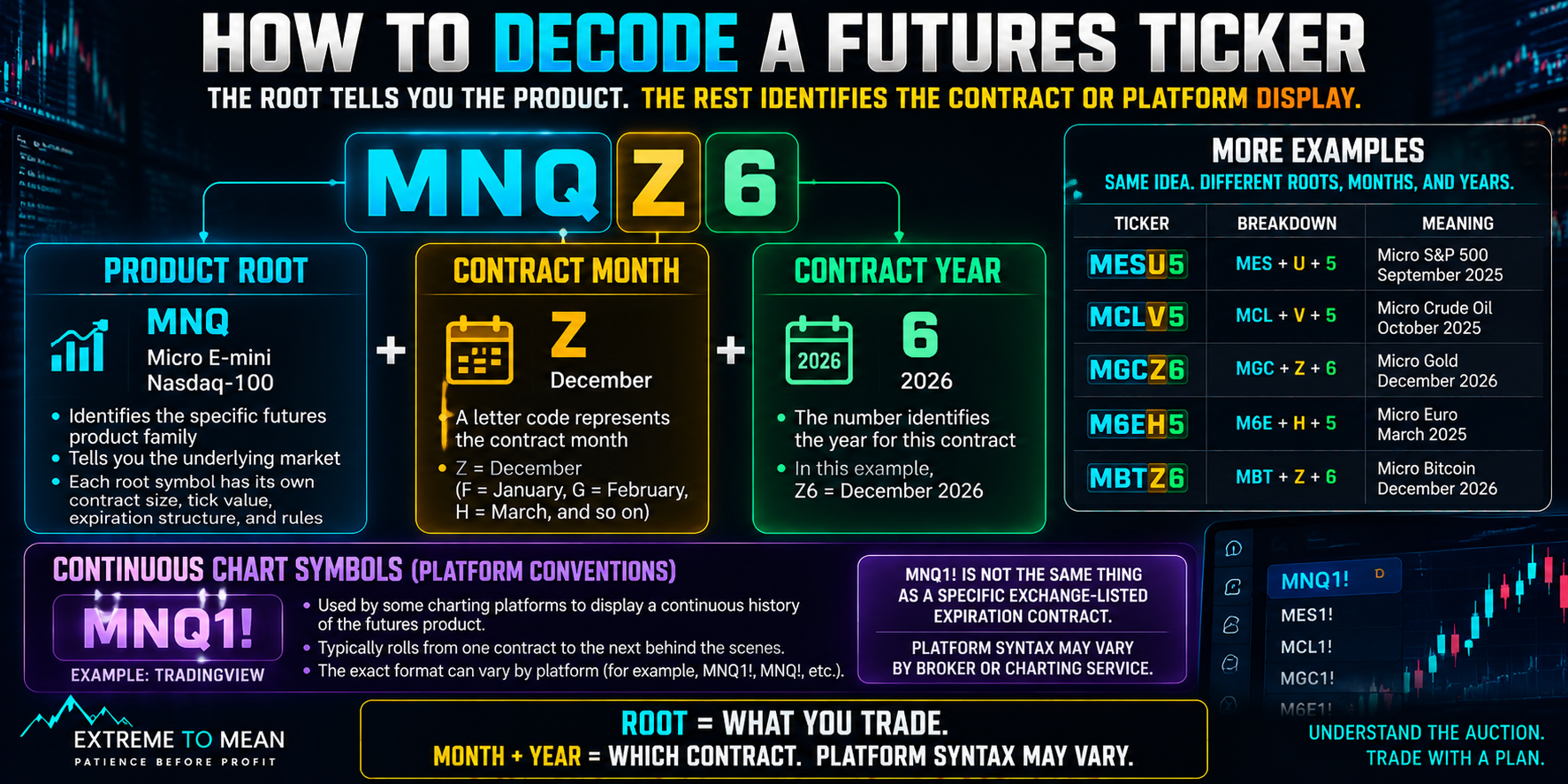
A beginner may see MNQ on one page, MNQZ6 on another, and MNQ1! on a TradingView-style chart and wonder whether they are three different Nasdaq products. They are not necessarily different product families. The important distinction is between the root product and the particular contract or charting convention being displayed.
Consider MNQZ6. `MNQ` is the Micro E-mini Nasdaq-100 product root, `Z` is the December futures month code, and `6` identifies 2026 in this context. The full ticker therefore identifies a specific December 2026 expiration rather than merely the generic MNQ product family.
A platform may instead display something such as MNQ1! as a continuous chart. That vendor-created symbol joins or rolls futures data so the trader can view a longer continuous history; it is not the literal exchange-listed expiration ticker you would necessarily submit as an order. The root tells you what product you are looking at; the rest of the ticker tells you which contract or platform convention is being displayed.
Why Two Micro Contracts Can Have Very Different Risk
Knowing that MNQ means Micro Nasdaq solves an identification problem, not a position-sizing problem. You still need to know how far your trade would be invalidated, how many dollars that movement represents per contract, and whether that amount fits your own risk plan. A Micro contract being smaller than its benchmark does not automatically tell you how many contracts you should trade.
This is also why a contract's tick value should never be separated from the movement you are preparing to tolerate. Forty MNQ points, fifty cents in MCL, and a particular move in MGC describe different financial exposures even if each trade uses one contract. Before any setup earns risk, the risk itself needs to be clear.
Smaller contracts can provide finer control over exposure, but smaller does not create an edge. An edge still comes from a repeatable decision process, not from choosing a ticker with the word Micro in its name. Contract mechanics tell you what you are trading; they do not tell you whether you should take the trade.
The ETM Micro Futures Quick Reference
Use this sequence whenever you encounter an unfamiliar futures ticker:
- SYMBOL — What is the product root?
- MARKET — What underlying market does it represent?
- SIZE — What standardized exposure does one contract control?
- TICK — What is the minimum quoted move, and what is that move worth?
- CONTRACT — Which expiration or continuous-chart convention am I viewing?
- RISK — Does the actual dollar exposure fit my own plan?
A good beginner question is not simply, “What does MNQ stand for?” Ask, “What exactly does one MNQ contract represent, how does its price move translate into dollars, and which expiration am I looking at?” That turns symbol recognition into useful contract knowledge.
If you use an ETM calculator or another tool from the free tools library, verify that you have selected the correct instrument before relying on the output. A calculator can only perform the math you ask it to perform; choosing MCL when you meant MNQ makes perfectly accurate arithmetic useless. Contract identification comes before position calculation.
What to Verify Before You Trade Any Futures Symbol
Before submitting an order in an unfamiliar contract, verify the current exchange and broker specifications. Confirm the product root, contract multiplier or unit size, minimum tick, dollar tick value, active expiration, settlement structure when relevant, and the exact ticker syntax your platform expects. Product specifications and available Micro contracts can change.
Do not use current margin requirements as permanent reference data either. Margins can move as exchanges and brokers respond to volatility and risk conditions, which makes them a poor field for an evergreen symbol guide. Contract size and exchange specifications are better starting points, but they should still be checked before trading.
If you are still building your futures foundation, the Start Here path is a better next step than trying to memorize every ticker in one sitting. Learn the symbols you actually encounter, understand what each contract represents, and know where to verify the rest. Recognition becomes useful when you understand the financial contract behind the abbreviation.
Final Thought
Micro futures make it possible to access many major markets with smaller standardized contracts, but Micro is not a universal unit of risk. MES, MGC, MCL, M6E, and MBT belong to different asset classes, use different contract sizes, and translate market movement into dollars in different ways. Never assume that two contracts behave similarly just because their names both contain “Micro.”
Learn the symbol, but never stop at the symbol. Every futures code represents a standardized contract with its own size, tick value, expiration, and risk. The ticker tells you what market you are looking at; the contract specifications tell you what that market can do to your account.
Educational content only. Trading involves substantial risk and is not suitable for everyone.