
The opening session brings together several forces that were not present in the same way overnight. Futures positioning, premarket reactions, economic releases, opening-auction price discovery, and a much larger cash-market participant base can all meet between 8:30 and the first hour of regular trading. That transition can reinforce the overnight move or expose that the move traveled farther than the cash session is willing to accept. The possibility of reversal is therefore real, but possibility is not confirmation, which is why this question belongs inside The Market rather than a standalone pattern.
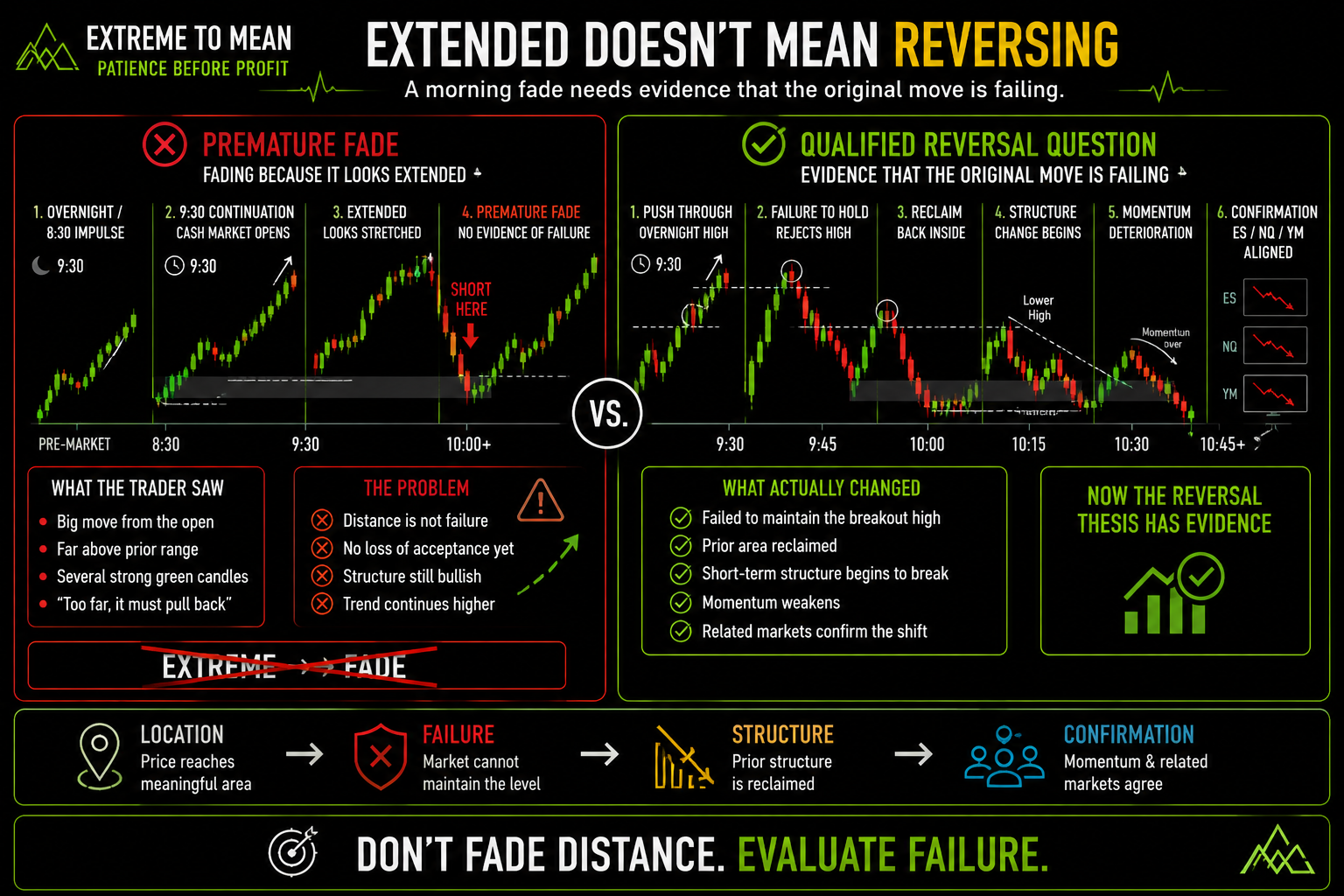
This distinction matters because fading an opening move often feels rational before the evidence exists. Price may be far above yesterday's range, sharply below an overnight reference, or extended after an economic release, making the opposite direction appear attractive simply because the move looks extreme. Yet strong trends frequently look extreme before continuing farther. The trader's job is to determine whether the market is actually changing behavior rather than deciding that distance alone must produce a turn.
Why Important Reversals Can Form Early
The overnight market can carry positioning into the morning that has not yet been tested by full U.S. cash-session participation. A major economic release can then create another rapid repricing before stocks officially open, adding urgency and sometimes substantial distance. At 9:30, the cash session introduces its own order flow and price-discovery process into that existing structure. The result can be confirmation of the overnight direction, a period of negotiation, or a forceful rejection of prices that looked convincing minutes earlier.
That is why pushes through the overnight high or low, prior-session extremes, and other visible references deserve attention during the opening period. A breakout above an important level can be genuine continuation if price accepts the new area and continues building structure there. The same breakout can become exhaustion if the market cannot maintain the extension and rapidly loses the area it just claimed. Time of day makes the interaction worth evaluating, but the behavior around the level determines what the interaction means.
"Too Far" Is Not a Reversal Signal
One of the weakest reversal arguments begins with distance alone. A trader sees a large gap, a fast opening impulse, or several consecutive directional candles and decides that the market has moved too far to continue. That conclusion feels sensible because markets do not move in straight lines forever. The problem is that "extended" describes appearance, not evidence that directional control has changed.
This is where the distinction taught in Reversion Is Not Reversal becomes especially important. A temporary move back toward a mean, moving average, midpoint, or prior structure can occur while the larger directional move remains intact. A genuine reversal requires more than countertrend movement; the market must begin changing the structure that supported the original direction. Without that change, the trader may simply be fading momentum because the chart looks uncomfortable.
Location Makes the Reversal Question More Relevant
A reversal hypothesis becomes more meaningful when the opening move reaches a location that already matters. Prior-day highs and lows, overnight extremes, established support or resistance zones, major session boundaries, and other structural references give the market something identifiable to accept or reject. A turn in the middle of open space may still develop, but it gives the trader less structural information about why the original move is being challenged. Location does not create the reversal, but it improves the quality of the question.
Available room matters on the other side of the turn as well. A bearish rejection from a meaningful high may look clean but still offer little room if important support sits immediately underneath. Likewise, a bullish opening reversal can occur beneath nearby resistance that limits the usefulness of the new direction. This is why room to revert remains part of the evaluation even when the reversal itself looks convincing.
Failure of Acceptance Is the First Important Clue
Consider an upside opening move that breaks an overnight high or prior-day reference. Continuation is still the cleaner interpretation while price can remain above the level, build structure there, and defend attempts to return inside the old area. The reversal question becomes more relevant when the market repeatedly fails to maintain trade above the breakout and begins reclaiming the previous structure. The information comes from losing acceptance, not from the breakout merely appearing large.
The same principle applies after a sharp move lower. A market that briefly trades below an important low and then immediately reclaims it has provided different evidence from one that remains below the level and continues building lower structure. The reclaim does not guarantee a full-session reversal, but it weakens the original continuation argument. A clean evaluation asks what the market failed to maintain before asking how far the opposite move might travel.
Structural Change Separates a Turn From a Reversal
A single countertrend candle is rarely enough to establish that the morning direction has changed. After an upside failure, the trader can watch whether price begins breaking the short-term sequence of higher lows, loses the breakout area, and fails on attempts to regain it. After a downside failure, the reverse process can develop through reclaimed levels, higher lows, and failed attempts to resume the decline. Structural change gives the reversal thesis something more substantial than the color of one candle.
The important point is not to wait for some perfect textbook pattern. Markets can reverse through different sequences, and the exact structure will vary with timeframe and volatility. What matters is that evidence begins moving from "the original trend is intact" toward "the original trend is no longer behaving the same way." Thinking in terms of the three market states helps because reversal is often a transition process before it becomes a clean move in the opposite direction.
Momentum Deterioration Can Support the Read
Momentum can add another layer when the opening impulse begins losing effectiveness. Price may continue making marginal new highs while each push travels less distance, immediately gives back progress, or requires increasingly aggressive effort to extend. A downside move can show the same deterioration through weaker extensions and faster recoveries. These observations can support a reversal thesis, but they should not replace structure and location.
Momentum divergence is especially easy to overstate because traders often search for it after deciding they already want to fade the move. An oscillator, candle pattern, or slowing impulse can remain divergent for a long time while a trend continues. The stronger process starts with what price is accepting and whether structure is changing, then uses momentum deterioration as supporting evidence. Confirmation should add weight to the interpretation rather than manufacture it.
Related Markets Can Expose an Isolated Move
Cross-market behavior can be especially useful in equity-index futures. If NQ pushes through an important morning high while ES and YM are also strengthening and holding comparable structures, the move has broader support than an isolated NQ extension. If NQ makes a fresh high while ES fails to participate and YM is already losing structure, the breakout deserves more scrutiny. Divergence is not an automatic reversal signal, but it can reduce confidence in the idea that broad directional pressure is strengthening.
The same logic works during the turn itself. If one index begins reclaiming structure while the others remain firmly directional, the reversal may still develop but the evidence is incomplete. When several related markets begin failing their opening moves together, the change carries more weight. Broader confirmation helps the trader distinguish an isolated contract-specific fluctuation from a more general shift in the opening environment.
A Cleaner Morning-Reversal Evaluation Process
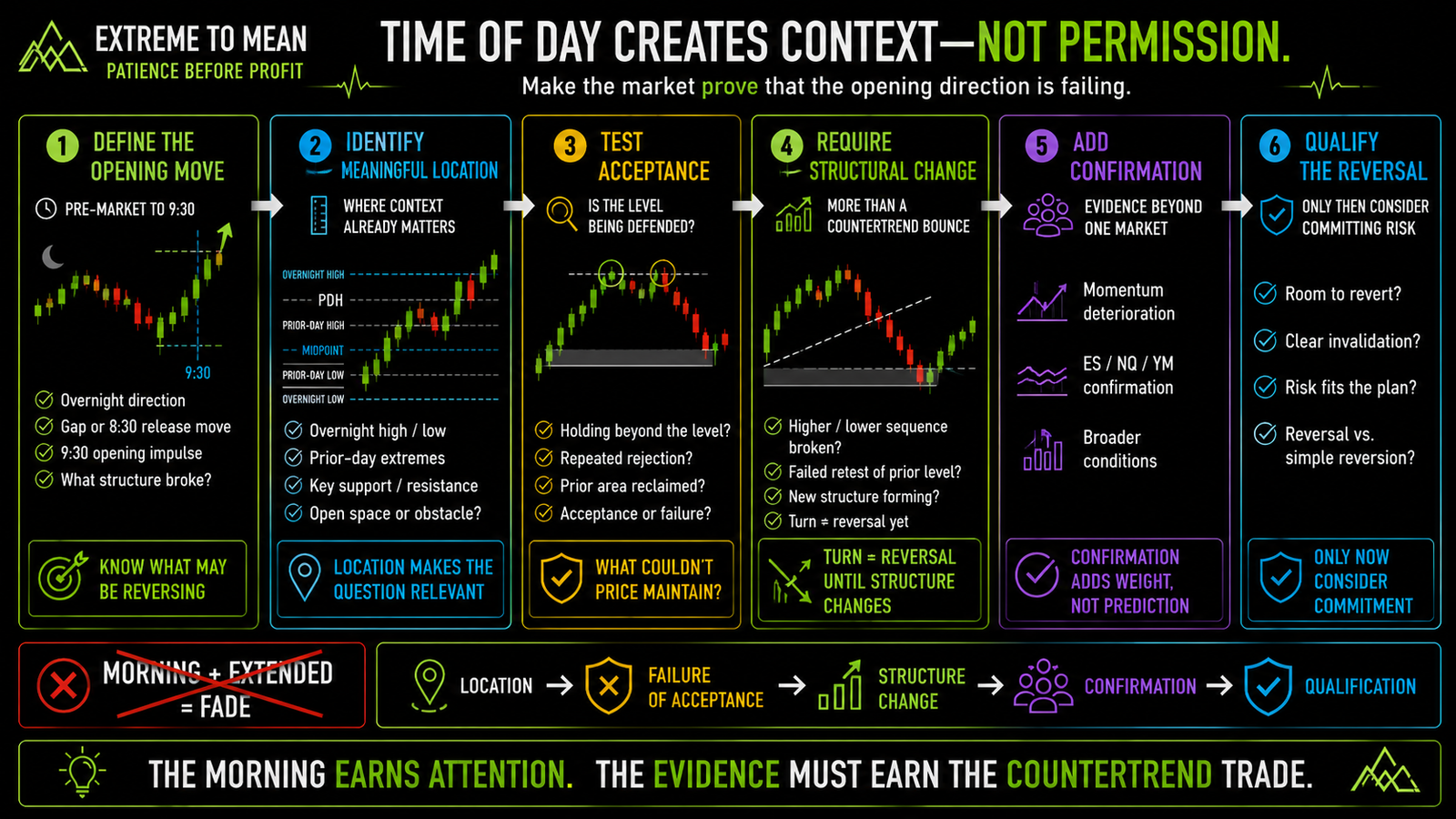
Start with the move that may be reversing rather than with the reversal you hope to trade. Identify where the opening impulse began, what important levels it broke, whether it was being accepted outside prior structure, and how extended it became relative to current conditions. Then watch what happens when the move encounters meaningful location. This creates a baseline against which failure can actually be measured.
Next, require evidence that the original direction is losing control. Look for failed acceptance, structural reclaim, deterioration in continuation attempts, clearer invalidation, and confirmation from related markets where appropriate. Only after that evidence begins to align should the opposite direction graduate from a countertrend idea to a reversal hypothesis worth qualifying. The cleaner question is not "Has price moved far enough to reverse?" but "What has the market actually failed to maintain?"
Better Questions Before Fading the Morning Move
A morning-reversal framework should make it harder, not easier, to justify random countertrend trades. The questions should force the trader to identify evidence that the original direction has changed rather than simply describe why the market looks stretched. They should also separate a meaningful reversal from a temporary reversion inside an intact trend. If the answers remain mostly about distance, emotion, or how unusual the move looks, the reversal thesis probably needs more evidence.
- What meaningful location has the opening move reached?
- Was the move accepted beyond prior structure before it began failing?
- What level or area has price now failed to maintain?
- Has short-term structure actually changed?
- Is momentum deteriorating, or is price merely pausing?
- Are ES, NQ, and YM confirming the change or diverging?
- Is there enough room for the opposite move to develop?
- Where would the reversal thesis be invalidated?
- Am I identifying a true reversal or only expecting reversion?
- Would I still take this trade if the exact same pattern appeared later in the day?
- Has the market earned a countertrend interpretation, or am I fading it because it looks extended?
These questions make trade review more useful because they record the transition from continuation to possible reversal. A trader can later compare cases where the opening move genuinely lost structure with cases where price merely paused and resumed the original direction. That can improve the consistency of future evaluation without turning morning reversals into a rigid formula. The goal is to recognize evidence more clearly, not to predict every intraday high or low.
Final Thought
Major intraday reversals can form during the morning because the opening session is a genuine transition in participation, liquidity, and price discovery. Overnight positioning can be challenged, economic reactions can be reassessed, and apparent breakouts can fail when the cash session refuses to accept the new area. Those conditions make the morning fertile ground for reversal analysis. They do not make every extended opening move a fade.
Let time of day tell you when to pay closer attention, then require location, failed acceptance, structural change, momentum deterioration, and confirmation to do the actual analytical work. For a deeper framework on reading structure and market behavior together, Decode the Market is the natural next step. The morning can create the conditions for a reversal, but the market still has to prove that the original move is failing. Time of day adds context; it does not create permission to countertrend.
Educational content only. Trading involves substantial risk and is not suitable for everyone.