
The Market Can Move Without Giving You a Trade
Markets are almost always doing something. Price pushes higher, reverses, breaks a level, pulls back, accelerates, pauses, and moves again. If movement itself is treated as opportunity, a trader can find a reason to participate almost continuously.
That is why the Setup curriculum has to separate market activity from trade qualification. The fact that price moved does not tell you whether the move occurred in useful context, at meaningful location, with a setup your strategy actually recognizes. Movement earns attention; it does not automatically earn capital.
This sounds obvious when the market is closed. It becomes harder when price moves twenty points without you and the chart makes the missed movement look tradable in hindsight. The trader starts thinking, “There had to be something in there I could have taken.”
Sometimes there was. Sometimes there was not.
More Trades Do Not Automatically Mean More Opportunity
The title of this article does not mean that one trade per day is ideal or that ten trades automatically means overtrading. A legitimate strategy may produce five qualified opportunities during an active session and none during the next one. The correct trade count is whatever the strategy and market conditions actually justify.
This is another reason a setup is not a signal. A chart can generate dozens of things that look interesting without producing dozens of complete trading decisions. The trader still needs context, location, qualification, risk, and enough remaining opportunity before the setup deserves serious consideration.
A trader who takes ten genuinely qualified trades has not violated some universal rule merely because the number is ten. A trader who takes one trade that cannot be explained by the strategy may already have stepped outside the process. Frequency is not the standard. Qualification is.
Ten Moves Can Produce One Trade
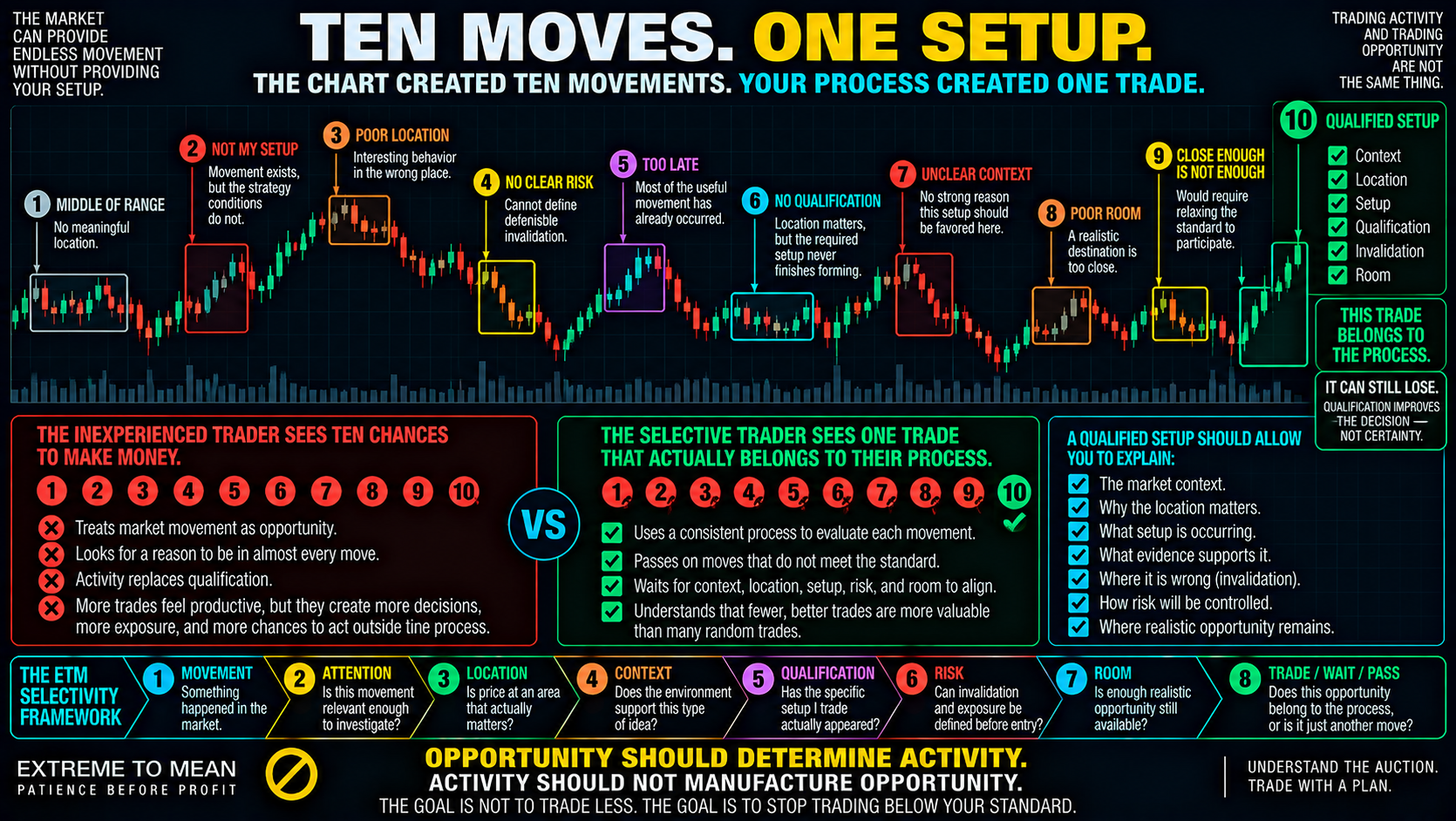
Imagine a morning futures session containing ten obvious price movements. To someone watching every candle, the chart looks full of opportunity. There were breakouts, pullbacks, reversals, bursts of momentum, and several moves that traveled far enough to look impressive afterward.
But look at those ten movements through a defined process. Several happened in the middle of unclear structure. Two became obvious only after most of the useful move had already occurred, two offered poor or undefined invalidation, and one reached a meaningful area but never actually completed the setup.
Then one opportunity develops differently. The market context supports the idea, the location matters, the setup matches the trader’s plan, qualification appears, invalidation is clear, and enough realistic room remains. The inexperienced trader sees ten chances to make money; the selective trader sees one trade that actually belongs to me.
What Makes One Setup Worth Waiting For
A good setup is not “good” because it looks especially beautiful or because someone labels it an A+ trade. It is useful because the trader can explain, before the outcome is known, why the strategy should apply in this particular situation. The reasoning is repeatable enough that another example could be evaluated using the same standard.
That begins with location as the first filter. Why should the trader care about this area instead of every other price on the screen? Then the trader needs to understand the surrounding context, identify the actual setup, and explain what evidence has caused the idea to move from interesting to qualified.
Risk must also survive that evaluation. As ETM teaches, the trade is not ready until the risk is clear, because a setup that cannot identify where the thesis is wrong is not yet a complete trading decision. Finally, enough realistic opportunity has to remain from the price where the trader can actually enter.
The advantage of this structure is not certainty. A fully qualified setup can still lose. The advantage is that the trader can explain why the risk was justified before discovering whether the outcome was favorable.
How “Close Enough” Turns Into Random Trading
Random trading does not always look reckless. It often begins with a trade that is almost reasonable. The location is close enough, the setup sort of resembles the trader’s normal pattern, or the market has been quiet long enough that a mediocre opportunity starts looking better than it did ten minutes earlier.
That is when the standard begins drifting. “This is my setup” becomes “this is close to my setup,” and eventually the trader is taking positions because something is moving rather than because the strategy has actually appeared. The decision may still contain analysis, but the reasoning is no longer consistently tied to the source of the trader’s supposed edge.
A useful definition of a random trade is therefore not simply “a trade taken without thinking.” It can be a trade for which the trader cannot clearly and consistently explain why the strategy should have an advantage in this specific context. The trader may have plenty of reasons; the problem is that those reasons change every time the chart changes.
The better question is: Would I take this exact setup if I had not been sitting here waiting for something to trade? That exposes how often scarcity, boredom, or recent movement quietly lowers the bar.
Selectivity Protects Attention Too
Every trade creates work. Once the trader enters, attention shifts toward monitoring the position, managing risk, interpreting new movement, considering exits, and deciding what to do after the trade is over. Even a marginal trade creates the same basic decision tree.
That matters because attention is finite. A trader who is constantly involved in mediocre positions may be mentally occupied when a much cleaner setup begins developing elsewhere or later in the same market. The cost of unnecessary participation is therefore not only the capital exposed on those trades; it is also the decision-making attention they consume.
The point is not that a particular number of trades causes fatigue. There is no universal threshold. The cleaner principle is that every trade should justify the attention and risk it requires, rather than being taken simply because the trader wants to remain involved.
A Missed Move Is Not Proof Your Rules Were Too Strict
One of the hardest parts of selectivity is watching price make a beautiful move without ever providing your setup. The chart can look obvious afterward, and hindsight creates a powerful temptation to loosen the rules next time. The trader sees what happened and assumes that not participating must mean something was wrong with the process.
That conclusion does not follow. A move can be real, large, and completely tradable under somebody else’s strategy while still never becoming your trade. The market does not have to organize every profitable movement around the specific conditions you have chosen to test and execute.
This is where doing nothing is still a trading decision. Passing on a move because it never met your standard is different from freezing in front of a setup that did meet it. One is process; the other may be an execution problem.
A missed move should therefore trigger a review, not an automatic rule change. Ask whether the setup actually existed under the rules you had before the move. If it did not, the later price action does not retroactively create one.
Some Days Give You Several Trades. Some Give You None.
Selectivity requires accepting uneven activity. Some sessions may produce several clean setups that fit the strategy almost back to back. Other sessions may provide one opportunity in six hours, and some may provide none.
A trader cannot demand equal opportunity from unequal market conditions. If the strategy requires meaningful location, specific behavior, definable invalidation, and sufficient room, then trade frequency naturally changes as those conditions appear more or less often. That variability is not a flaw in the process.
This is where Patience Before Profit becomes practical. Patience is not choosing an artificially low number of trades because fewer somehow sounds more disciplined. It is allowing the market to determine how often your specific opportunity actually exists.
If five legitimate setups appear, the lesson is not to ignore four because “one good setup is enough.” If zero appear, the lesson is not to manufacture one because you planned on trading that day.
Good Decisions and Good Outcomes Are Different
Suppose the one qualified setup from our ten-move example loses. At the same time, imagine that one of the marginal trades the selective trader rejected would have made money. Does that prove the trader chose incorrectly?
No. The quality of the decision has to be judged using information available before the outcome. The qualified setup had context, location, a repeatable setup, clear invalidation, controlled risk, and realistic opportunity; the random trade lacked enough of that structure to justify it consistently.
A good setup can lose. A random trade can win. If winning outcomes are allowed to redefine weak decisions as good ones, the trader will eventually train themselves to trust luck, hindsight, and improvisation instead of a process they can actually repeat.
The ETM Selectivity Framework
The purpose of this framework is not to reduce trading activity for its own sake. It is to prevent the desire for activity from lowering the qualification standard. Each stage asks whether the movement on the screen is getting closer to your trade.
- Movement — Something happened in the market.
- Attention — Is that movement relevant enough to investigate?
- Location — Is price interacting with an area that actually matters?
- Context — Does the current market environment support this type of idea?
- Qualification — Has the specific setup required by the strategy appeared?
- Risk — Can invalidation and exposure be defined before entry?
- Room — Is enough realistic opportunity still available?
- Trade / wait / pass — Does this opportunity belong to the strategy, or is it simply another market move?
The condensed process is Movement → Attention → Location → Context → Qualification → Risk → Room → Trade / Wait / Pass. The filter should remain the same whether the market has offered nothing all morning or already produced three good setups. Do not lower the standard because opportunity feels scarce.
The better question is: “Am I measuring opportunity by the number of moves I see—or by how many actually meet my standard?” That keeps the trader focused on the source of the decision rather than the amount of movement happening on the screen.
Final Thought
The goal is not fewer trades. The goal is fewer trades that never deserved to exist.
Markets will continue moving whether your setup is present or not. Some days your strategy may produce several legitimate opportunities, while other days it may produce one or none. Trying to force the same amount of activity from every session does not create more edge; it only lowers the distance between what your process requires and what you are willing to accept.
One clearly qualified setup is more useful to a repeatable process than ten trades invented because the market kept moving. That qualified setup can still lose, and one of the random trades can still win. What matters is whether you could explain the decision—context, location, qualification, risk, and opportunity—before the outcome was known.
Opportunity should determine activity. Activity should never manufacture opportunity. If trading too much is becoming the thing that pushes you below your own standards, the broader trading-too-much problem is the next place to examine why participation itself can start replacing selectivity.
Educational content only. Trading involves substantial risk and is not suitable for everyone.