
Why “More Buyers Than Sellers” Is the Wrong Starting Point
Suppose 500 ES contracts trade. Five hundred contracts were bought and five hundred were sold, so the completed transaction cannot contain more buying contracts than selling contracts. What can differ is urgency: buyers may repeatedly accept the ask, or sellers may repeatedly hit the bid.
That distinction is the foundation underneath much of the Market curriculum. Footprints, delta, CVD, tape reading, and absorption become easier to understand once we stop asking whether buyers or sellers existed and ask who demanded immediate execution. Order flow measures initiative, not the existence of counterparties.
Passive and Aggressive Orders in Plain English
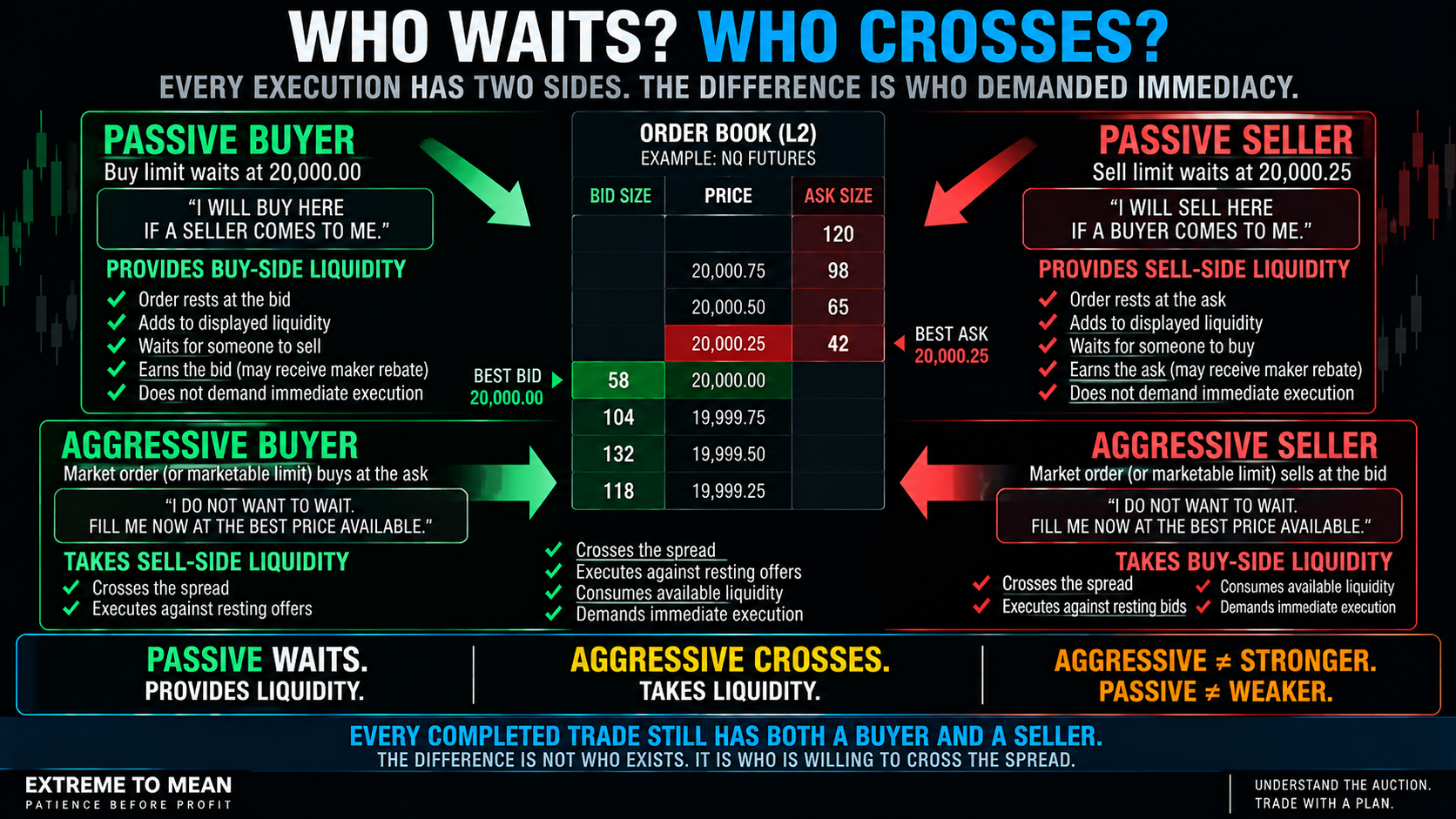
Imagine NQ is quoted at 20,000.00 bid and 20,000.25 ask. A trader places a buy limit at 20,000.00 and waits for a seller to trade with them; that resting order is providing liquidity. The trader is effectively saying, “I will buy here, but I am willing to wait.”
Another trader wants to buy now and accepts the 20,000.25 ask. Their marketable order executes against sell orders already resting there, so they are taking liquidity. Their urgency, not their opinion or identity, is what makes the behavior aggressive.
The words describe execution behavior, not personality or sophistication. “Aggressive” does not mean reckless, bullish, institutional, or correct, while “passive” does not mean timid, bearish, retail, or weak. Either kind of trader can use either behavior depending on the job they are trying to accomplish.
Market Order vs. Limit Order Is Not the Whole Story
Market orders are aggressive by design because they seek immediate execution against available opposing liquidity. A resting limit order is passive, but a limit order can also be marketable: if the ask is 20,000.25 and a trader submits a buy limit at 20,000.50, it may execute immediately against offers at or below the limit. That is why resting vs. marketable is more precise than simply saying limit vs. market.
How Aggressive Orders Move Through Available Liquidity
Consider a simplified order book with 20 contracts offered at 20,000.25, 30 at 20,000.50, and 40 at 20,000.75. If an aggressive buyer needs 70 contracts immediately, the first 20 can execute at the best ask, the next 30 at the next offer, and the remaining 20 at the third level. The average fill is above the original best ask because the order consumed more liquidity than one level could provide.
Price did not rise because sellers disappeared. Sellers existed at every executed level, but buying urgency consumed available sell liquidity at lower prices and had to transact against higher offers. The broader auction-and-liquidity framework is built on this interaction between urgency and available counterparties.
Providing Liquidity vs. Taking Liquidity
A liquidity provider posts executable interest and waits, while a liquidity taker submits a marketable order that immediately consumes quantity already available. You do not have to be a professional market maker to provide liquidity; a discretionary trader with a resting limit is providing liquidity at that moment. A participant can also switch roles by canceling a resting order and later crossing the spread when urgency changes.
Price Movement Is Aggression Interacting With Liquidity
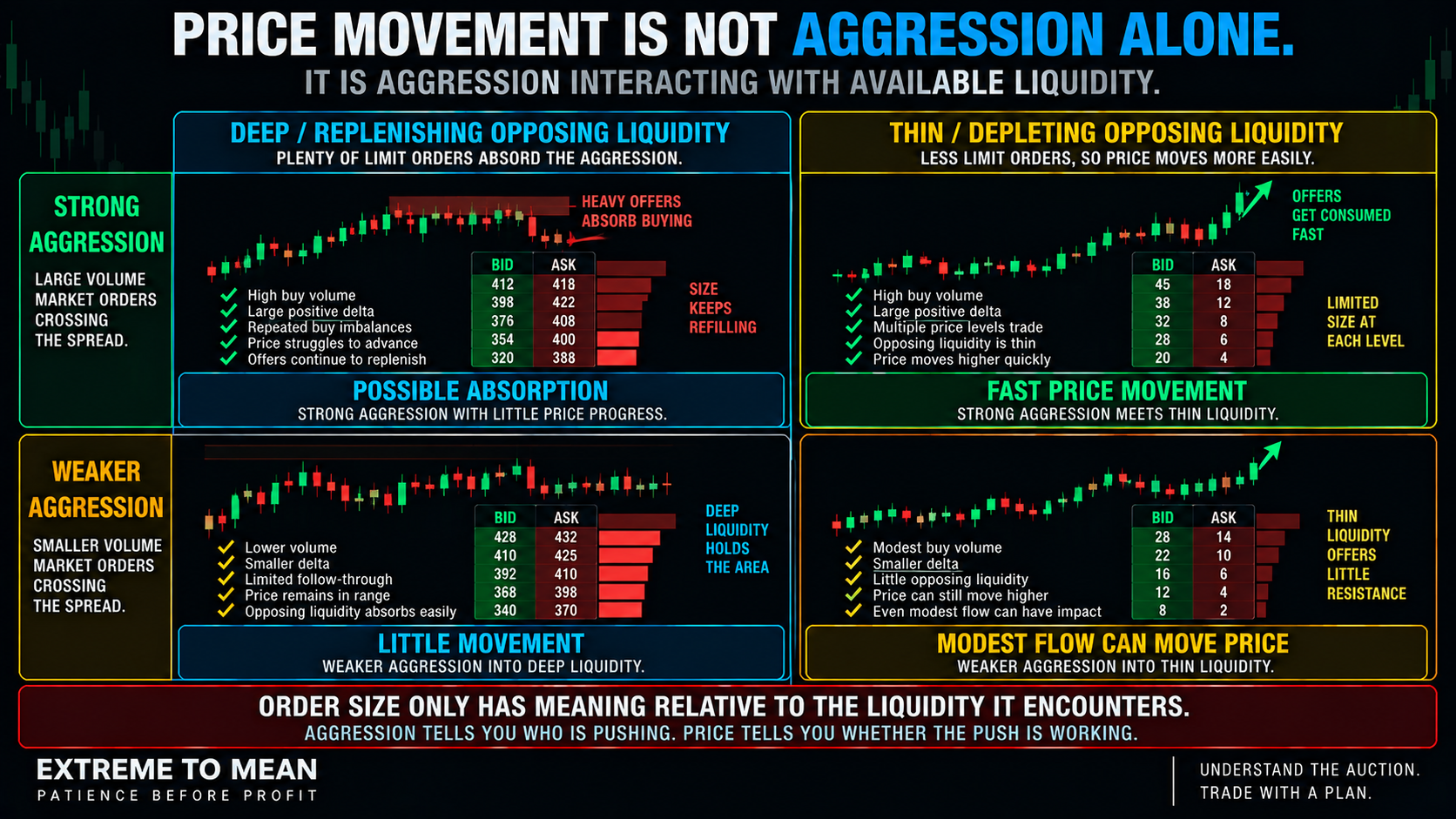
Aggressive flow is only half of the equation. Strong buying into thin offers can move price quickly, while equally strong buying into deep or replenishing sell liquidity can produce very little progress. Even modest buying can move price surprisingly far when little opposing liquidity is available.
That is why volume and liquidity are related but not interchangeable. Volume tells us how much actually traded; liquidity concerns how easily trading can occur without requiring large price changes. A market can transact enormous volume around one area and barely move, or move sharply on much less volume when the book is thin.
Aggression Does Not Mean Control
Suppose buyers repeatedly lift the ask near a prior high. If offers are consumed faster than sellers replace them, price may continue higher; if sellers keep replenishing, the same aggressive buying may produce little progress. The aggression is real in both cases, but control has to be judged through price response.
The same logic applies to aggressive selling. Heavy selling can push rapidly lower when buy liquidity is shallow, or stall when passive buyers keep accepting the flow. Aggression tells us who is pushing; price tells us whether the push is working.
This is one reason the market comes first. A large positive delta can coexist with failed upside progress, just as a large negative delta can coexist with a market that refuses to break lower. The order-flow statistic does not outrank the auction it is trying to describe.
Displayed Liquidity Is Not Executed Business
The DOM or market-depth display shows resting interest that is currently visible, and those orders can be added, changed, filled, or canceled. Tape, footprints, and delta describe transactions that actually executed. A large wall that disappears without trading is therefore different from heavy execution against an area that produces very little price progress.
Why This Explains Footprints, Delta, CVD, and Absorption
A footprint reorganizes executed activity by price, so ask-side volume generally represents transactions classified as aggressive buying and bid-side volume represents aggressive selling. Delta summarizes the difference between those classified aggressive volumes, while CVD accumulates that difference through time. None of those tools means that “more buyers existed.”
Passive strength is harder to summarize with one number because resting orders can change, replenish, include hidden quantity, or never execute. We often infer its importance from the response to aggression: huge buying plus little upside progress describes a different auction from modest buying plus rapid upside movement. Aggression is easier to count; passive strength often reveals itself through what aggression fails to accomplish.
That is also the mechanics underneath absorption. Strong aggression can keep hitting an area while opposing passive liquidity continues meeting it, producing heavy execution with surprisingly little price progress. The observation describes the interaction, not the identity or motive of whoever is providing the liquidity.
The Execution Trade-Off: Price Control vs. Fill Certainty
Passive and aggressive execution solve different problems. A resting order gives more control over acceptable price but introduces uncertainty about whether it will fill, especially when other orders are ahead in the queue. Being right about the price does not guarantee participation.
A marketable order prioritizes getting filled, but the trader gives up some control over the exact average price. In shallow or fast conditions it can execute across multiple levels and create slippage. Neither method is automatically superior; execution should match the strategy, urgency, liquidity, volatility, and risk plan.
| Behavior | Main Benefit | Main Cost or Risk |
|---|---|---|
| Passive / resting | More price control | May not fill; queue and adverse-selection risk |
| Aggressive / marketable | Greater execution urgency | Spread/slippage; less exact price control |
The spread is part of the cost of immediacy. A passive buyer may wait at the bid, while an aggressive buyer crosses to the ask because getting filled now matters more than waiting. Good execution is not always passive or aggressive; it is execution that matches the job the trade requires.
Market Conditions Still Matter
The same order size can have a very different effect overnight, near a major session open, during midday, or around scheduled news because available liquidity changes. Around fast events, resting liquidity may thin while marketable activity surges, which can produce rapid movement and worse execution. Market conditions change the quality of a setup, and they also change the price impact of order flow.
The ETM Passive-vs.-Aggressive Framework
Microstructure is useful when it helps us understand the auction without replacing the trading process. Work from available liquidity to execution, then judge what the execution accomplished before deciding whether it matters to a setup. The order-flow mechanics should improve the question rather than manufacture the trade.
- Order book: What liquidity is currently available?
- Urgency: Which side is willing to cross the spread?
- Execution: Where are trades actually occurring—bid or ask?
- Liquidity response: Is opposing liquidity being depleted, replenished, or withdrawn?
- Price response: How much progress does that aggression create?
- Context: Is this happening at a meaningful location and in a relevant market environment?
- Interpretation: Is aggression succeeding, failing, being absorbed, or disappearing?
- Trade thesis: Does the observation contribute to an actual setup?
- Invalidation: What price behavior proves the idea wrong?
- Risk: Can the position be taken responsibly?
The condensed version is Liquidity → Aggression → Execution → Response → Price → Decision. It connects market depth, tape, footprints, delta, CVD, and absorption without pretending any one tool reveals the complete auction. It also keeps the trader focused on evaluate → qualify → define risk → decide.
The better question is not, “Are buyers or sellers stronger?” Ask instead, “Who is demanding immediate execution, what liquidity are they meeting, and what price progress are they getting for that urgency?” That keeps the observation specific enough to improve preparation and trade review without pretending aggressor classification predicts the future.
Final Thought
Passive and aggressive orders are the basic mechanics underneath order flow. Passive orders provide executable liquidity by waiting at a price, while aggressive orders take available liquidity because immediate execution matters more than waiting. Neither side is automatically smarter, stronger, institutional, or correct.
The useful information comes from the interaction. How much aggression arrived, how much liquidity opposed it, whether that liquidity replenished or disappeared, and what price did as a result tell us more than the words “buying” or “selling” alone. This is why the same aggressive flow can create a fast move in one environment and almost no movement in another.
Understand that relationship and footprints, delta, CVD, absorption, tape reading, and market depth all become easier to interpret. Use microstructure to understand how the auction is happening, then let context, setup qualification, invalidation, and risk determine whether the information belongs in a trade. That process-first hierarchy is part of the broader Extreme to Mean system.
Educational content only. Trading involves substantial risk and is not suitable for everyone.