
What makes price stretch away from the mean looks more closely at how pressure and liquidity can keep an extended move going.
Many newer traders look at a chart and see candles, indicators, patterns, and color. Green feels strong. Red feels weak. A breakout feels exciting. A selloff feels dangerous. The Market lessons look beneath all of that at something much simpler: where buyers and sellers are willing to do business.
That is the auction, and the deeper guide to Auction Market Theory explains balance, imbalance, acceptance, and rejection within that process.
Price moves because there is an imbalance between aggressive buyers and aggressive sellers. It pauses when two-sided trade becomes more balanced. It accelerates when one side becomes trapped, stops get triggered, or liquidity gets taken. It reverses when the market runs out of willing participation in one direction and finds stronger interest in the other. Learning the three market states helps organize those shifts.
The problem is that most traders do not experience this process calmly. They experience it emotionally. They see a sharp move and feel like they are missing something. They see price running away and assume the market “knows” something before the news makes sense. They chase because the move looks obvious after it has already happened.
That mistake feels reasonable in the moment because the chart gives the illusion of certainty. But the trader’s job is not to react to motion. The trader’s job is to evaluate location, context, participation, and risk before deciding whether the setup has earned attention.
The Market Is an Auction, Not a Signal Machine
The stock market is not a machine designed to hand out clean signals. It is an auction where buyers, sellers, and other market participants constantly test price. Every candle represents a negotiation. Every push higher asks, “Are buyers still willing to pay more?” Every push lower asks, “Are sellers still willing to accept less?”
When price moves higher, it usually means buyers are willing to lift offers more aggressively than sellers are willing to absorb. When price moves lower, sellers are more aggressive than buyers at that moment. But that does not automatically mean the move is healthy, early, or worth chasing.
A market can move higher because real demand is building. It can also move higher because shorts are covering, stops are being triggered, or liquidity above a prior high is being swept. A market can move lower because sellers are in control. It can also move lower because weak longs are being forced out before price stabilizes.
This is why direction alone is not enough. A candle can tell you where price went, but context comes before the candle when deciding why it went there or whether the move is still clean. A trader needs to ask what the auction is doing, where it is doing it, and whether the current location offers a reasonable decision.
At Extreme to Mean, this matters because location comes before direction. A move at the wrong location can be emotionally attractive but structurally poor. A move at a better location may be less exciting, but it gives the trader more useful information to work with.
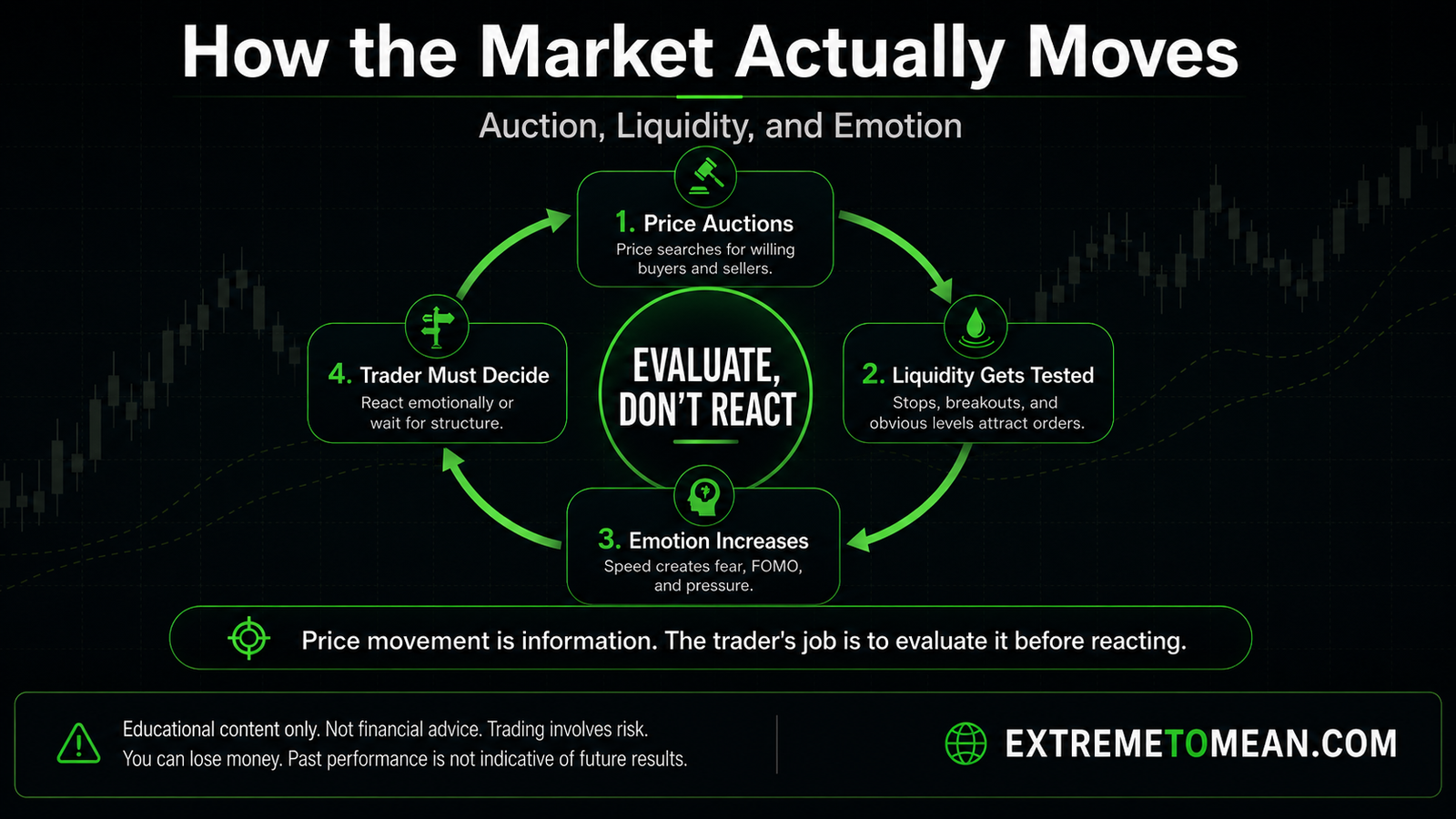
Liquidity Is the Fuel Behind Many Fast Moves
Liquidity is one of the most important concepts traders can learn, but it is often explained in a confusing way. In plain English, liquidity is where orders are likely to exist. These can be stop orders, breakout orders, resting limit orders, or areas where many traders are expected to make decisions. The DOM and market-depth guide separates displayed resting orders from completed transactions.
Common liquidity areas include prior highs, prior lows, opening range levels like the ones covered in Initial Balance trading, obvious support and resistance, round numbers, trendline breaks, and areas where price has recently reversed. These spots matter because traders tend to cluster their decisions around visible levels.
When price pushes into one of these areas, the move can speed up. That speed does not always mean the market is beginning a clean new trend. Sometimes it means the auction is reaching for orders. Price may run above a prior high, trigger buy stops, pull in breakout traders, and then stall if there is not enough fresh demand to continue.
The same thing can happen below a prior low. Price may drop into stops, trigger fear, attract late sellers, and then recover if the selling pressure dries up. To the trader watching in real time, this can feel confusing or even unfair. But from an auction perspective, the market tested a liquidity area, found participation, and then revealed whether that participation was strong enough to continue.
This is where patience matters. If a trader treats every breakout as truth, they can be pulled into weak locations. If a trader treats every breakdown as disaster, they can sell into exhaustion. Liquidity helps explain why obvious levels often create emotional decisions.
The better question is not, “Is price breaking out?”
The better question is, “What liquidity is price reaching for, and how is price reacting after it gets there?”
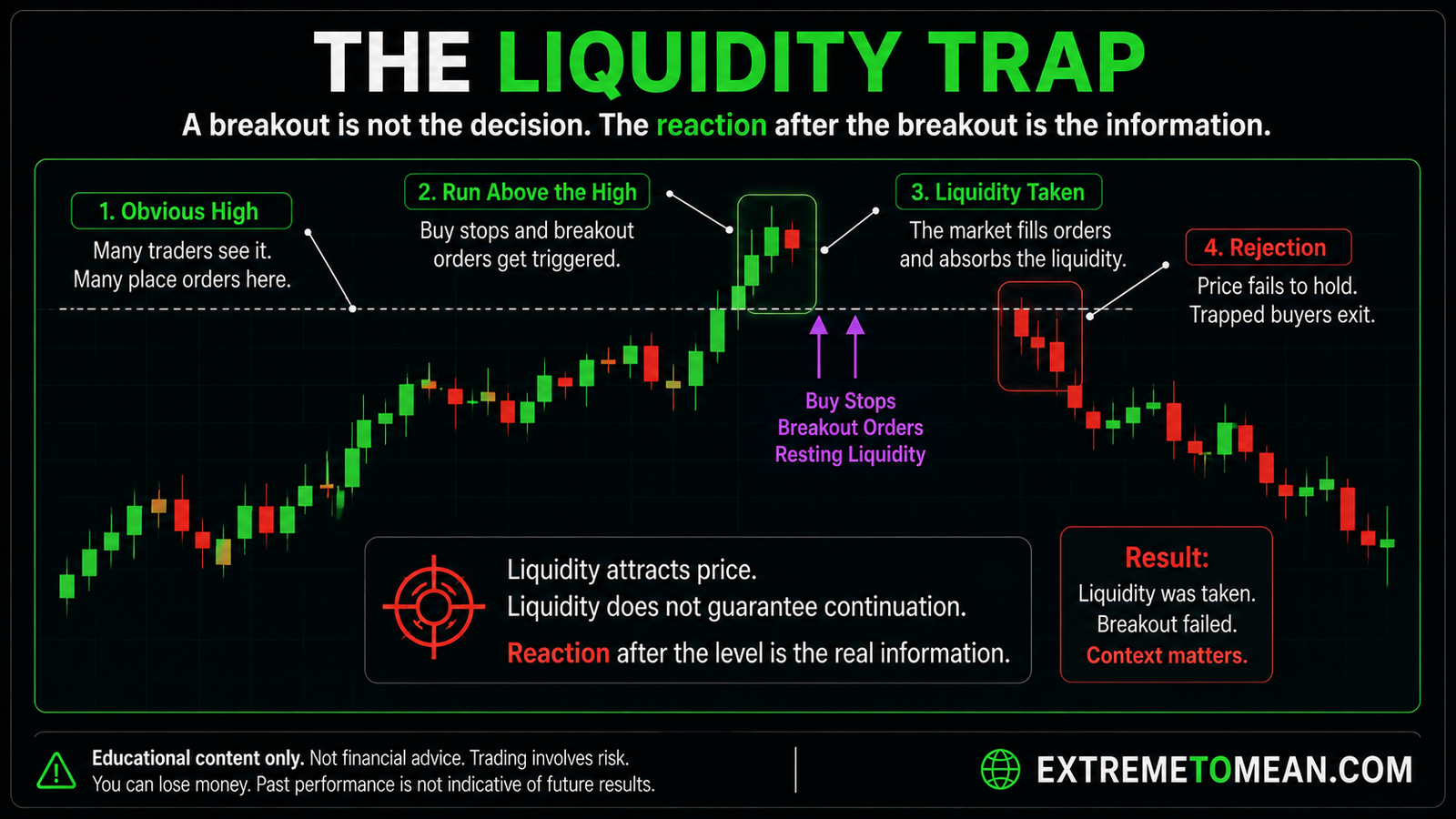
Emotion Turns Movement Into Pressure
The auction itself is not emotional. Traders are.
A strong move creates pressure because it changes how the trader feels about time. When price moves quickly, patience starts to feel like hesitation, and FOMO becomes the tax you pay for chasing. A trader may know the plan, but the speed of the move makes the plan feel too slow.
This is one of the most common process breakdowns in trading. The trader stops evaluating and starts reacting. Instead of asking whether the setup is clean, they ask whether they can still get in. Instead of measuring location, they focus on not being left behind. Instead of defining risk first, they enter and hope they can manage it later.
That behavior is understandable. Fast markets are designed to create discomfort. Green candles make traders feel late. Red candles make traders feel exposed. Reversals make traders doubt their read. Chop makes traders force action because they want the market to “do something.”
But emotion is not a trading signal. It is information about the trader, not proof about the market.
This is why a calm process matters. The trader does not need to predict every move. The trader needs to recognize when emotion is pushing them away from their rules. If the only reason for entering is that price is moving fast, that is usually not a complete decision. It may be a reaction wearing the mask of confidence.
Better decision quality starts when the trader can pause long enough to separate market information from internal pressure. Price movement matters, but the trader’s response to that movement matters just as much.
The Biggest Mistake Is Chasing After the Auction Has Already Moved
Chasing usually begins with a reasonable observation. Price is moving. Volume may be increasing. A level may be breaking. Other traders may be talking about the move. The setup may even look obvious on the chart.
The problem is not noticing movement. The problem is entering after the clean part of the decision has already passed.
When a trader chases, several things often happen at once. The entry is farther from the original structure. The stop becomes wider or less logical. The target becomes less balanced relative to the risk. The trader becomes more emotionally attached because they entered from pressure rather than process.
This is why chasing feels exciting before the entry and stressful after the entry. Before entering, the trader feels urgency. After entering, the trader realizes the market now has to continue immediately for the trade to feel comfortable. If price pauses, pulls back, or rotates, the trader is suddenly stuck managing a position from a weaker location.
That does not mean every late entry fails. It means late entries often come with lower decision quality. The trader may be right about direction and still make a poor trade because the location, structure, and risk were not clean.
Extreme to Mean focuses heavily on this distinction. A good market idea is not automatically a good trade. A move can be real and still be too extended. A level can break and still be vulnerable to a trap. A trader can understand the direction and still need to wait for better conditions.
The mistake feels reasonable because the trader is reacting to evidence that appears strong. But stronger movement is not always stronger opportunity. Sometimes it simply means the cleaner opportunity has already passed.
A Better Trader Watches Reaction, Not Just Direction
A better trader does not need to catch every move. The focus is on understanding what price is doing at important locations and whether the reaction creates a cleaner decision.
Instead of asking, “Where is price going?” the trader can ask, “Where is price trading from?” That one shift changes the entire decision process because the market comes first, before action.
For example, if price pushes into a prior high, the trader should not automatically assume continuation. The trader can watch how price behaves after the level is tested. Does it hold above the level and attract more buying? Does it reject quickly and trap breakout traders? Does it pause and build structure? Does it return back inside the prior range?
The same applies near lows, moving averages, supply zones, demand zones, opening ranges, or reversion areas. The location is not a command to trade. It is a place to pay closer attention.
This is where patience becomes practical. Patience is not doing nothing forever. It is waiting for the market to provide enough structure to make the decision cleaner. Sometimes that means waiting for confirmation. Sometimes it means waiting for price to return to a better area. Sometimes it means not trading because the auction is messy and the risk is not clear.
A better decision is cleaner because it is based on observable conditions instead of emotional pressure. The trader can define the level, explain the context, identify the invalidation point, and understand why the setup has earned attention. That still does not guarantee the outcome. It simply means the trader is making a more structured decision.
A Practical Filter Before Acting
Before entering a trade, especially after a fast move, the trader should slow the decision down. The goal is not to remove uncertainty. The goal is to avoid acting before the setup is complete.
Use this simple filter:
- Auction: What is price currently testing?
- Liquidity: Is price moving toward obvious stops, highs, lows, or breakout areas?
- Emotion: Am I interested because the setup is clean, or because I feel late?
- Location: Is this entry near structure, or am I chasing away from it?
- Risk: Can I define where the trade idea is wrong before entering?
- Reaction: How did price behave after reaching the important area?
- Decision: Has the setup earned risk, or only attention?
That last question matters. Not every interesting move deserves a trade. Some moves deserve observation. Some deserve preparation. Some deserve no action at all.
A trader can also use one better question before acting:
“If I were not already emotionally pulled into this move, would this still be a clean trade from this location?”
That question does not predict the future. It forces honesty. It helps the trader identify whether the decision is based on structure or urgency. If the answer is no, the better trade may be to wait.
Waiting is not weakness. Waiting is part of the job.
Final Thought
The stock market moves through auction, liquidity, and emotion. Price searches for participation. Liquidity often fuels sharp moves. Emotion pressures traders to act before the decision is clean.
The trader’s job is not to predict every move or react to every candle. The trader’s job is to evaluate what price is testing, where the liquidity may be, how the market reacts, and whether the setup offers enough structure to justify risk.
Better trading starts when movement alone is not enough. Traders can use macro context before the trade to build a broader view.
Patience Before Profit.
For a plain-English foundation, it helps to understand how buyers, sellers, and price interact in a market.
The order choices behind those decisions are covered in market, limit, and stop orders.
The bid, ask, and spread further explain where a trade actually meets the market.
When liquidity thins, slippage can make the fill price differ from the quote.
The same auction can be read through an individual stock or a broader benchmark, so it also helps to know what an index actually represents.
The next step is understanding why liquidity matters around obvious price levels.
Participation can be measured more directly through what market breadth reveals beyond price alone.
Educational content only. Trading involves substantial risk and is not suitable for everyone.