
Previous day high (PDH) and previous day low (PDL) are simple reference points with an important limitation. They show where the prior session reached an outer boundary, but they do not tell you what today’s market must do when price returns. A prior high is not automatically resistance, and a prior low is not automatically support. The level tells you where to pay attention; the interaction tells you whether anything actionable is developing.
This is why PDH and PDL belong naturally inside The Setup. They help answer where a meaningful interaction may occur, not whether a trade should be taken. A patient trader waits to see whether price rejects, accepts, briefly sweeps, fails, or continues through the area. The trader’s job is to evaluate, not react.
First, Define What “Previous Day” Means
For futures traders, “previous day” needs a consistent session definition because equity-index futures trade beyond regular U.S. cash-market hours. Your platform may show the prior regular-session high and low, a broader futures-session high and low, or both. Either can be useful if it matches your process, but changing definitions from one day to the next makes review less reliable. Decide what PDH and PDL mean on your chart before the market reaches them.
This matters because two traders can mark different “previous day highs” on the same futures contract. If overnight trade exceeded the prior cash-session high, the chosen session definition changes the actual level being evaluated. Preparation removes that ambiguity before live decision-making begins. The larger lesson connects directly to why location is the first filter: define the location first, then evaluate the behavior around it.
Why Yesterday’s Extremes Matter Without Becoming Mystical
The mistake is turning “worth watching” into “must hold.” PDH can reject price on one visit, accept trade above it on another, or be crossed several times before the market chooses direction. PDL can behave the same way in reverse. The trader should therefore read the interaction instead of assigning a fixed support-or-resistance label in advance.
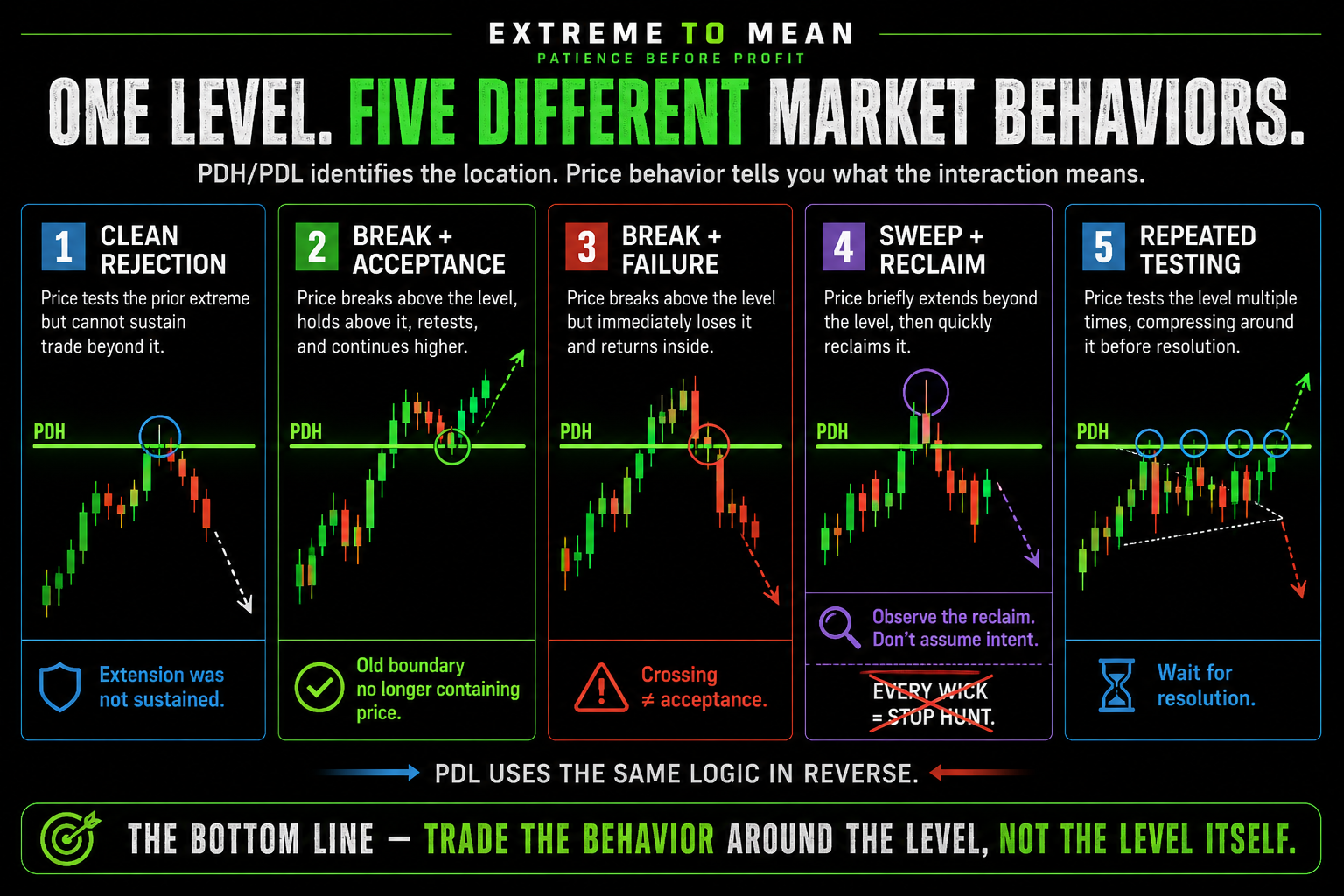
Five Ways Price Can Behave at PDH or PDL
A clean rejection occurs when price tests the prior extreme but cannot sustain trade beyond it. At PDH, price may push into or slightly above the level, return below it, and continue failing to reclaim the area. At PDL, the logic is reversed. The information is not that the line “worked,” but that extension beyond the prior boundary was attempted and not sustained.
A break and acceptance tells a different story. Price moves beyond the level and continues to conduct business there rather than immediately returning inside the prior range. Traders may look for time beyond the level, successful retests, continued structure in the breakout direction, and participation from related markets. The more price behaves as though the old boundary is no longer containing it, the weaker the automatic fade argument becomes.
A break and immediate failure occurs when price crosses the level but cannot remain beyond it. The initial movement can attract a trader who mistakes motion for confirmation, only to see price return inside the prior range. That failure does not guarantee a reversal across the entire range. It simply weakens the evidence for immediate continuation and forces the breakout thesis to be reevaluated.
A liquidity sweep and reclaim can resemble a failed breakout, but the label should be used carefully. Price may trade beyond an obvious extreme, trigger orders around that price, and then reclaim the level, yet the chart does not reveal the full intent or exact inventory behind the move. The practical observation is that price explored beyond the boundary and did not sustain the exploration. Calling every wick a “stop hunt” adds certainty the evidence does not provide.
Repeated testing is the fifth behavior and often the least comfortable. Price can test PDH several times, pull back, return, and compress around the area before either breaking and holding or failing back into the range. Repeated touches do not create an automatic rule that the level must weaken or strengthen. Watch how price responds after each test and whether acceptance is building around the boundary.
Acceptance Matters More Than the First Break
The first trade above PDH or below PDL is information, but it is not proof of continuation. A trader who treats the first print beyond the level as confirmation may be reacting before the market has shown whether it can sustain the move. Waiting for evidence of acceptance can help separate a location event from a qualified breakout idea. The question is not simply whether price crossed the line, but what happened after it crossed.
The same standard applies to rejection. A wick through PDH followed by one red candle is not automatically a short setup, just as a dip below PDL followed by one green candle is not automatically a long. Rejection becomes more useful when subsequent behavior continues to support it and the surrounding structure agrees. This is the same reason a setup is not a signal: one event should not do the work of the entire decision.
Cross-Market Confirmation Can Change the Reading
Equity-index futures can provide useful cross-market context because YM, ES, and NQ reflect different parts of the broad U.S. equity market. If YM breaks PDH while ES and NQ are also showing strength through comparable reference areas, the move has broader confirmation than a YM-only break. That still does not guarantee continuation. It simply gives the trader more evidence when judging whether the move is isolated or broadly supported.
Now consider YM briefly trading above PDH while ES remains below its own key area and NQ is failing to advance. YM may still continue, but the lack of participation elsewhere gives the trader a reason to be more cautious about calling the move broad strength. Instead of reacting to the breakout candle, ask whether related markets are confirming, diverging, or simply mixed. Confirmation should improve interpretation, not become another automatic signal.
Why the Weaker Decision Feels Reasonable
PDH and PDL create a powerful shortcut because the decision appears obvious. Price is at yesterday’s high, so fading it feels like selling resistance; price breaks yesterday’s high, so buying feels like joining strength. The trader can build a complete story in seconds because the reference line is clean. That speed is precisely why the decision needs a process around it.
Another weak decision is changing the story after entry. A trader fades PDH because it is “resistance,” watches price accept above it, and then decides the move is only a stop run that must come back. Flexibility is valuable while evaluating new evidence, but endless reinterpretation after commitment can become refusal to recognize invalidation. Define beforehand which behavior supports the idea and which behavior says it is no longer working as expected.
A Cleaner PDH/PDL Evaluation Process
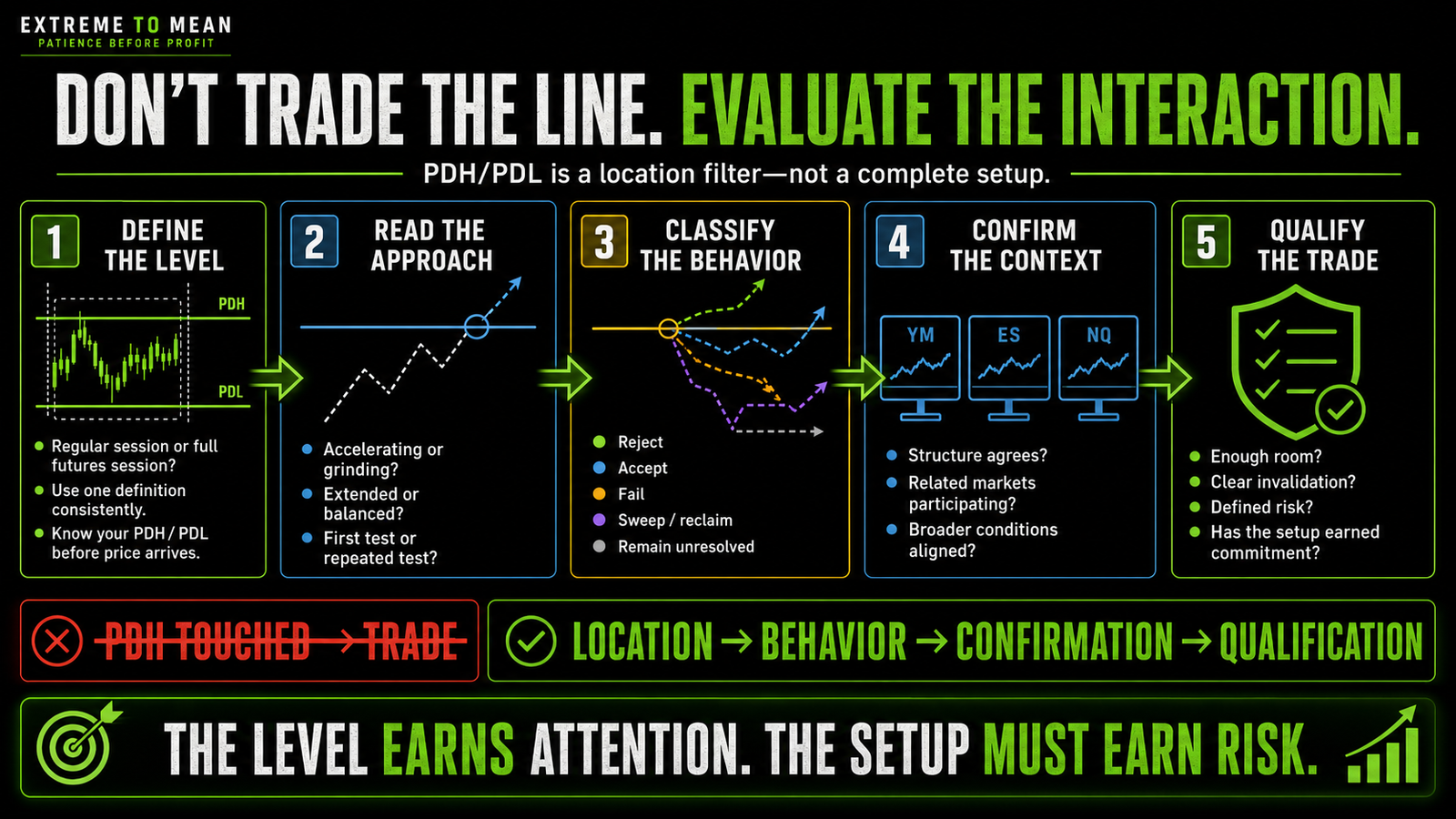
Start with location, but do not stop there. Before price arrives, know which session definition you are using, the broader market state, and nearby structures that could affect the trade. Then watch the approach and classify the interaction: rejection, acceptance, failure, sweep/reclaim, or repeated testing. This gives the decision a sequence instead of reducing it to “price touched the line.”
Next, add confirmation and trade qualification. Check whether structure and related markets support the interpretation, then consider the room available for the trade to develop. A technically interesting interaction can still be a poor trade if the next obstacle is too close or the invalidation point makes the risk unclear. Location can earn attention without earning risk.
Better Questions to Ask at the Level
Instead of asking only whether PDH will hold or PDL will break, use questions that force observation before prediction. The purpose is not to build an enormous checklist, but to slow down the exact moment when an obvious line makes action feel urgent. Good questions make the evidence easier to explain before risk is committed.
- Which session definition am I using for PDH and PDL?
- How is price approaching the level?
- Did price merely cross the level, or is it accepting beyond it?
- If the break failed, is that failure being sustained?
- Are YM, ES, and NQ confirming one another or diverging?
- Where is the next meaningful structure?
- What specific behavior would invalidate my interpretation?
- Has this interaction earned risk, or only attention?
These questions also improve trade review because the trader can record what was observed rather than only whether the trade won or lost. Over time, that produces a cleaner record of how location, confirmation, and invalidation were handled. The benefit is better preparation and more consistent decision-making. It is not a promise that any particular PDH or PDL interaction will resolve as expected.
Final Thought
Previous day high and low are valuable because they are simple, visible reference points. Their usefulness comes from giving the trader a place to observe a meaningful interaction, not from guaranteeing reversal or continuation. Price can reject, accept, sweep, reclaim, fail, or test the same area repeatedly. The behavior around the level carries more information than the line by itself.
Trade the behavior around the level, not the level itself. Let PDH and PDL organize your attention, then require the setup to earn commitment through structure, confirmation, room, and defined invalidation. For a deeper framework on reading price, structure, and context together, Decode the Market is the natural next step. Patience here means waiting until the interaction provides enough evidence for a disciplined decision.
Educational content only. Trading involves substantial risk and is not suitable for everyone.