
If a prop firm's consistency calculation uses the trader's largest winning day as a percentage of relevant total profit, the arithmetic is straightforward. The best day sits on top of the fraction, and the relevant profit total sits underneath it. If the numerator stays fixed, reducing the denominator makes the percentage larger, not smaller.
That is why this lesson belongs inside The Trader. The hard part is not dividing two numbers; it is identifying exactly which best-day figure, profit window, account stage, threshold, and reset policy the firm actually uses. A rule without a stage is only half a rule.
What a Prop-Firm Consistency Rule Actually Measures
Many best-day consistency rules measure profit concentration. They ask how much of the relevant profit was produced by the trader's largest qualifying day. If one day represents a very large share of the total, the account may need additional profit before the trader passes an evaluation or becomes payout-eligible.
That is different from a daily loss limit, drawdown limit, or maximum position size. A trader can have a day that is perfectly profitable and still cause the consistency calculation to require more total profit. Too large for the ratio does not necessarily mean too large to keep.
Consistency arithmetic also does not completely measure trading skill. A concentrated result could come from oversized risk, but it could also come from one legitimately exceptional opportunity or simply from having very few trading days so far. The formula measures concentration; it does not explain why that concentration exists.
The Two Formulas You Need
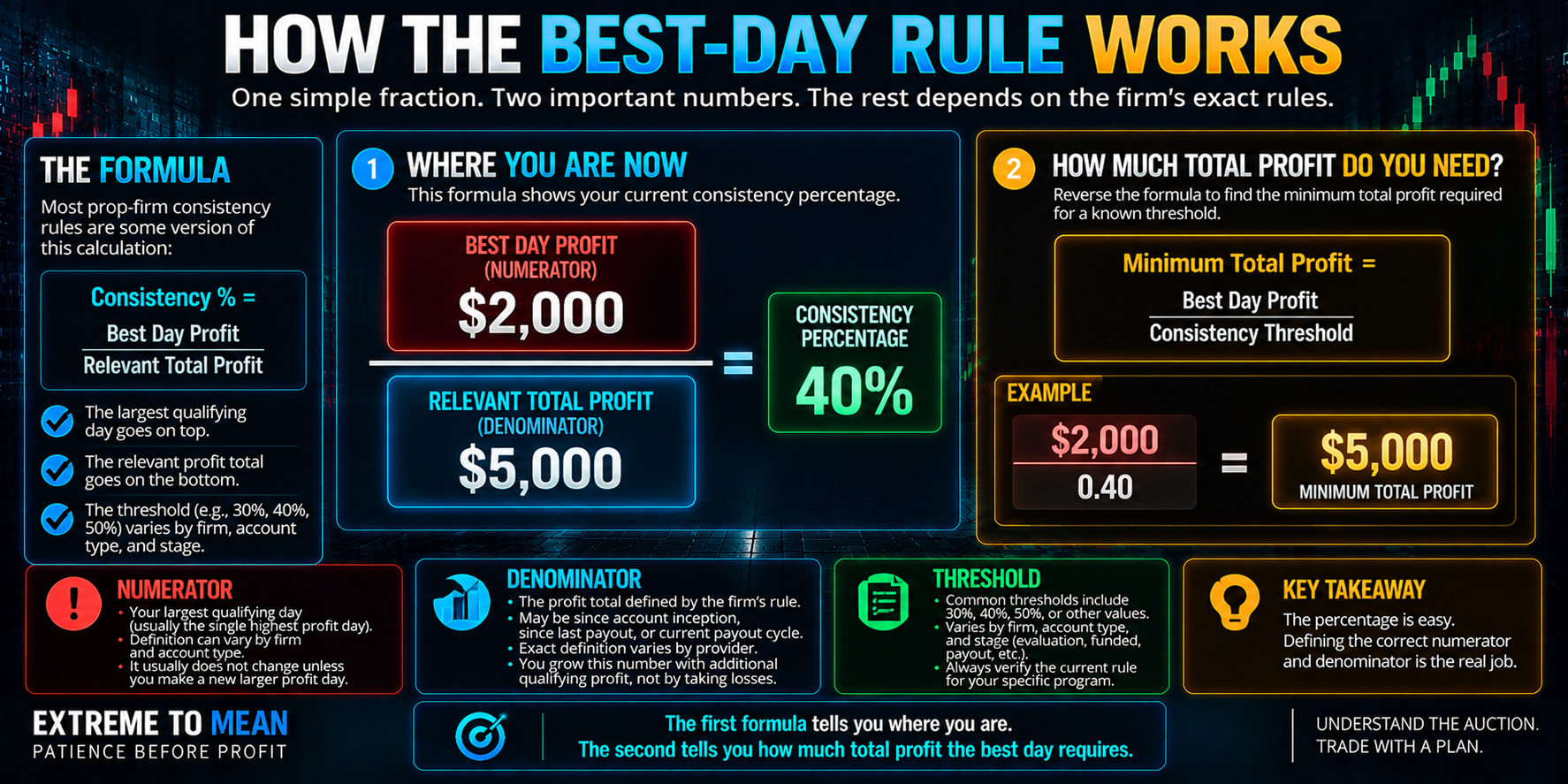
For the common best-day-share structure, the first formula tells you where you currently stand:
Consistency % = Best Day Profit ÷ Relevant Total Profit
Suppose your best day is $1,500 and the relevant profit total is $4,000. The calculation is $1,500 ÷ $4,000 = 37.5%. That tells you how much of the current profit came from the largest day.
The second formula works backward and tells you the minimum total needed for a known threshold:
Minimum Relevant Profit = Best Day Profit ÷ Consistency Threshold
If the best day is $1,500 and the threshold is 40%, convert 40% to 0.40 and calculate $1,500 ÷ 0.40 = $3,750. The first formula tells you where you are; the second tells you how much total profit the best day requires.
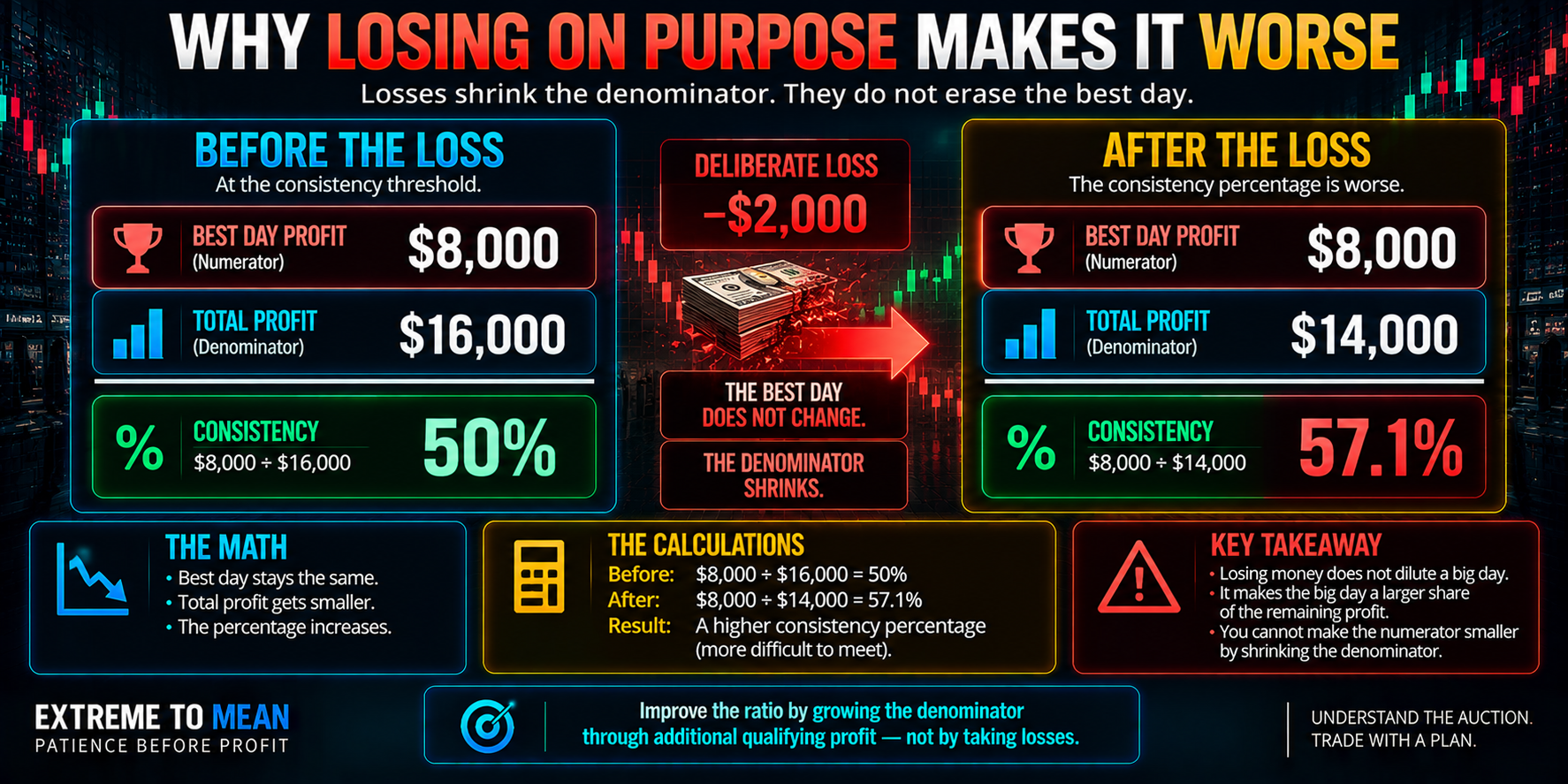
Why an $8,000 Day Cannot Be Fixed by Losing on Purpose
Now return to the $8,000 winning day. Under a hypothetical 50% consistency requirement, an $8,000 best day requires $16,000 of relevant total profit, because $8,000 ÷ 0.50 = $16,000. At $16,000 total, the best day represents exactly half of the profit.
Now deliberately lose $2,000. The best day does not change—it remains $8,000—but the relevant total falls to $14,000. The new ratio is $8,000 ÷ $14,000 = 57.1%, so the trader moved in the wrong direction.
You cannot make the numerator smaller by shrinking the denominator. Losses do not erase the big day; they make the big day dominate a smaller total. Even before considering drawdown or a firm's conduct rules, the arithmetic defeats the idea.
The Denominator Is the Number That Usually Needs to Grow
Keep the best day fixed at $8,000 and watch what happens as relevant profit changes:
- $8,000 ÷ $8,000 = 100%
- $8,000 ÷ $10,000 = 80%
- $8,000 ÷ $16,000 = 50%
- $8,000 ÷ $20,000 = 40%
- $8,000 ÷ $40,000 = 20%
The percentage declines because the denominator grows. That is the essential mechanism behind the normal best-day-share formula. Fix the ratio by improving the denominator, not by damaging the account.
This also explains why a new profitable account can initially show 100% consistency. If the first winning day makes $500 and total profit is also $500, then $500 ÷ $500 = 100%; nothing is mathematically wrong. There simply is not any other profit in the denominator yet.
Losing Days Can Push the Ratio Backward
Suppose the best day is $1,000 and total relevant profit has reached $2,500. The best day represents 40% of the total. If the trader then loses $500, relevant profit falls to $2,000 while the best day remains $1,000.
The ratio has now moved back to 50%. This is why a trader should not assume that reaching an acceptable consistency percentage once means the percentage can never move the wrong way again. Whether and when the calculation locks or resets depends entirely on the firm's current rules.
This is also where protecting the next decision matters. Once the trader starts taking trades specifically to manipulate an account statistic, the statistic can begin driving decisions the market never qualified. The formula should inform account planning, not become a reason to manufacture trades.
Evaluation Consistency and Payout Consistency Are Different
A trader hears, “That firm has a 40% consistency rule,” but that statement is incomplete. Is the rule used during evaluation, on a simulated funded account, on a live account, only when requesting a payout, or across multiple payout cycles? The same percentage can have very different consequences depending on where it is applied.
An evaluation consistency rule can cause a profit target to move higher when the best day becomes too concentrated. The trader may not fail the account; instead, the required total grows around the larger best day. Think best day → adjusted passing target.
A payout-window consistency rule works differently. The account can remain active while payout eligibility is delayed until additional net profit makes the largest day a sufficiently small percentage of the relevant profit window. Think best day → payout gate.
A third design can preserve a benchmark across future cycles. In that structure, a large historical best day can influence the amount of profit required in later withdrawal periods. Think best-ever day → future-cycle requirement.
Current Rules Show Why You Must Verify the Exact Program
As of October 31, 2026, current first-party rules demonstrate how different these structures can be. Topstep uses a 55% Consistency Target in its Trading Combine, while its optional Express Funded Account Consistency path uses 40% against total net profit and resets the calculation after a payout; its Standard XFA path does not use that same consistency objective.
Apex currently applies a 50% payout consistency requirement to its current Performance Accounts and states that its evaluations do not use an evaluation consistency rule. Its payout calculation compares the highest profitable day with net profit since account inception or the last approved payout, and losing days can therefore worsen the percentage.
Tradeify currently shows several different implementations: 40% during Select evaluation only, 35% for Growth Sim Funded, and graduated Lightning Funded requirements that change by payout number for newer accounts. That is a good illustration of why memorizing “Firm X uses Y percent” is not enough.
MyFundedFutures currently lists 30% on Rapid EOD evaluations, 50% on Rapid Intraday and applicable Pro evaluations (Pro Plan One Day Pass has no consistency rule), no Builder evaluation consistency rule, and a 50% Builder simulated-funded rule. FundedNext Futures provides another variation: 40% applies to Flex and Legacy challenges and Rapid Pro funded accounts, while Rapid Daily has no consistency rule and its Direct account uses a 20% perpetual rule.
Prop-firm terms change, so those examples are dated context—not evergreen numbers. Always verify the current official rule for the exact product before trading around it or requesting a payout. Never ask only, “What is the firm's consistency percentage?” Ask, “Which account, which stage, which window, and which formula?”
A New Best Day Can Move the Finish Line
Suppose a hypothetical account has a 40% consistency requirement and the trader's best day is $2,000. The minimum total needed is $2,000 ÷ 0.40 = $5,000. Everything is straightforward as long as $2,000 remains the best day.
Now the trader produces a new $3,000 best day. The required total becomes $3,000 ÷ 0.40 = $7,500. The trader did not lose money, but the larger numerator now requires a larger denominator.
That is why consistency rules can feel backward. The trader thinks, “I made more money, and now I need to make even more?” The rule is not asking whether the large day was profitable; it is measuring how dependent the relevant total is on that one day.
Do Not Artificially Cut a Valid Winner Just to Make the Math Pretty
Understanding the ratio does not mean every winning day should be engineered to look identical. Markets provide uneven opportunity, and a valid trade can sometimes produce an unusually strong result. Mathematical consistency and trading consistency are not the same thing.
If the trade remains valid under the trader's predefined management plan, the consistency percentage should not become an excuse for poor trade management. A trading plan made before the session should determine how risk and exits are handled, not panic about making the daily P&L aesthetically even. A consistency rule should influence account planning without turning good execution into artificial P&L engineering.
A large day may simply mean more normal qualified trading is required afterward. That is different from trying to manufacture losses, taking unnecessary trades, or cutting every legitimate winner early. You had a great day; you may simply need more profitable trading before the ratio qualifies.
Five Questions to Ask Before You Calculate Anything
Before opening the calculator, identify:
- Which account type? Evaluation, simulated funded, live, direct, or another product?
- Which stage? Passing requirement or payout requirement?
- What is the current threshold? Verify it from the firm's official terms.
- What counts as relevant profit? Since inception, since payout, current cycle, or another defined window?
- What resets? The best day, the total-profit window, the percentage, or nothing?
Do not open the calculator until you know what the firm is asking the calculator to measure. Even the term best day can have a specific definition involving realized P&L, end-of-day P&L, commissions, trading-day boundaries, or lock times. Using the right formula with the wrong profit number still gives the wrong answer.
That also means the advertised nominal account size is usually not the denominator. A $50,000 account showing $53,000 does not automatically mean the formula divides by $53,000; the relevant figure may instead be $3,000 of profit or profit earned during a defined payout cycle. Consistency usually measures profit concentration—not nominal buying power.
The ETM Identify → Define → Calculate → Compare → Continue Framework
Use IDENTIFY → DEFINE → CALCULATE → COMPARE → CONTINUE. Identify the exact current rule for the exact account and stage, then define the best-day metric, denominator, threshold, and reset window. Only then calculate the ratio.
Next, compare it with the actual requirement. If the ratio is outside the allowed range, reverse the formula to determine the minimum relevant total: Best Day ÷ Threshold = Required Profit. Subtract current relevant profit from that number to see how much additional net profit would be required.
Then continue normal qualified trading rather than trying to manipulate the fraction. The ETM free tools can support the broader preparation and review process, but no calculator can rescue an incorrect definition of the firm's rule. Define first; calculate second.
Final Thought
A prop-firm consistency rule becomes much less mysterious once you understand the fraction. The largest winning day sits on top, and the relevant total profit sits underneath it. If the best day represents too much of the total, the normal mathematical fix is to grow the denominator—not intentionally shrink it.
The harder part is knowing what those two numbers actually mean for your particular program. Consistency can apply during evaluation, at the funded stage, only at payout, or across multiple payout cycles, and reset behavior can differ just as much. Verify the exact account, stage, threshold, profit window, best-day definition, and reset policy from the firm's current official terms.
Do the math after you define the rule. Do not try to outsmart a fraction by losing money on purpose.
Educational content only. Trading involves substantial risk and is not suitable for everyone.