
The Mistake: Treating Stop Distance as Risk
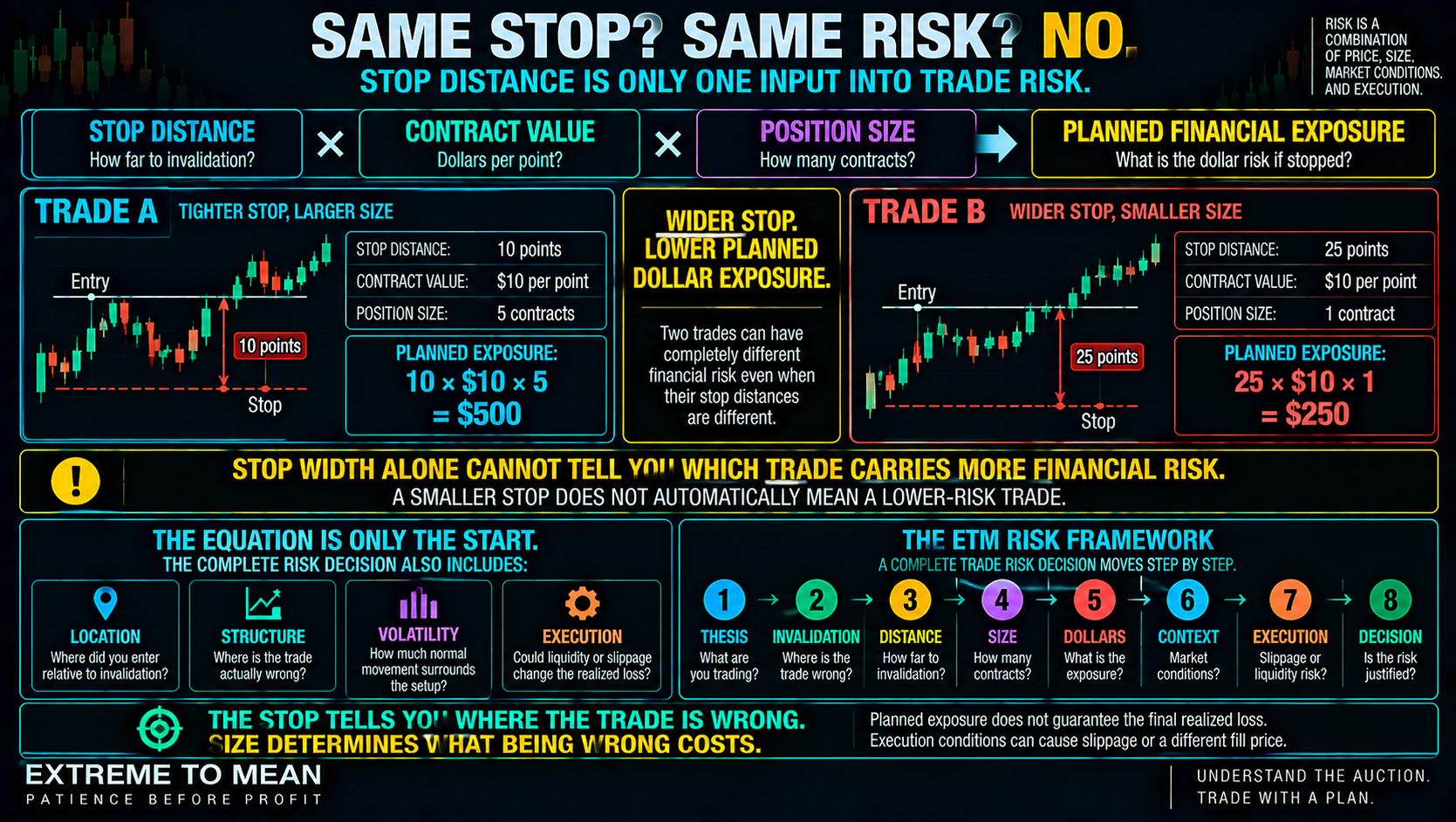
Stop distance tells you how far price can move from entry before a planned exit is triggered, but it does not tell you how much money the account is exposed to. In the Setup curriculum, risk only becomes meaningful when the trade structure and the amount of exposure are considered together. A ten-point stop can represent more financial risk than a twenty-five-point stop if the first trade carries much more size.
The mistake feels reasonable because points are visible on the chart. Traders can measure them instantly, compare one stop with another, and label the smaller number “safer.” But the account does not lose points; it loses dollars created by the interaction between price movement, contract value, position size, and actual execution.
A more useful question is not, “How tight is my stop?” It is, “If this trade is wrong, what am I actually exposing the account to?” That shift expands risk from a line on the chart into a complete trade-planning decision.
What a Stop Actually Does
A stop should represent the point where the trade thesis is no longer valid enough to justify staying in the position. That is why the sequence matters: thesis first, invalidation second, stop location third, and size after that. The stop is a risk-control tool built around the idea, not a number chosen first and then forced onto the chart.
This is the same reason the trade is not ready until the risk is clear. If the market can move through the stop during normal structure while the original thesis remains intact, the stop may be misplaced rather than disciplined. A tight stop is useful when the setup genuinely allows a nearby invalidation point, not merely because a smaller number feels more responsible.
The opposite error is also possible. A trader can place a stop so far away that the original thesis has already failed long before the order would exit. The goal is not to make stops tight or wide; it is to place them where the trade is actually wrong and then decide whether the resulting exposure fits the account and the plan.
Why Position Size Changes Everything
Consider two completely hypothetical trades using a fictional contract worth $10 per point. Trade A uses a 10-point stop with five contracts, creating $500 of planned price-risk exposure before fees or slippage; Trade B uses a 25-point stop with one contract, creating $250 of planned price-risk exposure. The wider stop carries less planned financial exposure because the position is much smaller.
The conceptual relationship is simple: stop distance × contract value × position size = planned price-risk exposure. That calculation still does not include commissions, fees, slippage, gaps, or other execution effects, but it immediately shows why stop width cannot be evaluated by itself. The account experiences the combined exposure, not the stop distance in isolation.
This does not mean the wider-stop trade is better. Its setup may be weaker, its location may be poor, or its potential reward may not justify the risk. The example only proves one point: two trades cannot be compared responsibly by stop distance alone.
Entry Location Determines How Much Risk the Trade Needs
Entry quality changes the distance between the trader and the point where the thesis becomes invalid. As location is the first filter, an entry taken far from meaningful structure may require a large stop simply because the trader arrived late. Many apparent stop problems therefore begin as location problems.
This is also why where you enter matters more than what you predict. A trader can be directionally correct and still create poor risk by entering at a price that leaves too much distance to logical invalidation. Better location does not guarantee the trade will work, but it can make the risk structure easier to define.
There is an important boundary here. The lesson is not that every good entry should produce a tiny stop, because some valid structures naturally require more room. The point is that stop distance should emerge from the relationship between entry and invalidation rather than from a preset desire to make the stop small.
Volatility and Structure Change the Meaning of Distance
Ten points does not represent the same amount of market movement in every environment. In a quiet session, ten points may sit comfortably outside normal noise around the setup; in a fast, volatile session, the same distance may be reached by ordinary rotation without meaningfully damaging the thesis. That is why market conditions change the quality of a setup.
The conclusion should not be “high volatility means use wider stops.” Volatility changes the behavior surrounding the setup, while structure still determines where the thesis is wrong. If that structure requires more room, position size may need to shrink so the financial exposure remains acceptable.
This distinction prevents a common shortcut. Traders sometimes respond to volatile markets by widening stops without reducing size, or by keeping stops artificially tight so the dollar amount looks smaller. Neither choice is automatically disciplined; the cleaner process is to let the setup define invalidation and then evaluate whether the resulting distance and size make sense together.
Planned Risk and Realized Risk Are Not Identical
A stop price is an instruction to exit when a condition is reached; it is not a guarantee that the trade will be filled at exactly that price. Fast movement, limited liquidity, gaps, or sudden order-flow changes can produce slippage, so the realized loss can differ from the amount calculated before entry. That is one reason planned exposure should be understood as an estimate rather than a guaranteed maximum.
This does not make stops useless. They remain an important risk-control mechanism because they define a planned exit when the trade reaches a specified point. The practical lesson is simply that financial risk includes an execution layer beyond the chart distance itself.
For a trade whose planned exposure is already near the maximum the trader is willing to tolerate, execution uncertainty matters even more. A small amount of adverse slippage can change the realized result, particularly when the market is moving quickly. Risk planning therefore needs enough realism to acknowledge that the stop line and the final fill price are not always identical.
Oversized Trades Create Execution Risk of Their Own
Position size also changes how difficult it may be for the trader to follow the plan. A technically valid stop and acceptable spreadsheet calculation can still become a poorly executed trade if the dollar movement is large enough to make the trader abandon the process. Premature exits, stop widening, constant interference, and impulsive decisions can all emerge when the exposure is larger than the trader can manage consistently.
This is not a claim that comfort should replace objective risk rules. The issue is whether the chosen exposure allows the trader to execute those rules without repeatedly overriding them because every tick feels financially threatening. A position that cannot be managed according to the original plan carries practical risk that a stop-distance calculation alone will never show.
The cleaner solution is not to move the stop closer simply to reduce anxiety. If the chart-defined invalidation remains valid, changing the stop may only distort the trade. Size is the variable that should be reconsidered when the financial exposure is too large to execute responsibly.
The ETM Risk Framework
A complete risk decision starts with the trade thesis and moves outward from there. Each step answers a different question, and skipping one usually hides part of the actual exposure. The chart defines where the thesis is wrong; the account determines how much exposure can fit around that structure.
Thesis — What market behavior is the trade attempting to capture?
Invalidation — What price behavior would make that thesis no longer valid?
Stop distance — How far is the invalidation point from the intended entry?
Position size — How much size is being carried across that distance?
Dollar exposure — What does the distance, contract value, and size mean financially?
Market conditions — Does current volatility and structure make the planned stop location reasonable?
Execution reality — Could slippage, liquidity, or fast movement materially change the realized loss?
Decision — Is the complete exposure justified by the setup and manageable under the trading plan?
The framework is Thesis → Invalidation → Stop Distance → Position Size → Dollar Exposure → Market Conditions → Execution Reality → Decision. It deliberately keeps stop placement and position sizing connected without turning either one into the whole definition of risk. That is the distinction a trader should carry into every plan before deciding whether a setup deserves capital.
Final Thought
A small stop can be disciplined, or it can simply be misplaced. A wide stop can represent excessive risk, or it can sit beyond a legitimate invalidation point while reduced size keeps the planned financial exposure smaller. Stop width alone cannot tell you which situation you are looking at.
The useful sequence is to let the setup establish the thesis, let structure establish invalidation, measure the resulting distance, and then decide how much exposure the account can carry. Volatility, execution, and the trader’s ability to follow the plan then complete the picture. Risk is the complete exposure created by the trade, not merely the number of points between entry and stop.
The better question is therefore not, “How tight is my stop?” It is, “If this trade is wrong, how much am I actually exposing—and is that exposure justified by the setup, structure, market conditions, and my ability to execute the plan?” That is the kind of decision the broader Extreme to Mean system is designed to organize.
Educational content only. Trading involves substantial risk and is not suitable for everyone.