
Most beginners think trading starts with predicting where price will go. They look at a chart and ask, "Is this going up or down?" That question feels natural because direction is the most visible part of the trade. If they think price will rise, they look for a long. If they think it will fall, they look for a short.
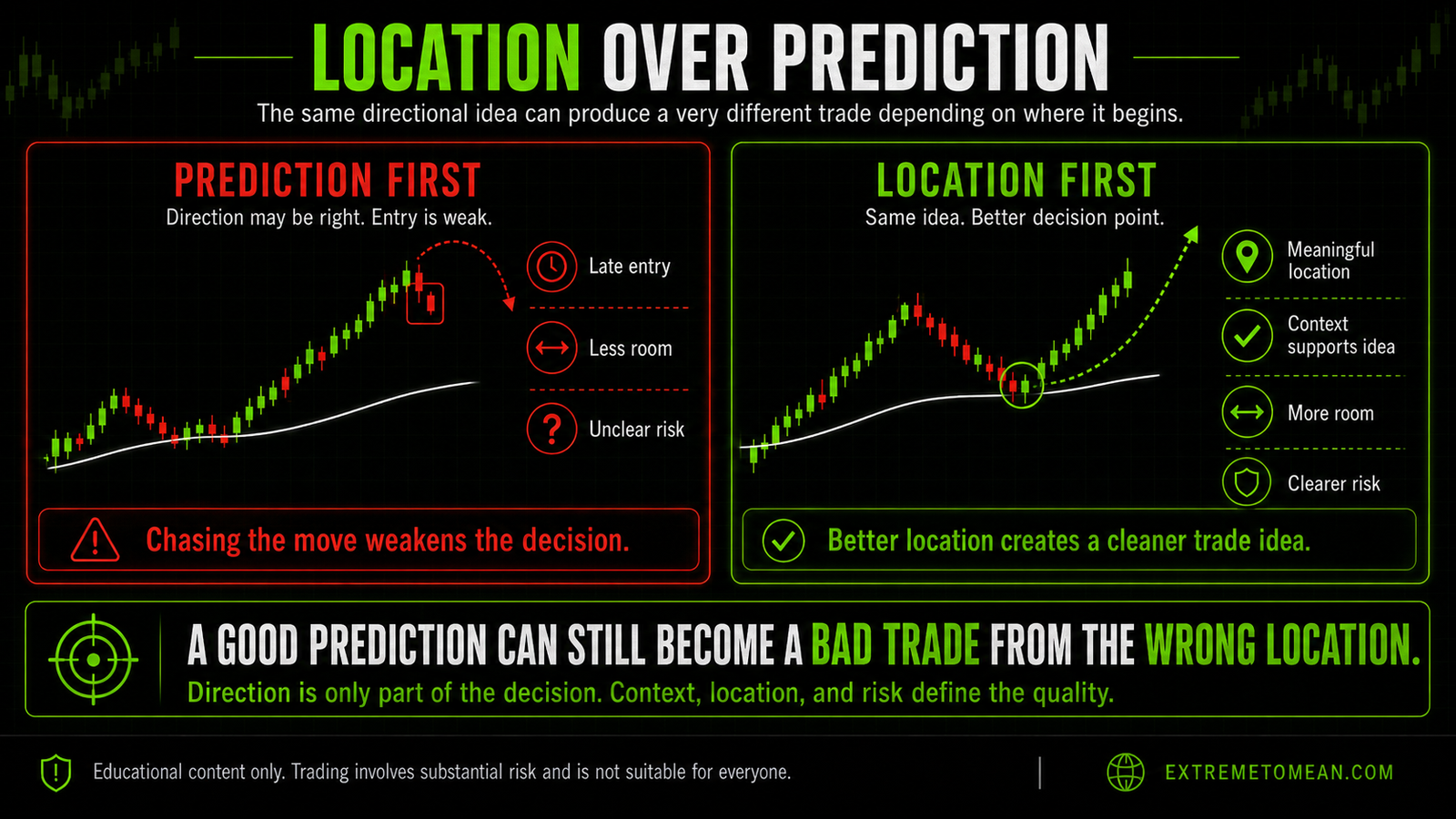
But direction alone is not a setup. A trader can be right about direction and still enter from a poor location — buying too late, shorting too low, chasing a move after the edge has passed, or entering near the mean where there is no room for the trade to develop. In those cases the prediction was not the problem. The entry was.
At Extreme to Mean, this is one of the first setup and risk lessons a trader has to learn: the market does not reward an opinion by itself. A setup has to be judged inside context. The location has to make sense. The risk has to be clear. The trade has to earn attention before it earns risk.
Direction Is Only One Part of the Decision
Direction matters, but it is not enough. You may believe price is likely to move higher — but not every long is equal. Buying after price has already pushed far from the mean is very different from buying after price pulls back into a meaningful location with structure behind it.
The short side works the same way. You may believe price is headed lower, but shorting after a large move down puts your entry in a weak spot. The market can still be bearish overall while price is too extended in the moment, and a reversion back toward balance can happen before the bigger move continues.
That is why location is the first filter. The entry is where the trade begins, and it also shapes the risk, the target, the emotional pressure, and the clarity of the decision. Enter from a poor location and you get less room, less clarity, and more pressure to manage the trade perfectly.
A better trader does not only ask, "Where do I think price is going?" They also ask, "Where am I trying to enter from?"
Context Decides Whether Location Has Quality
Location by itself is not enough either. A price level can look attractive, but the context around it decides whether it deserves attention. The same area means different things in a calm market, a strong trend, or the kind of middle that gets traders chopped up.
Price pulling back to a moving average during a clean trend can be a structured decision point. Price pulling back to that same moving average during messy chop can offer almost nothing. The level is identical. The context is not — and context changes the quality of the setup.
This is where many traders get frustrated. A setup works one day and fails the next, even though the pattern looks the same. The missing piece is usually context. The trader judged the shape of the setup without judging the condition it appeared in.
Extreme to Mean is built around this order: location comes before direction, and context comes before commitment. A stretched move can create interest. A moving-average turn can create attention. A familiar pattern can be worth watching. None of those things mean the trade is ready.
Why Chasing Feels Reasonable
Bad location usually feels reasonable in the moment, because the market is moving. Price pushes hard, the candle looks strong, the momentum looks obvious, and waiting feels like missing out.
That is how chasing starts. The trader does not feel emotional — they feel logical. "This is clearly moving higher." "This is obviously breaking down." The problem is not that they noticed direction. It is that they let direction replace location.
Chasing gets even more tempting once the cleaner entry is already gone. The trader starts lowering the standard. A trade that would have been unacceptable five minutes ago suddenly feels fine, only because price is moving without them. That is not evaluation. That is reacting to the discomfort of being late.
A Better Setup Starts From Better Location
A better setup starts from a location that makes the trade easy to define. That does not promise the trade will work. It means the decision is cleaner — you can define the location zone before choosing the final entry, explain where the idea is wrong, and determine whether there is enough room for the trade to make sense.
In reversion-to-mean trading, this usually means waiting for price to stretch away from balance before getting interested. The stretch creates distance, and distance creates room to revert. Even then, location only starts the process — context, structure, and risk finish it.
A clean read sounds like this: "Price is stretched from the mean, the context supports a possible reversion, structure is beginning to shift, and risk can be defined beyond the extreme." That is a very different statement from "I think price is going back up" or "This looks like it should fall." The better decision recognizes that the trade is not ready until the risk is clear.
A Location-First Decision Filter
Before entering, ask one better question:
Am I entering from a location that supports the trade idea, or am I chasing a prediction?
That question separates a structured setup from a directional opinion, and it forces you to judge the trade from the right starting point. A prediction can be interesting. A setup needs more than interest. A short filter helps:
- Is price near a meaningful location, or am I entering in the middle?
- Does the market context support this idea, or am I ignoring conditions?
- Is there enough room between entry and target?
- Has structure started to support the idea, or am I early?
- Is the risk clear before entry, including where the idea is wrong?
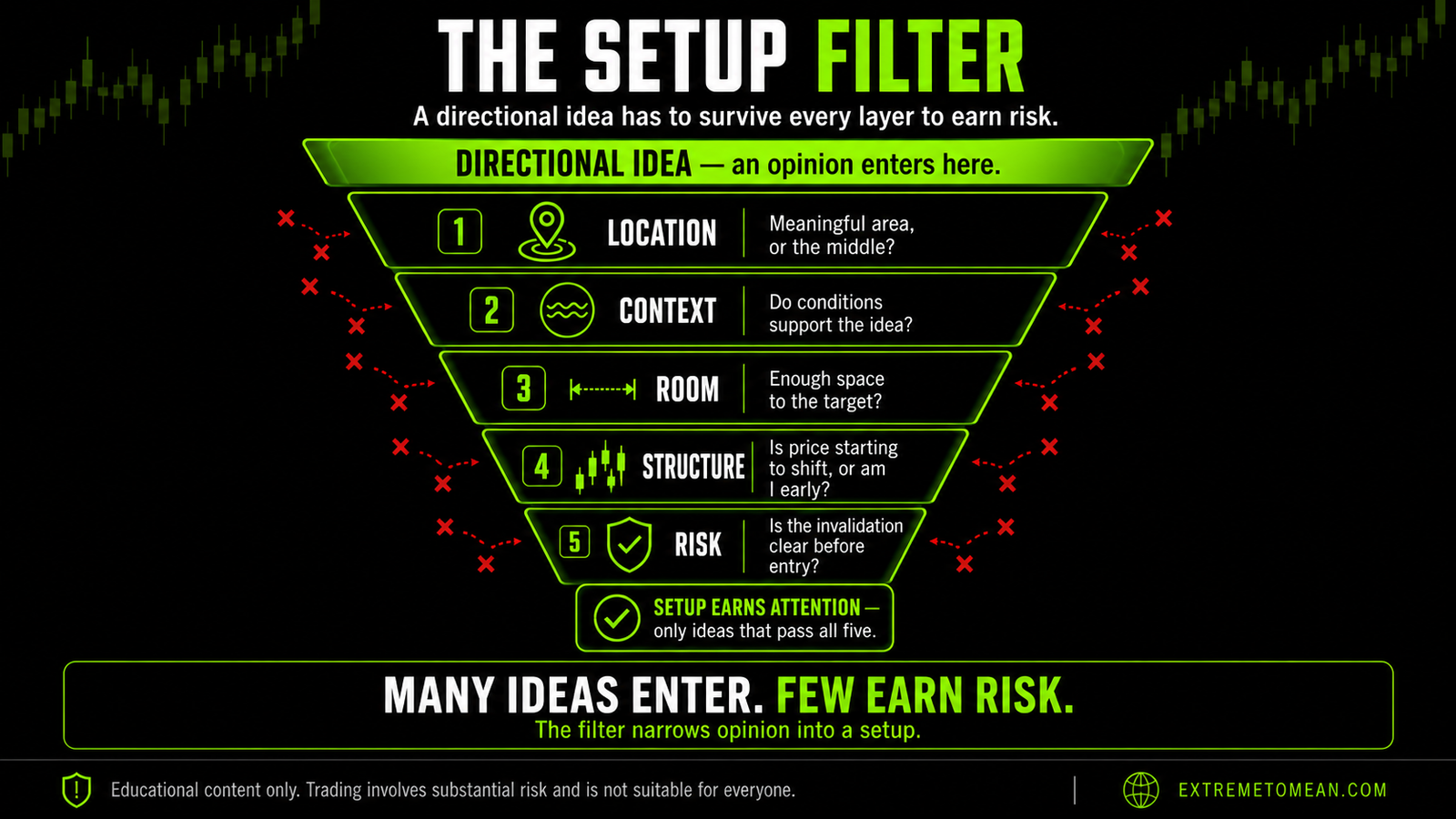
These questions do not make the market predictable. They make the decision more complete. You are not trying to prove you know the future. You are deciding whether this specific trade, from this specific location, in this specific context, deserves risk.
Final Thought
Where you enter matters more than what you predict because the entry shapes everything that follows — the risk, the room, the pressure, and whether the trade can be read clearly or is just a chase.
A prediction is only an opinion until context, location, structure, and risk turn it into a setup. That does not guarantee an outcome, but it does create a cleaner decision, and cleaner decisions are the foundation of a better process.
You already know how to measure distance from the mean. Location is the next filter: once price is stretched, where you act decides whether that stretch becomes a trade or a trap. From here, the question moves to whether the setup is actually finished forming — or whether you are still early.
Patience Before Profit means waiting for the trade to begin from a location that truly supports the idea. The goal is to read the market clearly enough to know when the setup has earned attention, then use the free setup-quality tools before risking the trade.
That decision starts with knowing what you are actually trading, because each instrument carries a different structure and pace.
When the chosen vehicle is futures, begin with what a futures contract actually is before treating it like a stock.
A good entry still requires understanding why entry needs a stop and target.
The full decision depends on how entry location affects invalidation and risk.
Educational content only. Trading involves substantial risk and is not suitable for everyone.