
Every trader sees movement. Candles expand, wicks snap back, price accelerates, volume picks up, and the screen suddenly feels important. That movement can create urgency, especially for newer traders who feel like they are about to miss something.
But movement by itself is not a setup. It is only information.
The trader’s job is not to react to every push, drop, bounce, or breakout attempt. The trader’s job is to evaluate whether that movement has created a tradeable situation. That difference matters because many bad trades begin with a true observation: “price is moving.” The mistake is turning that observation into a reason to act before the setup has earned attention.
This is one of the most important distinctions inside setup and risk lessons: seeing motion is not the same as seeing opportunity.
Movement Is Not a Setup
The market is always moving. Even when it looks quiet, price is constantly adjusting as buyers and sellers respond to orders, liquidity, emotion, news, positioning, and short-term imbalance. Some movement matters. Much of it does not.
A candle that suddenly expands may feel meaningful, but the candle alone does not answer the questions that matter. Where did the move begin? Where is it happening in the larger structure? Is price moving into a better location or away from one? Is there room for the trade to work, or is price already running into the next area where it may stall?
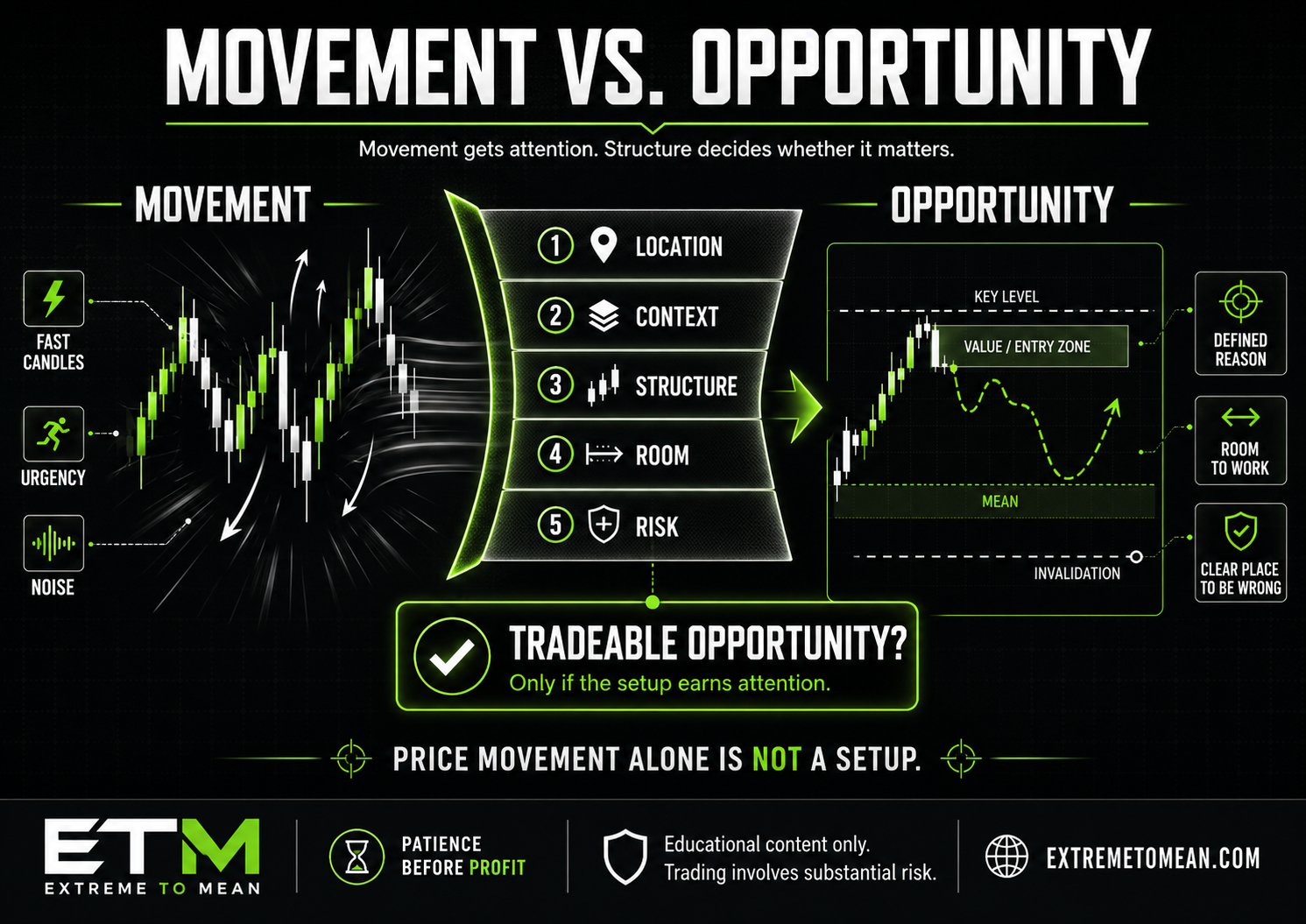
A trader who treats movement as opportunity often ends up chasing the part of the move that was easiest to see. By the time the trade feels obvious, the clean risk may already be gone. The market may still continue, but the trader is no longer entering from a place of structure. They are entering because the movement made them feel late.
That is why location comes first. A move at a poor location is still a poor setup. A move without room is still limited. A move without a clean place to be wrong is still difficult to manage. Before a trader gets excited about speed, they need to understand why location is the first filter.
Why Fast Movement Feels Like Opportunity
Fast movement gets attention because it creates emotional pressure. When price moves quickly, the brain naturally assumes something important is happening. Sometimes that is true. Other times, the move is only a short-term reaction, a liquidity sweep, a continuation push near exhaustion, or noise inside a larger range.
The problem is not noticing the movement. The problem is assigning too much meaning to it too quickly.
A fast candle can make a trader feel like the market is leaving without them. That feeling can turn into a rushed entry, especially if the trader has already missed earlier trades, taken a loss, or started the session impatient. The move becomes less about structure and more about relief: relief from waiting, relief from uncertainty, relief from the fear of missing out.
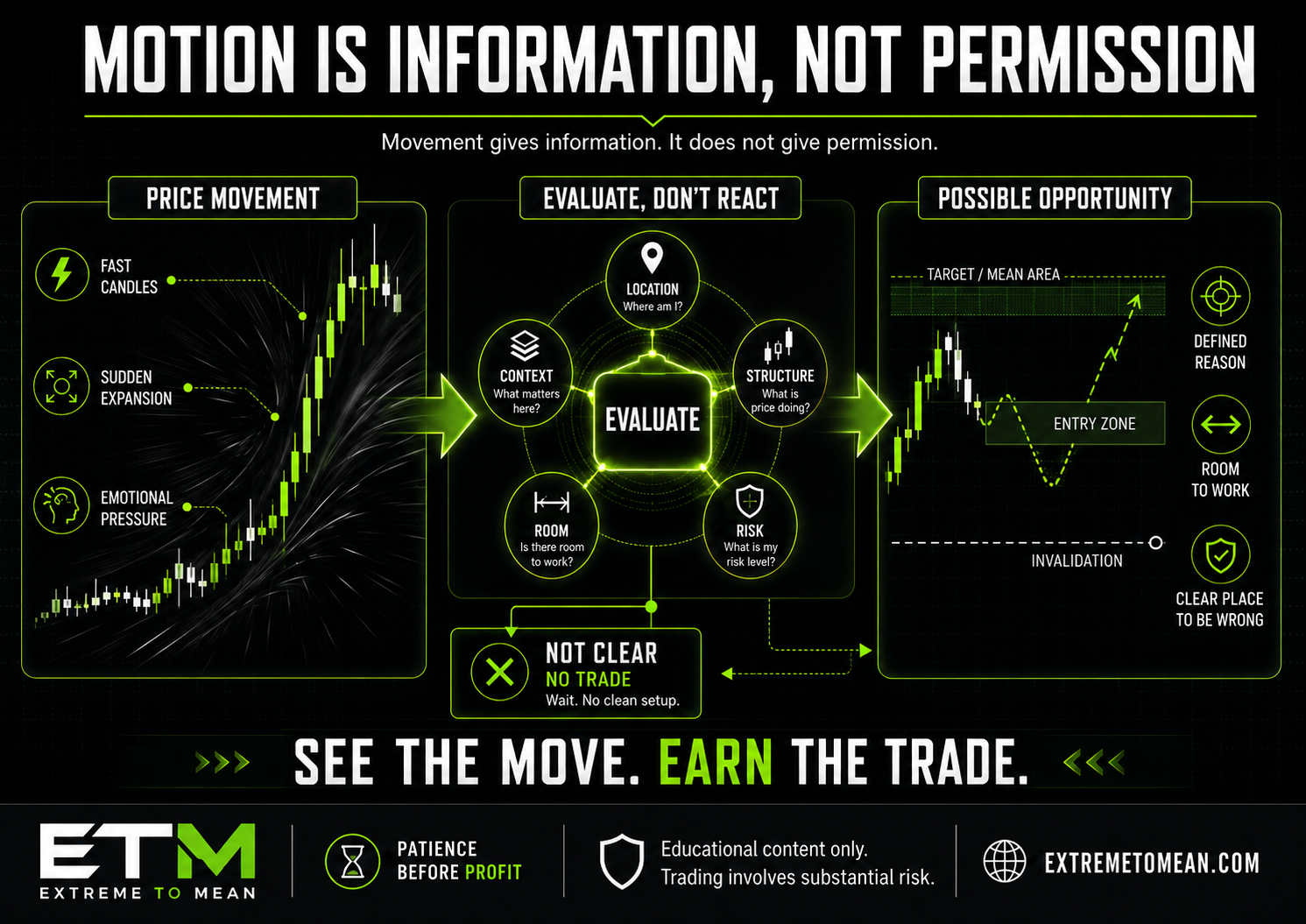
This is why chasing often feels logical in the moment. The trader is not usually thinking, “I want to take a bad trade.” They are thinking, “Something is happening, and I need to respond.” That thought feels responsible, but it can be dangerous when there is no defined setup behind it.
Fast movement deserves attention, but attention is not the same as action.
A disciplined trader can see the same move and slow the process down. Instead of asking, “How do I get in?” they ask, “Has this move created a place where risk can be defined?” That one question changes the decision from reaction to evaluation.
Where Reaction Turns Into Poor Risk
Most reaction trades break down in the same place: risk.
When a trader enters only because price is moving, the stop often becomes an afterthought. They may place it too close because the entry is late. They may place it too far away because there is no nearby structure to lean on. They may avoid defining it altogether because they do not want to admit that the trade is unclear.
That is not a setup problem. That is a decision-quality problem.
A trade needs a clean place to be wrong. That does not mean the trade will work. It means the trader knows what would invalidate the idea before they enter. If price breaks that level, fails to respond, or moves through the structure the trade depended on, the idea is no longer valid.
Without that line, the trader is guessing while already in the trade.
This is where movement can become expensive emotionally, even before it becomes expensive financially. A trader who enters without clear risk has to make too many decisions under pressure. Should they hold? Should they cut? Should they add? Was that pullback normal? Is the move still valid? The trader is now trying to build a plan while the trade is already moving against them.
That is why the trade is not ready until the risk is clear. A setup has not earned risk simply because price is active. It earns risk when the trader can define the idea, the invalidation point, and the conditions that make the trade worth considering.
What Opportunity Actually Looks Like
Opportunity is more specific than movement.
An opportunity begins when price reaches an area where a trader has a reason to pay attention. That area may be an extreme, a prior level, a failed breakout zone, a value area, a mean-reversion location, or another structure that fits the trader’s system. The exact tool matters less than the process. The trader is not acting because price moved. They are evaluating because price moved into a meaningful area.
From there, the trader needs context. Is the market trending, ranging, expanding, compressing, rejecting, or chopping? Is the move aligned with the larger environment, or is it fighting it? Is price extended from the mean, or sitting in the middle where direction is less clear? Context does not predict the future, but it helps the trader understand the quality of the situation.
Then comes structure. Has price shown a reaction that gives the trader something to work with? Is there a clear level, turn, rejection, pullback, reclaim, failure, or confirmation that fits the setup? Structure helps separate a trade idea from a random guess.
Finally, there must be room. A setup can have location and structure but still offer poor opportunity if price is already too close to the next likely obstacle. The question is not only “Can this move work?” The better question is, “Is there enough room for this trade to make sense before price reaches the next problem area?”
This is where room to revert becomes important. In reversion-to-mean trading, a trader is not just looking for price to move. They are evaluating whether price has enough space to move back toward a reasonable target before the trade becomes crowded, trapped, or unclear.
A Cleaner Decision Filter
A better trader does not need to respond to every candle. A better trader needs a filter that separates movement from opportunity.
Before acting on a fast move, ask:
- Is price at a meaningful location, or am I only reacting to speed?
- Does the larger context support this idea, or am I ignoring the environment?
- Is there structure that gives the trade a reason, or am I guessing?
- Is there enough room for the trade to make sense?
- Do I have a clean place to be wrong?
- Would I still want this trade if the candle were moving slower?
That last question is powerful because speed can distort judgment. If the only reason a trade looks attractive is that price is moving fast, the setup may not be as clean as it feels. Slowing the question down forces the trader to evaluate the trade without the emotional pressure of the candle.
A clean setup does not require certainty. It requires a defined idea.
The trader should be able to explain the trade in plain English before entering. For example: “Price has pushed into a meaningful extreme, the larger context supports a possible reversion attempt, there is room back toward the mean, and I know where the idea is wrong.” That statement does not guarantee anything. It simply shows that the trade has structure.
Compare that with: “Price is ripping, and I do not want to miss it.” That may be a true feeling, but it is not a trade plan.
The difference is not intelligence. It is process.
Final Thought
Movement is easy to see. Opportunity takes more work.
The market will always offer motion. Some of it will be useful. Some of it will be random. Some of it will be designed to make traders feel late, impatient, or pressured. Your job is not to respond to every move. Your job is to decide whether the move has created a clean situation worth evaluating.
A setup earns attention when location, context, structure, room, and risk begin to line up. It earns risk only when there is a defined reason for the trade and a clean place to be wrong.
That is the difference between reacting to price and trading with a process.
For a broader beginner path built around patience, structure, and decision quality, start with the beginner trading path.
Educational content only. Trading involves substantial risk and is not suitable for everyone.