
VWAP is a cumulative volume-weighted average price, but that average cannot exist without a starting point. Session VWAP normally begins from a predefined session reset, while Anchored VWAP begins from a deliberately selected event or bar. Inside The Market, the useful question is not which line looks better, but which market history belongs to the decision you are trying to make.
Start With the Question the VWAP Is Answering
The basic VWAP idea is the same in both cases: price and volume accumulate from a starting point, and the resulting weighted average updates as new transactions are added. The arithmetic is not the important distinction for this lesson. The analytical difference begins with one question: when should that cumulative history start?
Session VWAP asks a session-based question, while Anchored VWAP asks an event-based or structure-based question. Once that distinction is clear, the fact that the two lines can land at different prices becomes much easier to understand. Same idea. Different starting point. Different market question.
What Session VWAP Actually Measures
A Session VWAP begins from the reset defined by the selected session and accumulates from there until the next reset. In plain English, it asks, “What has the volume-weighted average price been during this session?” That makes it useful when the trader’s question is specifically about the current session as a whole.
One advantage of Session VWAP is that its starting rule is usually predefined rather than chosen after looking at the chart. Two traders using the same instrument, data, session definition, and settings should generally be studying the same underlying sample. That reduces one source of discretion and hindsight, even though it does not make the line automatically more important.
For futures traders, however, the word session still needs to be checked rather than assumed. ES and NQ trade beyond the U.S. cash-equity session, so one platform might use a full electronic session while another chart uses RTH or a custom session template. Two lines labeled “Session VWAP” can therefore differ if the session boundaries behind them are not the same.
What Anchored VWAP Actually Measures
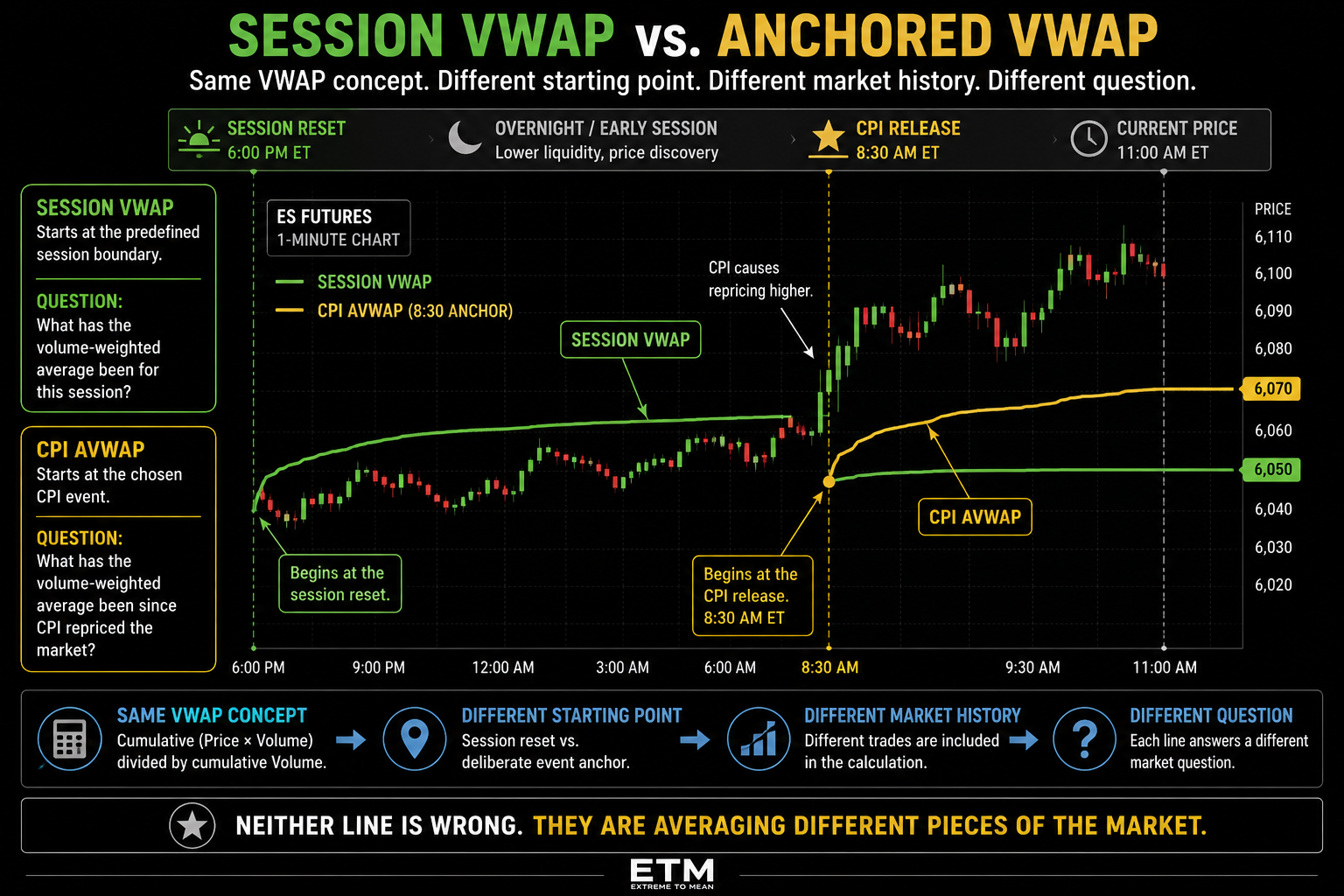
Anchored VWAP uses the same general volume-weighted-average concept but starts from a user-selected bar or event. Instead of asking what the average has been for the entire session, the trader can ask what the weighted average has been since CPI, a major swing, a breakout, or another independently defined event. That is why anchor selection becomes part of the analysis rather than merely a chart setting.
This is where choosing an Anchored VWAP without forcing the level matters. A defensible anchor should come from a market question that existed before the trader knew where the line would land, not from dragging the starting point until the result supports a preferred story. AVWAP’s flexibility can make it more relevant to a specific event, but that same flexibility can make cherry-picking easier.
Neither characteristic makes Anchored VWAP universally better than Session VWAP. Session VWAP has a more reproducible reset rule, while AVWAP has more event-specific flexibility. The useful choice depends on which market history the trader actually wants to study.
Same Formula Family, Different Data Sample
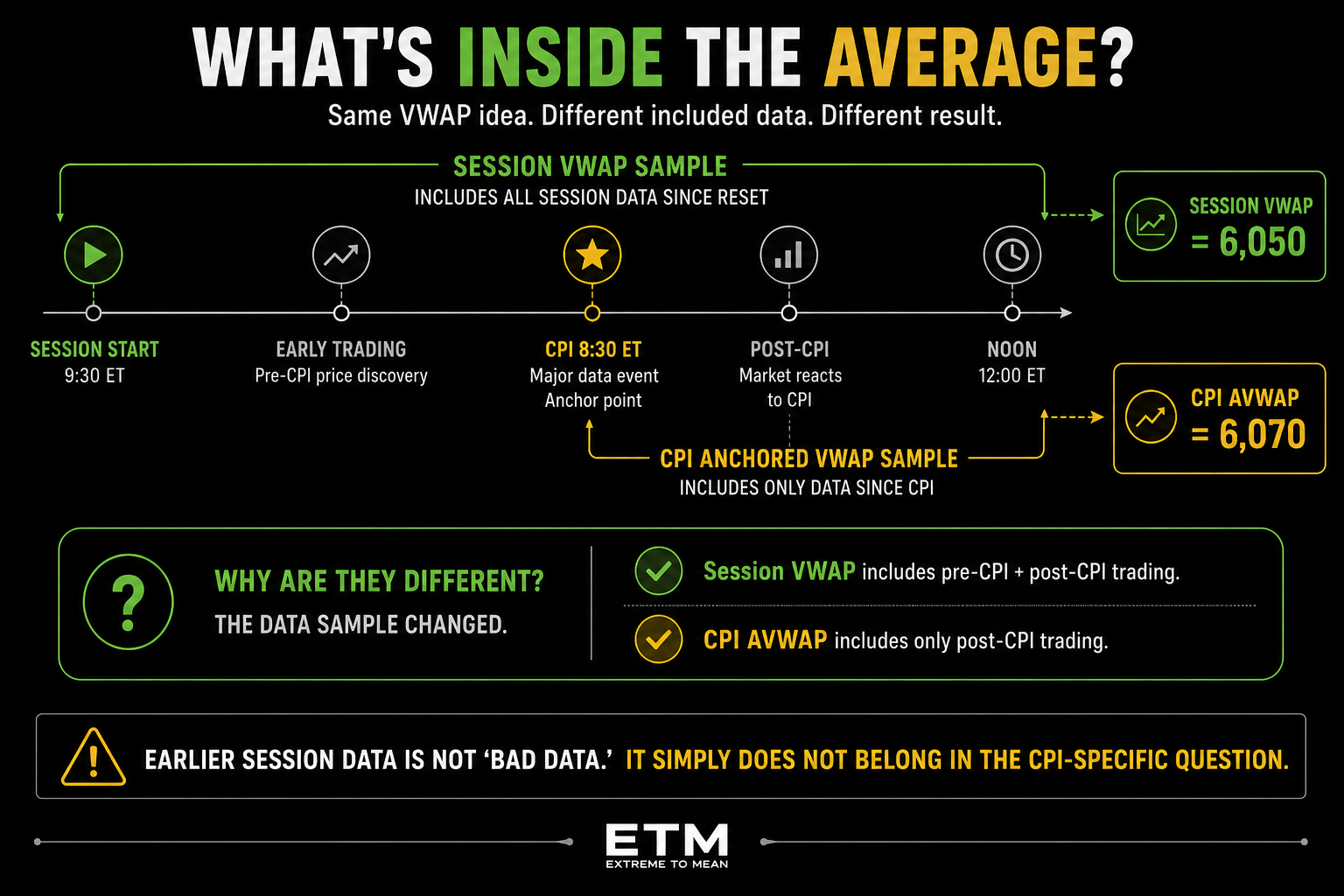
Suppose ES has been trading overnight and CPI is released at 8:30 a.m. ET. The Session VWAP may include all qualifying price-and-volume history from the session reset through the current moment, while a CPI Anchored VWAP includes only transactions from the CPI anchor forward. Both lines can be calculated correctly and still produce different values because the included datasets are different.
The earlier session history is not “bad data” simply because the CPI AVWAP excludes it. If the trader wants to know the weighted average for the full session, that earlier activity belongs in the sample. If the question is how the market has transacted since CPI changed the information environment, intentionally excluding the pre-CPI history is exactly the point.
This is the distinction to protect: data is not irrelevant merely because AVWAP leaves it out. It is irrelevant only when it does not belong to the market question being asked. Decide what period matters first, then let the indicator calculate from that decision.
One ES Day Can Produce Two Valid VWAPs
Imagine the session begins with VWAP accumulating from its reset, then CPI arrives at 8:30 and price reprices sharply higher. By 11:00, Session VWAP contains both the pre-CPI and post-CPI trading, while the CPI AVWAP contains only transactions since the release. The two averages can therefore be materially separated without creating a contradiction.
The Session VWAP answers, “What is the weighted average for the broader session?” The CPI AVWAP answers, “What is the weighted average since the CPI repricing began?” Same market, same general VWAP concept, but different starting points create different questions.
A VWAP line only makes sense after you know what it is averaging from. A Session VWAP at 6,050 and a CPI AVWAP at 6,070 do not need a bullish or bearish story simply because they disagree. Their separation may be nothing more mysterious than different cumulative histories producing different weighted averages.
Neither Line Is Automatically More Accurate
Anchored VWAP can feel more precise because the trader can begin the calculation at a market event that seems especially meaningful. That does not make AVWAP more accurate in any universal sense because the anchor itself introduces judgment. Hindsight bias, selective storytelling, and too many competing anchors remain possible when the starting point is discretionary.
Session VWAP can feel more objective because its reset is predefined. That does not make it the one correct VWAP for every decision, especially if a major event materially changes market behavior halfway through the session. A whole-session average and a post-event average can both be valid while answering different analytical questions.
The clean conclusion is that neither is better in isolation. Use Session VWAP when the question concerns the selected session as a whole; use AVWAP when the question concerns activity since a specifically justified event or structural starting point. If you cannot explain why one starting point is more appropriate than another, choosing between the two becomes indicator preference rather than analysis.
Agreement and Disagreement Both Need Context
Sometimes Session VWAP and AVWAP converge near the same price. Two independently defined references occupying similar territory can make an area more worthy of attention, but that does not turn the level into automatic support, resistance, or a high-probability trade. Confluence upgrades attention, not certainty.
The lines can also diverge sharply. Suppose Session VWAP is 6,050, CPI AVWAP is 6,070, and current price is 6,075; the factual observation is that the session-wide and post-event averages differ because their samples contain different history. Calling that “VWAP divergence,” institutional disagreement, or a directional signal adds meaning the calculations themselves do not prove.
Even when both lines overlap and price reacts there, avoid causal storytelling. The same area may also contain structure, prior price references, Volume Profile information, or other market context. What you actually observed was a reaction around an area containing multiple references, and that is enough.
Above, Below, and Reclaim Mean Different Things
Price above Session VWAP means current price is above the weighted average calculated from the selected session start. Price above a CPI AVWAP means current price is above the weighted average calculated since CPI. Neither statement independently means bullish trade, trend continuation, support underneath, or that participants are profitable.
The same distinction applies to a reclaim. Reclaiming Session VWAP means moving back above the session-wide average, while reclaiming an event AVWAP means moving above the average calculated from that event. Before attaching trading meaning to the word reclaim, ask: reclaim of which VWAP, and why does that particular sample matter?
This is where the three market states still belong in the decision. A trending, rotational, or transitional market can interact with either VWAP very differently, and neither line becomes an automatic mean-reversion target simply because of its label. Describe first, interpret second.
Do Not Shop for the VWAP That Agrees With You
A trader can potentially plot Session VWAP, Weekly VWAP, Monthly VWAP, CPI AVWAP, FOMC AVWAP, swing-low AVWAP, swing-high AVWAP, and breakout AVWAP on the same chart. Eventually, one of those lines is likely to sit close enough to current price to support whatever argument the trader already wants to make. More references do not automatically create more clarity.
If you keep changing the starting point until a VWAP validates your bias, you are no longer using the indicator to test the market. You are using the market to justify the indicator. That is the same hindsight problem AVWAP creates when the anchor follows the desired answer instead of an independently defined question.
Give every VWAP one defined job. Session VWAP can represent the selected session’s weighted average, while one event AVWAP can represent the weighted average since a clearly justified event. If two lines have no distinct analytical jobs, removing one can improve clarity rather than reduce information.
Reset Logic Changes How the Lines Behave
At the start of a new session, Session VWAP resets and begins accumulating a new sample. An AVWAP anchored several days earlier can continue uninterrupted because its defining event has not changed. The visual difference at the session reset is therefore a consequence of different starting logic rather than one indicator suddenly becoming wrong.
The size of each sample also affects responsiveness. A Session VWAP containing only today’s data can sometimes react more visibly to new transactions than a multi-day AVWAP containing much more accumulated history. But Session VWAP is not inherently “fast” and AVWAP inherently “slow,” because an AVWAP anchored five minutes ago could contain less history than the Session VWAP.
The more precise statement is that responsiveness depends partly on how much data has accumulated since each starting point. New transactions affect both averages, but their influence depends on the size and composition of the sample already present. This is another reason the starting point is inseparable from the meaning of the line.
A Practical Session VWAP vs. AVWAP Framework
Use Question → Starting Point → Included Data → VWAP → Context → Decision. The sequence forces the trader to identify the market history first instead of jumping directly from a visible line to a trade. It also provides a simple review process when two VWAPs disagree.
- Question: What market period or event am I trying to understand?
- Starting Point: Does that require a session reset or a deliberate event or structural anchor?
- Included Data: Which transactions belong inside that calculation?
- VWAP: What weighted average does that sample produce?
- Context: What do current structure, trend, volatility, and location add?
- Decision: Does price behavior around the reference contribute to a setup that actually deserves risk?
| Question | Session VWAP | Anchored VWAP |
|---|---|---|
| What is weighted? | Price by volume | Price by volume |
| Who determines the start? | Session/reset definition | Trader or anchor rule |
| Typical starting point | New session | Chosen event or bar |
| Typical duration | Until next session reset | From anchor forward, potentially multi-session |
| Main question | What is the weighted average for this session? | What is the weighted average since this event? |
| Main advantage | Consistent predefined reset | Event-specific flexibility |
| Main analytical risk | Wrong session definition or wrong question | Cherry-picked or hindsight-driven anchor |
| Can price be above or below it? | Yes | Yes |
| Automatic support/resistance? | No | No |
| Automatic mean-reversion target? | No | No |
| Universally better? | No | No |
The best question is: “What market history do I want this VWAP to include?” Then ask, “Why should the calculation begin there rather than somewhere else?” If Session VWAP and AVWAP disagree, the final test is whether you can explain that disagreement from their different samples without inventing a bullish or bearish story.
Final Thought
Session VWAP and Anchored VWAP are not competing indicators trying to discover the one correct average. They apply the same general volume-weighted-average idea to different pieces of market history. Session VWAP begins from a predefined session boundary, while Anchored VWAP begins from a selected event or structural starting point.
The useful question is therefore not which line is better. It is which history belongs to the decision you are making right now, and whether you can explain why that starting point deserves to define the sample. Once the line is plotted, current market behavior still has to determine whether the reference contributes anything useful to a trade.
Before asking whether Session VWAP or Anchored VWAP is the better level, make sure you can explain exactly which market history each line contains and which of those histories is actually relevant to your current decision. Readers who want to continue building that context-first approach can explore Decode the Market, where market tools are treated as evidence rather than replacements for judgment.
Educational content only. Trading involves substantial risk and is not suitable for everyone.