
Imagine taking the same qualified setup twice. In simulation, you enter when your rules say to enter, place the planned stop, allow the trade to develop, and accept the result. There is no desperate search for another candle, no sudden need to protect every dollar of open profit, and no urge to move the stop because being wrong has become uncomfortable.
Now attach meaningful consequences to the same trade. Maybe it is your own brokerage capital, a paid prop evaluation, account eligibility, accumulated cushion, or progress toward a potential payout. The market did not suddenly change because the account changed. What changed was the consequence attached to being wrong.
Simulation and Consequence Train Different Parts of Trading
Simulation is valuable because it lets you learn without paying financially for every mistake. You can practice order entry, recognize setups, test routines, apply risk rules, collect samples, and become familiar with the normal wins and losses of a strategy. If you cannot consistently follow a basic process in simulation, adding financial pressure is unlikely to make that process cleaner.
At the same time, simulation cannot fully recreate what a loss means once the result becomes personal. A simulated $100 loss is simply another number in the record, while a meaningful loss may represent account cushion, progress, a bill, or money the trader does not want to give back. That does not make simulation fake or useless; it means practice without consequence and execution under consequence are testing different parts of the job.
This distinction matters especially in prop trading. An account can still be simulated at the execution level while carrying very real consequences for the trader, such as losing an evaluation fee, account eligibility, accumulated progress, or a potential payout opportunity. So the useful comparison is not always simply SIM versus LIVE; it is often practice without meaningful consequences versus trading where the outcome materially matters to you.
The Strategy Did Not Suddenly Forget How to Work
Traders often interpret the sim-to-live gap as proof that something is wrong with their knowledge. They still know what their setup looks like, where the stop belongs, and what the management plan says. What often changes is their willingness to trust those decisions once following them can produce a result they care about.
A normal pullback that looked harmless in simulation may suddenly look like evidence that the trade is failing. A missed entry can create urgency because the trader starts calculating what they “would have made,” while one planned loss can make the next valid setup feel dangerous. Knowledge and execution are different skills, especially when pressure changes.
This is why the broader Trader curriculum cannot end with knowing what good decisions look like. The trader eventually has to learn whether those decisions survive uncertainty, losses, open profit, account pressure, and the temptation to interfere. The goal is not to become emotionless; it is to keep the reaction from becoming the trading plan.
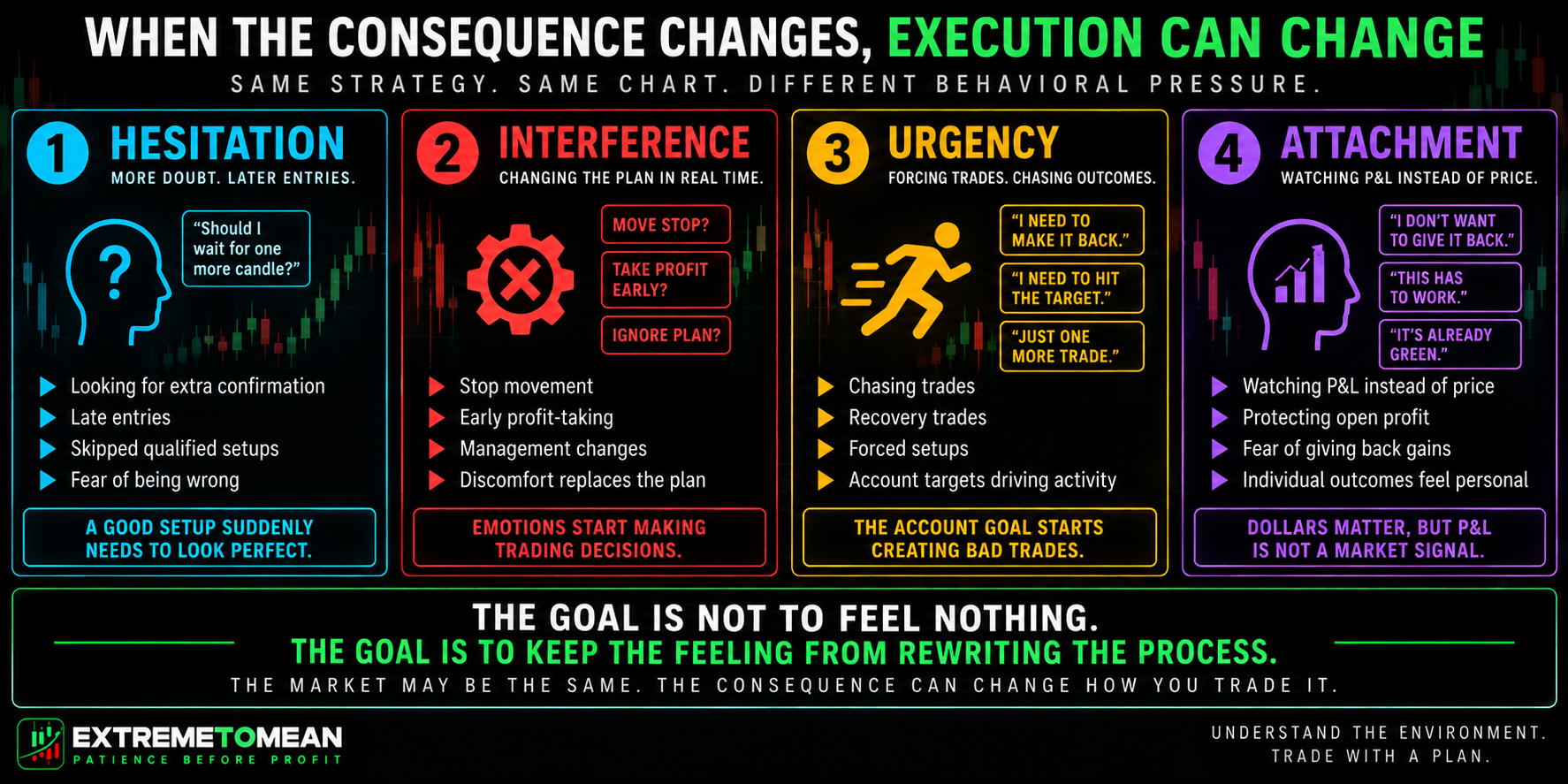
Four Ways Meaningful Consequences Distort Execution
The first distortion is hesitation. A setup that required enough evidence in simulation suddenly needs one more candle, another indicator, or extra confirmation because the trader wants more certainty before risking something meaningful. The problem is that markets do not become certain simply because the trader now has more to lose.
The second is interference. Stops get moved because accepting the planned loss feels worse than leaving the loss unrealized, or winners are closed early because open profit begins to feel like money the trader already owns. A predefined management rule can certainly change a stop or target, but discomfort alone is not a new market signal.
The third is urgency. A trader starts forcing trades because they want to recover a loss, finish an evaluation, protect a good day, or reach a milestone before the session ends. That is closely related to the cost of trading too much: the account objective begins creating activity that the market itself never justified.
The fourth is attachment. Instead of watching structure, location, invalidation, or whatever variables the strategy actually uses, the trader starts watching the P&L column. Dollars matter for account risk, but the P&L window tells you what the trade means to your account; it does not tell you what price is doing.
Position Size Is Also a Behavioral Variable
Traders often call this entire problem “psychology,” when exposure may be the simpler explanation. A trader might follow every rule with one MNQ contract, then become hesitant, reactive, and obsessed with P&L when the exposure increases substantially. The strategy did not change, but the financial meaning of ordinary market movement did.
That leads to a useful test: if your behavior changes when your size changes, position size is part of the behavioral problem. The right size is not merely the largest size an account can mathematically survive. It is also a size at which the trader can still execute the plan they claim to follow.
Smaller exposure can therefore be useful during the transition, but smaller does not mean harmless. Several Micro contracts can still create meaningful risk, and poor execution remains poor execution regardless of contract size. The advantage of smaller increments is that they can let the trader introduce consequence without immediately making every normal fluctuation feel like an emergency.
Simulation Should Practice the Process You Actually Want
Simulation becomes less useful when the trader treats it like an arcade game. Oversizing, taking random trades, resetting after losses, ignoring stops, or revenge trading because “it is only sim” may rehearse exactly the behaviors the trader does not want later. Simulation removes financial consequences; it should not remove process consequences.
Practice also becomes more useful when the conditions resemble the environment you intend to trade. Use realistic strategy rules, reasonable size assumptions, actual session limits, honest recordkeeping, and commissions or costs where the platform supports them. You do not need to pretend simulation perfectly recreates live execution, but you should avoid deliberately practicing a version of trading that you would never attempt when consequences matter.
Different results between simulation and live trading should not automatically be blamed on emotion, either. Fills, slippage, commissions, queue position, order type, liquidity, and the simulation model itself can affect results. A useful review therefore asks two separate questions: Did my behavior change, and did the execution economics change?
Live Trading Should Add Consequence, Not Unanswered Questions
Before introducing meaningful risk, the basic process should start feeling boring. You should know what setup you trade, how you enter, what invalidates the idea, how size is determined, when you stop trading, and how you review the outcome. If those decisions are still being invented on every simulated trade, financial pressure is being added to a process that is not stable yet.
A profitable week in simulation does not answer this readiness question. Short-term results can come from favorable conditions, normal variance, or a small sample, so there is no universal number of green days or simulated trades that proves someone is ready. The better evidence is repeated process execution: the trader recognizes the same setups, respects stops and size, accepts no-trade sessions, and does not keep rewriting the rules after every result.
That creates two different readiness questions. Can I execute the strategy correctly in practice? And then: Can I preserve that execution when the outcome matters? The first can be developed heavily in simulation; the second requires introducing some level of meaningful consequence.
The Transition Should Be Gradual
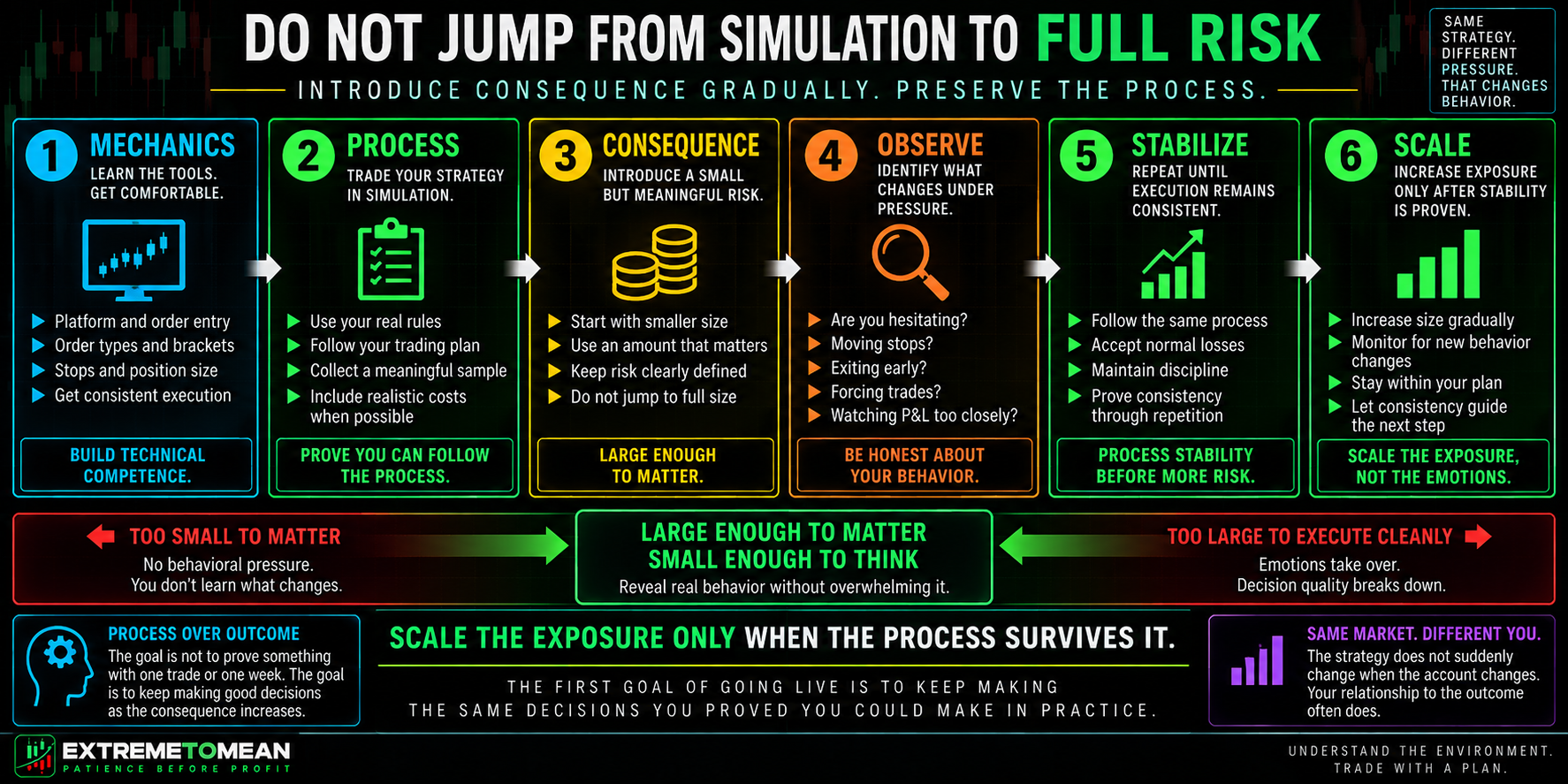
Moving from simulation to meaningful risk does not have to be a light switch. Going directly from zero consequence to the full exposure you eventually hope to trade makes it difficult to separate a strategy problem from an exposure problem. A more useful transition introduces pressure slowly enough that behavioral changes can actually be observed.
A practical sequence looks like this:
- Learn the mechanics — master the platform, order types, stops, brackets, and basic execution.
- Prove the process — trade the actual strategy in simulation using realistic rules and honest recordkeeping.
- Introduce a small meaningful consequence — use exposure that matters enough to reveal behavior without making one trade overwhelming.
- Observe what changes — look for hesitation, stop interference, premature exits, P&L fixation, skipped setups, or unplanned trades.
- Stabilize before scaling — require the decision process to remain consistent through meaningful repetition.
- Scale gradually — increase exposure only when the new level does not materially damage execution.
There is no universal dollar amount or contract quantity for Step 3. The productive level depends on the trader, strategy, account, contract, stop distance, and financial circumstances. The principle is simpler: the transition size should be large enough to matter and small enough to think.
Compare Behavior, Not Just P&L
Suppose your simulated trading produced stronger results than your first period trading meaningful exposure. That difference alone does not tell you why. Before changing the strategy, compare the actual decisions that produced those results.
Look at whether you entered the same setups, entered at roughly the same point, used the same invalidation, respected the same size, managed winners the same way, skipped qualified trades, added unplanned trades, or behaved differently after losses and wins. This turns “I trade worse when it matters” into something observable. Once the difference can be identified, it can be worked on.
A simple behavior log can make this easier. Track whether the live consequence caused you to hesitate, chase, move a stop emotionally, cut a winner early, watch dollars instead of the market, or violate a no-trade condition. The first goal is not to make the consequence-based P&L look impressive; it is to make the decisions resemble the process you already practiced.
Do Not Let a Few Live Results Rewrite the Entire Story
A losing live week does not automatically prove the simulator was meaningless or the strategy stopped working. Maybe behavior changed, maybe market conditions changed, maybe actual costs mattered, or maybe normal variance produced an unpleasant run. The correct response is diagnosis before strategy replacement.
Winning does not prove the transition is complete either. A favorable first few trades can hide hesitation, poor management, or oversized exposure just as easily as early losses can exaggerate a sound process. The framework for rebuilding trading confidence through evidence uses the same standard: the question is whether decision quality survives winners, losers, slow sessions, missed opportunities, and normal drawdown.
This is where protecting your next decision becomes more useful than proving something with one trade or one week. If increasing size creates repeated interference, reducing exposure is information, not humiliation. Stabilize the process first; then test whether a modest increase can survive without changing who is making the decisions.
Final Thought
Simulation is where the mechanics, setup recognition, rules, and routine should become repeatable. Meaningful consequences add a different test: can you still follow that process when being wrong actually matters? The market has not become more certain just because the dollars became more important.
The better question is not, “Am I finally ready to trade big?” Ask, “What changed in my decisions when the consequence changed?” If hesitation, interference, urgency, or attachment appeared, reduce the consequence, return to the process, repeat the setup, and track the difference.
The goal of the transition is behavioral continuity. Introduce enough consequence to expose what changes, keep the risk small enough that you can still think, and increase exposure only when the same decision process survives the added pressure. For traders building that broader process, the Extreme to Mean system is the logical next step.
Educational content only. Trading involves substantial risk and is not suitable for everyone.