
A losing streak affects more than the account balance. After enough losses, a trader may begin questioning setups that previously felt clear, hesitating when valid opportunities appear, or assuming that another loss is waiting behind every entry. Another trader may react in the opposite direction by increasing size, trading more often, or taking weaker setups in an effort to recover quickly. Both reactions allow recent outcomes to change the process.
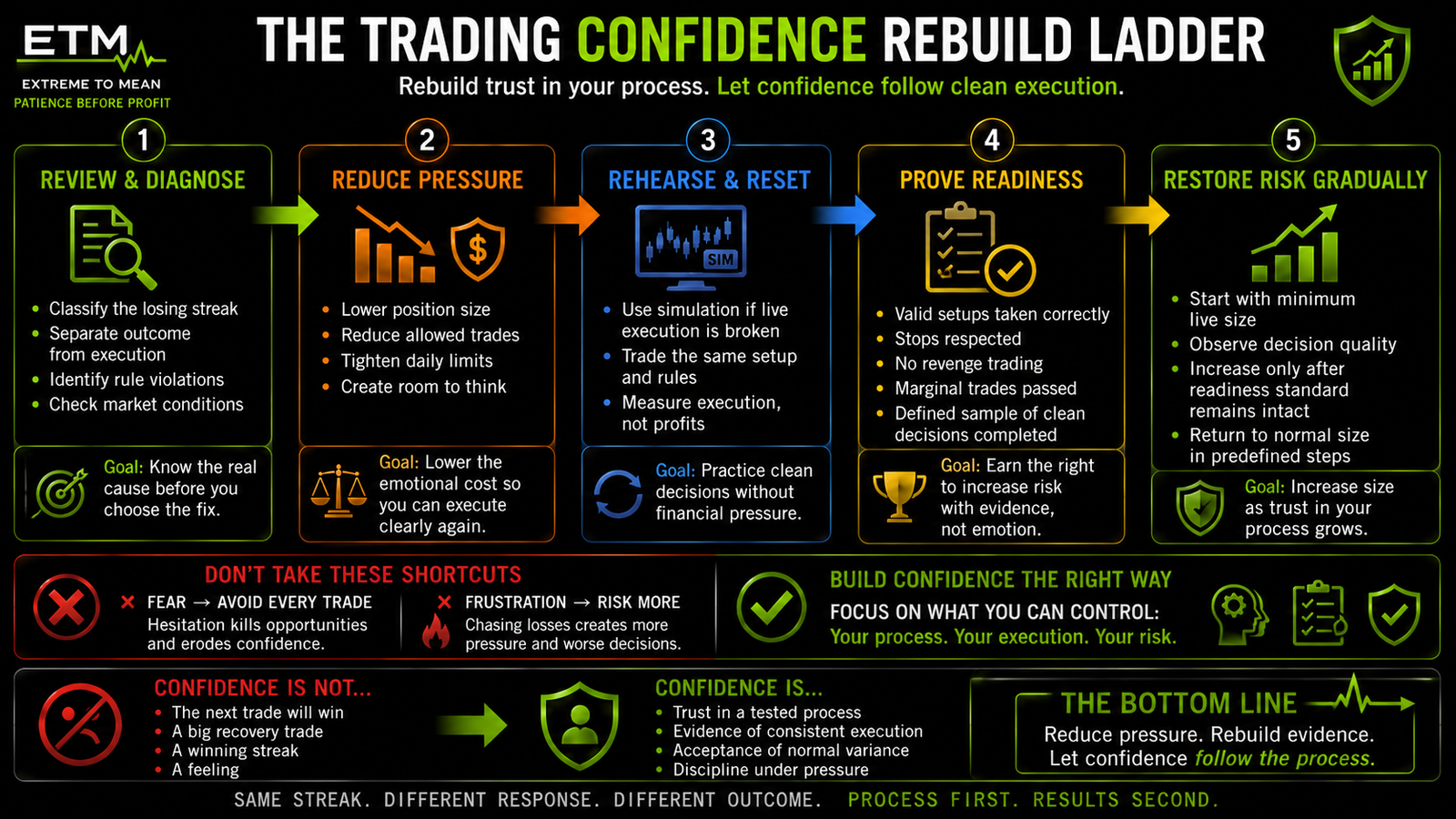
The lessons in The Trader category emphasize that discipline is most important when emotions create pressure to abandon structure. The purpose of a recovery process is not to make the trader feel fearless again. It is to determine what actually went wrong, reduce unnecessary pressure, and rebuild evidence that the process can still be followed correctly. Confidence should return as a result of clean execution rather than as a requirement before clean execution can begin.
First Determine What the Losing Streak Means
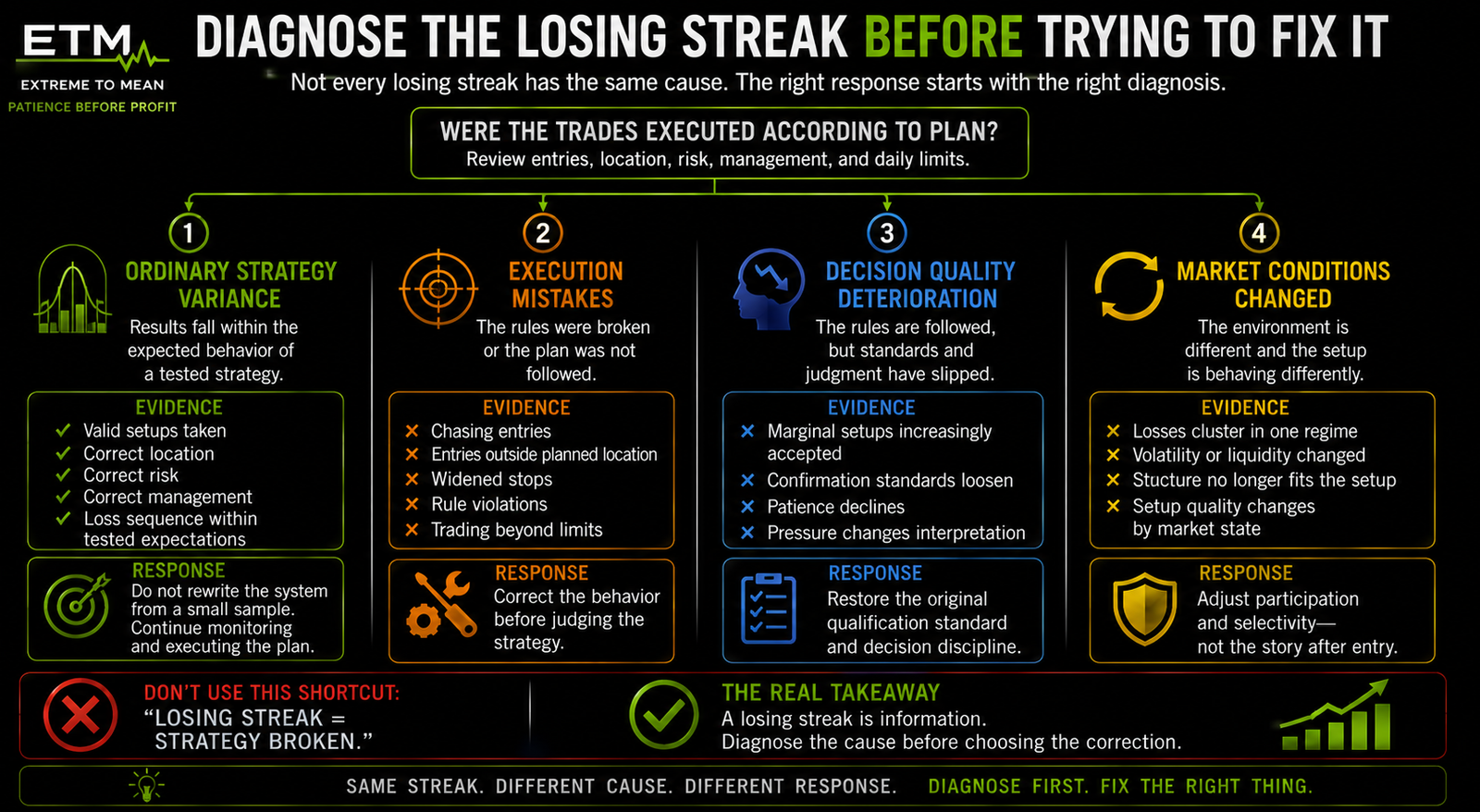
Not every losing streak signals the same problem. A tested strategy can produce several losses even when every trade followed the rules, because no legitimate trading method wins every time. Another streak may reveal repeated execution mistakes, deteriorating decision quality, or a market environment that no longer fits the setup as well as it did before. Recovery begins with classification rather than reaction.
This distinction matters because each problem requires a different response. Ordinary strategy variance does not justify rewriting a valid system after a few unfavorable outcomes, while repeated execution mistakes should not be dismissed as bad luck. A trader whose process has deteriorated needs behavioral correction, while a trader facing changed market conditions may need greater selectivity or temporarily less participation. Treating every losing streak as the same problem produces the wrong solution.
The first review should therefore separate results from decisions. Look at whether the trades met the actual entry criteria, occurred in acceptable market conditions, respected location and risk rules, and were managed according to plan. The question is not whether the trades lost money. The question is whether the losses came from trades the process was designed to take.
Ordinary Variance Can Feel Like Something Is Broken
A sequence of losses can feel statistically impossible when the trader experiences each loss personally. After four or five unsuccessful trades, the mind begins searching for an explanation because randomness feels less believable than a hidden problem. The trader may assume the setup has stopped working even when the trades still fit the historical behavior of the strategy. That discomfort makes premature system changes feel responsible.
Changing rules during ordinary variance can create a second problem on top of the first. The trader may remove valid setups, tighten stops without structural justification, abandon entries that historically belonged to the system, or start experimenting in the middle of live execution. The next group of trades is then no longer testing the same process that produced the original results. Confidence becomes harder to rebuild because the trader no longer knows what is being evaluated.
This is where historical review matters. If the strategy has previously experienced comparable losing sequences while remaining within its expected behavior, the current streak may require patience rather than redesign. That does not mean assuming everything is fine. It means gathering enough evidence before declaring that the system has changed.
Execution Mistakes Require a Different Response
Some losing streaks are not strategy variance at all. The trader may be entering late, chasing after the original location is gone, skipping invalidation rules, taking trades in the middle of poor structure, or participating after the daily decision quality has already deteriorated. Several individually small deviations can create a streak that appears to be a system problem. The system is then being judged through trades it never approved.
The lesson in Protect Your Next Decision becomes especially important here. One poor trade can create emotional pressure that affects the next decision, and that next decision can become weaker even if the original loss was completely normal. After several repetitions, the trader may believe the market has become impossible when the real problem is that execution has drifted. Recovery requires stopping the drift before evaluating the strategy itself.
The review should identify specific deviations rather than using vague descriptions such as “bad discipline.” A useful observation is that three entries occurred outside the planned location, two stops were widened, or trading continued after the daily loss threshold. Those are correctable behaviors. “I traded badly” is too broad to produce a reliable correction.
Decision Quality Can Deteriorate Before the Rules Break
A trader can technically follow the written rules while still making increasingly weak decisions. Perhaps marginal setups are being interpreted generously, confirmation is being accepted too early, or conditions that once would have produced patience are suddenly being treated as good enough. The written checklist may still be satisfied, but the standard used to interpret it has slipped. Losing pressure often makes that erosion difficult to recognize.
This is why the trader should review not only what was taken but what was passed. Compare losing trades with the cleaner setups from earlier periods and ask whether the same standard was actually applied. A strategy with discretionary elements depends on consistent judgment around context, location, and quality. If that judgment has weakened, rebuilding confidence requires restoring the original decision standard rather than simply taking more trades.
Market Conditions May Have Changed
Sometimes the trader is executing correctly and the strategy is behaving differently because the market environment has changed. A setup designed for directional movement may struggle in compressed, rotational conditions, while a reversion approach may behave differently when momentum keeps extending beyond normal extremes. Volatility, liquidity, participation, and time-of-day behavior can all change the quality of familiar opportunities. A losing streak can therefore contain useful information about context.
The mistake is assuming that a valid setup must perform equally well under every condition. Trading rules should identify where the setup earns attention and where patience becomes the better decision. A trader may discover that most recent losses occurred during one market state, one session period, or one type of location. That evidence can justify temporary selectivity without requiring an emotional abandonment of the entire strategy.
Losing Streaks Create Two Dangerous Reactions
The first reaction is fear. A trader sees a valid setup, recognizes that it meets the plan, and still cannot execute because the previous losses are being projected onto the next trade. Hesitation can lead to missed entries, late chasing, smaller trades taken for the wrong reason, or abandoning the setup after watching it work without participation. The trader is no longer evaluating the current opportunity independently.
The second reaction is aggression. The trader wants the drawdown repaired quickly and begins taking more trades, increasing position size, accepting weaker locations, or continuing long after the normal stopping point. The problem described in trading too much often becomes more dangerous after losses because additional activity feels like the path back to normal. In reality, recovery pressure can turn trading frequency into another source of deteriorating decisions.
Fear and aggression look opposite, but they come from the same problem. Both allow the recent P&L to control the next decision. The fearful trader avoids valid risk because another loss feels intolerable, while the aggressive trader accepts invalid risk because recovery feels urgent. Rebuilding confidence requires removing both pressures from the decision.
Stop Trying to Win the Confidence Back
Confidence is not rebuilt by finding one large winning trade. A dramatic recovery trade may improve the account balance temporarily, but it can reinforce the belief that emotional discomfort should be solved through market outcomes. The trader then becomes dependent on winning in order to feel capable of executing correctly. That is a fragile form of confidence.
The cleaner goal is much smaller: execute the next qualified decision according to plan. The promise described in a trading plan before the open matters more after a difficult period because the trader needs an external standard that was defined before emotion became intense. A losing trade taken correctly can contribute to recovery because it proves the trader can still follow the process under pressure. A winning trade taken outside the rules does not provide the same evidence.
Temporary Risk Reduction Can Create Room to Think
Reducing position size after a damaging streak can be useful when the normal risk level is interfering with clear execution. The purpose is not to punish the trader or assume that smaller size guarantees better results. It is to lower the emotional consequence of each outcome enough that setup quality can be evaluated more objectively. Risk reduction creates room for observation.
The reduction should be defined before the next trade rather than improvised after fear appears. A trader might temporarily use the smallest practical live size, reduce the number of allowed trades, or lower the daily loss threshold while the process is being reviewed. The exact adjustment depends on the trading plan and instrument. What matters is that the temporary risk level makes correct execution possible without becoming an indefinite avoidance strategy.
Simulation Is a Tool, Not an Exile
There are times when live trading should stop temporarily. Repeated rule violations, inability to execute a valid stop, revenge trading, or severe hesitation may indicate that the trader needs to demonstrate clean decisions without financial pressure first. Simulation can provide that environment, while the guide to the behavioral gap between simulation and live risk explains what practice alone cannot prove. It allows the trader to practice the same setup, schedule, and management rules while removing the immediate monetary consequence.
Simulation becomes less useful when it has no exit standard. A trader who simply says, “I will stay in sim until I feel confident,” may remain there because confidence is being treated as an emotion rather than evidence. The better approach is to define what must be demonstrated before returning to live risk. Simulation should have a purpose, a measurement standard, and a path back.
Define Readiness Before Restoring Risk
A recovery plan should establish objective readiness standards before normal size returns. These standards should measure execution quality rather than require a specific profit amount. The trader needs evidence that the process is being followed consistently and that the behaviors responsible for the breakdown have been corrected. That creates a more stable foundation than waiting for a winning streak.
A practical recovery review can ask:
- Have the losing trades been classified as variance, execution error, decision deterioration, or changed conditions?
- Am I taking only setups that meet the original qualification standard?
- Are entries occurring at the planned location rather than after chasing?
- Are stops and invalidation rules being respected without negotiation?
- Am I stopping when the daily plan says to stop?
- Can I take a valid loss without immediately changing the next decision?
- Can I pass a marginal setup without feeling that I must recover missed opportunity?
- Have I demonstrated clean execution for a defined sample of trades?
- If I used simulation, have I met the written standard for returning to live trading?
- Is the next increase in position size predetermined rather than emotionally chosen?
The better question is not, “Do I feel confident again?” It is, “What evidence shows that I am ready to execute the process at this level of risk?” Feelings can improve after one winning trade and collapse after the next loss. Readiness standards remain available regardless of the most recent outcome.
Restore Position Size Gradually
Returning immediately from reduced risk to full normal size can recreate the same pressure that caused the recovery process to begin. The trader may have demonstrated good execution at smaller size without yet proving that the same decision quality survives when the financial consequence increases. A gradual restoration process allows that transition to be observed. Each increase becomes another test of execution rather than a reward for recent profits.
The progression should be tied to predefined behavior. The trader might move from simulation to minimum live size, remain there through a defined sample of clean trades, and then increase toward normal size only if the rules continue to be followed. A loss does not automatically send the trader backward, and a win does not automatically move the trader forward. The determining factor is whether decision quality remains intact.
Confidence Should Follow Evidence
Healthy trading confidence is not the belief that the market will cooperate. It is confidence that the trader knows what qualifies, knows where the trade is wrong, knows how much risk is permitted, and knows what to do when the result is unfavorable. That confidence can exist before a losing trade because it is attached to the process rather than the outcome. It can also survive a losing streak when the evidence shows that the process is still being executed correctly.
This distinction removes an impossible burden from the next trade. The next setup does not need to repair the account, prove the strategy works, or restore the trader’s identity. It only needs to be evaluated honestly under the same standards as every other opportunity. Confidence grows when the trader repeatedly proves that those standards can be respected.
Final Thought
A losing streak does not automatically mean that the trader has lost the ability to trade or that the strategy has stopped working. It may reflect ordinary variance, execution mistakes, deteriorating judgment, changing market conditions, or some combination of those factors. The recovery process begins by identifying which problem actually exists. Only then can the response match the cause.
The goal is not to feel certain that the next trade will win. Review objectively, reduce pressure when necessary, use simulation when execution has genuinely broken down, define readiness standards, and restore risk gradually as clean decisions accumulate. Confidence should be the result of evidence that the process can still be trusted. Readers who want to go deeper into patience, discipline, and decision quality can continue through The Patience Principle.
Educational content only. Trading involves substantial risk and is not suitable for everyone.