
A challenge is supposed to test whether your trading process can operate inside defined constraints. It does not need to answer whether you are talented enough, whether you deserve to succeed, or whether you can impress anyone with how quickly you finish. Once those questions enter the trade, the market setup and the emotional value of the result can become dangerously mixed.
The distinction sounds small, but it changes decisions. Trading to pass asks, “What does the process require right now?” Trading to prove asks, “What result would make me feel successful right now?”
A Prop Challenge Can Quietly Become an Identity Test
A trader can understand every rule and still turn an evaluation into an identity test. The profit target becomes evidence of ability, a losing day feels like evidence against it, and another trader’s faster progress suddenly becomes relevant to decisions that should have nothing to do with comparison. The challenge has not changed, but the meaning assigned to it has.
That is why this lesson belongs inside the broader Trader curriculum. Good trading decisions still come from a defined process, not from what a particular outcome would say about the person making them. The account can evaluate your behavior without becoming a referendum on your intelligence or worth.
There is nothing wrong with wanting to pass. That is the stated objective, and pretending otherwise would be silly. The problem begins when each individual trade becomes responsible for completing that objective or proving that you deserve to complete it.
The Profit Target Is a Destination, Not Today’s Assignment
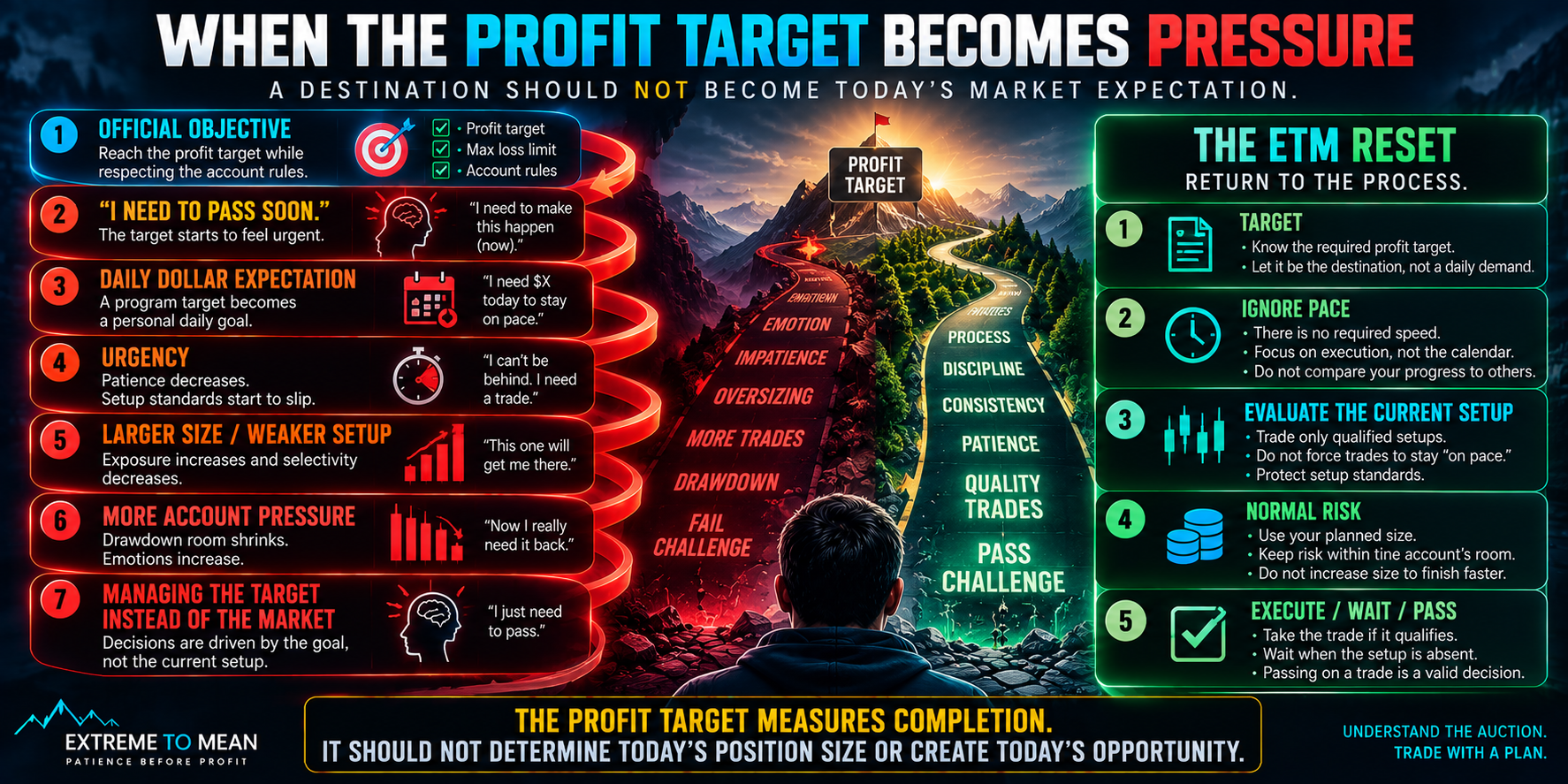
A profit target describes where the evaluation eventually needs to go. It does not create a daily quota, and it does not mean the market must provide enough qualified opportunity today to keep you “on pace.” Turning a destination into a daily demand is how an account objective begins manufacturing market expectations.
Suppose the remaining target is close enough that finishing today feels possible. The temptation is to look at the number and decide what you “need” from the session before you know what the session will actually offer. Once that happens, ordinary setups can begin carrying extraordinary expectations.
The cleaner approach is to let the target measure completion while the setup determines whether you trade. A trading plan made before the open matters because it gives the current market—not the remaining target—the job of deciding whether an opportunity qualifies. The destination stays visible, but it stops dictating today’s position size, frequency, or willingness to wait.
Trading to Pass Usually Looks Boring
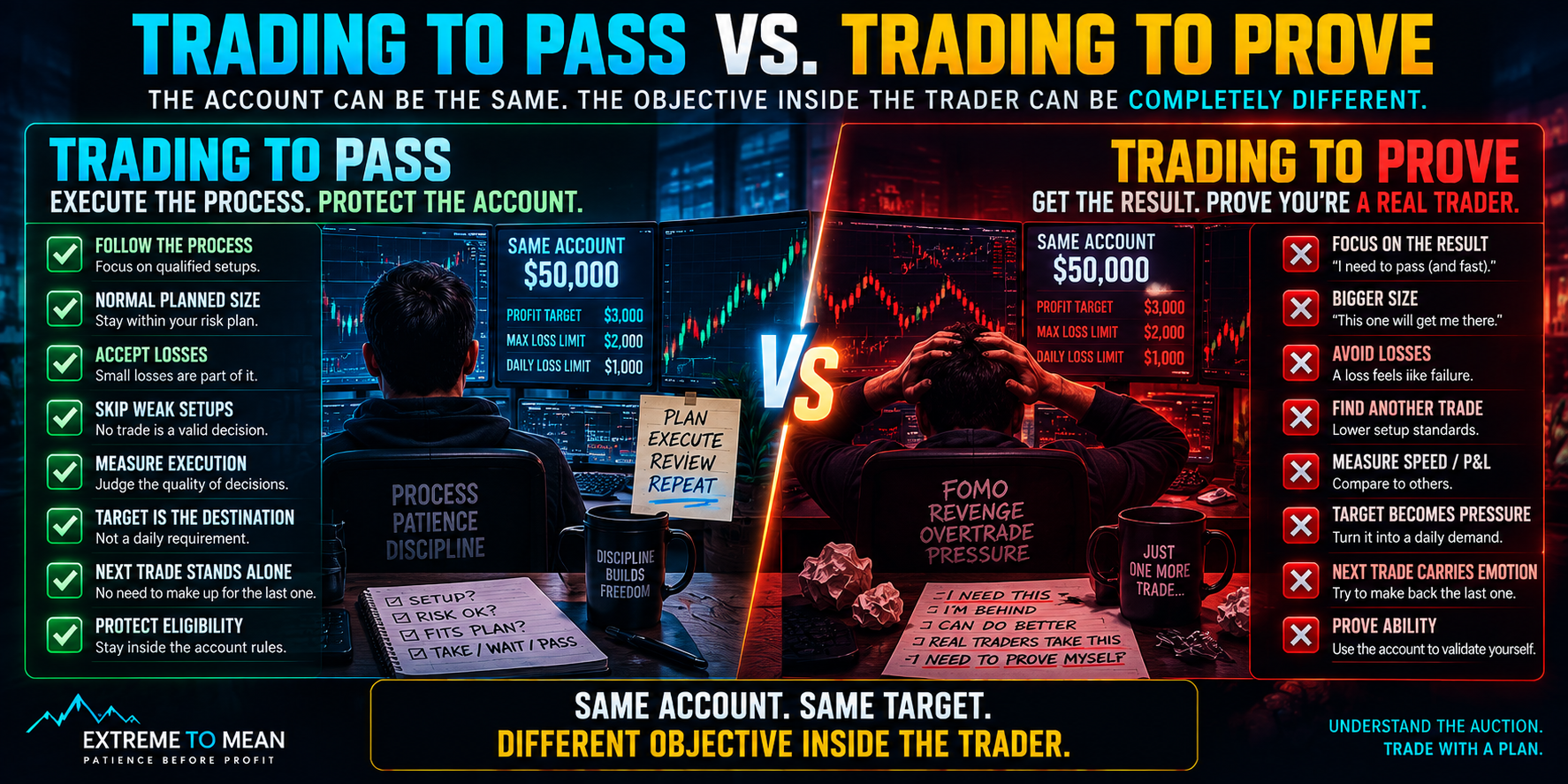
Trading to pass often looks unimpressive. It can mean normal size, modest gains, small planned losses, flat days, skipped setups, and sessions where nothing qualifies at all. None of that produces a dramatic screenshot, but a prop evaluation does not award extra credit for looking heroic.
This can be especially uncomfortable when another trader posts a larger day or finishes an evaluation faster. A clean +$180 session may suddenly feel inadequate beside someone else’s +$1,200, even if your own trades followed the plan perfectly. The comparison changes the scorecard from “Did I execute well?” to “Am I progressing fast enough?”
Doing nothing can still be a trading decision when the opportunity is absent. A trader who passes on a weak setup has not fallen behind merely because that setup later works. The process is judged by whether the decision was repeatable with the information available at the time, not by whether every skipped trade would have made money.
When Bigger Size Becomes a Way to Prove Something
The first visible change in proving behavior is often not the strategy but the size. The trader can still claim to be taking the same setup while quietly deciding that this particular trade deserves more exposure because finishing today would feel important. The chart may be nearly identical to yesterday’s chart, but the emotional value of winning has changed.
Consider two traders on the same evaluation who both need additional profit to pass and both see the same legitimate but ordinary futures setup. Trader A confirms the setup, uses the normal planned size, defines invalidation, takes the trade, and accepts the modest gain it produces. Nothing dramatic happens, and when no other setup qualifies, Trader A stops.
Trader B sees the same setup but thinks, “If I increase size here, I could finish this today.” The market has not improved enough to justify the difference; only the desired meaning of the outcome has changed. Size rises, every tick suddenly matters more, and normal movement becomes harder to tolerate because this trade is now carrying the weight of finishing the challenge.
Trader B might still win. That matters because the lesson should not depend on the market punishing the weaker decision immediately. If a rule-breaking or emotionally distorted trade wins, the result may actually reinforce the behavior even though the process became less repeatable.
Why Losses Feel Different When Your Identity Is Attached
A planned loss means something very different when the evaluation is only a process test. It can be reviewed as one trade inside a larger sample: Was the setup valid, was the risk acceptable, and was execution clean? The loss may be disappointing without needing to become personal.
When the evaluation has become proof of identity, however, the same loss can feel like evidence that the trader is not good enough. Now the next trade may be asked to repair the account, recover confidence, defend the previous market opinion, and restore self-image all at once. That is too many jobs for one trade.
Protecting your next decision becomes critical because the next setup still has to qualify independently. Revenge trading can emerge from a prior loss, but trading to prove something is broader than revenge; the proving motive can exist before the first loss ever occurs. A trader can begin the morning already determined to finish today, trade full size, or demonstrate that they can handle a difficult market.
Speed, Comparison, and the Pressure to Finish
Speed can become a hidden scorecard even when the program itself does not require the trader to rush. Number of days, number of trades, another trader’s progress, or how close the target feels can all become measurements of personal competence. The question quietly changes from “Am I executing correctly?” to “Why am I not there yet?”
Passing quickly is not automatically reckless, just as passing slowly is not automatically disciplined. Sometimes clean opportunities arrive quickly and the evaluation progresses quickly with them. The problem is forcing speed after the market stops supplying the opportunities needed to support it.
This is where the profit target can mutate into pressure. Target becomes pace, pace becomes a daily dollar expectation, the expectation creates urgency, and urgency starts granting exceptions to normal size or setup standards. Eventually the trader is no longer managing the market in front of them; they are managing the discomfort of not being finished yet.
How to Tell Which Game You Are Playing
The easiest way to identify which game you are playing is to remove the audience and the finish line from the decision. Ask whether you would take the same setup if you were nowhere near the target and whether you would use the same size if nobody knew how quickly you passed. If the answer changes, the desired result may be controlling the trade.
Another strong question is, “Has the market improved—or has my desire for the outcome increased?” A better setup can justify a different decision when your actual rules support it, but wanting the target more badly does not improve market quality. Desire is not confirmation.
Then ask the uncomfortable question: “If this trade wins outside my rules, would I want to repeat the decision?” A winning exception is still evidence of an exception, and a process cannot become reliable if profitable rule-breaking is automatically treated as proof of skill. Review the quality of the decision before celebrating what the P&L happened to do.
The ETM Pass-vs.-Prove Framework
The pass-versus-prove distinction can be reduced to two paths. The process path is OBJECTIVE → SETUP → RISK → EXECUTION → REVIEW, because each stage has a defined job and the outcome is allowed to remain uncertain. The proving path is OBJECTIVE → EGO → URGENCY → EXCEPTION → CONSEQUENCE, because the desired result begins overriding how the trade would normally be handled.
Before acting, ask:
- What am I trying to accomplish with this trade?
- Would I take this setup if I were nowhere near the profit target?
- Would I use this same size if nobody knew how quickly I passed?
- Has the market improved—or has my desire for the outcome increased?
- Am I executing the plan or repairing how I feel about the account?
- Would a normal loss here still feel acceptable?
- If this trade wins outside my rules, would I want to repeat the decision?
Those questions are not meant to make you passive; they are meant to keep the evaluation objective from leaking into the setup itself. Depending on what the answers reveal, the decision may be PROCESS, PAUSE, REDUCE, or PASS. If pressure repeatedly creates extra attempts simply because progress feels too slow, trading too much may be the problem that deserves attention.
The simplest diagnostic may be: “If nobody ever saw this account, would I trade it the same way?” If the answer is yes, the decision is more likely to be anchored in the actual process. If the answer is no, the account may be telling a story about you that has become more important than the market.
Final Thought
A prop challenge already gives you something to accomplish. You do not need to add a second test underneath it about whether you are smart enough, tough enough, fast enough, or worthy enough to call yourself a trader. Let the account measure whether you can repeatedly execute a process inside its rules.
The profit target is a destination, not today’s assignment. Trade the setup in front of you, use the risk the process permits, and let each trade stand on its own instead of making it responsible for finishing the evaluation or proving who you are. The account can measure completion; it does not need to measure your identity.
Educational content only. Trading involves substantial risk and is not suitable for everyone.