
A low-quality trade can be cheap on the statement and expensive everywhere else. The real bill may not appear until the next decision.
A low-quality trade can lose twice: once in the account and again in the quality of the next decision.
The mistake is judging a weak trade only by the dollars it won or lost. A trade can close for minus $75, plus $150, or breakeven and still leave behind frustration, distraction, self-doubt, urgency, or false confidence. Once that residue changes how the next setup is judged, the first trade is still influencing the session even though the position is gone.
That is why this lesson belongs inside The Trader. The issue is not whether the market eventually rewarded the entry; it is whether the decision deserved risk under the trader's own process. Trade quality is decided by the decision, not by whether the market happened to pay it.
A Low-Quality Trade Costs More Than Its Stop
A low-quality trade is not simply a losing trade. It is a trade that did not deserve risk under the trader's process because location was weak, context was poor, qualification was incomplete, invalidation was unclear, or emotion replaced the original standard. The outcome can still be a win or a loss.
A clean planned loss and a weak loss can create very different aftermaths. A clean loss may be disappointing, but the trader can still say, "The setup qualified, the risk was acceptable, and the trade failed." A weak loss often carries a second thought: "I knew that trade did not need to exist."
The money may be gone once, but regret can replay the decision many times. Loss feels different when the trader believes they volunteered for unnecessary risk. The financial result is visible immediately; the emotional and decision costs may continue after the trade closes.
Why a Bad Decision Feels Different From a Clean Loss
Suppose two trades each lose $100. Trade A met the setup requirements, fit the planned risk, and followed the plan; Trade B had poor location, incomplete confirmation, and the trader knew it was weak before entering. Same P&L, very different information.
Trade A mainly says a qualified trade can still lose. Trade B can trigger regret, anger, embarrassment, or self-criticism because the trader is also processing a decision they believe should have been rejected. Breaking your own standard can create more doubt than being wrong about the market.
That is why process and outcome must stay separate when protecting the next decision. The next setup should not have to carry the emotional weight of the last mistake. If the trader cannot separate the two, a small poor-quality trade can become larger than its dollar amount.
How Weak Trades Damage Attention and Self-Trust
After a low-quality trade, attention can shift away from the market and toward the mistake. Part of the mind may be replaying the entry, criticizing the rule break, or calculating how to undo the result while the trader is still reading price. A low-quality trade can make the trader trade two things at once: the market and the memory of the mistake.
That divided attention matters when a genuinely better setup appears. The next trade may be objectively cleaner while the trader is mentally less available to recognize it because attention is still trapped in the prior decision. The trader can hesitate on valid evidence, rush to recover a loss, or reinterpret normal market behavior through the mistake.
Self-trust can shift as well. The question is no longer merely, "Was my market read wrong?" but, "Can I trust myself to follow the rules I already know?" The emotional cost can therefore show up as too much action or too little action.
Why the Emotional Cost Can Create the Next Bad Trade
A weak loss can create false urgency because the next trade quietly receives a new assignment: repair the previous one. The market may not have improved, yet the trader wants another opportunity sooner because the emotional state changed. The next setup becomes dangerous when it is asked to solve the emotional problem created by the last one.
One trader may become aggressive and think, "I need it back." Another may become overly cautious and think, "I do not trust myself anymore." Both responses move decision quality away from the normal standard.
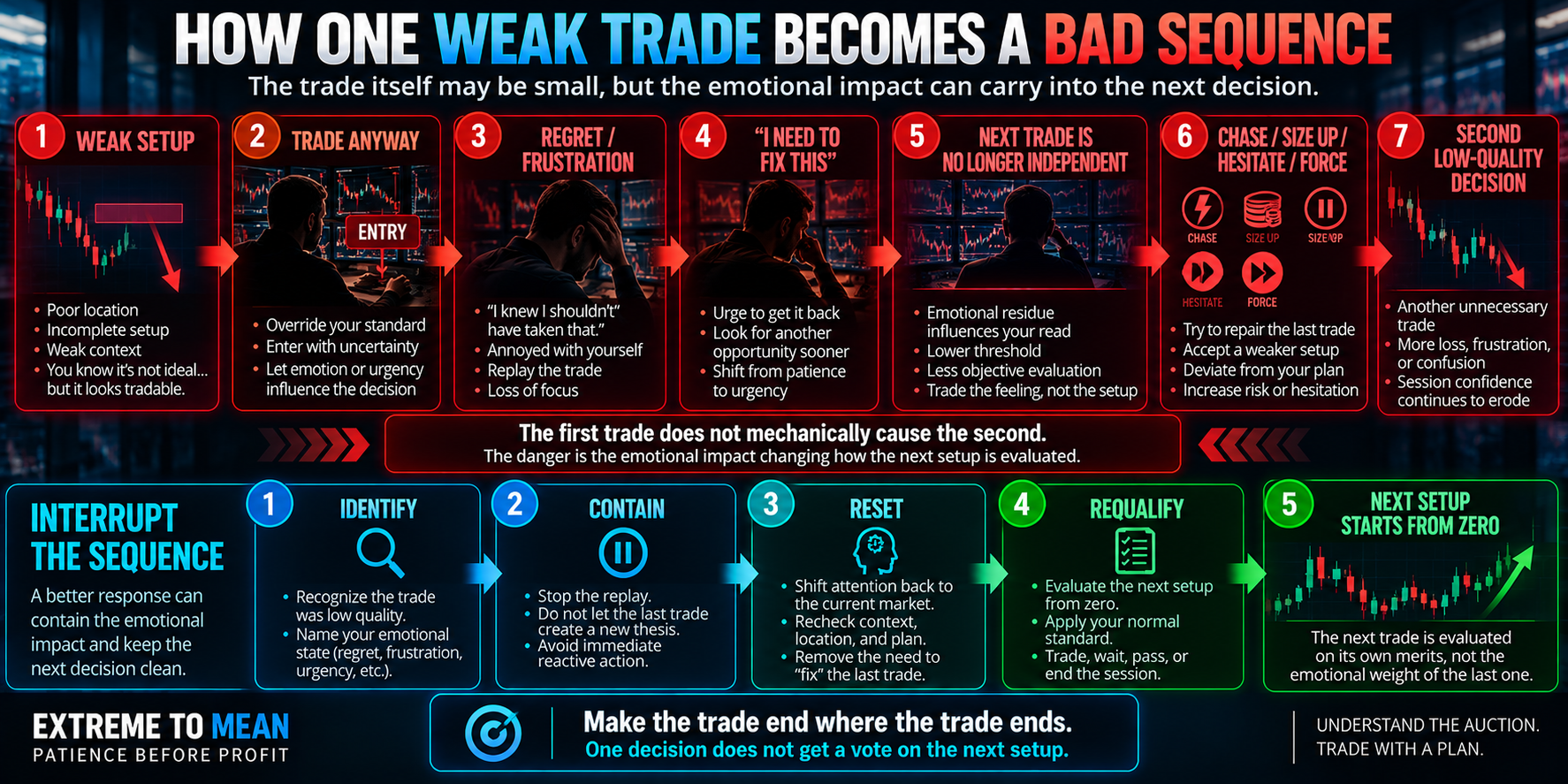
This is how a small mistake can become a sequence. Low-quality trade becomes regret or frustration, which reduces attention or creates urgency, which alters the next qualification decision. The trade itself may be small; the chain it starts may not be.
A Winning Bad Trade Can Be Even More Dangerous
A low-quality trade does not have to lose to create damage. If the trader chases, ignores location, takes an incomplete setup, and gets rewarded anyway, the immediate result can be relief and validation. The trader may conclude that the original standards were too strict.
The market can pay you for a mistake without making the mistake valuable. A losing bad trade can teach caution; a winning bad trade can teach permission, making the next weak trade easier to justify. The cost of the winner may therefore arrive later as lowered standards rather than immediate regret.
This is one reason your trading plan is a promise made before the open. A profitable exception is still an exception if it violated the process that was supposed to govern the trade. Flexibility should come from new market information, not from promoting a weak decision because it happened to work.
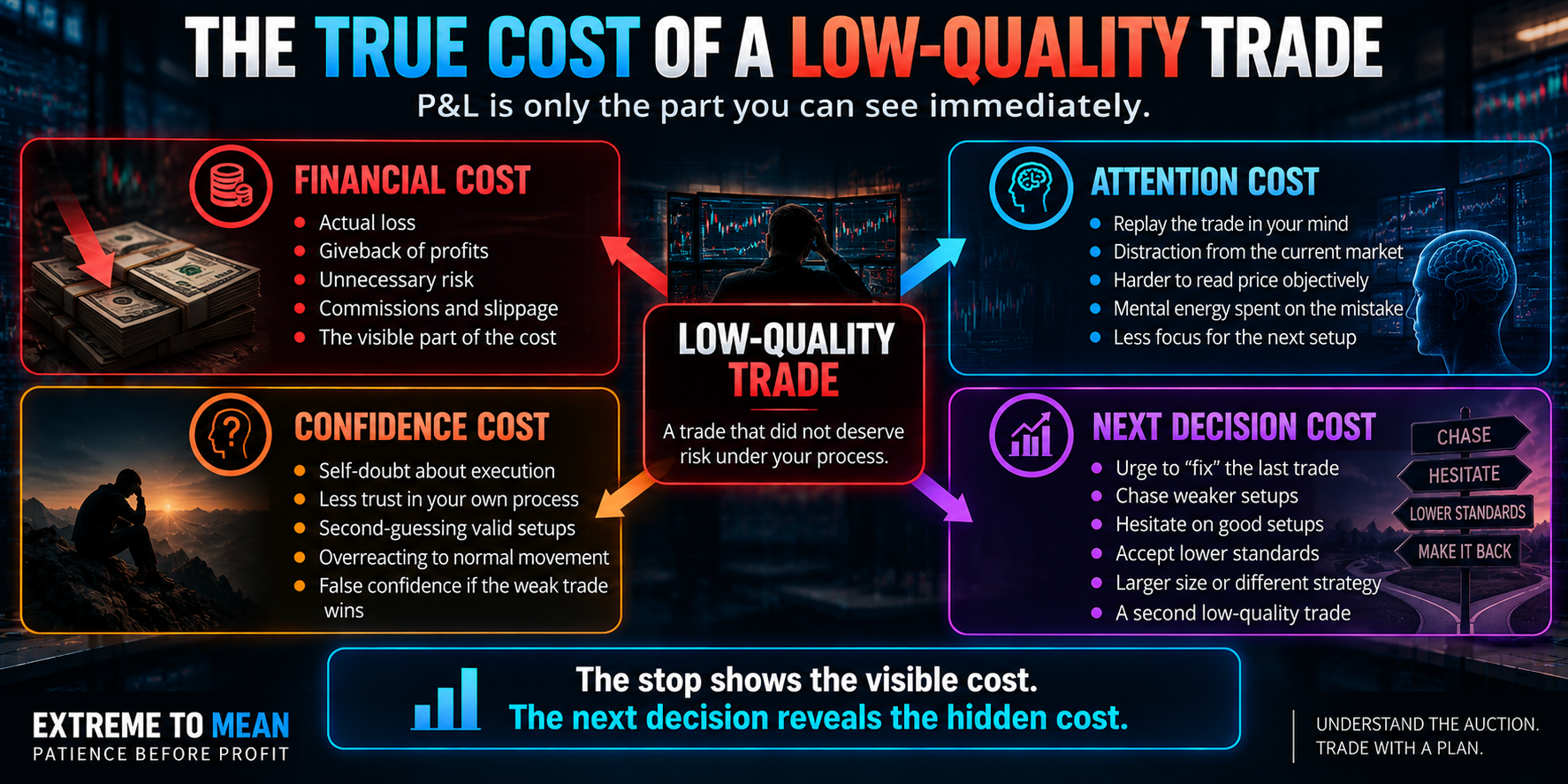
The Four Hidden Costs of a Low-Quality Trade
The first cost is money: the actual loss, giveback, or unnecessary risk. The second is attention: mental energy spent replaying, defending, or regretting the mistake. The third is confidence: reduced trust in execution, or false confidence if the weak trade happened to win.
The fourth cost is the next decision. The next setup may be chased because the trader wants recovery, avoided because confidence has fallen, oversized because urgency increased, or accepted at a lower standard because the prior exception worked. The stop shows the visible cost; the next decision reveals the hidden cost.
These costs are not guaranteed after every poor trade, and they cannot be measured precisely in dollars. The point is to notice whether the trade changed the state from which the next decision is being made. Ask: If the previous trade had never happened, would I evaluate this next setup the same way?
How One Weak Trade Can Change the Session
Consider an NQ trader watching a setup develop in mediocre context and imperfect location. Qualification is incomplete, and the trader already knows, "This is not really there yet," but enters anyway with $100 of planned risk. The trade stops, and the visible cost is minus $100.
A cleaner setup appears later, but Trader A is now focused on getting the money back, quicker to enter, and slightly larger than normal. The second trade loses $175, so the session is now down $275; the first loss did not mechanically cause the second, but it helped create an emotional state that distorted the next judgment. Trader A carried the first trade into the second.
Trader B makes a different separation. The first trade is labeled below standard, but the next question is not, "How do I get $100 back?" It is, "What must be true before the next trade deserves risk?" If the next setup qualifies, trade; if it does not, let the first trade end where it ended.
The Emotional Cost Audit
After a questionable trade, the goal is not to punish yourself or assume the session is ruined. The goal is to determine whether emotional spillover is beginning to change the next decision. Ask:
- Was the trade actually low quality, independent of the outcome?
- What is my current state: regret, frustration, urgency, fear, relief, or overconfidence?
- Am I watching the current market, or replaying the previous trade?
- Has my standard for the next setup changed?
- Am I trying to fix P&L or fix the decision process?
- Would I take the next trade if the previous one never happened?
- Am I hesitating on a good setup because the weak one damaged confidence?
- Does my existing plan require a reset, a pause, or the session to be done?
The strongest question is often the simplest: Would I take this next trade if the previous trade did not exist? That forces the next setup to stand on its own rather than inherit the emotional burden of the last one. It keeps the review focused on evaluation rather than reaction.
For traders who notice one weak decision repeatedly turning into several unnecessary entries, the trading-too-much problem guide is a useful next step. Overtrading has many causes, but emotional spillover from a low-quality decision is one path worth recognizing. The purpose is not to erase emotion; it is to stop emotion from silently rewriting qualification.
The ETM Identify → Contain → Reset → Requalify Framework
Use IDENTIFY → CONTAIN → RESET → REQUALIFY. Identify what made the trade low quality, contain the regret, anger, relief, or overconfidence so it does not become a new trade thesis, and reset attention to the current market and original standards. Then requalify the next setup from zero.
This is not a full reset protocol; it is a boundary between one decision and the next. The practical rule is simple: the last trade does not get a vote on the next setup. It may teach you something, but the next trade still has to qualify independently.
Final Thought
A low-quality trade is expensive because its influence can continue long after the position is closed. The money won or lost is only the visible part; frustration, self-doubt, distraction, urgency, or false confidence can quietly change how the next setup is judged.
That is why decision quality matters even when the dollars seem small—and even when the bad trade happens to win. Identify what made the trade weak, contain the emotional spillover, and force the next setup to qualify on its own. The last trade should be allowed to teach you something; it should not be allowed to make the next decision for you.
Educational content only. Trading involves substantial risk and is not suitable for everyone.