
Indicators can be useful because they organize information that may be difficult to read quickly. A momentum tool can show that directional pressure is changing, a moving average can help frame trend, and a volatility measure can show that conditions are expanding or contracting. The mistake begins when one useful observation is promoted into automatic permission to enter.
That distinction belongs naturally inside the broader Trader curriculum. The trader's job is not to reject signals or pretend indicators have no value; it is to decide what job each tool has and how its information fits into the larger decision. Structured judgment means combining evidence inside defined rules, not doing whatever feels right after a light turns green.
A Signal Is Information, Not Permission
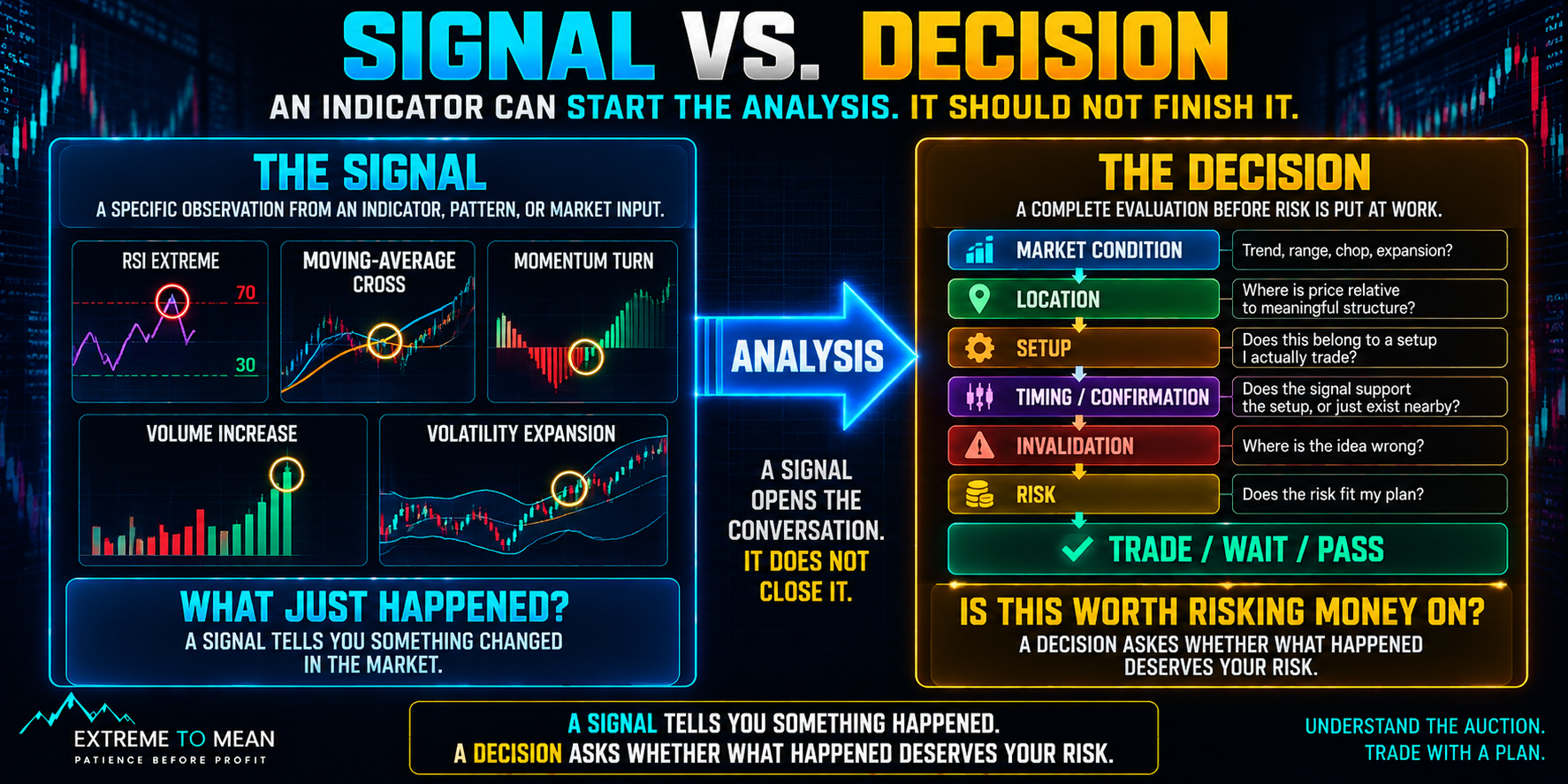
For this lesson, a signal is a specific observation produced by an indicator, rule, pattern, or market input that deserves attention. A moving-average crossover, an oscillator turning higher, volatility expansion, a volume change, or price crossing a technical level can all qualify as signals. Each one says, in effect, “Something changed.”
What the signal does not automatically say is, “Put money at risk now.” A bullish momentum turn may tell you that short-term pressure is improving, but it does not necessarily tell you whether price is at a good location, whether the broader condition supports a long, or whether your actual setup exists. Indicators answer questions; the mistake begins when one answer is treated as the whole decision.
This is why A Setup Is Not a Signal is such an important companion idea. Recognizing evidence is not the same as completing trade qualification, because a tradable idea still needs structure, location, timing, invalidation, and acceptable risk. Something flashing on the chart can begin the analysis without being allowed to finish it.
What an Indicator Can—and Cannot—Tell You
Technical indicators are generally calculations built from market data such as price, volume, volatility, time, or combinations of those inputs. That does not make them useless; it makes their job easier to define. The indicator is processing market information, not receiving a message from the future.
A trend tool may help answer, “What is the broader directional condition?” A momentum tool may help answer, “Is directional pressure strengthening or weakening?” A volatility tool may help answer, “Are current conditions compressed or expanded?”
Those are valuable questions, but they are narrower than the question required to risk capital. None of them automatically answers, “Is this a good location to enter, where is the idea wrong, and does the risk fit?” Do not ask an indicator to answer a question it was never designed to answer.
Why the Same Signal Changes With Location and Context
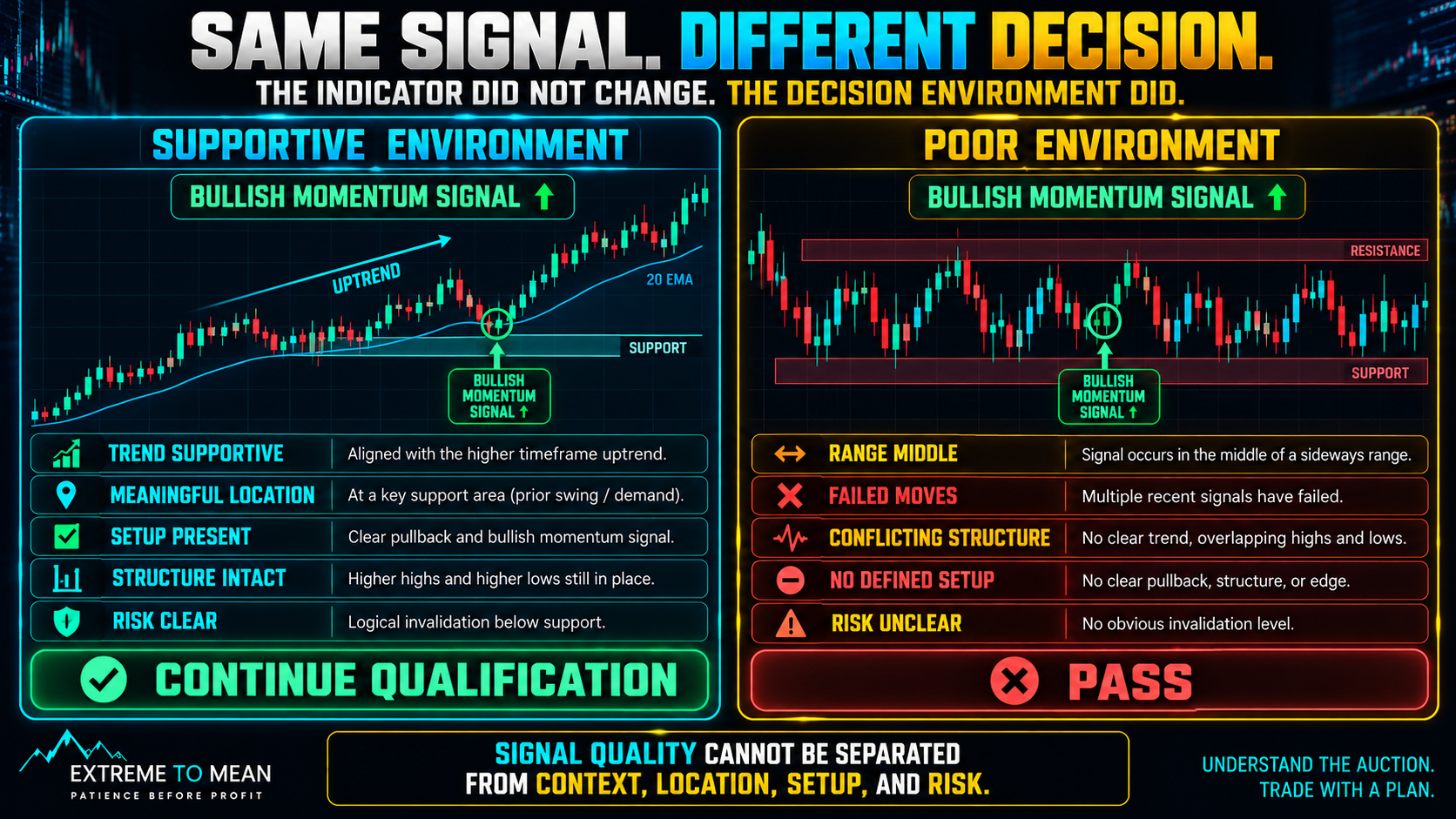
Suppose the same bullish momentum signal appears twice during the same session. In the first case, price is in an established uptrend, has pulled back into meaningful support, structure remains intact, and one of your planned setups is beginning to form. The momentum turn supports an idea that already has context and location.
Later, the exact same bullish signal appears again, but price is now sitting in the middle of a messy range after several failed moves. Structure is unclear, the setup is absent, and any reasonable invalidation would be awkward or expensive. The indicator may still be correctly reporting improving short-term momentum, yet the cleaner decision may be to pass.
The indicator did not “work” in one case and “fail” in the other simply because the decisions differed. It answered the same narrow question in both environments while the surrounding decision conditions changed. Market conditions change the quality of a setup, and location changes the meaning of evidence.
More Indicators Do Not Automatically Mean More Confirmation
When traders feel uncertain, adding another indicator can feel like adding more evidence. One momentum tool is bullish, so the trader checks another oscillator, then another moving-average calculation, and eventually the chart contains several formulas describing similar behavior. The screen looks more sophisticated even though the information may not be meaningfully more independent.
Confirmation is not the same thing as duplication. Three tools that all derive from similar price behavior may be three different calculations of essentially the same market characteristic rather than three separate reasons to trade. Counting indicator votes can create false confidence when the real decision still lacks location, setup, or risk.
The better question is not, “How many indicators agree?” Ask, “What different decision question does each tool help me answer?” If several tools all perform the same job, the extra agreement may add less information than it appears to.
What Job Does This Indicator Have?
Every indicator on a trading chart should have a defined analytical job. A trend tool might help organize directional context, a momentum tool might help assess whether pressure is strengthening or fading, a volatility tool might help describe expansion or compression, and a volume tool might help evaluate participation. The exact tools matter less than whether the trader understands what each one contributes.
A useful mindset is, “This indicator helps me assess momentum.” A weaker mindset is, “The indicator told me to buy.” The first keeps responsibility with the trader; the second hands the trading decision to a calculation that was never designed to evaluate the whole situation.
If you cannot explain the specific decision question an indicator helps you answer, it may be chart decoration rather than useful evidence. The goal is not necessarily to use fewer indicators, and it is not to use more. The goal is to give every indicator a clear job.
From Signal to Setup to Actual Decision
The clean process begins by asking what the signal actually says. If momentum turned higher, record that as improving momentum rather than immediately translating it into “long.” Then place that observation back into the market that produced it.
What condition are you trading: trend, range, chop, expansion, or something less clear? Where is price relative to meaningful structure, and is there a setup you actually trade at that location? Only after those questions are answered should the signal be considered as confirmation rather than entry permission.
This keeps an important distinction intact: location and setup are not the same thing as trigger and confirmation. A great trigger in a poor location is still in a poor location, while a strong signal next to no defined setup is still not a trade. The signal can point; the trader still has to decide whether the destination is worth going to.
Risk Still Has the Final Vote
Even a strong signal in a sensible location cannot solve every problem. A trade still needs a defensible place where the idea is wrong, and the dollar risk created by that invalidation still has to fit the plan. Strong signal + unclear risk = not ready.
The same applies when the correct structural stop is simply too far away. The indicator cannot shrink that distance, improve the contract math, or make unacceptable risk acceptable. The trade is not ready until the risk is clear, regardless of how compelling the signal looks.
This is where mechanical signal-following often breaks down. The trader sees a trigger first and tries to invent the risk afterward because the emotional commitment has already begun. A cleaner process makes the signal earn its place inside a trade whose invalidation and risk were evaluated honestly.
Use Indicators to Disqualify Trades Too
Indicators should not exist only to tell the trader “go.” They can also show that momentum is not supporting the setup, volatility is behaving poorly, trend evidence conflicts with the thesis, or conditions are not developing as expected. Useful evidence can lower confidence just as easily as it can raise it.
That makes signals part of filtering rather than merely triggering. A signal may support further qualification, tell you to wait, or help confirm that the cleaner choice is to pass. The trader who uses indicators only as entry permission is ignoring half of what evidence can do.
This is especially useful when urgency is building. If a chart alert fires after price has already left your planned location, the signal may be accurate while the trade itself is late. Chasing the trade because an indicator finally confirmed what you wanted to see still turns information into reaction.
The ETM Signal-to-Decision Framework
Use this sequence before allowing any indicator signal to become a trade:
- SIGNAL — What did the indicator actually tell me?
- CONTEXT — What type of market environment am I in?
- LOCATION — Where is price relative to meaningful structure or opportunity?
- SETUP — Does this belong to something I actually trade?
- CONFIRMATION — Does the signal support the setup, or merely exist nearby?
- RISK — Where is the idea wrong, and does the risk fit?
- DECISION — TRADE / WAIT / PASS
That sequence does not eliminate judgment; it defines where judgment belongs. Judgment is structured interpretation inside a repeatable process, while impulse is a decision looking for an explanation after the fact. The framework keeps the indicator useful without allowing it to become the authority.
A strong final question is, “If this indicator were hidden, would the rest of the trade still make sense?” If the answer is no because the setup, location, or invalidation disappears without the signal, the trade may be depending on the tool to supply more meaning than it actually contains. If the answer is yes, the signal is more likely doing what a good indicator should do: supporting an already coherent decision.
Final Thought
Indicators are most useful when they make one part of the market easier to understand. Let them measure trend, momentum, volatility, volume, or another defined condition, then put that evidence back into the complete trading decision. A signal deserves attention, but only a qualified trade deserves risk.
The problem is not using signals. The problem is confusing a signal with a complete decision and allowing a calculation to replace the trader's responsibility to evaluate context, location, setup, invalidation, and risk. Use indicators to organize judgment, not to escape it.
Educational content only. Trading involves substantial risk and is not suitable for everyone.