
Many beginners enter the market with a mixed understanding of what they are doing. They hear about good companies, strong brands, long-term wealth, market returns, day trading, swing trading, charts, earnings, and price movement all at once. It becomes easy to blend everything together.
That confusion creates a real problem. A person may enter a position like a trader, but manage it like an investor. They may buy because price is moving today, but then justify holding because the company seems strong long term. Or they may say they are investing, but panic over every short-term candle.
This article belongs in The Basics because a beginner needs to know what game they are playing before they can evaluate a decision clearly. Trading and investing can both involve stocks, ETFs, futures, or other financial instruments, but the purpose behind the decision is different.
Neither approach is automatically better. The problem is not choosing one or the other. The problem is mixing them without realizing it.
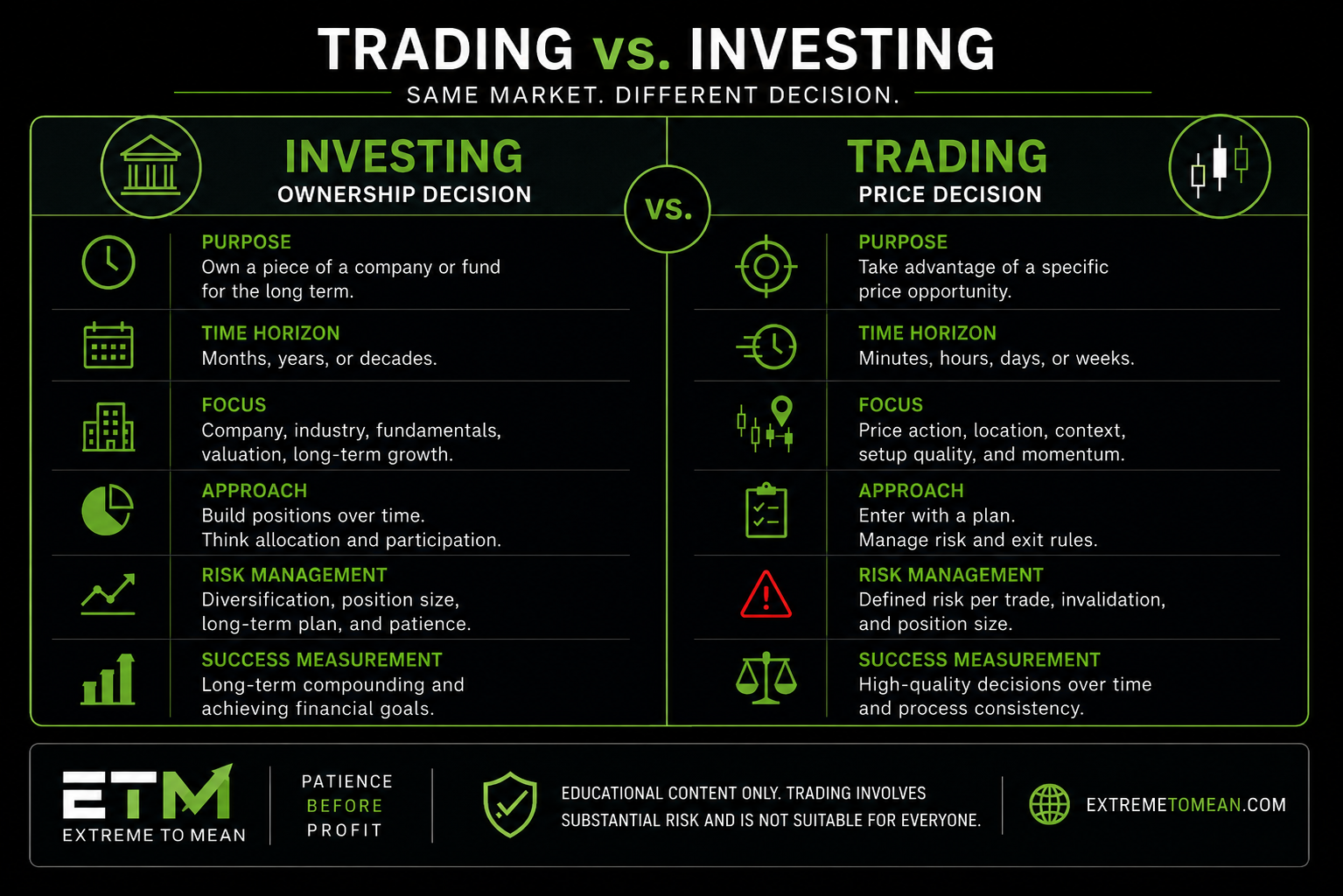
Investing Is Usually an Ownership Decision
Investing usually begins with the idea of ownership.
An investor may buy a stock because they want to own part of a company. They may buy an ETF because they want exposure to a basket of companies, a sector, or a broad market index. The decision is often based on long-term participation rather than short-term price movement.
The investor’s question is usually something like, “Do I want to own this over time?”
That question can include many factors: the quality of the business, the strength of the industry, long-term earnings, valuation, dividends, economic trends, or the investor’s personal financial goals. The time horizon may be months, years, or decades — the horizon Warren Buffett built his investing approach around is closer to decades than to a single session.
Because of that longer time horizon, an investor may be willing to sit through normal market fluctuations. A stock may pull back, a sector may go out of favor, or the broader market may decline for a period of time. That does not automatically invalidate an investment thesis.
The key is that the investor’s decision was not supposed to be judged by every short-term move.
This does not mean investing is safe or simple. Investments can lose value. A long-term thesis can be wrong. A strong company can struggle. But the process is usually built around ownership and time, not short-term entry and exit decisions. That same ownership-versus-price distinction shows up outside equities too — the comparison between Bitcoin and gold only makes sense once the holder has decided which job the asset is meant to do over time.
Trading Is a Price Decision Under Risk
Trading is different.
A trader is not usually asking, “Do I want to own this for years?” A trader is asking, “Is there a clear enough opportunity here, at this price, under these conditions, to justify risk?”
That is a different decision.
A trade may last minutes, hours, days, or weeks depending on the style of trading. The trader may care about the instrument, but the main focus is usually price behavior, location, context, risk, and timing. The trader wants to know whether the current conditions support a specific decision.
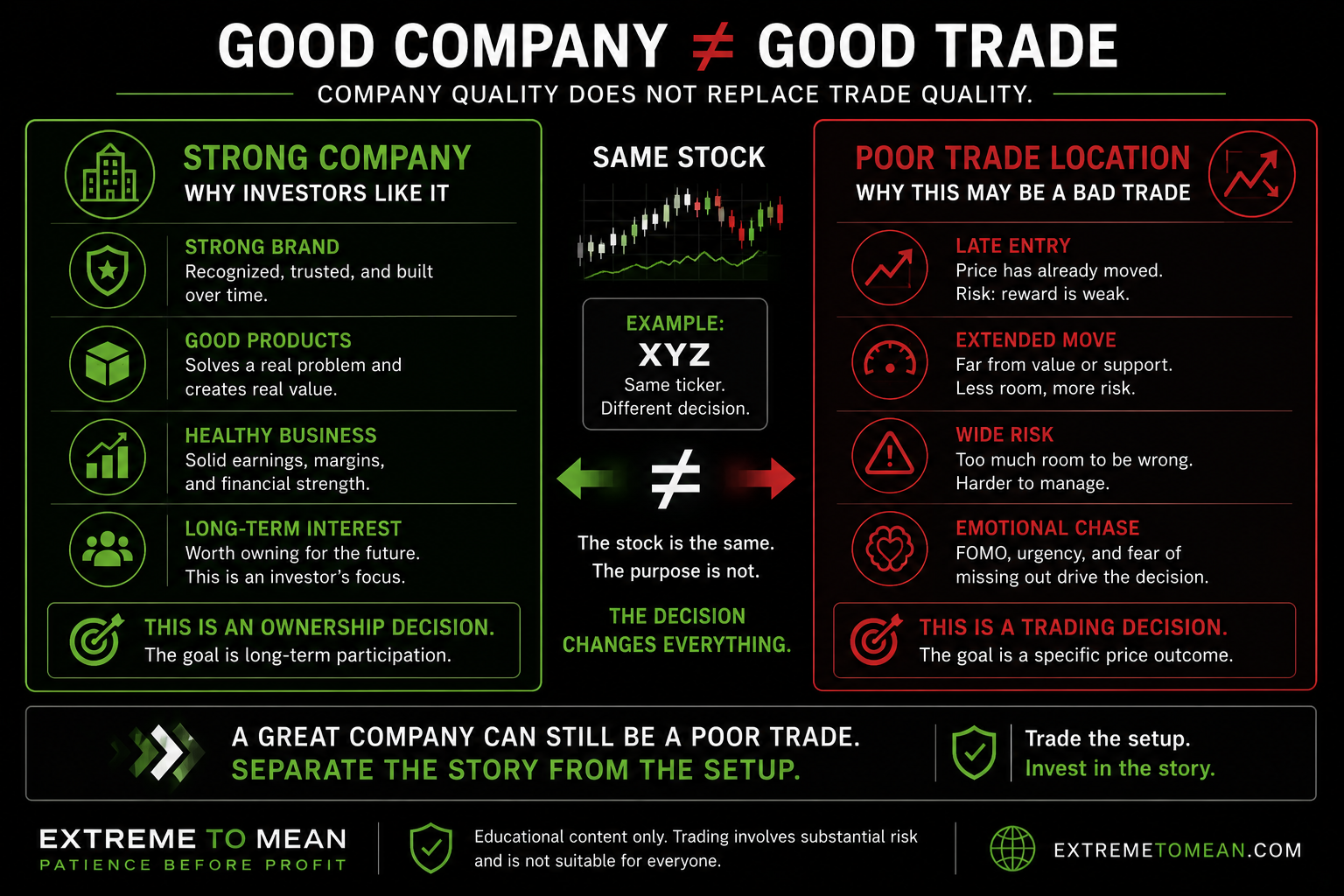
A trader may buy a stock without wanting to own the company long term. A trader may short a weak move without believing the company is permanently broken. A trader may step aside from a strong company because the chart is extended, the market is messy, or the risk is not clear.
This is where many beginners get tripped up. They assume that liking the company is enough to justify the trade. But a good company is not automatically a good trade.
Price may already be far from a clean entry. The move may be crowded. The risk may be too wide. The market may be in a poor condition. The trader may be late. Any of those things can make the trade decision weak, even if the company itself is strong.
This connects directly to the Extreme to Mean lesson that where you enter matters more than what you predict. A trader is not just evaluating the idea. A trader is evaluating the decision.
The Mistake: Entering as a Trader, Holding as an Investor
One of the most common beginner mistakes is entering a position for one reason and holding it for another.
A beginner may buy because price is moving up quickly. That is a trading reason. The decision is based on short-term movement, urgency, and the hope that price continues higher.
Then price turns lower.
Instead of reviewing the original trade idea, the beginner changes the story. They say, “I still like the company,” or “This is a long-term hold now,” or “It will come back eventually.” Without realizing it, they have converted a failed or unclear trade into an investment.
That shift may feel reasonable in the moment because it reduces emotional pressure. The trader no longer has to admit that the original decision may have been poor. They can replace the short-term trade plan with a long-term belief.
But that is not process. That is avoidance.
A trade should not become an investment just because the trade moved against the trader. If the original decision was a trade, it needed a trade plan: entry, risk, invalidation, and exit logic. If the original decision was an investment, it needed an investment thesis and a time horizon from the beginning.
The issue is not holding longer. The issue is changing the reason after risk appears.
This is why Extreme to Mean treats risk clarity as part of the decision, not something to figure out later. A position is not truly planned if the trader only knows why they entered and has no idea what would prove the idea wrong.
For a deeper lesson on that idea, the article on the trade is not ready until the risk is clear connects directly to this mistake.
Time Horizon Changes the Decision
Time horizon means the period of time a person expects the decision to play out.
This matters because the same price movement can mean different things depending on the time horizon. A one-day pullback may be meaningless to a long-term investor. That same pullback may completely invalidate a short-term trade.
A long-term investor may care more about whether the business continues to improve over years. A trader may care more about whether price is holding a level today, whether a setup still has room to move, or whether the market condition supports the trade right now.
Without a clear time horizon, every move becomes confusing.
If price drops slightly, is that normal noise or a reason to exit? If price rallies, is that a short-term target or the beginning of a longer-term hold? If the position moves sideways, is patience required, or is capital being tied up in a low-quality trade?
The answer depends on the original decision.
A beginner often struggles because they do not define the decision before entering. They buy first and then try to decide what kind of position it is. That puts the trader in a weak position emotionally, because the market is already moving while the plan is still unclear.
A better process defines the time horizon before the position is opened.
That does not mean the trader knows what will happen. It means the trader knows what type of decision they are making. That alone can reduce confusion.
Different Decisions Require Different Risk Rules
Trading and investing also require different risk rules.
An investor may manage risk through diversification, allocation size, long-term planning, valuation discipline, or periodic review. The investor may not use a tight stop loss because the decision is not based on short-term price behavior.
A trader usually needs a more immediate risk plan. If the trade is based on a specific setup, price location, or short-term condition, the trader needs to know when that idea is no longer valid. The risk point has to match the reason for the trade.
For example, if a trader buys because price is holding a specific area, then a clean failure of that area may matter. If the trader buys because momentum is strong, then a loss of momentum may matter. If the trader buys because price is reverting from an extreme, then the trader needs to know where the reversion idea is no longer reasonable.
The risk plan should fit the decision.
This is why it becomes dangerous to use investment language to excuse a trade that lost its structure. “I like the company” does not automatically solve a poor entry. “It is a long-term hold now” does not erase oversized risk. “It should come back” is not the same as a plan.
A trader does not need perfect certainty. But the trader does need a defined process for what happens if the market does not cooperate.
Extreme to Mean is built around that kind of process. The setup has to earn attention before it earns risk. The position has to make sense before the trader puts capital behind it.
A Better Question Before Taking the Position
The beginner question is often, “Do I like this?”
That question is too vague. A person can like a company, like a chart, like a product, like a story, or like a recent move. None of those automatically define whether the decision is an investment or a trade.
A better question is:
“Am I making an ownership decision or a trade decision?”
That question forces the trader to separate the purpose of the position from the emotion of the moment.
Before entering, a beginner can ask:
- Am I planning to own this over a longer horizon, or trade a specific price move?
- What is my reason for entering?
- What time horizon does this decision require?
- What would tell me the original idea is wrong?
- Am I using a long-term story to justify a short-term mistake?
- Is the position size appropriate for the type of decision I am making?
- Am I acting from process, or am I reacting to price movement?
These questions are not designed to create certainty. They are designed to create clarity.
The market does not owe the trader a clean outcome. Price can move against a good investment. Price can move against a reasonable trade. The purpose of the question is not to guarantee the result. The purpose is to make sure the trader knows what decision they are actually making.
That is the meaning of Patience Before Profit at the beginner level. Patience is not just waiting for a better price. It is waiting until the decision is defined well enough to act responsibly.
A new trader who wants to continue building the foundation can start with the beginner trading path before moving into market context, setups, and trader behavior.
Final Thought
Trading and investing can both happen in the same market, but they are not the same process.
Investing is usually built around long-term ownership and participation. Trading is built around a more specific price decision, usually with a shorter time horizon and more immediate risk rules. Traders can compare the major time horizons used by active traders before choosing an approach. Neither approach is automatically right or wrong, but mixing them without a plan creates confusion.
The danger is not holding. The danger is holding for a reason that did not exist when the position was opened.
Before entering, define the decision. Are you investing, or are you trading?
Educational content only. Trading involves substantial risk and is not suitable for everyone.