
Recognizing a Setup Early Is Not the Same as Having a Trade
Early recognition is useful because it tells the trader where attention belongs. Price may be reaching meaningful location, beginning a pullback, stretching from value, or testing a breakout area. In the Setup curriculum, those developing conditions start the qualification process; they do not automatically justify entry.
The problem starts when the trader mentally completes the pattern before the market does. A partial setup can look familiar enough that the next step feels inevitable, especially after seeing similar examples work before. Anticipation then turns into prediction: the trader is risking money on evidence expected to appear next.
That is why a setup is not a signal. A familiar structure beginning to develop may deserve attention, but the strategy still needs whatever conditions define the setup as ready. Anticipation earns attention; qualification is what can justify risk.
What It Means for a Setup to Be Incomplete
An incomplete setup is not necessarily a bad setup. It is a market situation in which some required pieces are present and others have not yet appeared. The trader may have good location and a promising idea while still lacking enough information to define the trade.
Consider a pullback into an area the trader believes could support continuation. Price has reached the location, but the required response has not appeared, structure remains unclear, and invalidation cannot yet be defined confidently. Entering now means trading the expectation that missing evidence will arrive after the position is already open.
Sometimes it does, and that can make the early entry feel validated. But being early and later being proved correct is not the same as having entered a qualified setup. The process must be judged by what was known when the risk was taken.
Premature Entries Force You to Predict the Missing Evidence
A premature trade asks the trader to fill in the blanks. Instead of waiting for the market to show the required behavior, the trader assumes what the next structural response or continuation attempt will do. The decision shifts from evaluating evidence to forecasting evidence that does not yet exist.
This feels reasonable because waiting can seem expensive. Additional confirmation may lead to a worse price, so entering early can feel like the only way to preserve location. The mistake is treating unresolved uncertainty as though it has already been settled because the setup looks familiar.
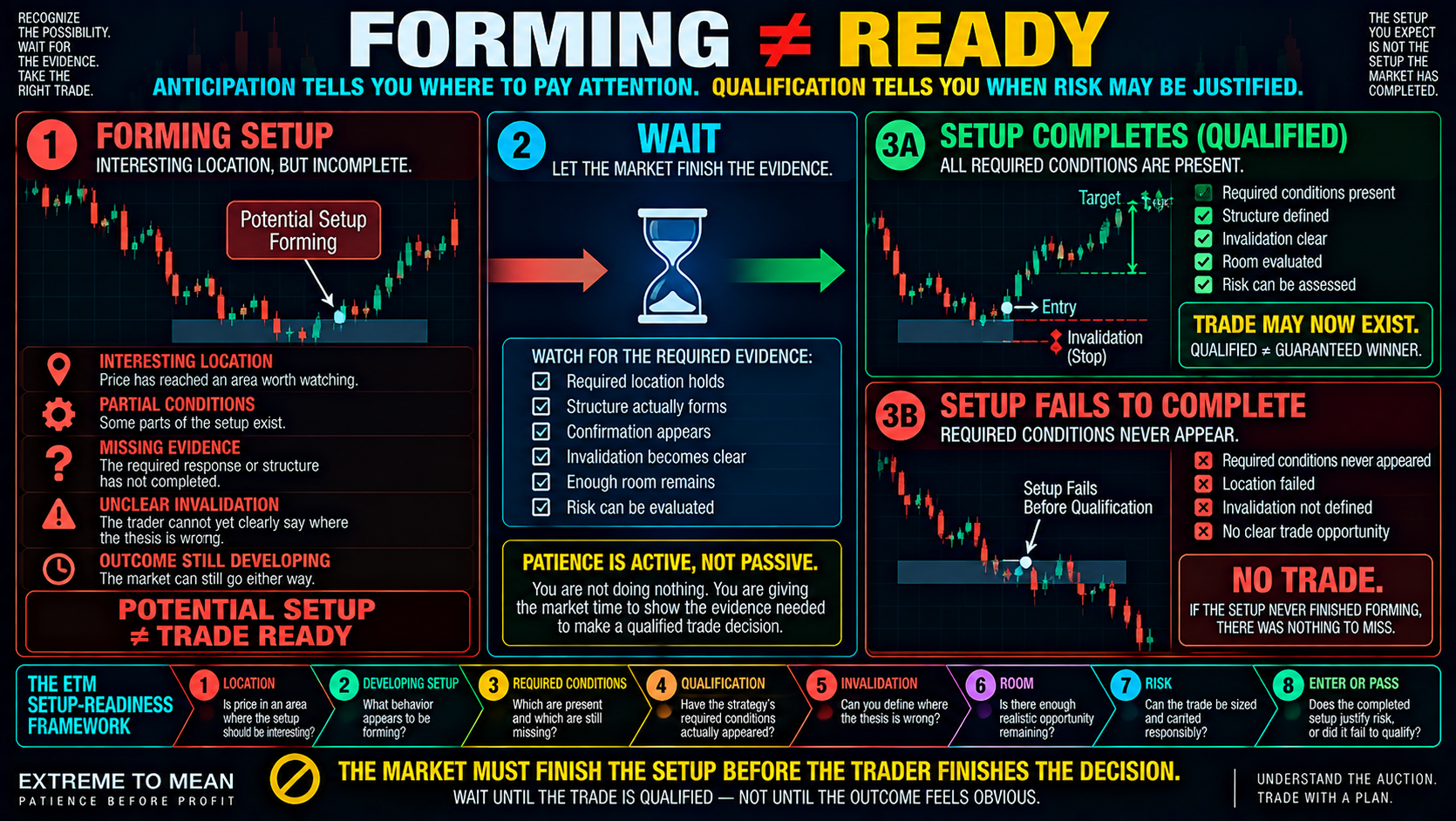
The cleaner question is, “Which conditions are present, and which am I assuming will appear next?” If an essential part of the setup is still hypothetical, the trade is not ready. The setup you expect is not the setup the market has completed.
Why Premature Entries Create Unclear Risk
Risk becomes difficult to define when the setup has not finished defining its structure. The trader may not know which level must hold, whether the move is continuation or reversal, how much room remains, or what behavior actually invalidates the thesis. A stop chosen before those questions are answered can become a guess rather than part of a complete plan.
This is why the trade is not ready until the risk is clear. Entering first and discovering invalidation afterward forces the trader to solve the trade while money and emotion are already involved. Qualification gives the market time to reveal enough structure for risk to be evaluated before capital is committed.
A completed setup still does not guarantee an attractive trade. The resulting stop may be too far away, the position may need to be smaller, or the remaining room may be insufficient. The advantage is that the trader is evaluating a structure that now exists instead of inventing risk rules around an unfinished idea.
Early Entries Turn Observation Into Emotional Management
Before entry, the trader can watch a developing setup with relative neutrality. After entry, the same unfinished price action becomes personal because every movement now affects an open position. Questions that should have been answered beforehand become emotional management problems.
The trader starts asking, “Is this still forming?”, “Should I move the stop?”, or “Maybe I entered too early.” Those reactions can look like poor emotional control, but the deeper cause may be structural: the trader entered before the trade was fully defined. If you keep asking whether the setup is still forming after you are already in it, you probably entered before the setup was complete.
Patience Is Active, Not Passive
Waiting for a setup to complete is not the same as doing nothing. The trader is watching whether location remains valid, whether required structure and confirmation appear, whether invalidation becomes clear, and whether enough room remains. Patience is an active decision process.
That idea fits the broader ETM view that Patience Before Profit is more than a tagline. The trader is not waiting because slower decisions are automatically better; the trader is waiting for uncertainty to reduce enough that the opportunity can be evaluated as a trade. If the setup fails before qualifying, the filter did its job rather than causing a missed trade.
If the setup never finishes forming, there was nothing to miss. Price may reach the location, fail to provide the required evidence, and continue through it without ever creating a valid setup. Avoiding risk in that situation is the qualification process working as intended.
Wait for Qualification, Not Certainty
There is an opposite mistake: waiting too long. A trader can demand so much additional confirmation that price leaves the attractive location, risk distance expands, and remaining room shrinks. More waiting is not automatically better.
The objective is to wait until the trade is qualified, not until the outcome feels certain. Qualification means the required conditions are present and the trader can define the trade, invalidation, and available opportunity. Certainty is a higher standard that markets cannot provide.
This is where location is the first filter still matters. Confirmation that arrives after the opportunity has deteriorated may strengthen the story while weakening the trade. The goal is enough evidence to justify risk while the location and geometry still make sense.
Define Readiness Before the Moment Arrives
One of the best ways to avoid premature entry is to decide in advance what must be present before the setup can be called ready. The details differ by strategy, but the trader should know the required conditions before price reaches the decision point. Otherwise, the standard can drift as excitement rises.
Return to the pullback example. In the premature version, the trader enters on contact even though the required response has not appeared and invalidation remains vague; in the qualified version, the trader waits for the planned conditions and then either receives a defined trade or watches the market fail to qualify. One path creates a trade to evaluate, while the other correctly creates no trade at all.
The ETM Setup-Readiness Framework
The framework separates recognizing potential from committing risk. A developing setup should move through a sequence in which evidence accumulates, risk becomes definable, and the trader either receives a qualified opportunity or lets the idea go. The market has to finish the setup before the trader finishes the decision.
- Location — Is price reaching an area where the strategy should become interesting?
- Developing setup — What market behavior appears to be forming?
- Required conditions — Which parts are already present, and which are still missing?
- Qualification — Have the strategy’s required conditions actually appeared?
- Invalidation — Can the trader define where the thesis is wrong?
- Room — Is enough realistic opportunity still available from the qualified entry?
- Risk — Can the trade be sized and carried responsibly?
- Enter or pass — Does the completed setup justify committing capital, or did it fail to qualify?
The condensed framework is Location → Developing Setup → Required Conditions → Qualification → Invalidation → Room → Risk → Enter or Pass. It is not a universal trigger; its job is to separate what the market has already shown from what the trader expects it to show next. Anticipation tells you where to pay attention; qualification tells you when risk may be justified.
The better question is no longer, “Do I think this setup is about to happen?” Ask, “Has the market actually completed the conditions that make this setup ready for risk?” That turns patience into a concrete qualification process rather than a vague instruction to wait.
Final Thought
Seeing a setup early can be a skill. The problem begins when recognition is treated as completion and money is risked before the market supplies the evidence required by the strategy. An unfinished setup can still become a good trade later, but the trader does not need to finance the uncertainty while waiting to find out.
Waiting does not mean demanding certainty or delaying until the opportunity is gone. It means knowing what must be present before the trade is allowed to exist, then giving the market enough time to provide that evidence or fail to do so. That is active patience.
The setup you expect is not the setup the market has completed. Let the market finish the evidence, define the risk, and either create a trade or remove the opportunity. That is how the broader Extreme to Mean system turns patience into a decision process rather than a slogan.
Educational content only. Trading involves substantial risk and is not suitable for everyone.