
Once a strategy looks promising, the research problem changes. We are no longer asking whether we can build something that fits the past; we are asking whether the decisions made from one part of history survive another part that did not help create them. That distinction is central to The Setup, because evidence becomes more valuable when the strategy has fewer opportunities to learn the answer before the test begins.
Historical data can therefore play two different jobs. Development data teaches us: we use it to build rules, choose parameters, reject ideas and make changes. Evaluation data grades us: it asks what happened after those decisions were already made.
Data cannot be both the teacher and the final exam without creating a conflict.
In-Sample vs. Out-of-Sample: Teacher and Exam
In-sample data is the history you allow yourself to use while developing the strategy. If you use 2019 through 2022 to select a moving-average length, add a volatility filter, change the stop rule and decide which version looks best, then those years are part of development.
That is not a criticism of in-sample testing. A strategy has to be developed somewhere, and in-sample data is where experimentation belongs. The important limitation is that in-sample performance tells you how well the strategy fits the data that helped create it, not how well the idea will generalize.
Out-of-sample data plays the opposite role. If the strategy is developed using 2019 through 2022 and then evaluated on 2023 without 2023 influencing any earlier decision, 2023 is genuinely out of sample. Out-of-sample asks whether yesterday's research survives tomorrow's data.
That sounds simple until the first disappointing result appears. If 2023 performs badly, you add a filter because of what you saw, and then test 2023 again, the date on the calendar has not changed—but its role has. The test has started teaching the strategy.
Why Trading Data Must Stay in Chronological Order
Markets are time series, so the direction of time is part of the experiment. Training on observations from 2024 and then claiming that performance on 2021 represents an unseen historical test creates a backwards research process: the development stage has already been exposed to a later market regime.
General machine-learning examples sometimes shuffle observations randomly into training and testing sets. For market research, that can allow later observations to influence development while earlier observations are used for evaluation, and it can also ignore the serial dependence that often exists in financial data. Time-series validation methods therefore preserve chronological order specifically to avoid training on future observations and evaluating on the past.
The cleaner rule is:
PAST → FUTURE
A valid trading test should ask the same question reality will eventually ask: Can information available earlier survive what happens later?
The Simple Holdout Test—and Why It Is Not Enough by Itself
The easiest improvement over a full-history backtest is a holdout. Suppose you use 2018 through 2023 for development, freeze the strategy, and reserve 2024 through 2025 for one final test. That gives the strategy one encounter with genuinely unseen history.
The limitation is that one holdout period is still only one realization. A very favorable regime can make a weak strategy look unusually good, while an unusually hostile period can make a reasonable strategy look worse than it usually would. Research on backtest overfitting has specifically warned that simple holdout procedures can be unreliable in investment-strategy selection when substantial searching has already occurred.
One unseen period is better than none—but it is still only one period.
That is the practical reason walk-forward analysis becomes useful.
What Walk-Forward Analysis Actually Does
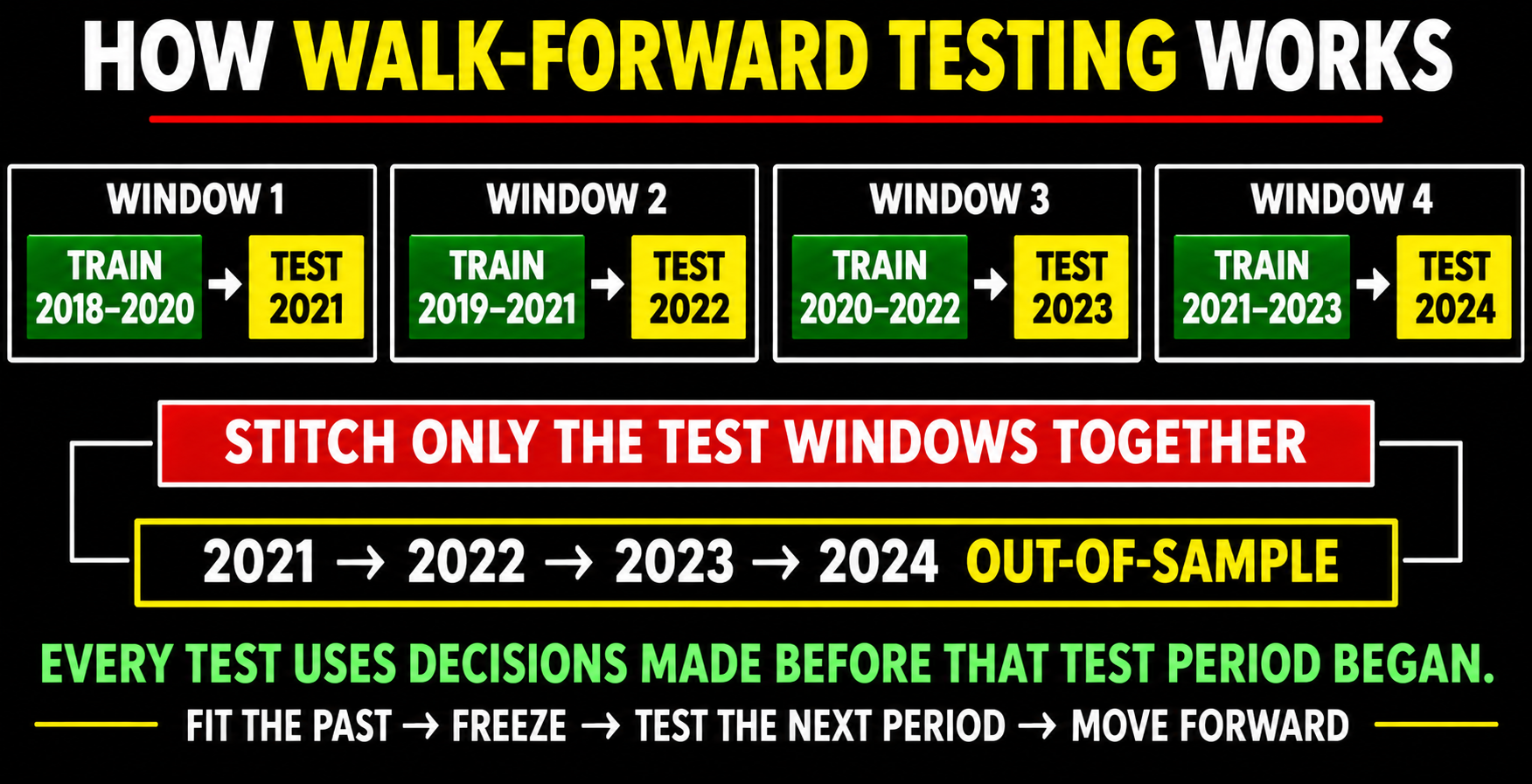
Walk-forward testing repeats the same basic chronological experiment across several windows:
FIT ON THE PAST → FREEZE → TEST THE NEXT PERIOD → MOVE FORWARD → REPEAT
Imagine four illustrative folds:
- Train on 2018–2020 → test 2021.
- Train on 2019–2021 → test 2022.
- Train on 2020–2022 → test 2023.
- Train on 2021–2023 → test 2024.
Each test period is evaluated using decisions made before that period begins. At the end, we stitch together only the out-of-sample test segments to see how the research process behaved when each next block of history was still unseen.
This structure does not require optimization. Some implementations use each training window to optimize parameters before applying the chosen settings to the next out-of-sample period, while a simpler strategy can keep fixed rules and use the same rolling structure only for repeated chronological validation. Walk-forward describes the evaluation structure; optimization is optional inside it.
If the Strategy Re-Optimizes, Test the Re-Optimization Rule
Suppose the live process will reselect a moving-average parameter every six months. The strategy is no longer simply “use MA 50”; the real process is “every six months, search this predefined range using this exact metric, select the winner, then use it for the next period.”
That selection procedure is part of the strategy and needs to remain inside the training window. Choose the parameter using earlier data, lock it, then evaluate it on the next block. If re-optimization is part of how the strategy will operate live, the re-optimization rule must itself be tested.
What is not valid is TEST → DISLIKE RESULT → CHANGE PARAMETER → RETEST THE SAME PERIOD. The moment you change the strategy because of the test result, the test has started teaching the strategy.
When Out-of-Sample Stops Being Out-of-Sample
This is probably the most common validation mistake because the trader can still point to the same date range and call it “OOS.”
Imagine the strategy is developed through 2023. You test 2024, dislike the result, add a volatility filter specifically because of what happened in 2024, then run 2024 again and obtain a strong result.
The first 2024 test may have been genuinely out of sample. The revised strategy has now learned from 2024, so the second test is no longer an independent evaluation of that revised strategy.
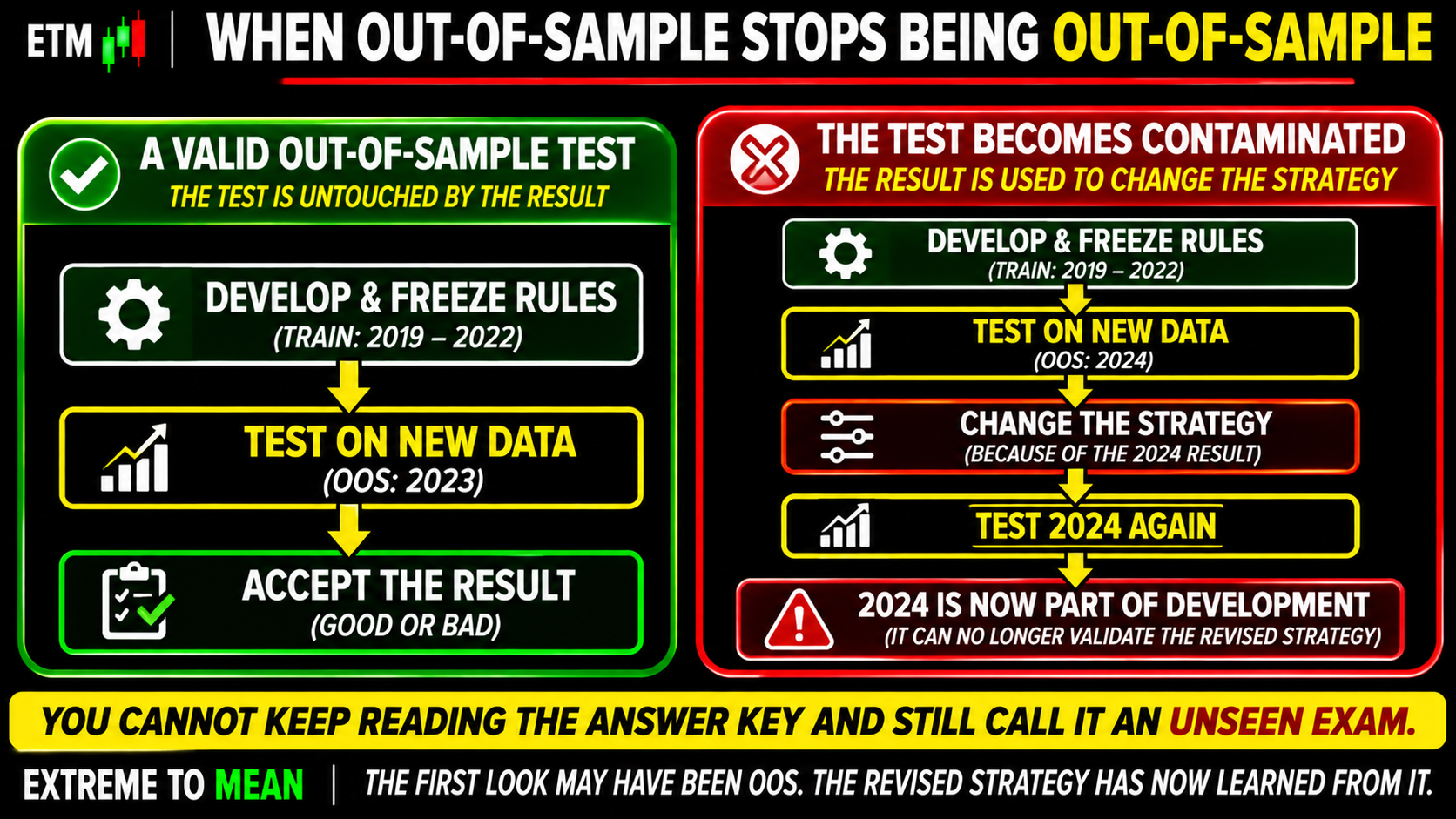
Think of it like a practice exam. You take the exam, study exactly the questions you missed, retake the same exam and score 100%. You may have learned something useful, but that exam can no longer measure your ability on unseen questions.
A test set is only truly out of sample until you use its answer to change the question.
Rolling vs. Expanding Windows
Walk-forward analysis can use different training-window structures. A rolling window keeps a fixed amount of recent history, so older observations eventually fall out; an expanding or anchored window keeps the original starting point and adds more history as time advances.
Rolling windows may respond more quickly to changing regimes because old data stops influencing the model. The tradeoff is that less history is available in each training block. Expanding windows preserve more accumulated evidence, but very old regimes can continue affecting the process long after the market has changed.
Rolling forgets old data. Expanding remembers it. Neither is automatically superior.
The dangerous move is trying three training lengths, four test lengths, rolling and expanding variants, and several re-optimization schedules—and then declaring whichever combination produced the best out-of-sample curve to be “the correct validation method.” At that point, the validation design itself has become another optimized parameter.
Preserve a Final Lockbox
Repeated walk-forward analysis is valuable during research, but even repeated validation creates opportunities for the researcher to learn from what happened. One way to strengthen the process is to preserve a final period that remains completely untouched while the strategy and the validation procedure are being built.
Suppose the complete history runs from 2015 through 2025. You might use 2015 through 2023 for development and repeated walk-forward work while leaving 2024–2025 unopened. Only after the strategy specification, parameter-selection process, cost model and validation rules are frozen do you run the final lockbox once.
The lockbox exists to protect you from your future self.
A successful lockbox does not prove the strategy is robust. That period can still be unusually favorable or unusually hostile. Untouched data strengthens evidence; it does not eliminate uncertainty.
Historical OOS Is Not Forward Testing
A historical out-of-sample period existed before the strategy was built, even if the strategy-development process was disciplined enough not to use it. A forward test is different because the observations arrive after the rules have already been frozen.
That distinction matters because historical researchers can accidentally know things about a later period even when their code does not formally use it. They may have seen the market, remember a major event, know which instruments survived, or have access to cleaned datasets assembled with later knowledge.
The strongest out-of-sample data is data that did not exist when the strategy was built.
Historical OOS and walk-forward analysis are therefore steps in an evidence ladder, not substitutes for future observation. After historical research is frozen, the next useful question is whether the process survives simulation or controlled forward testing on genuinely new data.
Data Leakage: When the Future Sneaks Into the Past
Clean train/test dates do not save a backtest if the features themselves contain future information. A centered moving average, future-bar high or low, or indicator calculated using observations unavailable at the decision time can leak tomorrow into yesterday.
Leakage can also happen more subtly through data transformations. Suppose the entire 2015–2025 dataset is standardized using its full-period mean and standard deviation, but 2024–2025 is supposed to be out of sample. The transformation has already learned something from the future test period.
The cleaner process fits every learned transformation on the training window and then applies that frozen transformation to the next test window. Every learned transformation belongs inside the training window—not just the headline strategy parameters.
Sometimes even adjacent train and test samples can overlap in information. Time-series validation frameworks may therefore use a gap between the training and testing blocks when observations near the boundary are not cleanly independent.
Walk-Forward Can Be Overfit Too
Walk-forward analysis is a tool, not immunity from researcher choice.
A trader can search training-window length, test-window length, step size, rolling versus expanding windows, re-optimization frequency, parameter ranges, markets, sessions and selection metrics. Try enough combinations and one walk-forward configuration may eventually look impressive even if the underlying idea is weak.
Research on multiple testing makes the broader problem clear: when many strategy variants are tried and only the strongest result is reported, apparent performance becomes inflated and the number of trials matters when judging how surprising the winner really is.
Every choice made because one historical result looked better belongs to the optimization budget.
That is why understanding what an edge actually is requires more than finding a profitable configuration. A robust research process should make success progressively harder to obtain by accident.
Read the Folds, Not Just the Combined Equity Curve
Suppose four out-of-sample folds produce:
+$2,000 / −$500 / −$700 / +$10,000
The combined result is +$10,800, which looks excellent at first glance. But nearly all the profit came from one period, so the useful question becomes whether one unusual regime is carrying the entire strategy.
The same issue appears with normalized returns. A walk-forward sequence of +4R, −2R, +1R and +25R is profitable overall, but almost all the result comes from one fold. The combined equity curve can hide that dependence.
Review each fold alongside the combined OOS result. Look at expectancy, drawdown, trade count, payoff, cost sensitivity, parameter stability and whether performance is concentrated in one environment. Validation should test the shape of the evidence—not just one headline number.
Worse Out-of-Sample Performance Can Still Be Useful
A robust strategy often looks worse out of sample than it did during development. That is not automatically a failure because the in-sample period helped select the idea in the first place.
Imagine in-sample expectancy of +0.40R per trade falls to +0.12R in repeated out-of-sample folds. If performance remains positive across several windows, realistic costs are included, drawdown remains tolerable and no catastrophic collapse appears, that weaker result may be more credible than a spectacular development curve.
The right question is not whether OOS looks as beautiful as IS; it is whether enough of the hypothesized edge survives.
A smaller edge that survives new data can be more valuable than a spectacular edge that exists only in development.
A Failed OOS Test Is Useful
A weak out-of-sample result is not wasted research. It may tell you—before real capital is exposed—that the apparent edge depended too heavily on one regime, one parameter choice, unrealistic execution or an accidental historical pattern.
The temptation is to repair every failed fold with another exception. One volatility filter becomes a session rule, then a trend exception, then a special news-day rule, until the strategy can explain almost every historical failure. That is how a simple hypothesis gradually turns into an overfit rulebook.
A failed period may inspire a new experiment, but it cannot simply be erased from the current experiment because it was inconvenient. Every failure does not deserve a new rule. Sometimes the correct result is that the strategy is not robust enough.
The Walk-Forward Testing Checklist
Before trusting a walk-forward result, ask:
- What data was used to build or modify the strategy?
- What data was genuinely unseen when each decision was made?
- Did I preserve chronological order?
- Were all parameters and transformations fitted only on prior data?
- Did I freeze the rules before each test window?
- Did an OOS result cause me to change the strategy?
- Was rolling versus expanding chosen before seeing which looked better?
- Did I inspect every fold rather than only the combined curve?
- Have I preserved a final untouched lockbox?
- Did I count the other strategy variants and validation settings I tried?
- Do the results survive realistic costs and nearby parameter choices?
- After historical testing, does the process survive genuinely new forward data?
The most important question is whether the strategy was allowed to change after seeing the answer. A research process becomes stronger when the test can surprise us and we are willing to accept the result.
The ETM Build → Freeze → Test → Walk → Lock Framework
Use BUILD → FREEZE → TEST → WALK → LOCK. BUILD the idea using allowed in-sample history; FREEZE the decisions before opening the next test block; TEST on chronological unseen data. WALK the process forward across multiple periods, then LOCK one final untouched holdout before moving into future data.
The outcomes are REJECT / REFINE / RETEST ON NEW DATA / ADVANCE. Refinement is allowed, but once a test period teaches the next strategy version, that period belongs to development and a new evaluation period is required.
This is the research equivalent of the trade not being ready until the risk is clear. A strategy is not ready merely because its historical curve is attractive; the evidence needs a process designed to make self-deception harder.
The ETM free tools can support structured research and review, but no tool can make contaminated data untouched again. A test becomes useful when the strategy cannot change the test after seeing the answer.
Final Thought
A backtest becomes more credible when the data used to develop the strategy is separated from the data used to judge it. In-sample history is where we are allowed to build, tune, reject and improve ideas; out-of-sample history asks what happens after those decisions are already made.
Walk-forward analysis repeats that process across multiple chronological periods. It gives the strategy more than one encounter with unseen history and helps reveal whether performance survives different conditions, but it does not make overfitting disappear. WALK-FORWARD REDUCES SOME FORMS OF SELF-DECEPTION; IT DOES NOT REMOVE THEM ALL.
If we change the strategy after seeing an out-of-sample failure, that period has started teaching us. If we search enough window lengths and validation methods until one looks good, we can overfit the evaluation itself. The stronger process is to freeze the rules before each test, keep every learned transformation inside the training window, inspect each fold, preserve a final lockbox and then move to future data after the research process stops changing.
The goal is not to produce the prettiest historical equity curve. It is to make it progressively harder for the strategy to succeed merely because we already knew the past.
Educational content only. Trading involves substantial risk and is not suitable for everyone.