
Before a beginner can understand charts, candles, setups, or risk, they need to understand what a market actually is. Most people hear “the market” and think of a place where prices go up and down. That is true, but it is incomplete.
A market is not a prediction machine. It does not know where price “should” go. It does not care what one trader believes. It is simply the place where buyers and sellers keep meeting, disagreeing, negotiating, and eventually agreeing on a price where a transaction can happen.
That may sound simple, but it is one of the most important ideas in The Basics. If a trader does not understand how price is formed, every move can feel mysterious. A candle can feel like a message. A fast move can feel like certainty. A pullback can feel like failure.
But price movement is not magic. It is the result of buyers and sellers interacting in real time.
A Market Is Where Buyers and Sellers Meet
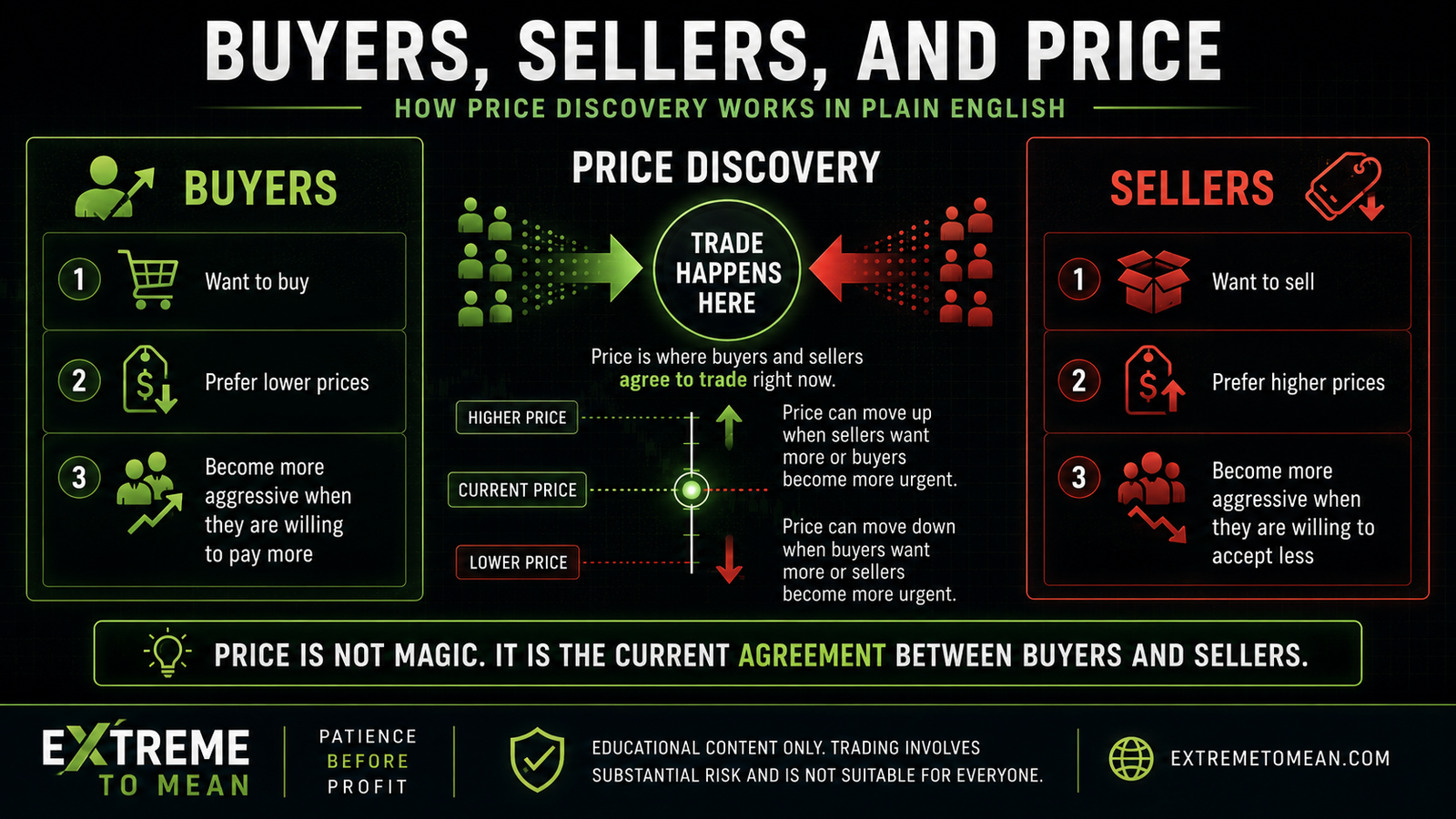
At the most basic level, a market needs two sides: someone willing to buy and someone willing to sell.
The buyer wants to acquire something. The seller wants to give it up in exchange for money. A trade happens only when those two sides agree on a price. Without agreement, there is no transaction. What that money itself represents is its own question, explored in commodity money versus fiat money.
This is true whether the market is for stocks, futures, real estate, used cars, or groceries. The details change, but the core idea remains the same. A market exists because buyers, sellers, and other participants have different needs, time horizons, and levels of urgency.
In financial markets, this happens electronically and very quickly. You may not see the person on the other side of your trade, but they exist. If you buy, someone else is selling. If you sell, someone else is buying.
That is why price should not be viewed as something floating randomly in space. Price is the current point where transactions are taking place. It reflects where buyers and sellers are willing to do business at that moment.
The key phrase is “at that moment.”
A price that made sense five minutes ago may not attract the same interest now. A level that buyers defended earlier may fail later. A move that looked strong may slow down when fewer buyers are willing to keep paying higher prices. Markets can update before the public explanation makes sense because participants are always updating their decisions.
Price Is Agreement, Not Truth
One of the biggest beginner mistakes is treating price as truth.
If a stock trades at $100, that does not mean the company is “really worth” exactly $100 in some permanent way. It means buyers and sellers are currently agreeing to trade near that price. Tomorrow, or even five minutes from now, that agreement may change.
Price is not a final verdict. It is a live negotiation.
This matters because traders often attach too much meaning to one price print, one candle, or one move. They assume that because price moved higher, the market must be bullish. They assume that because price dropped, something must be wrong. Sometimes those conclusions may fit the broader context, but price alone does not explain everything.
A market can move higher because buyers are aggressive. It can also move higher because sellers step away. A market can fall because sellers are strong. It can also fall because buyers are no longer willing to support higher prices. The chart shows the result, but the reason behind the result can be more complicated.
That is why Extreme to Mean teaches traders to slow down and study context. Price matters, but price needs to be understood inside the larger condition of the market. Later, when a trader studies why market context comes first, this foundation becomes important.
The question is not just, “Where is price?”
The better question is, “What is price doing, where is it doing it, and who seems more willing to act at this level?”
Why Price Moves
Price moves because the balance between buyers and sellers changes.
If buyers are more willing to act aggressively, they may have to pay higher prices to get filled. As trades continue at higher levels, price rises. If sellers are more willing to act aggressively, they may have to accept lower prices to get out or establish short positions. As trades continue at lower levels, price falls.
That same pressure is the basic reason traders study going long or short: the direction of the trade only makes sense after the trader understands how price is moving.
This does not mean there are only buyers in an up move or only sellers in a down move. Every trade still has both sides. For someone to buy, someone else must sell. For someone to sell, someone else must buy.
The difference is urgency.
If buyers are more urgent than sellers, price may need to move higher to find enough sellers. If sellers are more urgent than buyers, price may need to move lower to find enough buyers. This ongoing process is called price discovery.
Price discovery simply means the market is finding the level where business can happen.
A beginner does not need to know every advanced market mechanic right away. But they do need to understand this: price changes because participants keep accepting new levels. The market is always testing where buyers will step in, where sellers will respond, and where agreement breaks down.
That is why a chart can move fast. If one side becomes much more aggressive, price may travel quickly through areas where there is not enough opposing interest. That fast move can make a beginner feel like they must act immediately. But speed alone does not make a trade clean.
A fast market is still a market. It still needs context, location, and risk.
The Mistake: Thinking Price Movement Is a Signal by Itself
When new traders first watch live markets, they often mistake movement for meaning.
A candle pushes up, and it feels like a buy signal. Price drops quickly, and it feels like something is breaking. A level gets touched, and it feels like the market is telling them what to do.
This reaction is understandable. Markets are visual, fast, and emotional. When price moves, it creates pressure. A trader feels like they are either missing opportunity or avoiding danger. That pressure can make movement feel more important than it really is.
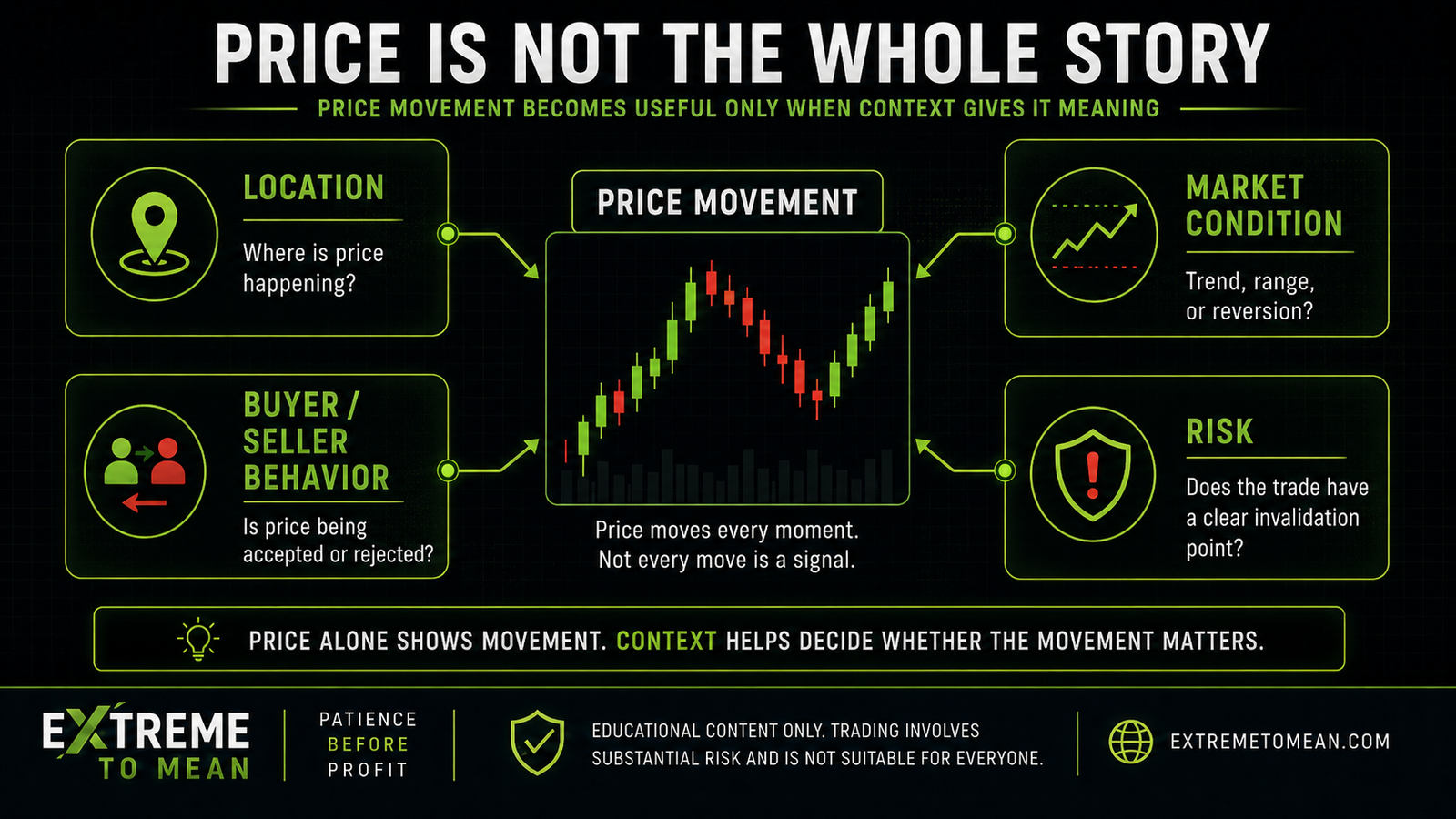
But price movement by itself is not a complete trade idea.
A move can be strong but late. A breakout can be real or temporary. A drop can be the beginning of weakness or the end of a short-term flush. A bounce can be meaningful or just noise. Without context, the trader is only reacting to what just happened.
This is where beginners often confuse seeing movement with understanding movement.
The market may be moving, but that does not mean the trader has a clean decision. There is a difference between noticing activity and identifying a structured opportunity. The market can be active all day while offering very few decisions worth taking.
Extreme to Mean is built around this distinction. The goal is not to respond to every price change. The goal is to understand whether the current movement is happening in a place and condition that deserves attention. That same idea connects directly to the deeper lesson on how the stock market actually moves.
The next basic layer is understanding what volume and liquidity mean.
Once a trader understands that buyers and sellers create price, the quote itself becomes easier to read. The next step is seeing how the bid and ask show buyers and sellers in real time.
A Better Trader Studies Behavior, Not Just Price
A beginner may ask, “Is price going up or down?”
A better trader asks, “How is price behaving, and does that behavior matter where it is happening?”
That difference may sound small, but it changes the decision process. Price direction is only one piece of information. Behavior includes the way price moves, slows, rejects, accepts, returns, or struggles.
For example, a market moving higher can show several different behaviors. It may move higher smoothly with buyers continuing to accept higher prices. It may spike higher quickly and then fail. It may grind upward without much conviction. It may push into an area where sellers previously responded.
Each version tells a different story, even though all of them involve price moving up.
The same is true when price falls. A drop into a meaningful area may matter more than a drop in the middle of nowhere. A selloff that slows and stalls may deserve different attention than a selloff that accelerates cleanly through support. The price direction is only the surface.
This is why location matters so much. Price at a meaningful area is different from price floating in the middle of a range. A move into a known area of interest is different from a move happening after the clean part of the opportunity may already be gone.
Before a trader studies entries, they need to understand why location is the first filter. The market is not just moving; it is moving from one area to another. The quality of a decision depends heavily on where that movement is taking place.
The Better Question Before Reacting to Price
A market is always producing new information. The beginner’s challenge is learning not to treat every piece of information as equally important.
Some price movement deserves attention. Some does not. Some movement confirms that buyers or sellers are showing real interest. Some movement is only noise inside a larger condition. Some movement creates a cleaner decision. Some movement only creates emotional pressure.
A useful beginner question is:
“Is this price movement creating a clearer decision, or just making me feel urgency?”
That question helps separate evaluation from reaction.
A trader can also slow down by asking:
- Where is price right now?
- Is this area meaningful, or is it just the middle of movement?
- Are buyers or sellers showing urgency?
- Is price being accepted at these levels, or quickly rejected?
- What would need to happen before this becomes a clean trade idea?
- Is my attention based on structure, or only on speed?
These questions do not make price predictable. They do not guarantee that the next move will be clean. But they help the trader stay grounded in process instead of emotion.
Markets create constant motion. The trader’s job is not to chase all of it. The trader’s job is to evaluate which motion matters.
That is the heart of Patience Before Profit. Patience is not passive. It is the discipline to wait until market behavior becomes clear enough to deserve a decision. Sometimes the market gives that clarity. Sometimes it does not.
A beginner who wants to keep building this foundation can start with the beginner trading path before moving deeper into setups, market context, and trader behavior.
Final Thought
A market is where buyers and sellers meet, disagree, negotiate, and eventually agree on price.
Price moves because that agreement keeps changing. Buyers become more or less aggressive. Sellers become more or less aggressive. Levels are accepted, rejected, defended, or abandoned. The chart is simply the visual record of that process, which is why seeing price on a timeline is such an important beginner skill.
From there, reading a single candlestick helps a beginner see how one period records that negotiation.
For a beginner, this is a major shift. Price is not magic. It is not a command. It is not a guarantee. It is information.
The trader’s job is to evaluate that information before acting.
The next foundation is understanding how a broker connects an individual trader to the market.
Educational content only. Trading involves substantial risk and is not suitable for everyone.