
Before a trader can understand ETFs, index futures, market context, or broad market movement, they need to understand what an index actually is. The S&P 500, Nasdaq, and Dow are talked about every day as if they are single things moving up and down. In reality, they are scoreboards for groups of companies.
That matters because traders often react to “the market” without knowing what they are actually looking at. A stock may be up while the broader index is weak. An index may be rising while many individual stocks underneath it are struggling. The headline number can be useful, but it does not tell the whole story by itself.
The goal is not to memorize every index calculation. The goal is to understand what an index represents, why traders watch it, and how it helps create better market context. If you are still building your foundation, this lesson belongs inside the broader Basics trading education path.
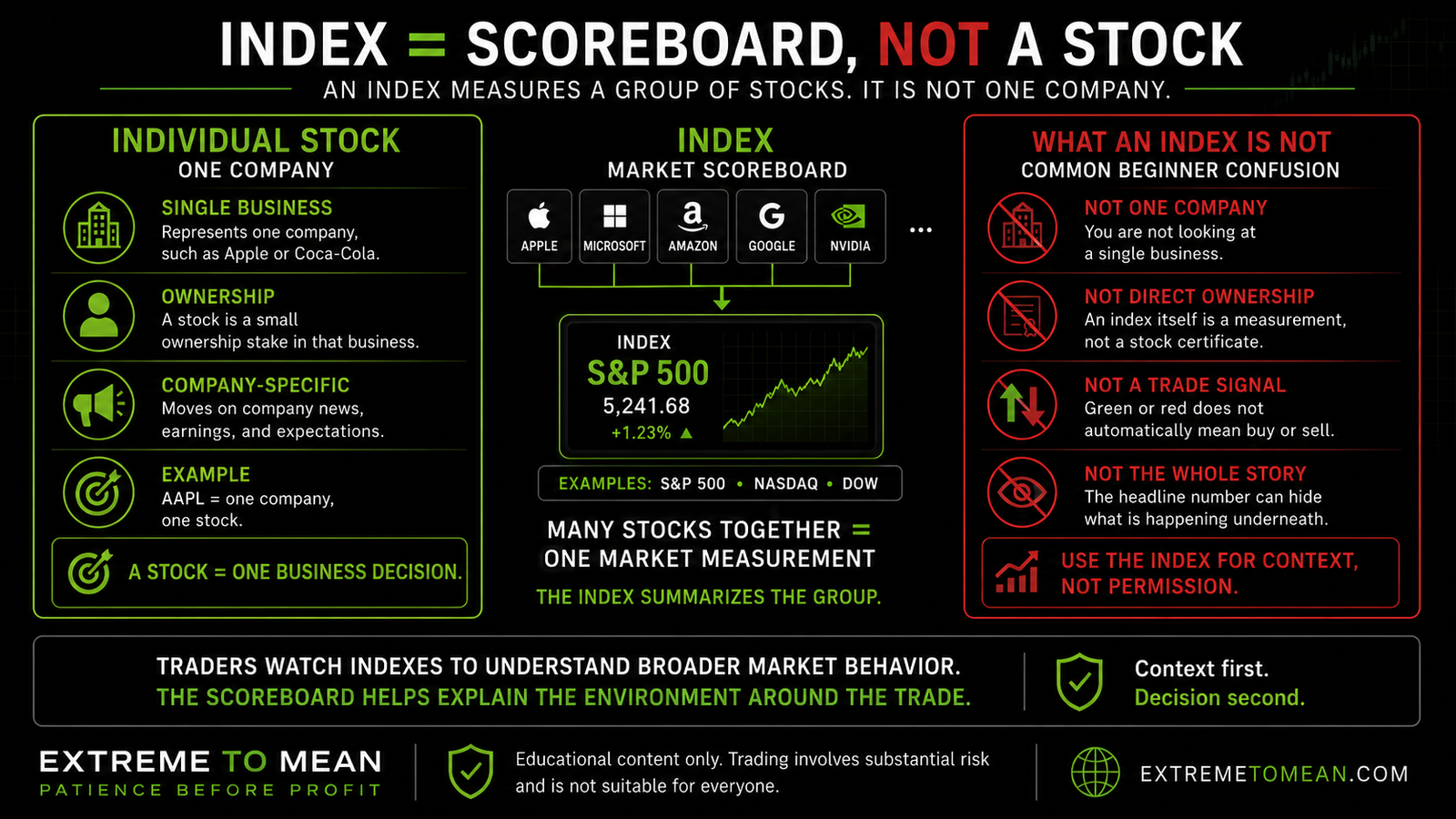
An Index Is a Basket, Not a Business
A stock represents ownership in a specific company. If you buy shares of Apple, Microsoft, or Coca-Cola, you are buying a piece of that individual business. The price of that stock is influenced by that company’s earnings, growth expectations, news, leadership, industry, and investor demand.
An index is different.
An index tracks a group of stocks. It takes many companies and turns their combined movement into one number. That number gives traders and investors a way to see how a certain part of the market is behaving.
The S&P 500 tracks 500 large U.S. companies. The Nasdaq Composite is heavily influenced by technology and growth-oriented companies. The Dow Jones Industrial Average tracks 30 major U.S. companies. Each index has its own rules for which companies are included and how much influence each company has.
That is why an index should not be thought of as one company. It is a measurement. It is a way to ask, “How is this group of stocks doing?”
This is one reason beginners should understand what a stock really is before trying to understand broader market tools. A stock is a company interest. An index is a measurement of many stocks together.
Think of an index like a scoreboard at a sporting event. The scoreboard tells you the score, but it is not the players, the coaches, the strategy, or every individual play. It gives you a useful summary, but it does not explain every detail underneath it.
Why Traders Watch Indexes
Traders watch indexes because individual stocks do not move in isolation. A company can have its own story, but it still trades inside a broader market environment. When the overall market is strong, many stocks may receive support from broad buying. When the overall market is weak, even good companies can get pulled lower.
This does not mean every stock moves the same way as the index. It means the index gives context.
Context is the condition around the trade. It helps answer questions like:
- Is the broader market strong or weak today?
- Are buyers active across many stocks, or only a few?
- Is the move broad, or is it concentrated in certain names?
- Is the market trending, ranging, or pulling back?
- Is my trade aligned with the broader environment, or fighting it?
Those questions matter because a trade can look different depending on the market around it. A bullish setup in a strong market may deserve different attention than the same setup during heavy index weakness. A stock breaking higher while the broader market is falling may be showing relative strength, but that still needs to be evaluated carefully.
At Extreme to Mean, the process begins with understanding the environment before judging the setup. That same idea shows up throughout the market context lessons, because the market condition can change the quality of a decision.
An index helps traders zoom out. It does not predict the future. It does not guarantee that a trade will work. It simply gives a cleaner starting point for understanding what is happening around the trade.
The Headline Index Can Hide What Is Happening Underneath
One common beginner mistake is thinking that if the index is green, the whole market is strong. That is not always true. An index can rise because a small number of heavily weighted stocks are moving higher, even while many stocks underneath are flat or weak.
This is especially important with indexes that are weighted by market capitalization. Market capitalization means the total value of a company’s shares in the market. In a market-cap-weighted index, larger companies have more influence than smaller companies.
For example, if several massive technology companies are moving higher, they can pull a major index up even if many other stocks are not participating. The index may look strong on the surface, but the strength may not be broad.
The opposite can also happen. A few large stocks may drag an index lower while other parts of the market are holding up better. The scoreboard matters, but the scoreboard is still a summary.
This is why traders should avoid making decisions from the headline number alone. “The S&P is up” is information, but it is not a complete trading plan. “The Nasdaq is down” is information, but it does not automatically mean every stock should be shorted or avoided.
A better trader asks what is underneath the move.
Is the index moving because many stocks are participating, or because a few heavy names are doing most of the work? Is the move supported by broad demand, or is it narrow? Is the index breaking structure, or simply reacting inside a normal range?
These questions do not make the market predictable. They make the trader less reactive.
Indexes Help Explain ETFs and Futures
Indexes are also important because many popular trading products are built around them. A beginner may hear about SPY, QQQ, DIA, ES, NQ, or YM before fully understanding what those products are connected to. That can create confusion.
An ETF, or exchange-traded fund, is a product that trades on an exchange like a stock but can represent a basket of assets. Some ETFs are designed to track indexes. For example, SPY is designed to track the S&P 500, QQQ is tied to the Nasdaq-100, and DIA is tied to the Dow Jones Industrial Average.
Index futures are different products, but they are also connected to indexes. Futures like ES, NQ, and YM are contracts tied to the movement of major stock indexes. Traders use them to trade broader market movement rather than one individual company.
The details of ETFs and futures deserve their own lessons, but the foundation starts here: the index is the measurement, while the tradable product is the vehicle connected to that measurement.
This is where beginners often mix things up. They may say they are “buying the Nasdaq” when they are actually buying an ETF or trading a futures contract tied to a Nasdaq-related index. The language sounds small, but the distinction matters because each product has different mechanics, risks, costs, and behavior.
That distinction connects directly to the difference between trading and investing. Holding an index ETF for a long-term investment is not the same as day trading an index future. The underlying index may be related, but the decision, timeframe, risk, and process are completely different.
Understanding the scoreboard helps you understand the tools built around it. Without that foundation, the trader may act on a symbol without understanding what it represents.
The Index Is Context, Not Permission
An index can help a trader understand the market, but it should not become an automatic trade signal. Seeing the S&P 500 rise does not mean every long trade is good. Seeing the Nasdaq fall does not mean every short trade is clean.
This is where patience matters.
A beginner may look at a green index and feel pressure to buy something before the move is gone. That feeling is understandable. Markets move quickly, financial media talks in urgent language, and charts can make it seem like everyone else is already making decisions.
But reacting to the index alone is not a process. It is a shortcut.
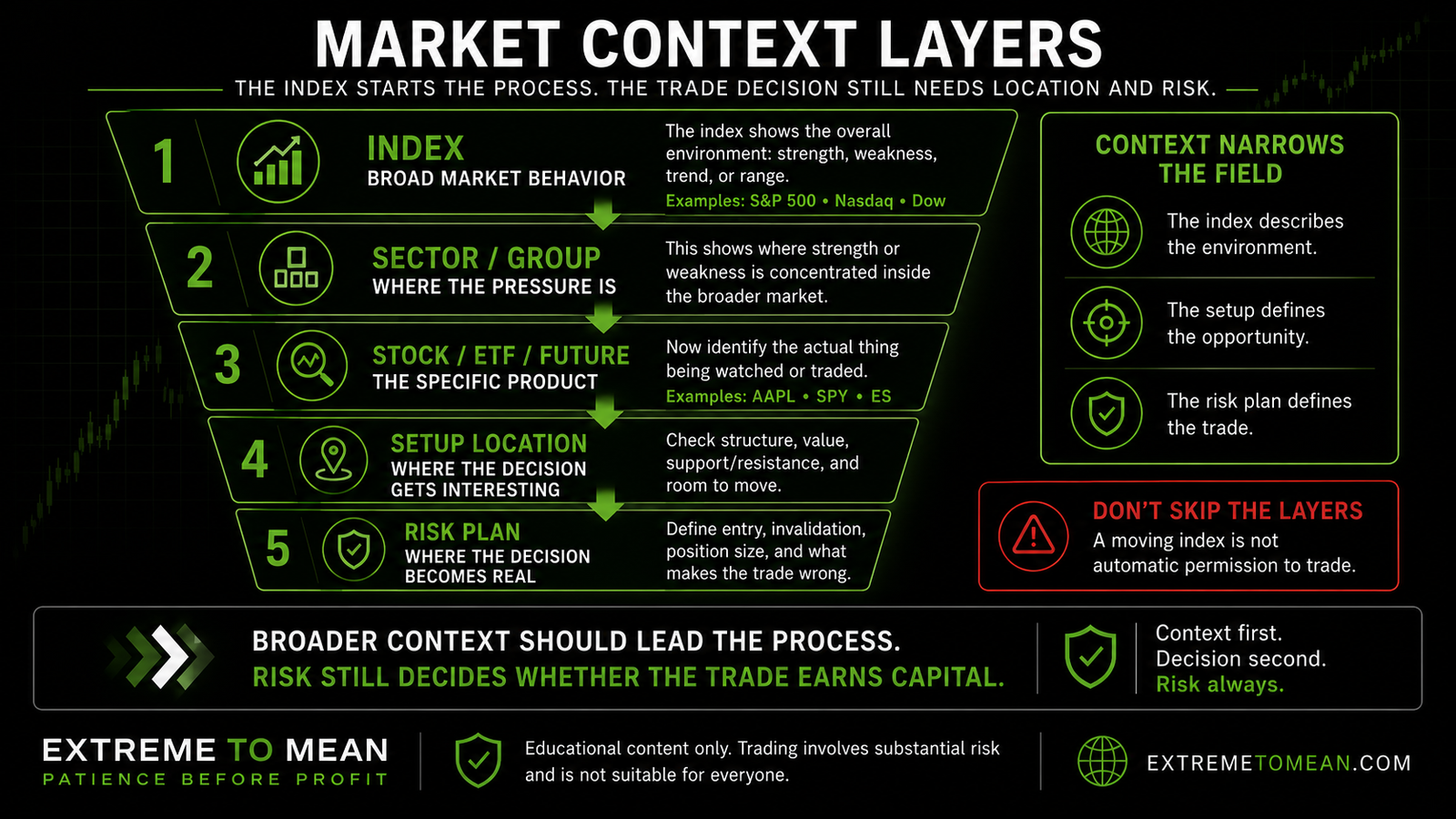
A cleaner decision starts with separating context from execution. The index can tell you something about the broader environment. It may show strength, weakness, range, volatility, or pressure. But the actual trade still needs its own structure, location, risk, and reason.
That is why Extreme to Mean separates market context from setup quality. The market can create the environment, but the setup still has to earn attention. Then the risk has to be clear before any decision earns capital.
A trader who skips that sequence can end up chasing a move simply because the index is moving. That is not evaluation. That is reaction.
The better question is not, “Is the index green or red?”
The better question is, “What does this index move tell me about the environment, and do I have a clean setup with clear risk?”
That question slows the decision down. It gives the trader room to think. It turns the index from a trigger into a context tool.
A Simple Index Decision Filter
When you look at an index, do not start by asking whether it is going up or down. Start by asking what the movement is telling you about the market condition.
A simple filter can help:
- What index am I watching, and what group of stocks does it represent?
- Is the index trending, ranging, or reacting from an extreme?
- Is the move broad, or is it being driven by a few large names?
- Is my stock, ETF, or future moving with the index or against it?
- Am I using the index as context, or am I treating it like a signal?
- Is there a clear setup, location, and risk plan before I act?
These questions do not need to be complicated. They are designed to prevent the most common beginner mistake: reacting to the market’s scoreboard without understanding the game underneath it.
If you are trading an individual stock, the index can help you understand the wind around that stock. If you are trading an index ETF or futures contract, the index can help you understand what your product is designed to follow. If you are simply studying the market, the index can help you see broad behavior without getting lost in every single stock.
The index is useful because it organizes information. It becomes dangerous only when a trader treats it as permission to act without a complete decision process.
For beginners building that process, the next step is to start with the full beginner path and learn how each concept fits together before trying to force trades from scattered information. You can start with the beginner trading path before moving into deeper lessons on context, setup quality, and risk.
Final Thought
An index is a market scoreboard. It tracks a group of stocks and helps traders understand broader market behavior, but it is not a company, not a complete explanation, and not a trade signal by itself.
Used well, an index gives context. Used poorly, it becomes another reason to react.
The trader’s job is not to chase the scoreboard. The trader’s job is to understand what the scoreboard is measuring, evaluate the environment, wait for a cleaner setup, and make decisions with risk clearly defined.
Educational content only. Trading involves substantial risk and is not suitable for everyone.