
Before a trader studies charts, candles, setups, or risk, they need to understand what is actually being bought and sold. Many beginners hear words like stock, share, market price, and ownership without ever slowing down to define them. They know that a stock can go up or down, but they may not understand what the stock actually represents.
That creates a weak foundation. If someone does not understand what a stock is, it becomes easier to confuse a company with its stock price, a good business with a good trade, or a popular name with a clean decision.
This article belongs in The Basics because everything else depends on this first layer. Before a trader can evaluate market context, setups, or risk, they need to know what instrument they are dealing with.
A Stock Is a Piece of Ownership
A stock represents ownership in a company. When a company is divided into shares, each share represents a small ownership claim on that business. If you own one share, you own a small piece of the company.
That does not mean you control the company. Owning a few shares does not mean you can walk into headquarters and make decisions. But it does mean you own a financial interest in the business. If the company grows, earns more, pays dividends, or becomes more valuable in the eyes of investors, that ownership may become more desirable.
The word “share” matters because it describes what is being divided. A company can be divided into many shares, and those shares can trade in the market. If a company has one million shares and you own one share, you own one small piece of the larger business.
That is the basic idea. A stock is not just a chart. It is not just a ticker symbol. It is not just something that flashes green or red on a watchlist. It represents an ownership stake in a real company.
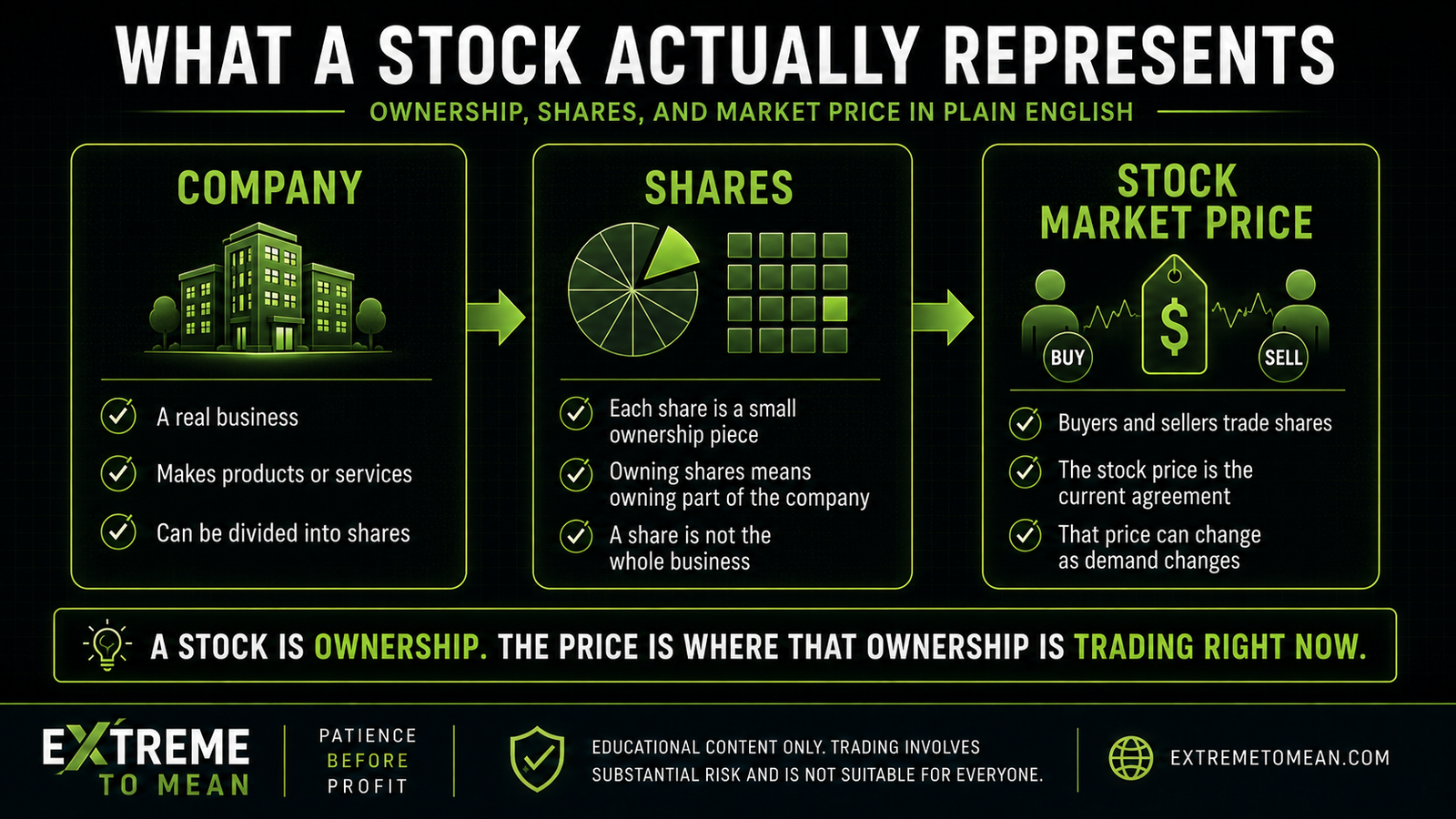
This foundation is important because many beginners first encounter stocks as moving prices. They see a symbol, a chart, a percentage gain, or a headline. But underneath that movement is a basic ownership structure: shares represent claims on part of a business.
Why Companies Issue Shares
Companies issue shares to raise money.
A business may want capital to expand, hire employees, build products, pay down debt, fund research, acquire another company, or grow into new markets. One way to raise that capital is to sell ownership shares to investors.
When a private company becomes publicly traded, it offers shares to the public through a process often called going public. After that, those shares can trade between buyers and sellers in the open market. The company may receive money when shares are first issued, but after that, most daily trading happens between market participants.
That distinction matters.
When you buy shares of a publicly traded company in the stock market, you are usually buying from another investor or trader, not directly from the company itself. Someone else is willing to sell, and you are willing to buy. The trade happens when both sides agree on price.
This connects directly to the beginner market lesson: price forms because buyers and sellers meet. For a deeper explanation of that process, Extreme to Mean also teaches how the stock market actually moves through auction behavior, liquidity, and emotion.
A stock’s price is not set once and left alone. It is constantly updated as people buy and sell shares.
What Stock Price Actually Means
A stock price is the current price where buyers and sellers are willing to trade shares.
If a stock is trading at $50, that does not mean the company is permanently “worth $50.” It means the most recent transactions are happening around $50 per share. That number can change as buyers become more aggressive, sellers become more aggressive, or new information changes how people value the stock.
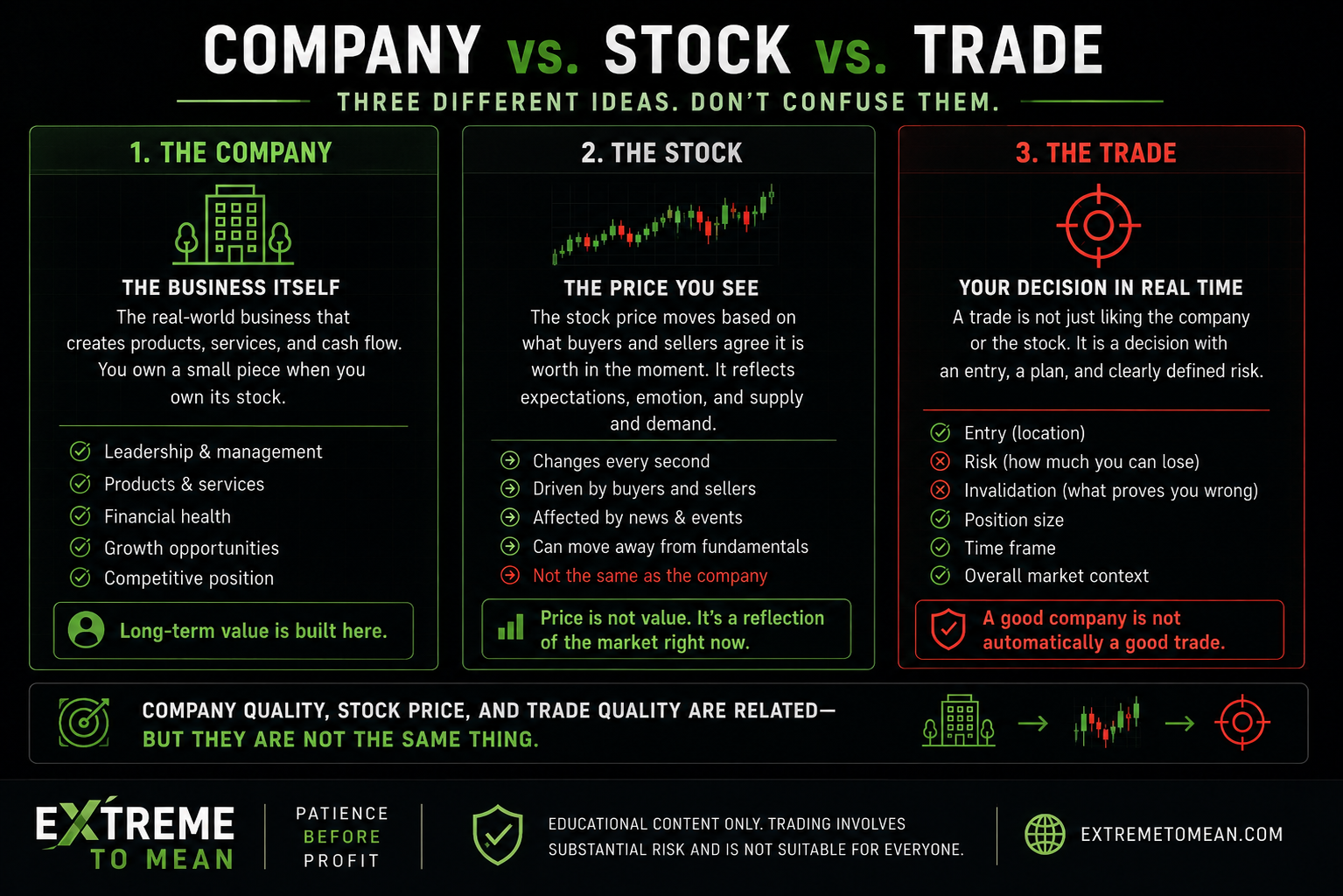
Price is not the same thing as the company itself.
A company can be strong while its stock price falls. A company can be weak while its stock price rises. That may feel strange at first, but it happens because stock prices reflect expectations, positioning, emotion, liquidity, and changing opinions — not just the current quality of the business.
Imagine a company that reports good earnings, but investors expected even better results. The business may still be healthy, but the stock price can fall if buyers are disappointed or sellers become more aggressive. On the other hand, a struggling company can see its stock price rise if traders believe conditions may improve or if short-term demand overwhelms supply.
This is why price should not be treated as a simple truth. It is information, but it is not the whole story.
A beginner may look at a rising stock and think, “This must be a good company.” Sometimes that may be true. But the better question is, “What is price reflecting right now, and am I looking at ownership, investment value, or a trade decision?”
Those are different questions.
Why Stock Prices Move
Stock prices move because the balance between buyers and sellers changes.
If more buyers are willing to pay higher prices, the stock can rise. If more sellers are willing to accept lower prices, the stock can fall. Every trade still needs both sides, but the urgency of each side can shift.
A stock may move because of company news, earnings, interest rates — including shifts in the 10-year Treasury yield — market conditions, sector strength, broad index movement, institutional activity, fear, optimism, or simple short-term supply and demand. Some moves have clear explanations. Others are harder to identify in the moment.
That is one reason beginners should be careful about assuming they know exactly why price moved. The market may react to news differently than expected. A stock may rise on bad news if the news was already priced in. A stock may fall on good news if buyers were already positioned before the announcement.
The chart shows what happened. It does not always explain why it happened.
This is where market context becomes important. A stock does not move in isolation. It may be affected by the broader market, its sector, the overall trading environment, and the behavior of buyers and sellers around key areas. That is why Extreme to Mean puts so much emphasis on understanding why market context comes first.
A stock price is the result of many participants making decisions at the same time. Some are investing. Some are trading. Some are hedging. Some are reacting. Some are forced to act. The final price movement is the combined result of all that activity.
A Good Company Is Not Automatically a Good Trade
One of the most important beginner lessons is this: a good company is not automatically a good trade.
A company can have strong products, strong leadership, strong earnings, and a strong long-term story. That still does not mean buying the stock at any price, at any time, is a clean trade. The stock may already be extended. The entry may be poor. The risk may be unclear. The market may be weak. The trader may be reacting late.
This mistake feels reasonable because beginners often connect quality with opportunity. If they like the company, they assume the stock is worth buying. If they hear a positive story, they assume the trade makes sense.
But trading is not only about what you buy. It is also about where you buy, why you buy, how much risk you take, and what you will do if price moves against you.
A trader can be right about a company and still make a poor trade in the stock. They can buy too late, size too large, ignore risk, or enter during poor conditions. The business story may be solid, but the trade decision may still be weak.
That is why Extreme to Mean separates the idea from the execution. A trade has to earn attention before it earns risk. Later setup lessons go deeper into where you enter matters more than what you predict, but the basic idea starts here.
Owning a stock and trading a stock are not the same thing.
A Better Way to Think Before Buying a Stock
A beginner often asks, “Is this a good stock?”
That question is understandable, but it is incomplete. Better questions depend on what the person is trying to do. Are they investing? Are they trading? Are they holding for years? Are they looking for a shorter-term move? Are they reacting to a headline?
For a trader, the better question is:
“Is this stock offering a clear trade decision, or do I just like the company?”
That question separates interest from action.
Before buying a stock, a beginner can slow down and ask:
- What company does this stock represent?
- Am I thinking like an investor or a trader?
- Why am I interested in it right now?
- Is price in a clean location, or am I chasing movement?
- What would tell me this decision is wrong?
- How much risk am I accepting if price moves against me?
These questions do not make the trade safe. They do not make the future predictable. But they move the trader away from impulse and toward decision quality.
That is the point of Patience Before Profit. Patience is not waiting because waiting sounds disciplined. Patience means refusing to act until the decision has enough structure to deserve action.
A stock can be interesting without being ready. A company can be strong while the trade is unclear. A market can be moving while the better decision is to wait.
A new trader who wants to keep building this foundation can start with the beginner trading path before moving into charts, setups, and risk management lessons.
Final Thought
A stock is a share of ownership in a company, but trading a stock is not the same as simply believing in that company.
The stock price changes because buyers and sellers keep agreeing to trade at different levels. Those levels can shift because of expectations, urgency, news, emotion, liquidity, and broader market conditions. Price is information, but it is not a guarantee.
For a beginner, the cleanest foundation is this: understand what you are buying before deciding whether it is worth trading.
Educational content only. Trading involves substantial risk and is not suitable for everyone.