
Options can look simple on a trading screen. A trader may see a ticker, a price, a chart, and a buy or sell button. That familiar layout can make options feel like another version of stock trading.
That is where many beginners get into trouble.
An option is not ownership in a company. It is not the same as buying shares. It is a contract based on something else, such as a stock, ETF, index, or futures contract. The value of that contract can change because of price movement, time remaining, volatility, strike price, and other factors.
This lesson is not about options strategies. It is about understanding the instrument before any strategy is even considered. Inside the Basics trading education path, the goal is to know what product you are looking at before you start making decisions with it.
An Option Is a Contract Based on Another Asset
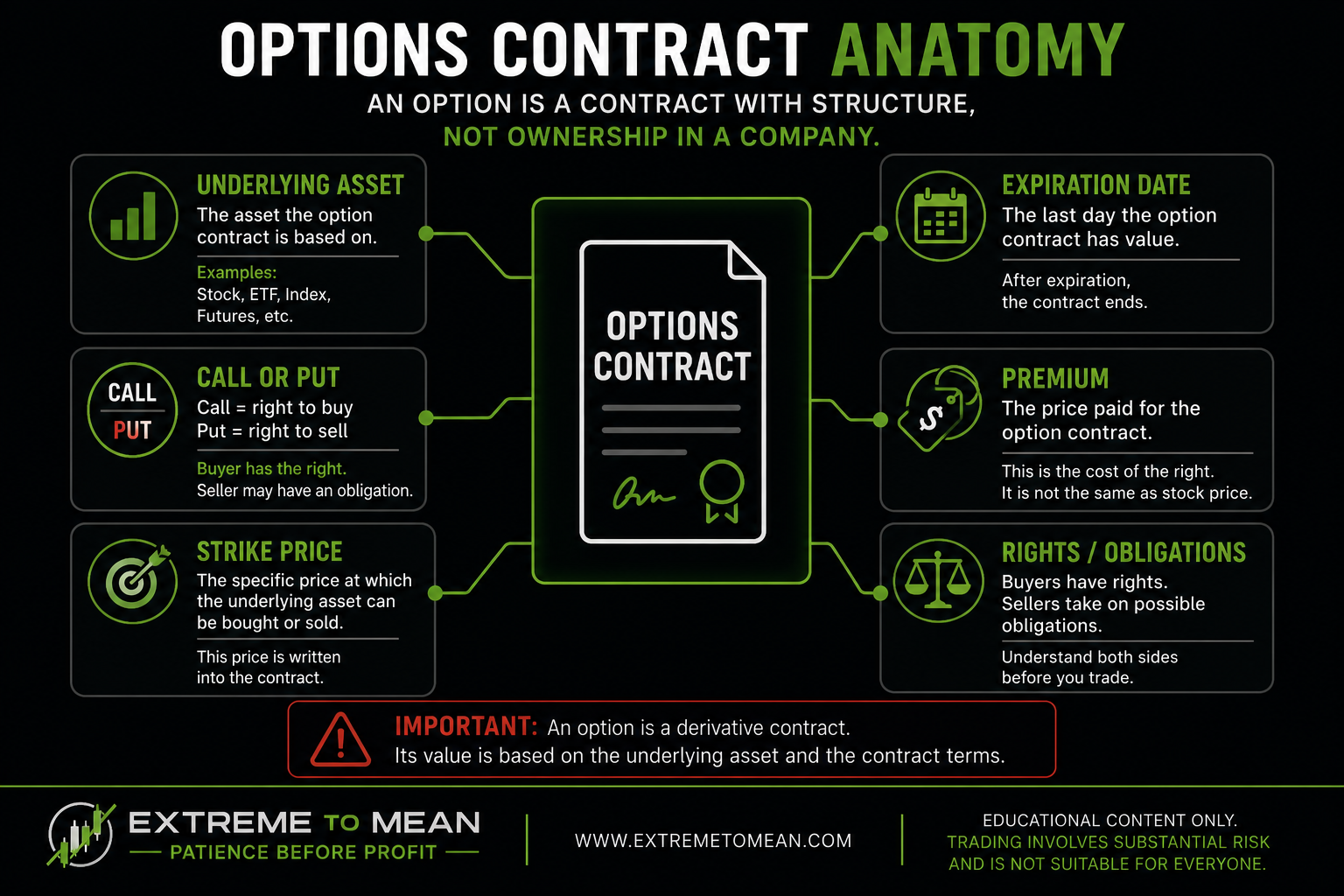
An options contract is tied to an underlying asset. The underlying asset is the thing the option is based on. That could be an individual stock, an ETF, an index, or in some cases a futures contract.
If the option is based on Apple stock, Apple is the underlying. If the option is based on SPY, SPY is the underlying. If the option is based on an index or futures product, that underlying market drives the contract’s value.
This is different from what a stock really is. A stock represents ownership interest in a specific company. An option represents a contract tied to an underlying asset.
That contract has several important parts:
- The underlying asset
- The option type
- The strike price
- The expiration date
- The premium, or price paid for the option
- The rights and obligations attached to the contract
The important beginner point is that options are derivative products. A derivative is a financial product whose value is based on something else. The option does not stand alone. It gets its value from the underlying asset and from the contract’s structure.
That structure is why options can behave differently from the underlying stock or ETF. A stock may move in the direction a trader expected, but the option may not respond the way the trader expected if time, volatility, or strike selection work against the contract.
The chart may look familiar. The mechanics are not.
Calls, Puts, Rights, and Obligations
There are two basic types of options: calls and puts.
A call option gives the buyer the right, but not the obligation, to buy the underlying asset at a specific price before or at expiration, depending on the type of option. A put option gives the buyer the right, but not the obligation, to sell the underlying asset at a specific price before or at expiration.
The phrase “right, but not the obligation” matters.
If someone buys an option, they are buying a right. They pay a premium for that right. The premium is the cost of the option contract.
The seller, also called the writer, takes on the other side of that contract. Depending on the position and how the contract is structured, the seller may have an obligation if the option is exercised or assigned. That obligation is one reason options can carry risks that beginners do not always see on the surface.
This is where beginners often oversimplify.
They hear that buying a call is “bullish” or buying a put is “bearish,” and they stop there. That may describe the basic directional idea, but it does not explain the full contract. A call can lose value even if the underlying does not move enough. A put can lose value if the timing is wrong. Selling options can create obligations that require a much deeper understanding of risk.
The better question is not, “Do I think the stock goes up or down?”
The better question is, “What right or obligation does this options contract create, and what has to happen before expiration for this decision to make sense?”
That question slows the trader down. It moves the focus from prediction to structure.
Strike Price and Expiration Change the Decision
Every option has a strike price. The strike price is the price level written into the contract. It is the price at which the underlying asset may be bought or sold if the option is exercised.
Every option also has an expiration date. The expiration date is the date when the contract ends. Once an option expires, the contract no longer has future life.
These two details change everything.
A stock does not have an expiration date. If you buy shares of a company, the shares do not disappear just because a certain Friday arrives. An option contract does expire. That means the trader is not only making a price decision. They are also making a time decision.
This is why options are different from stocks, ETFs, and even many beginner product discussions. The trader is not simply asking whether the underlying asset might move. The trader has to consider whether it may move enough, in the right direction, within the time available, and under conditions that support the option’s value.
That is a lot for a beginner to process.
It also explains why options can feel frustrating. A trader may be directionally right but still choose the wrong expiration. They may choose a strike price that does not fit the move. They may enter too late. They may underestimate how quickly time can affect the contract.
This does not mean options are bad. It means options are contracts with rules.
Those rules need to be understood before the trader starts focusing on trade ideas.
Time and Volatility Matter
Options are affected by more than the underlying price.
Time matters because every options contract has a limited life. As expiration approaches, the remaining time value of the contract can change. This is often called time decay. In plain English, the option has less time for the expected move to happen, and that can affect its value.
Volatility matters because options are also influenced by expectations about how much the underlying asset may move. When expected movement is high, options can become more expensive. When expected movement falls, options can lose value even if the underlying price has not moved dramatically.
This is one of the biggest beginner surprises.
A trader may buy an option before news, earnings, or a major market event because they expect movement. The underlying asset may move, but if the option was expensive because volatility was already high, the contract may still disappoint. The trader was not only trading direction. They were trading the price of the contract, the time remaining, and the volatility built into that contract.
That is why options require more than chart reading.
A stock chart can help show price movement. An ETF chart can help show basket movement. A futures chart can help show contract movement. But with options, the trader also has to understand how the option itself is priced and why it may not move one-for-one with the underlying asset.
This is where patience becomes practical. If a beginner does not understand time and volatility, rushing into an options contract because the underlying chart looks interesting is not a clean process. It is a reaction to partial information.
A setup may look interesting, but the contract still has to make sense.
Options Are Not Just “Cheaper Stocks”
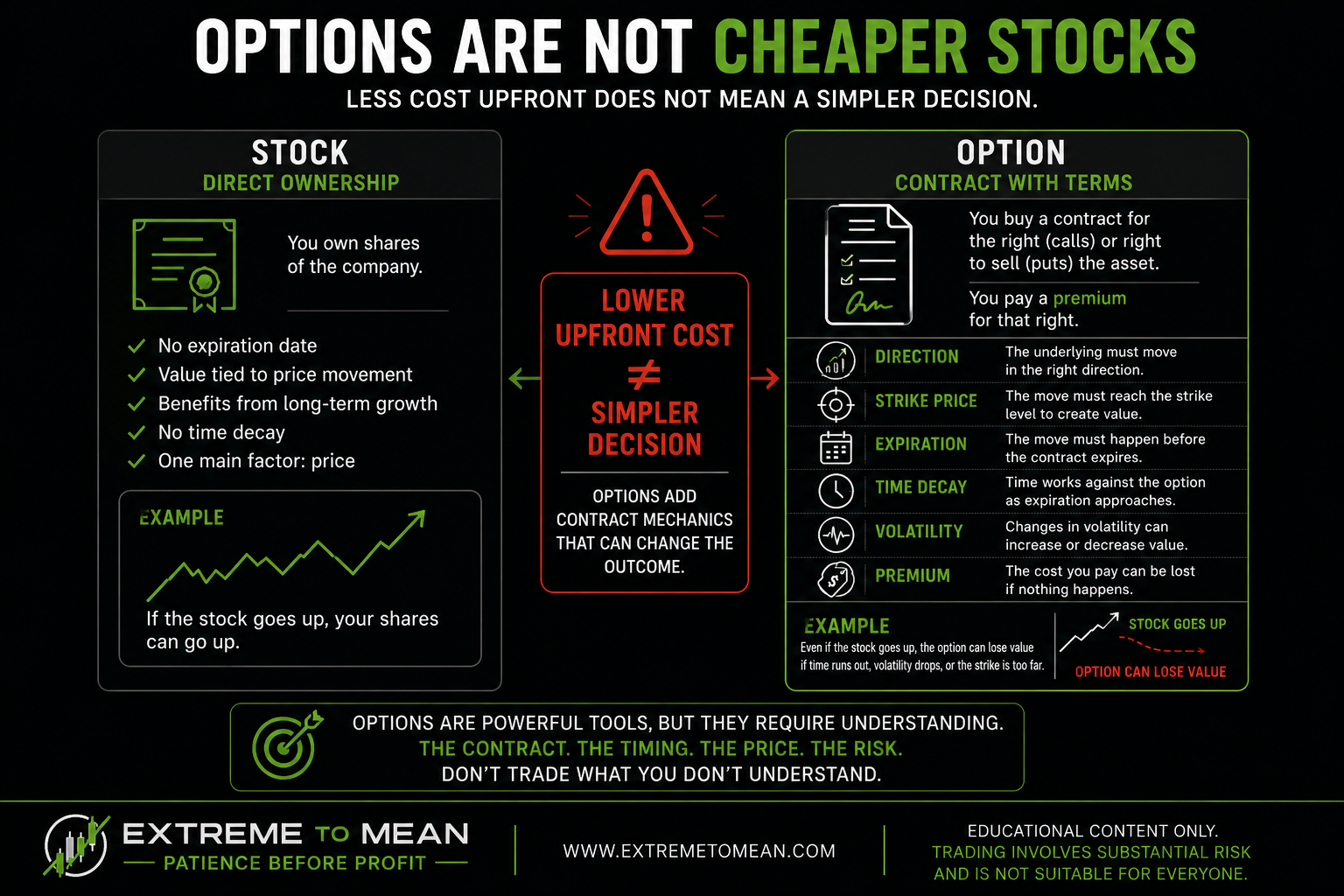
One common beginner mistake is thinking of options as a cheaper way to trade expensive stocks. The logic feels reasonable. If a stock is too expensive, an option may appear to offer exposure for less money upfront.
But less money upfront does not mean the decision is simpler.
An option has a premium, strike price, expiration date, and changing sensitivity to the underlying asset. The option may move differently from the stock. It may lose value as time passes. It may respond sharply to volatility changes. It may require a larger move than the trader realizes before the contract behaves the way they expected.
This is why options should not be treated as shortcuts.
The shortcut mindset says, “I can control the same idea for less money.”
The process mindset says, “I need to understand the contract, the timing, the strike, the volatility, and the risk before I act.”
That process mindset connects directly to the difference between trading and investing. Buying shares for long-term ownership is not the same as buying an options contract with a deadline. The instrument changes the decision.
It also connects to setup and risk lessons, because options do not remove the need for location, structure, and invalidation. If anything, the contract structure makes decision quality even more important.
A trader can be right about direction and still wrong about the option.
That is not a contradiction. That is the product.
A Simple Options Decision Filter
A beginner does not need to master every options strategy before understanding the basic instrument. But they do need to know what questions matter before touching the product.
A simple options filter can help:
- What is the underlying asset?
- Is this a call or a put?
- Am I buying a right or taking on an obligation?
- What is the strike price?
- When does the contract expire?
- How much premium is at risk?
- What needs to happen before expiration?
- How might time affect this contract?
- How might volatility affect this contract?
- Am I evaluating the contract, or just reacting to the underlying chart?
The better question is not, “Can I make money if this moves?”
The better question is, “Do I understand what this contract needs, what it risks, and how it can lose value even if the underlying moves?”
That question is more useful because it forces the trader to evaluate the product instead of chasing the idea. It also protects the trader from confusing direction with decision quality.
For beginners, options should be approached slowly. They are not just another ticker. They are contracts with rights, obligations, expiration, time value, volatility exposure, and risk mechanics that need to be understood before strategy enters the conversation.
If you are still building your instrument map, you can start with the beginner trading path before moving into more advanced products and trade structures.
Final Thought
An options contract is a contract, not a stock. It gives rights, can create obligations, and has a strike price and expiration date built into the decision.
That structure changes everything.
The trader’s job is not to react because an option looks cheaper than the stock or because the underlying chart is moving. The trader’s job is to understand the contract, the timing, the risk, and the conditions required before the decision earns attention.
Educational content only. Trading involves substantial risk and is not suitable for everyone.