
Before a trader studies candles, setups, indicators, patterns, or reversion-to-mean behavior, they need to understand what trading actually is. Trading is not just “buying something.” It is not guessing where price will go next. It is not pressing buttons because a chart moved quickly.
At its core, trading is a decision made under uncertainty. One early part of that process is learning how a price chart organizes price over time before treating movement as a signal.
A trader enters a position because they believe there is a reasonable case for price to move in a certain direction over a certain period of time. That belief may be based on market structure, context, location, price behavior, risk, or some other framework. But no matter how strong the idea feels, the outcome is never guaranteed.
That is why the first lesson in The Basics is not about strategy. It is about understanding the nature of the activity itself.
Trading Is a Decision, Not Just a Purchase
When someone buys a shirt, a phone, or a piece of furniture, the transaction is usually complete once the purchase is made. The buyer pays the price, receives the item, and moves on.
Trading is different.
When a trader buys a stock, futures contract, ETF, or option, the transaction is not really “finished” at the moment of entry. The entry only begins the risk. After the trade is opened, price can move higher, lower, sideways, quickly, slowly, cleanly, or violently. The trader still has to manage what happens next.
That is why trading should be thought of as a decision process, not a shopping process.
A trader is not simply asking, “Do I want to buy this?” A trader is asking a more serious set of questions:
- What am I trading?
- Why am I entering here?
- What would prove this idea wrong?
- How much am I willing to risk?
- Where would I exit if price moves against me?
- Is this decision based on structure, or am I reacting emotionally?
Those questions matter because trading involves exposure. Once a position is open, the trader is exposed to price movement. That exposure can create a gain, a loss, or confusion if the trader never had a clear plan.
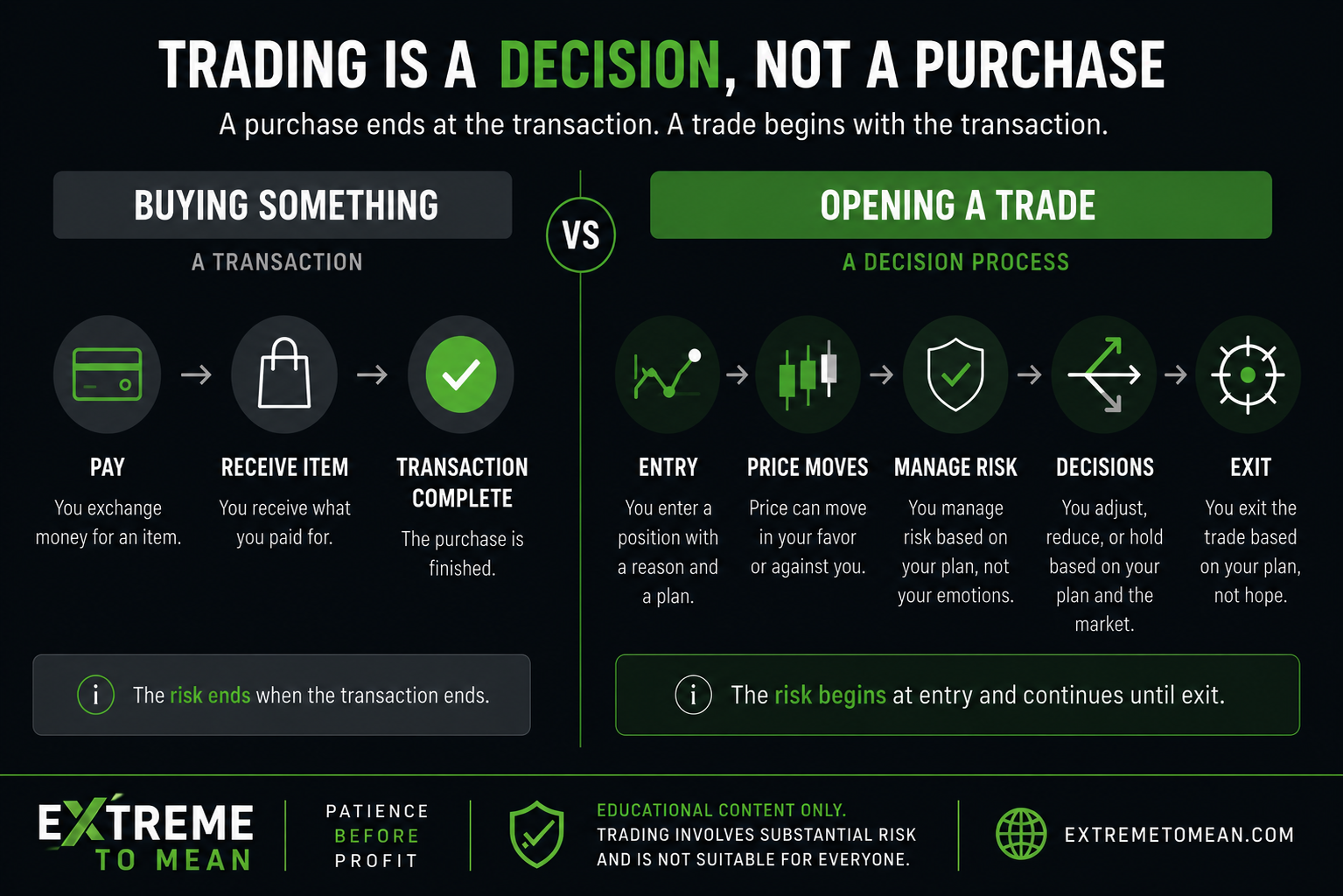
A beginner often sees the buy button as the main event. A more developed trader understands that the buy button is only one part of a larger decision.
Trading Is Different From Investing
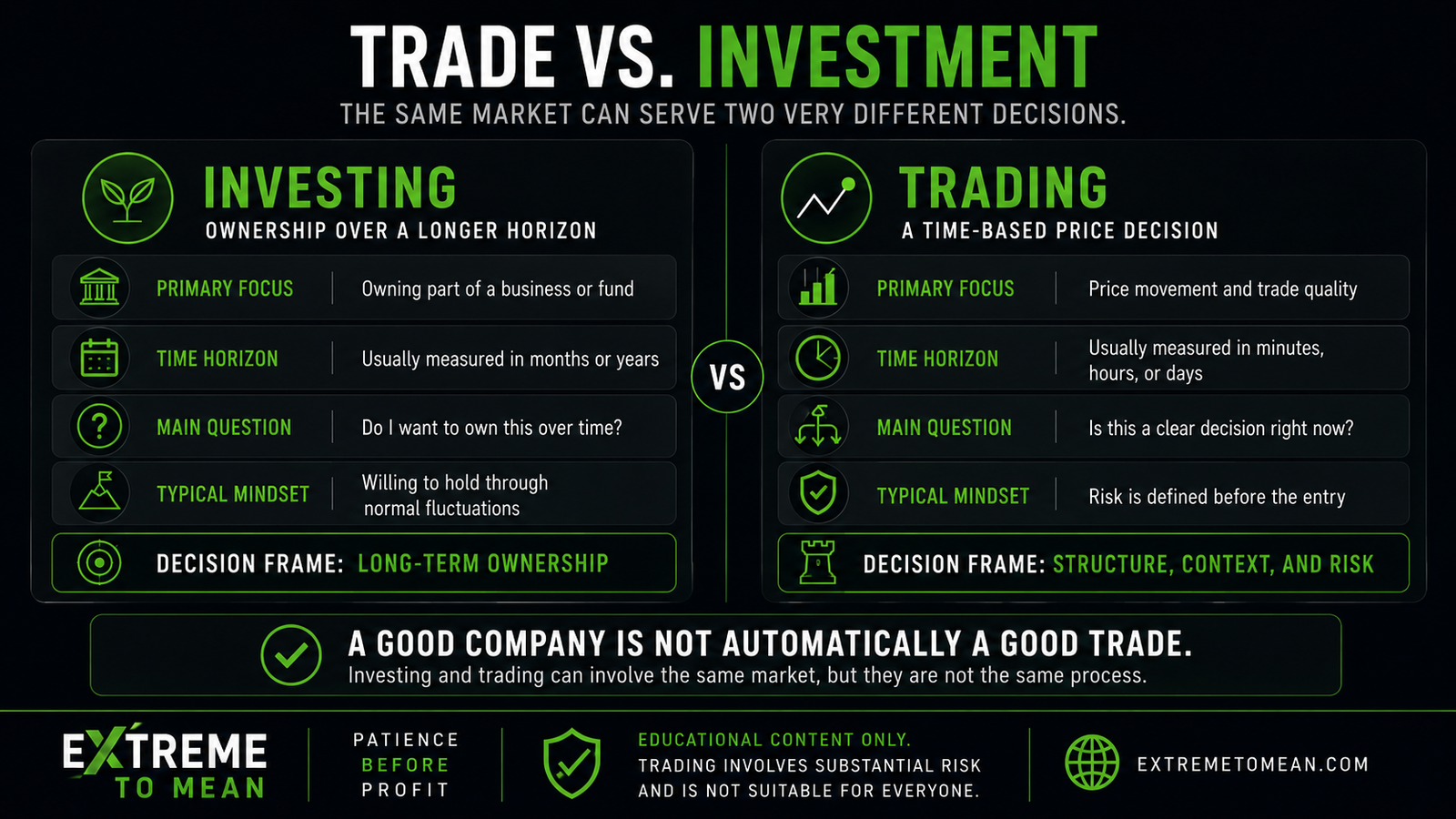
Trading and investing both involve financial markets, but they are not the same activity.
Investing usually focuses on long-term ownership. An investor may buy shares of a company because they believe in the company’s future, earnings, management, products, or long-term growth. The investor may be willing to hold through large price swings because the decision is based on a longer time horizon.
Trading usually focuses on shorter-term price movement. A trader may not care whether a company is excellent over the next ten years. The trader may only care whether price has a reasonable chance to move from one area to another within a specific period of time.
Neither approach is automatically better. They are simply different.
The problem begins when a beginner mixes the two without realizing it. They enter a trade because price is moving, but then hold it like an investment when it goes against them. Or they buy a company because they like the story, but then panic when the short-term chart moves lower.
A good company is not automatically a good trade. A weak company is not automatically a good short. A strong opinion is not the same thing as a structured decision.
This is one reason Extreme to Mean separates market education into layers. Before a trader can understand why market context comes first, they need to know whether they are thinking like an investor, a trader, or someone reacting without a clear framework.
Price Can Move For You or Against You
Every trade has two basic possibilities once it is opened: price can move in a way that helps the position, or price can move in a way that hurts the position.
If a trader buys something, they generally want price to rise. If price rises after entry, the position may show a gain. If price falls after entry, the position may show a loss.
If a trader sells short, the logic is reversed. The trader is positioning for price to fall. If price falls after entry, the short position may benefit. If price rises, the short position may lose.
The important part is not memorizing long and short yet. The dedicated lesson on the two directions a trade can take comes later. The important part is understanding that every trade carries direction and risk.
A trade is not just an opinion. It is an opinion attached to money, timing, and consequence.
That is why price movement feels emotional. When money is involved, every candle can start to feel important. A small pullback can feel like danger. A fast move can feel like opportunity. A missed entry can feel like punishment. A losing trade can feel personal.
But the market is not rewarding or punishing the trader. It is simply moving.
The trader’s job is not to control price. The trader’s job is to evaluate conditions, define risk, and make better decisions before reacting.
The Mistake: Confusing Activity With Process
One of the earliest mistakes beginners make is confusing activity with trading skill.
They think trading means constantly doing something. Watching every candle. Taking every move. Jumping from one idea to the next. Entering because price is moving. Exiting because the trade feels uncomfortable. Re-entering because price keeps going.
That activity can feel productive in the moment because the trader is engaged. They are watching the screen, making decisions, and responding to movement. But being busy is not the same thing as having a process.
A trader without process is usually being pulled around by price.
This mistake feels reasonable because markets are always moving. Something is almost always green, red, breaking out, pulling back, bouncing, rejecting, or accelerating. To a beginner, movement itself can feel like a reason to act.
But movement alone is not enough.
A price move may be meaningful, or it may be noise. A candle may matter, or it may be temporary. A breakout may continue, or it may fail. A pullback may be an opportunity, or it may be the start of something worse.
This is why Extreme to Mean puts so much weight on patience, location, and structure. The goal is not to trade every movement. The goal is to learn which movements deserve attention and which ones are better left alone.
A setup has to earn attention before it earns risk.
A Trade Needs Context, Not Just Direction
A beginner may think the main question is, “Will price go up or down?”
That question matters, but by itself, it is incomplete. A better trader asks where the trade is happening, what condition the market is in, how much room price has to move, and what would make the idea invalid.
Direction without context can be dangerous.
Price may be moving up, but the trade may be chasing too far from a clean location. Price may be falling, but it may already be extended into an area where sellers are late. A candle may look strong, but the broader market may be choppy. A setup may look attractive, but the risk may be unclear.
That is why later Extreme to Mean lessons spend so much time on location. Before a trader focuses on entries, they need to understand why location is the first filter.
Trading is not about finding a reason to click. It is about deciding whether the current conditions are good enough to justify risk.
That distinction changes everything.
A reactive trader sees movement and asks, “Can I get in?” A process-driven trader sees movement and asks, “Is this a clean enough decision?”
The second question is slower, but it is also more useful.
Risk Is Part of the Trade From the Beginning
Many beginners think about risk after they enter. They buy first, then decide what to do if price moves against them. That creates a problem because the emotional pressure begins after the position is already open.
Risk should be part of the trade before the entry.
A trader does not need to know the future, but they should know what they are willing to lose if the idea is wrong. They should know where the trade no longer makes sense. They should know whether the potential reward is worth the risk being taken.
That does not make the trade safe. Trading always involves risk. But it does make the decision more structured.
The difference is important.
A planned loss is not enjoyable, but it can be part of a controlled process. An unplanned loss often creates confusion, frustration, and emotional decision-making. The trader starts adjusting, hoping, adding, moving the exit, or refusing to accept that the original idea failed.
This is why the risk side of a trade cannot be treated as an afterthought. A trade is not ready just because the entry looks interesting. A trade is only complete as a decision when the risk is clear.
For a deeper lesson on this idea, Extreme to Mean teaches that the trade is not ready until the risk is clear.
A Better Question Before Taking a Trade
The beginner question is usually, “Do I think this will go up or down?”
That is understandable. Direction is the most obvious part of trading. But direction is only one piece of the decision.
A better question is:
“Is this a structured trade idea, or am I reacting to movement?”
That question forces the trader to slow down. It moves the focus away from excitement and back toward process. It asks whether the trade has a reason, a location, a risk point, and a purpose.
Before entering, a trader can ask:
- What financial instrument am I trading?
- What direction am I considering?
- What is the reason for the trade?
- Is the trade happening at a meaningful location?
- What would tell me I am wrong?
- Where is my risk defined?
- Am I acting because the setup is clear, or because I feel pressure to do something?
These questions will not make the market predictable. They will not guarantee a good outcome. But they can help separate a trade decision from an emotional reaction.
That is the foundation of Patience Before Profit.
Patience does not mean doing nothing forever. It means waiting until the decision is clear enough to deserve action. Sometimes that means taking the trade. Sometimes that means doing nothing because the market has not offered a clean enough opportunity.
Doing nothing can feel frustrating to a beginner because it feels like missed action. But in trading, doing nothing is still a decision when it protects the trader from unclear conditions.
A trader who wants a stronger starting path can start with the beginner trading path before moving into deeper lessons on setups, market behavior, and trader psychology.
Final Thought
Trading is not just buying something and hoping it goes higher.
Trading is making a decision under uncertainty. It requires a financial instrument, a direction, a reason, a time horizon, and a plan for risk. The market may cooperate, or it may not. That uncertainty is not a flaw in trading. It is part of trading.
The beginner’s job is not to predict every move. The beginner’s job is to learn how to evaluate conditions before acting.
That is where better trading begins.
Actual participation also requires understanding the broker and account used to access the market.
Educational content only. Trading involves substantial risk and is not suitable for everyone.