
Prop-firm consistency rules can feel like an annoying obstacle between a trader and a payout. Their deeper value is that they expose one of the hardest trading impulses to control: the desire to finish faster.
The danger is not having a big winning day. The danger is needing one.
A consistency rule creates friction against a seductive idea: “If I can just make enough today, this is over.” Once that thought takes over, normal progress can feel inadequate, controlled size can feel too slow, and perfectly acceptable setups can be judged by how quickly they move the account instead of by whether they actually deserve risk.
That is why this lesson belongs inside The Trader. Consistency rules vary materially across providers, programs, and account types, but the behavioral question is broader than any one formula: Am I trying to trade well repeatedly, or am I trying to finish the account as fast as possible?
Profitability and Consistency Are Not the Same Thing
A trader can make money over a period without producing that money in a repeatable way. Imagine five days of results: one very large winner, two modest losses, and two small gains. The account may be profitable even though one day produced nearly all of the net result.
That does not automatically mean the trader performed badly. Markets are uneven, opportunities vary, and occasionally an excellent setup can naturally produce an exceptional outcome. But the distribution raises a different question from profitability.
Profitability asks whether you made money. Consistency asks how you made it. A process that depends on one extraordinary result is different from a process that repeatedly produces controlled decisions across changing conditions.
What Consistency Rules Are Really Measuring
Consistency rules are not standardized across the prop industry. Some programs may limit how concentrated profits can be in one day, while others use different requirements or no consistency rule at all. The exact mechanics should always be checked against the current rules of the specific program.
Conceptually, though, these rules are concerned with concentration. The issue is not that a big winning day is bad; it is whether the account depends on big winning days. One exceptional result is very different from needing exceptional results to make the process work.
That distinction matters because consistency of P&L and consistency of process are related but not identical. A firm may measure the first because it is easy to quantify. ETM is more interested in the second: whether the trader’s behavior remains recognizable when the numbers change.
The Finish Line Changes How the Trader Sees the Market
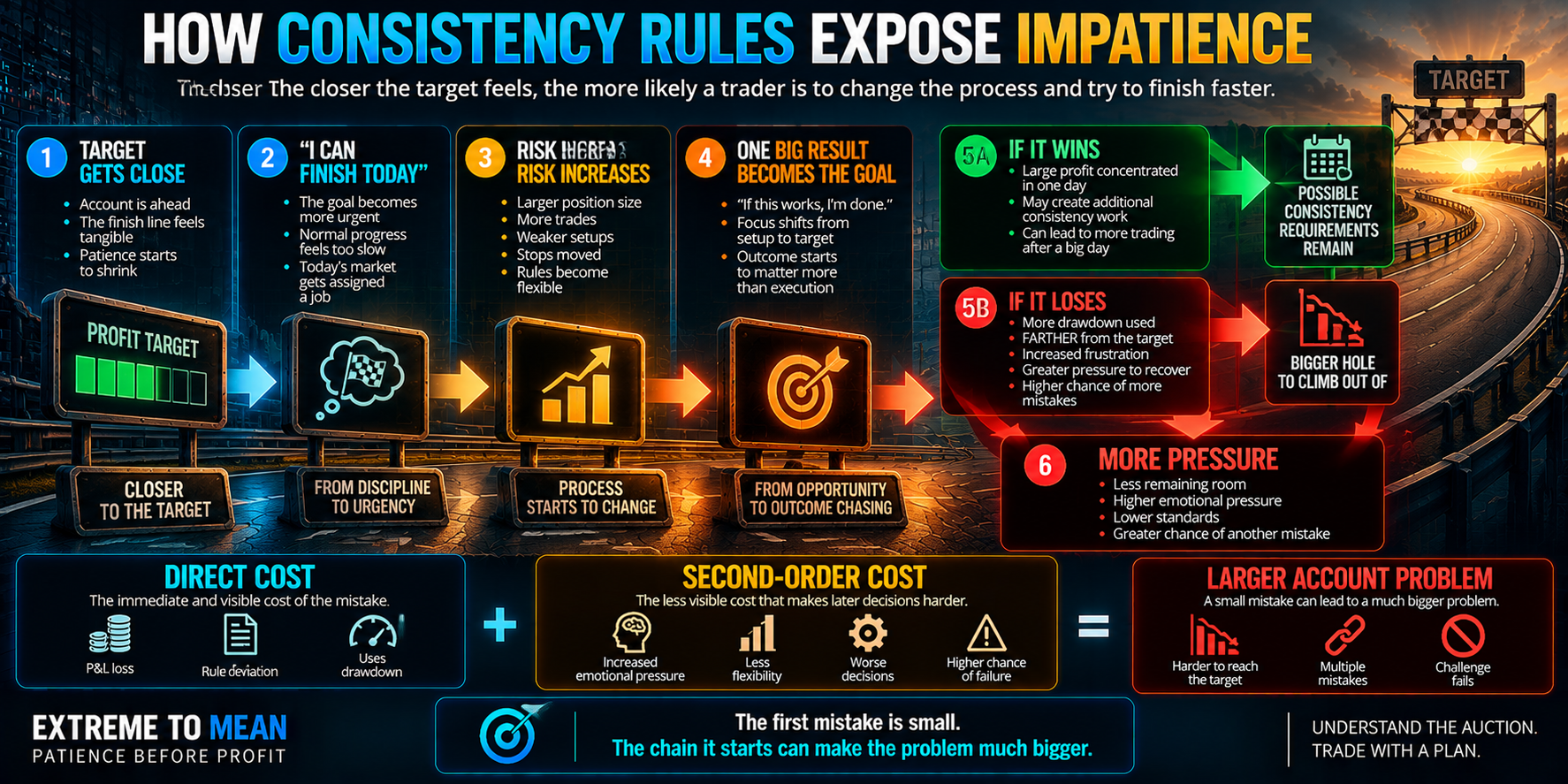
A trader may begin an evaluation patiently, taking only qualified setups and using normal size. Then the target gets close enough to feel tangible, and a new thought appears: “If I just make the rest today, I am done.” Nothing about the market has necessarily changed.
What changed is the trader’s relationship to the account. Today’s market has suddenly been assigned a job: deliver the remaining target. The closer the target feels, the easier it becomes to trade the finish line instead of the setup.
That can make a normal-sized winner feel disappointing. A perfectly good trade may suddenly register as “not enough” because it did not accelerate the account quickly enough. When a good trade feels disappointing because it was not big enough, impatience has changed the definition of success.
How Consistency Rules Expose Sizing Impatience
Position size often changes before the trader admits that urgency changed. A trader who normally uses controlled exposure sees one strong setup while close to the target and thinks, “If I size this up and it works, I can finish today.” The larger position may be justified verbally by the quality of the setup, while the real motive is speed.
A higher-quality setup can deserve attention without automatically deserving a completely different risk profile. If variable sizing is already part of a predefined process, that is one thing; changing the rule because the finish line is close is another. When position size changes because the objective feels near, impatience has entered the risk decision.
This is where your trading plan is a promise made before the open. The plan exists partly to keep account progress from rewriting risk rules in the middle of the session. Being closer to the target does not make the setup more qualified.
One Big Win Can Create a New Problem
Suppose a trader is close to completing an objective and increases size on a strong setup. The trade wins, producing an unusually large day, and the account moves materially closer to the goal. From a pure P&L perspective, the decision looks successful.
Depending on the program’s current consistency structure, however, concentrating a large portion of profit into one day may create additional requirements before eligibility or payout conditions are satisfied. The trade designed to finish the account quickly can create the need for more trading afterward. Rushing can make finishing take longer.
That does not mean the trader should suppress legitimate profits or intentionally cut good trades short. A large day produced by a qualified setup, normal risk, and normal execution is not the problem. The danger is changing the process because the trader needs the large day.
The Same Rush Can Fail in the Opposite Direction
The oversized attempt can also lose. Now the account is farther from the target, drawdown room is smaller, and the trader is frustrated because a nearly completed objective has become a recovery problem. Trying to accelerate progress can increase the distance left to travel.
That is the trap hidden inside the word “efficient.” Taking more risk to shorten the calendar may feel efficient only if the trade works. Faster is not automatically more efficient when speed increases the chance of having to repair damage or start over.
A consistency rule makes that tradeoff visible. It asks the trader to tolerate the possibility that the account may require another day, another week, or simply another qualified setup. Near the finish line, ordinary progress can suddenly feel too slow.
Impatience Is Often Strongest When the Goal Is Closest
Many traders think impatience appears primarily when nothing is happening. In prop accounts, it can become strongest when something is almost complete. The account is nearly passed, the payout window is approaching, or only a modest amount remains.
That proximity creates urgency because the trader can visualize the finish. Waiting one more day feels more expensive than it did earlier, even though the market itself has not become more favorable. The desire to save time begins influencing decisions that should be based on setup quality.
The thought “I do not want to wait another day” can affect size, trade count, stop discipline, and willingness to accept mediocre setups. The desire to save one day can create a mistake that costs much more time. The problem is not ambition; it is allowing the calendar to become a trading signal.
Consistency Means Repeatable Behavior, Not Identical P&L
Consistency should not be confused with producing the same profit every day. Markets do not provide identical opportunity, and a disciplined trader may have a flat day, a small day, a losing day, or an unusually strong day. Artificially forcing identical outcomes would itself distort trading.
A more useful definition is behavioral. Consistent trading does not mean identical P&L; it means recognizable behavior across different P&L. The trader still uses the normal process, normal qualification standards, and controlled risk even when the result varies.
That is why a consistency formula is not a complete measure of skill. A trader could theoretically satisfy a numerical formula while making poor decisions, or violate one after a genuinely exceptional day while following a sound process. Whether or not a specific rule is elegant, the pressure it creates can still reveal whether the trader is willing to abandon repeatable behavior to accelerate the outcome.
Progress Is More Than Dollars Toward the Target
Prop traders naturally measure progress by the remaining distance to the goal. But under a repeatability framework, progress also includes maintaining normal size, following rules, selecting qualified setups, and avoiding dependence on one oversized event. The balance is not the only thing being built.
Progress is not just how far the account moved. It is whether the process that moved it can be repeated. A modest day earned through normal execution may therefore be more useful than a much larger day manufactured through abnormal risk.
That does not make smaller profits inherently superior. If the market provides a legitimate high-quality opportunity and the plan captures a strong result, take the result. The distinction is between allowing an opportunity to become large and requiring it to become large because the account objective is nearby.
Intensity vs. Repetition
There are two very different ways a trader can attempt to solve the same remaining objective. The first is intensity: increase size, force more opportunity, take additional trades, and try to produce one decisive result. Progress may be fast if it works, but the process becomes increasingly dependent on that outcome.
The second is repetition: maintain normal size, wait for qualified setups, accept uneven daily P&L, and allow progress to accumulate. It may look slower from one session to the next, but the behavior is more repeatable. Repeatable behavior first; repeatable results second.
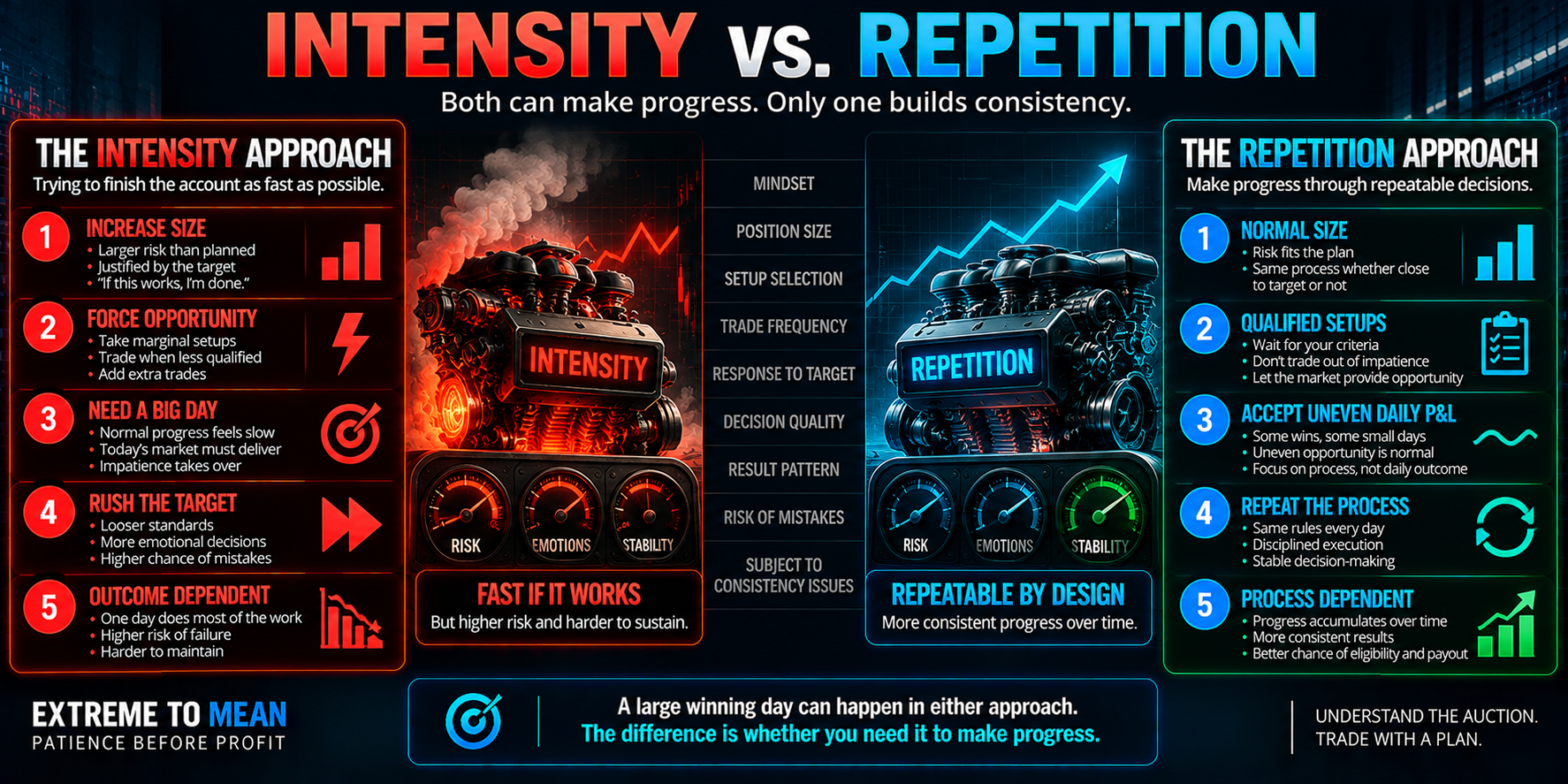
Controlled size supports that repetition because it helps keep one trade from becoming emotionally larger than the process. This is not an argument that smaller is always better; it is an argument that the account target should not determine exposure. The market opportunity and the predefined plan should.
Two Traders Near the Same Finish Line
Imagine two traders are each close to completing the same objective. Trader A normally trades two contracts, sees a strong setup, and takes five because, “If this works, I am done.” The trade wins, creating a large result concentrated into one session.
Depending on the program, Trader A may now discover that additional consistency work remains. Instead of feeling finished, the trader becomes irritated: “I already made the money—why do I have to keep trading?” That frustration creates a new temptation to manufacture enough smaller results to satisfy the account structure.
Trader B sees the same setup and uses the normal planned size. The win is smaller, and the trader may need another day or several additional qualified opportunities. But risk remained normal, behavior remained repeatable, and the account did not become dependent on one outsized decision.
Trader A tried to compress the process into one day. Trader B allowed the process to take as long as the market required. Neither approach guarantees an outcome, but only one kept the finish line from changing the trading process.
Do Not Start Trading the Formula Instead of the Market
Consistency rules can tempt traders into reverse-engineering the exact daily results needed to satisfy them. Operationally, understanding the current rule is necessary. Behaviorally, however, there is danger when the strategy becomes “manage the formula.”
If the trader is taking extra trades primarily to alter profit distribution, the account statistic has started driving market decisions. If the strategy becomes managing the formula, the trader may stop managing the trade. The setup should still have to qualify independently.
This is another reason protecting the next decision matters. Yesterday’s unusually large win, today’s remaining target, or tomorrow’s payout eligibility should not get a vote on whether the current setup deserves risk. Each trade still has to stand on its own.
The Consistency Pressure Check
Before changing behavior because the account is close to a target or payout condition, ask:
- Would I take this same trade at the same size if I were much farther from the target?
- Has the setup changed, or only my desire to finish?
- Am I trying to create a big day?
- Is this position size still part of my normal process?
- Would a modest win feel disappointing today?
- Am I trading the market or the consistency formula?
- Am I taking extra trades because I want to alter the distribution of profits?
- Would I still take this trade if the account statistics were hidden?
- Am I willing to let passing take another day?
- Does this decision make my behavior more repeatable or more dependent on one outcome?
The questions are not designed to suppress legitimate opportunity. They are designed to expose whether the finish line has quietly become part of the setup. Being one trade away from passing does not make the trade in front of you better.
For traders who notice that proximity to a goal creates extra activity, the trading-too-much problem guide is a useful next step. The account objective may explain the urgency, but it does not qualify additional trades. Opportunity still comes from the market.
The ETM Standardize → Qualify → Size → Execute → Repeat Framework
Use STANDARDIZE → QUALIFY → SIZE → EXECUTE → REPEAT. Standardize the normal process before the session begins, then require the setup to qualify on its own. Size according to that process rather than according to how close the account is to the finish line.
Execute the trade that actually exists, then allow progress to accumulate through repetition. The choices remain trade, wait, or pass. Consistency is built before the P&L becomes consistent.
Final Thought
Consistency rules can be frustrating because they interfere with one of the strongest impulses in prop trading: the desire to finish quickly. Once the target feels close, normal progress can suddenly seem too slow, size can creep higher, and perfectly acceptable results can feel disappointing simply because they did not move the account far enough.
A large winning day is not automatically bad, and consistency does not mean producing identical results every session. The real question is whether progress is being built through behavior the trader can repeat. Keep the risk process recognizable, let each setup qualify independently, and allow the market—not the finish line—to determine the pace.
A trader who needs one exceptional day may be chasing an outcome. A trader who can keep making good decisions is building a process.
Educational content only. Trading involves substantial risk and is not suitable for everyone.