
Mean reversion can make impatience feel intelligent. The farther price travels from a familiar reference, the easier it becomes to think the move has gone “too far” and must come back. But an extreme is where mean-reversion analysis begins, not where the trade automatically begins.
An extreme earns your attention. The complete sequence still has to earn your risk.
Mean reversion asks a trader to consider taking the other side of a move that is already happening. That creates a built-in tension: the distance from balance may be increasing at the exact moment the directional pressure is still strongest. The patient trader is not trying to predict the precise top or bottom; they are waiting for evidence that the extension is becoming tradable.
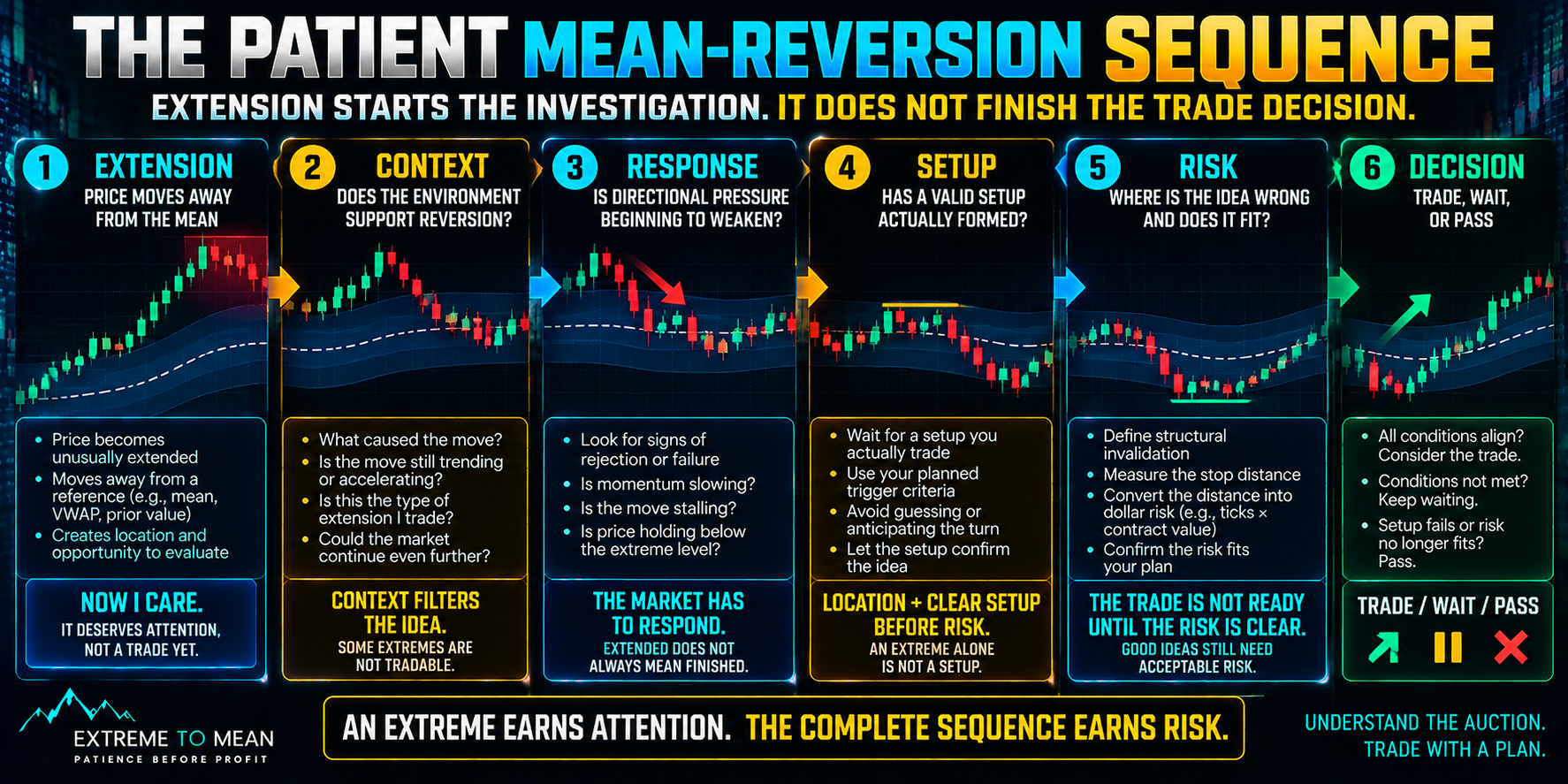
That is why this lesson belongs inside the broader Trader curriculum. The process is not STRETCH → FADE. It is STRETCH → CONTEXT → RESPONSE → SETUP → RISK → DECISION.
An Extreme Is Where Mean-Reversion Analysis Begins
Mean reversion needs some form of distance before there is anything to investigate. Price may be unusually far from a reference, statistically stretched, extended after a fast directional move, or displaced from a prior area of balance. That distance can create interesting location, but location alone does not create a reversal, a trigger, an acceptable stop, or favorable risk.
A useful way to think about an extreme is: now I care. It should not automatically become now I trade. What Extreme to Mean really means is a movement from imbalance back toward balance, but recognizing imbalance does not tell you exactly when that return will begin.
An extreme therefore answers one question: Where should I pay closer attention? It does not answer the more important execution question: What has changed now that price is far enough? Mean reversion punishes traders who confuse “far” with “finished.”
Price Can Become More Extreme Before It Reverts
If price looks overextended, it can still become more overextended. Markets can trend, accelerate, reprice after new information, break established ranges, or build an entirely new area of value. The fact that price has traveled unusually far does not prove that the force creating the move has been exhausted.
That is the psychological trap. Imagine an index future rallies 20 points and the trader thinks, “Too high.” It rallies another 20 and now feels “definitely too high,” then adds another 30 and begins to look ridiculous.
The trader's conviction grows because the distance is growing, but the market is simultaneously proving that the current directional force is still capable of extending price. The farther price runs, the more attractive the fade may feel—and the more evidence you may need that the move is actually weakening. Not every extreme is a trade, especially while continuation remains strong.
The Mean Is a Reference, Not a Promise
The word “mean” can create a dangerous mental shortcut. Traders begin treating the reference like a magnet with a deadline, as though price becomes more obligated to return with every additional point of extension. Markets do not owe the trader a timely reversion.
Even when some form of reversion eventually occurs, the trader still has to survive timing, drawdown, invalidation, changing structure, opportunity cost, and account risk. The reference itself can move, the regime can change, and the market can establish a new area of balance. “It will eventually come back” is not a risk-management plan.
Research into mean-reverting behavior is highly dependent on the asset, timeframe, regime, definition of the mean, transaction costs, and methodology. Evidence of reversion in one setting does not prove that a particular intraday futures extreme should reverse now. Mean reversion is a tendency to evaluate, not a promise about the next candle.
Patience Means Waiting for Context, Not Just More Distance
A patient mean-reversion trader should not simply keep waiting for a larger numerical extreme. The better question is what kind of market created the extension? A mature directional move, fresh breakout, economic-data repricing, liquidation burst, or ordinary auction extension can all look “far” while carrying very different implications.
The same distance from a reference can therefore deserve different treatment in different environments. Market conditions change the quality of a setup, and that matters even more when the thesis asks price to move against its current direction. The useful combination is EXTREME + CONTEXT, not extreme alone.
Context does not need to predict the reversal. Its job is to help the trader decide whether reversion is even a reasonable hypothesis in the environment that produced the move. If the market is still clearly repricing and accepting new prices, patience may mean continuing to stand aside.
The Four Things a Mean-Reversion Trader Must Wait For
There are four distinct waits inside a patient mean-reversion process. The first is meaningful extension: price has to move far enough away from balance that reversion is worth evaluating rather than being manufactured in the middle of ordinary noise. The second is supportive context: the trader asks whether this is the type of extension their process is designed to fade.
The third wait is for the market response and actual setup. The trader looks for conceptual evidence that directional pressure is no longer accelerating in the same way—perhaps failure to continue, rejection of the extreme, stabilization, a meaningful reclaim, or buyers or sellers losing the ability to extend. This remains intentionally process-level; the article does not define a proprietary trigger.
The fourth wait is for risk to become clear. Even a plausible reversion is not ready until the trader can answer where the idea is wrong, what structural invalidation requires, and whether that risk fits. The trade is not ready until the risk is clear, so the final outcome after these four waits is still TRADE / WAIT / PASS.
Why Entering Early Feels So Tempting
The strongest mean-reversion temptation often appears while the move is still extending. A trader sees price far from the reference and feels they are getting a better fade price with every additional point. The apparent bargain becomes more emotionally attractive even though the market is showing continued directional strength.
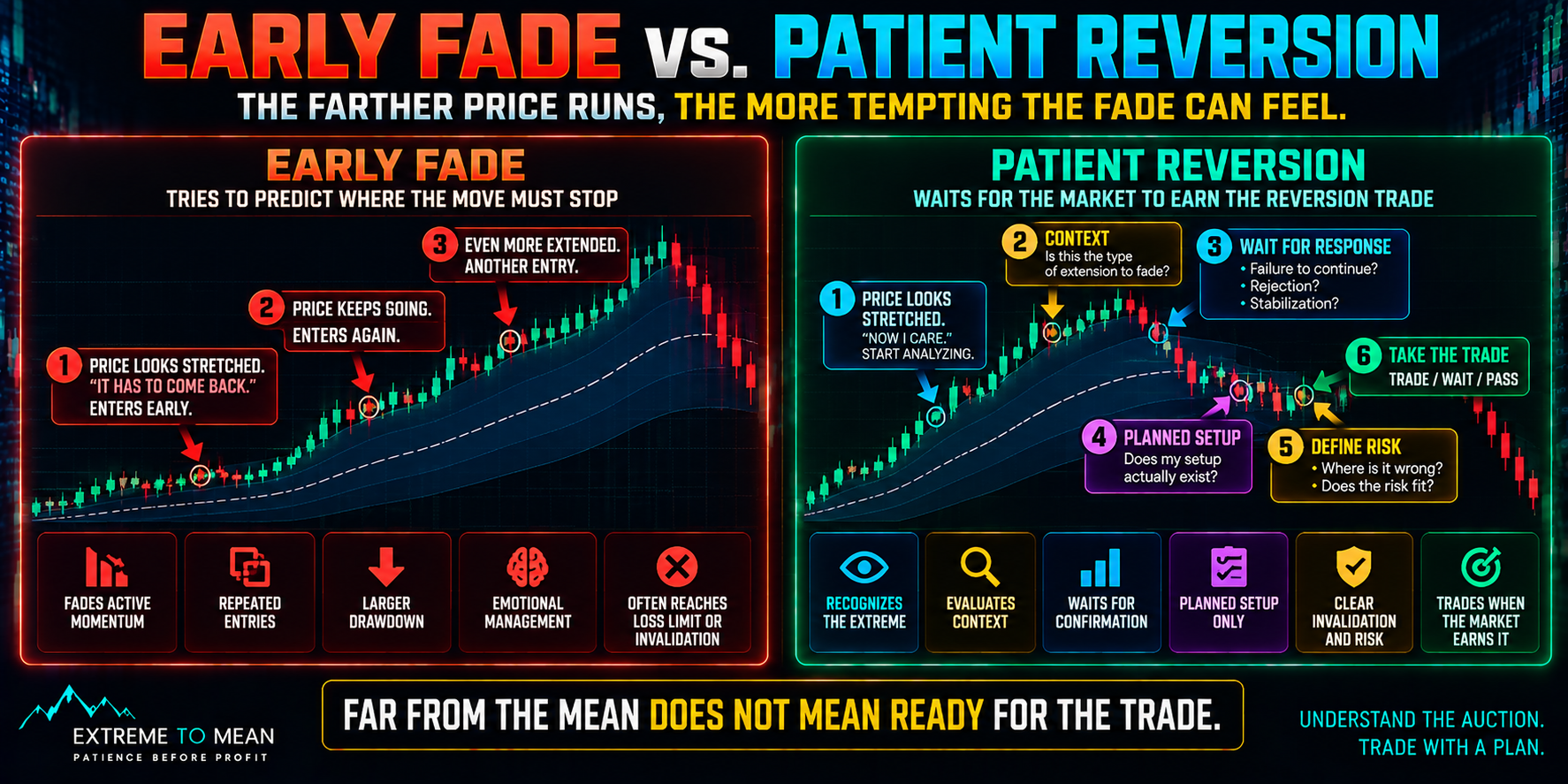
Consider two traders watching the same fast rally. Trader A sees the extension and shorts immediately; when price continues higher, they short again because the market now looks even more overbought. By the time the market finally reverses, Trader A may have already reached a stop, a loss limit, or an emotional breaking point.
Trader B sees the same extreme and says, “Now I care.” They ask what caused the move, whether the environment remains directional, whether extension is continuing, whether the market has shown rejection or stabilization, whether a planned setup is forming, and whether invalidation can be defined. Trader A tried to predict where the move had to stop; Trader B waited for the market to earn the reversion trade.
Patience Can Improve Risk—but Waiting Has a Cost
Entering too early can create larger adverse excursion, wider structural stops, repeated entries, emotional stop movement, and lost confidence before the actual reversion begins. Waiting may allow the market to reveal clearer invalidation, cleaner structure, and more evidence that the directional move is losing force. Patience can therefore improve risk definition as well as decision quality.
But waiting is not free. Sometimes the best evidence arrives only after price has already moved partway back toward the mean, which can reduce remaining room or worsen the entry price. Sometimes the reversal is so fast that the trader never receives the setup they require.
That tradeoff matters because the lesson is not wait longer. It is wait for what your process actually requires. More confirmation is not automatically better if the extra delay destroys the opportunity the strategy was designed to capture.
Sometimes the Reversion Happens Without Your Trade
A market can reach an extreme and reverse violently before a trader's planned setup forms. The move may travel all the way back toward balance while the trader remains flat. That does not prove the waiting process failed.
The market provided a reversion, but it may not have provided your trade. You are not entitled to every reversion simply because you recognized the extreme, and a move can happen without offering you a qualified way to participate. Missing the reversal is cheaper than inventing one too early.
This is where chasing the trade can quietly replace patience. After waiting correctly and watching the reversal begin without them, traders often feel pressure to jump in late simply to prove their read was right. Recognition does not create entitlement; if location, setup, or risk no longer works, the correct decision can still be to pass.
The ETM Patient Mean-Reversion Framework
Use this sequence:
- EXTENSION — Is price meaningfully away from balance?
- CONTEXT — Why did it get there, and does the environment support a reversion idea?
- RESPONSE — Is price still accelerating, or is directional pressure beginning to fail, reject, or stabilize?
- SETUP — Has the actual planned setup formed?
- RISK — Where is the idea wrong, and does that risk fit?
- DECISION — TRADE / WAIT / PASS
A simpler mnemonic is FAR → WHY → STOPPING? → SETUP → RISK. “Far” asks whether price is actually extended; “Why” asks what created the extension; “Stopping?” asks whether continuation is weakening; then the trader waits for the planned setup and defines risk. The trader should always know which stage they are waiting on.
The better question is not, “Is price far enough?” and then stop thinking. Ask, “What has changed now that price is far enough?” That keeps patience concrete and process-based rather than vague.
Final Thought
Mean reversion is not a race to identify the exact top or bottom. Price first has to become meaningfully extended, the surrounding context has to support the idea, the directional move has to give you some reason to believe reversion is becoming plausible, and the setup still has to define acceptable risk. An extreme tells you to pay attention; patience gives the market time to tell you whether that extreme has actually become a trade.
The patient mean-reversion trader is not waiting because waiting is morally superior or because later is always better. They are waiting because a trade against an existing move needs more than distance to justify taking the other side. The extreme earns your attention. The setup still has to earn your risk.
Educational content only. Trading involves substantial risk and is not suitable for everyone.