
Every trader hears the advice eventually: be patient. Wait for your setup. Do not force trades. Let the market come to you.
The problem is that those words are easy to agree with and hard to live. In the moment, patience rarely feels like discipline. It feels like hesitation. It feels like falling behind. It feels like watching other traders participate while you sit there wondering if you are missing something.
That is why most traders do not learn patience from a quote, a rule, or a reminder written on a sticky note. They learn it through repeated pain. They learn it after taking trades that were not really there. They learn it after chasing movement that never offered a clean entry. They learn it after realizing that the trade they forced out of boredom damaged their confidence before the good setup ever arrived.
This is one of the central lessons behind The Patience Principle: patience is not passive, and it is not a personality trait you either have or do not have. It is a skill. More specifically, it is the skill of knowing what you are waiting for and refusing to act until the market gives it to you.
That is where the hard way begins.
The First Lie Traders Believe
Most new traders bring a normal-world belief into the market: more effort should create better results.
In school, work, sports, business, and most skills, more practice tends to help. More effort usually creates more output. More activity often looks like more progress. So when a trader first sits down at the chart, the brain runs the same program: more screen time, more trades, more involvement.
That belief feels responsible. It feels like work. A quiet session feels wasted. A day with no trades feels like a day where nothing was accomplished. The trader starts looking for something to do because doing nothing feels like being behind.
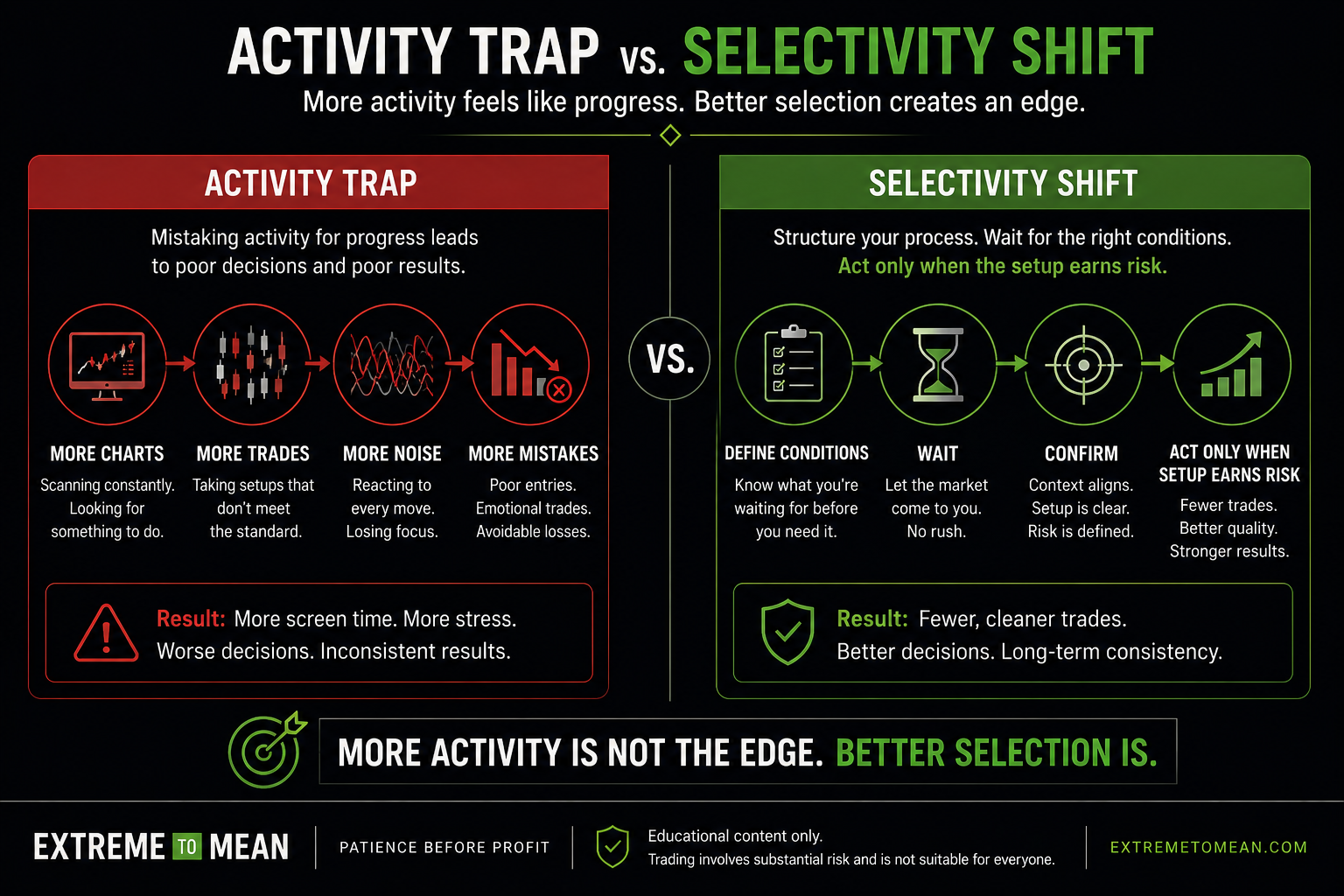
But trading does not reward activity the way most other skills do. Trading rewards selectivity. It rewards timing. It rewards the ability to identify when the market has created a situation worth risking capital on and when it has not.
That is a different kind of work.
A trader can be busy all day and still make poor decisions. They can stare at every candle, take every small signal, and still fail to operate with edge. Movement is always available. Opportunity is not. This is why trader psychology lessons matter so much: the battle is often less about seeing the market and more about resisting the urge to turn every market movement into action.
The first hard lesson is simple: being active does not mean being effective.
Why Activity Feels Like Progress
Activity feels good because it gives the illusion of control.
When a trader is in a position, they feel involved. They are doing something. They have a number to watch, a trade to manage, a result to care about. Even if the setup is weak, the act of trading can temporarily quiet the discomfort of waiting.
That is what makes impatience so expensive. It does not usually feel like impatience in the moment. It feels like readiness. It feels like confidence. It feels like finally acting after watching the market move without you.
This is the same emotional trap that shows up in chasing. When price moves quickly, the trader feels pressure to participate before the opportunity disappears. But as we have covered in FOMO turns movement into urgency, movement by itself is not a signal. A move can be real and still offer no clean trade. A candle can look strong and still leave the trader with unclear risk, late location, and no defined structure.
The hard part is that patience does not give the same immediate emotional reward as action. Waiting does not produce a flashing number on the screen. It does not provide the satisfaction of clicking the mouse. It asks the trader to sit with discomfort long enough for the market to either confirm the idea or disqualify it.
That is why patience has to be structured. Without structure, waiting becomes vague. With structure, waiting becomes a decision.
What the Market Eventually Teaches
The market eventually teaches traders that effort and timing are not the same thing.
You can work hard and still enter too early. You can study all morning and still take the wrong trade. You can correctly identify direction and still lose because you entered from poor location or without enough confirmation. The market does not grade effort. It only responds to the quality of the decision made at the time risk was taken.
This is where many traders begin to mature. They stop asking, “How can I find more trades?” and start asking, “Which trades actually deserve my attention?”
That shift changes everything.
A trader who is still trapped in activity wants the market to give them something to do. A more disciplined trader wants the market to meet specific conditions. They are not waiting because they are afraid. They are waiting because their plan has not been satisfied yet.
This is also where Patience Before Profit stops being a phrase and becomes a standard. The setup does not earn risk because the trader is bored. It does not earn risk because the last move was missed. It does not earn risk because the trader needs to end the day with a trade. It earns risk only when location, context, structure, and risk are clear enough to justify the decision.
The market teaches this lesson in a blunt way. It lets traders act too soon. It lets them chase. It lets them overtrade. Then it shows them the difference between activity and edge.
The trader who pays attention eventually realizes that the problem was not a lack of action. It was a lack of selectivity.
Patience Is Not Passive
One of the biggest misunderstandings about patience is that it means sitting around doing nothing.
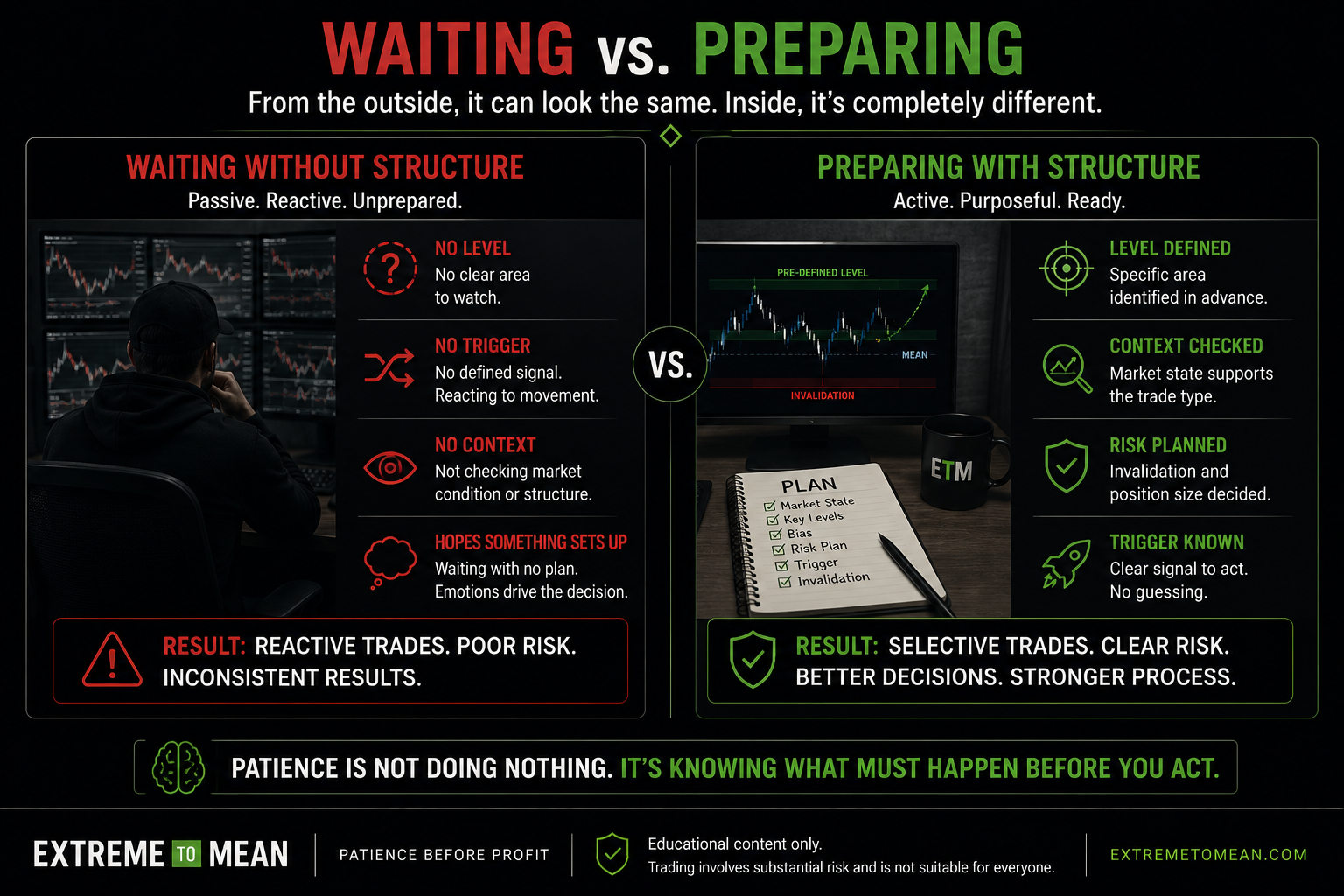
That version of patience is not useful. It is passive. It leaves the trader waiting without a plan, staring at the screen, hoping the right thing appears. When price finally moves, the trader is still unprepared because they never defined what mattered.
Real patience is different. It is active preparation.
A patient trader knows what conditions matter before the trade appears. They know the levels they care about. They know whether the market state supports the trade type. They know where risk would be invalidated. They know what confirmation would need to look like before the trade earns attention.
That kind of waiting is work.
It may not look active from the outside, but inside the process, a lot is happening. The trader is filtering. Comparing. Eliminating. Watching for alignment. Waiting for the market to answer the questions that matter.
This is why patience and structure belong together. Patience without structure becomes hope. Structure without patience becomes something the trader abandons the moment emotion gets loud. The two need each other.
A trader who wants to build patience should not simply tell themselves to wait. They should define what waiting is for. The better question is not “Am I being patient?” The better question is: “What specific condition am I waiting for, and has the market actually given it to me?”
That question turns patience into a process.
How a Better Trader Uses the Hard Lesson
A better trader does not become patient because they enjoy waiting. They become patient because they have seen what impatience costs.
They have seen what happens when they trade because the market is moving instead of because the setup is ready. They have seen how one unnecessary trade can drain focus. They have seen how a weak entry can make the next clean opportunity harder to take. They have seen how easily the mind can turn almost-there into good enough.
The difference is not that the better trader feels no urgency. They feel it and still follow the process.
That is the practical difference. A less disciplined trader treats urgency as information about the market. A better trader treats urgency as information about themselves. If they feel rushed, they slow down. If they feel pulled into a trade, they check the criteria. If they want to act because they are tired of waiting, they recognize that as a warning sign, not a signal.
This is also why doing nothing can be a real trading decision. As discussed in why doing nothing is still a trading decision, standing aside is not automatically avoidance. When the setup is unclear, when the risk is not defined, or when the market state does not support the trade, doing nothing is active risk management.
The hard lesson becomes useful only when it changes behavior. If a trader keeps paying for the same impatience, the lesson has not landed yet. If they start building rules around the moments where impatience usually takes over, the hard lesson begins turning into structure.
That is when patience stops being something the trader wishes they had and becomes something they practice.
A Better Question Before You Click
Before entering a trade, the question is not simply, “Can this work?”
Almost anything can work in the market. A bad entry can win. A late chase can continue. A weak setup can catch a move. That possibility is exactly what makes poor decisions so tempting.
The better question is: “Has this trade earned risk according to my process?”
That question forces the trader back to structure. It separates possibility from qualification. It reminds the trader that the job is not to predict every move, but to evaluate whether this move, in this location, under these conditions, deserves participation.
A simple patience filter can help:
- Am I acting because the setup is ready, or because I am tired of waiting?
- Do I know the level, the reason, and the invalidation point before entering?
- Does the current market condition support this trade type?
- Would I still want this trade if I had not missed the earlier move?
- If I do nothing here, am I avoiding a good trade or rejecting an unqualified one?
If the answers are unclear, the trade has not earned risk yet. That does not mean the trade cannot work. It means the decision is not clean enough to deserve capital.
For newer traders building this discipline, it can help to start with the broader beginner path before trying to refine entries. The start with the beginner trading path page is a better next step than chasing more signals because the foundation has to come before the trigger.
Final Thought
Every trader eventually learns patience. The only question is how much they pay before the lesson becomes real.
The hard way is taking too many trades, confusing activity with progress, and learning through frustration that the market does not reward effort the way life usually does. The hard way is realizing that more screen time does not matter if it leads to more emotional decisions — that showing up and watching doesn't entitle you to an opportunity. The hard way is seeing the good setup arrive after focus has already been spent on trades that never earned attention.
The smarter way is to build patience into the process before the market forces the lesson. Define what you are waiting for. Know the conditions that matter. Let the setup earn attention before it earns risk. Treat waiting as preparation, not absence.
Patience does not make the market predictable. It does not guarantee results. It simply gives the trader a cleaner standard for deciding when to act and when to stand aside.
That standard is what most traders eventually learn, usually the hard way.
Educational content only. Trading involves substantial risk and is not suitable for everyone.