
Every trader has done it. The market moves. You watched it. You waited. You hesitated. Then it moved again, and suddenly the voice in your head gets loud: you're missing this, get in, it's still going. So you get in — late, with no clear level, no defined risk, and no real reason beyond the feeling that something is happening and you are not part of it.
That is FOMO. Fear of missing out. And it is not just a bad habit — it is the single most consistent way traders take money that was never theirs to take and hand it to the market voluntarily.
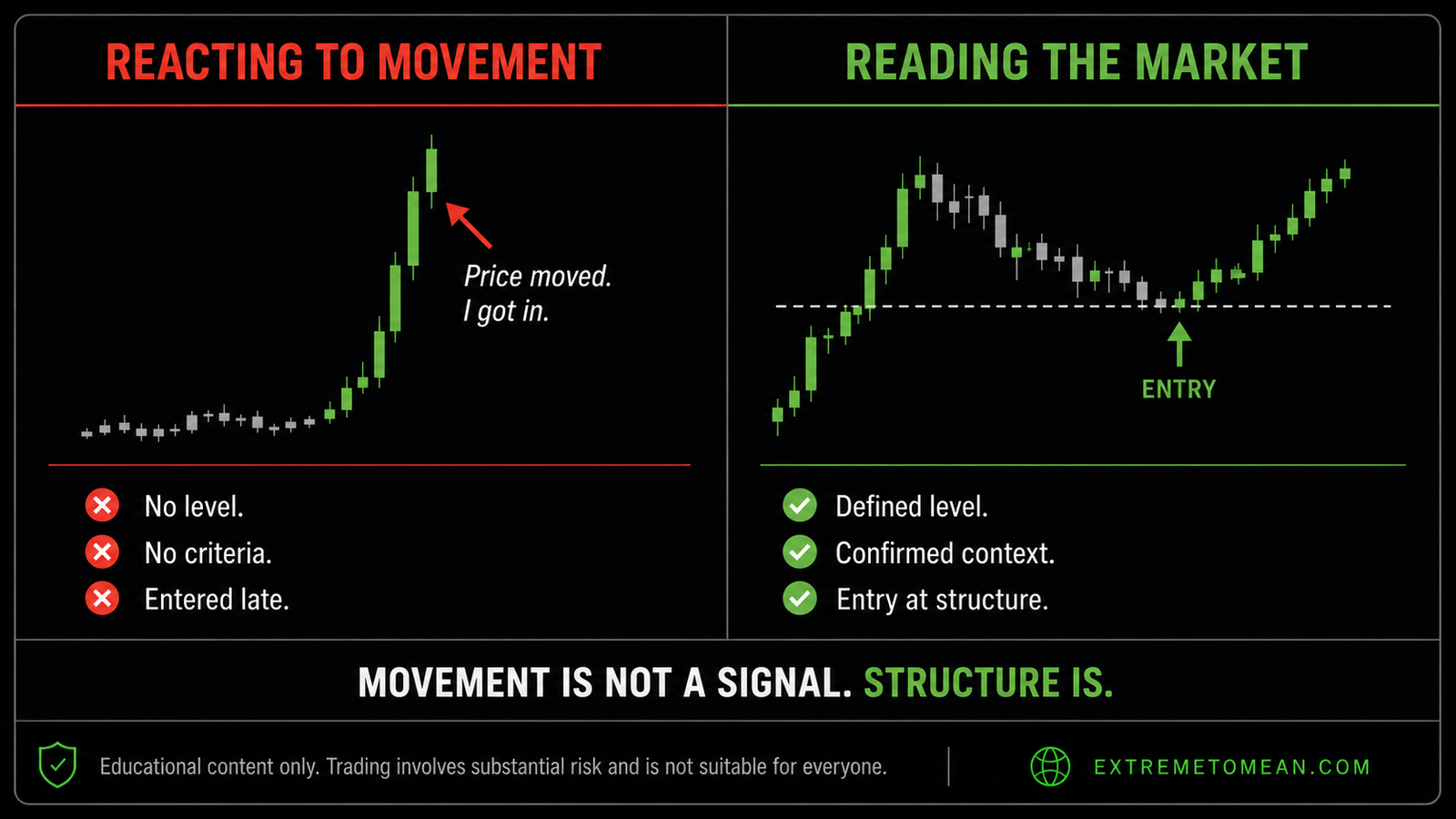
The frustrating part is that FOMO does not feel like fear in the moment. It feels like urgency. It feels like decisiveness. It feels like you are finally taking action instead of sitting on the sidelines. The trader psychology lessons focus on that emotional disguise because it is what makes FOMO so dangerous. You are not recognizing a real opportunity. You are reacting to movement — and movement by itself is not a signal.
FOMO Is a Reaction, Not a Read
There is a significant difference between identifying a trade and reacting to a move. When you identify a trade, you have done the work ahead of time. You know what the market needs to do, where it needs to be, and what condition needs to be present before you consider entering. When you react to a move, you have done none of that work — you are just responding to what already happened and assuming it will keep happening.
FOMO is always a reaction. It has no structure behind it. There is no level that invited you in, no context that said the setup was ready, no confirmation that price was in a location worth your risk. There is only the visual stimulus of price moving and your brain interpreting that movement as opportunity.
The market moves constantly. That is its nature. Movement is not the same as a trade. A candle closing higher is not a setup. A breakout bar is not an entry. Price being somewhere you did not expect it to be is not a reason to participate. The trader's job is to evaluate what the market is offering — not to react to the fact that it is moving at all.
Why It Feels Reasonable in the Moment
The difficult truth about FOMO is that it usually comes wrapped in logic that sounds credible. You will tell yourself things like: the trend is clearly up, momentum is strong, this is a great tape, I should be long right now. And some of those observations might even be accurate. The problem is that they are incomplete. Momentum being strong does not tell you where to enter. A clear trend does not mean price is at a level worth risking against. Tape quality and entry quality are not the same thing. That is why FOMO feels like opportunity but usually becomes regret.
Traders also reinforce FOMO through a specific type of scorekeeping that works against them. They remember the trades they sat out that went on to run. They remember standing aside while a move developed that they "knew" was coming. They do not remember with the same clarity the times they chased into a move and gave back ground because there was no real location behind the entry. The mind keeps a biased ledger, and that ledger pushes you toward action when patience would have served better.
This is also why FOMO tends to escalate. The first time you miss a move, you feel frustrated. The second time, you feel disciplined — briefly. By the third time, the discomfort is significant enough that you override whatever process you have and just get in. At that point, you are no longer trading. You are managing an emotional state by using your capital to do it.
The Real Cost of Chasing
The most visible cost of FOMO is a bad trade. You enter late, price pulls back, you take a loss and move on. That is a tuition payment. Painful, but survivable.
The less visible cost is what chasing does to your process over time. Every time you skip your criteria and get in anyway, you train yourself that the criteria are optional. Every time you enter without a level, you make it slightly harder to hold the standard on the next trade. The habit compounds. Eventually, you are not following a system at all — you are following your emotional state, and you have a set of rules you refer to occasionally when it is convenient. That is how chasing damages your ability to protect your next decision.
There is also a practical problem: when you enter late without a defined level, you have no clean place to be wrong. Good trades have a structure that tells you where the idea fails. FOMO trades do not have that structure, which means your stop placement becomes arbitrary — either too tight and too easily hit, or too wide and too expensive when it does hit.
FOMO does not just cost you on the individual trade. It costs you clarity on your actual edge.
Trading Means Knowing When Not to Trade
Here is a reframe worth sitting with: the most valuable skill in trading is not finding trades. It is disqualifying trades that do not meet your criteria.
Any trader with a basic understanding of chart structure can identify a direction. The harder skill — and the one that actually separates consistent results from inconsistent ones — is the ability to look at a setup that almost qualifies and say not yet or not this one. That skill only develops when you accept that your job is not to be in a trade. Your job is to be in the right trade, at the right location, with the right context behind it. It also means understanding why the middle gets traders chopped up.
The market is open five days a week. It generates dozens of potential setups every session. If you missed one, another is coming. That is not wishful thinking — it is the mechanical reality of how markets work. Price will pull back. It will offer another entry point. Another instrument will set up. Another session will come. The supply of opportunities is not fixed, and you are not competing against a clock.
Waiting is not losing time. Waiting with a reason is building precision. This is where the patient trader gets paid by the impatient one.
The Better Question Before You Act
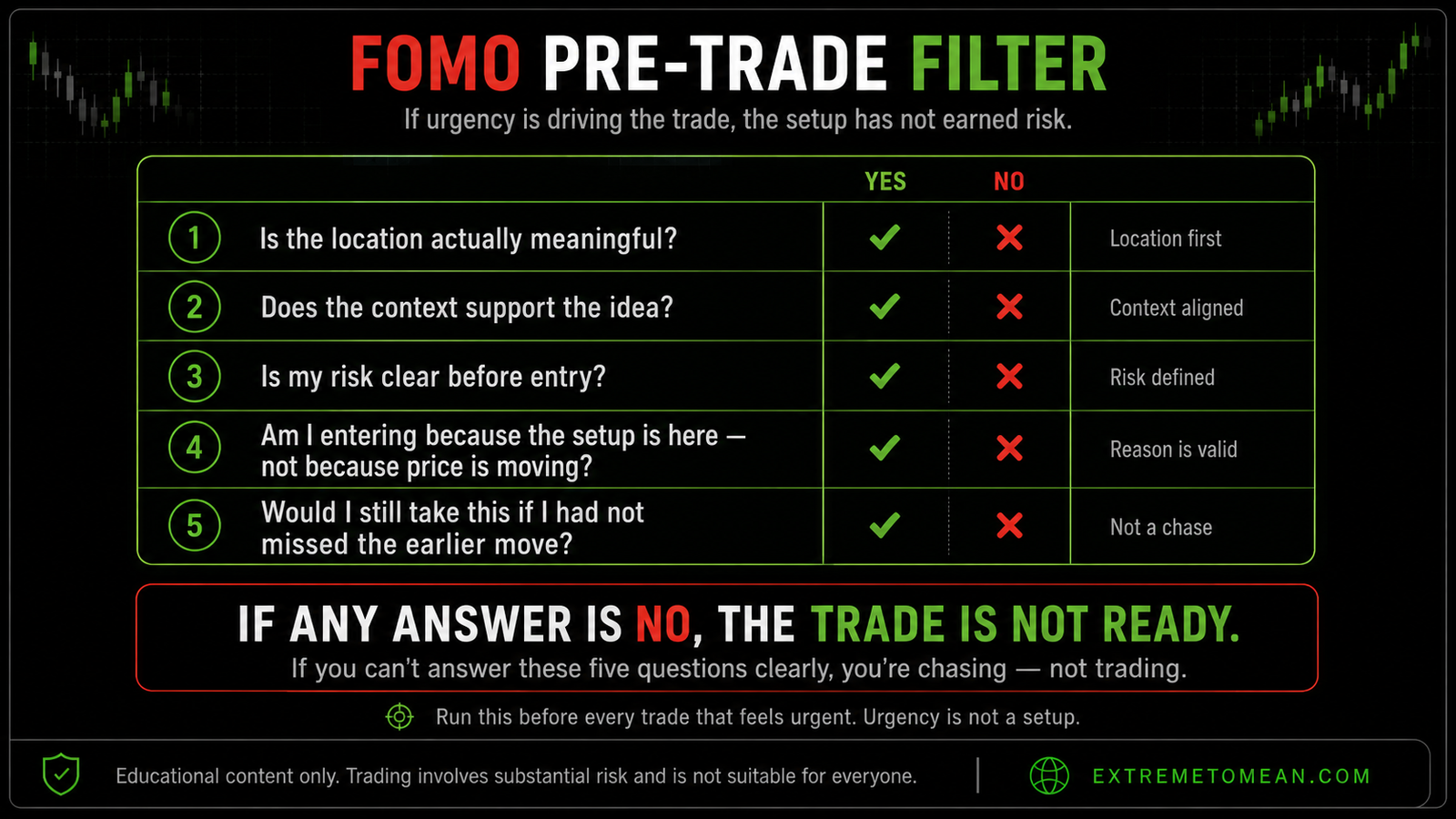
Before entering any trade under pressure, pause and run through this filter:
- Do I have a level? Is there a price that invited me in, or am I entering into open air?
- Do I have context? Does the market structure support this direction, or am I reacting to one candle?
- Do I have a defined risk? Where is my stop, and is it logical — or is it based on what I can afford to lose?
- Am I evaluating or reacting? Did I decide this before the move started, or did the move trigger the decision?
- Is this my setup, or is this a chase? If the market offered this entry five minutes ago and I passed, what has changed?
If you cannot answer those questions cleanly and quickly, the trade is not ready. And if the trade is not ready, the answer is not to force it — the answer is to wait.
The better question to ask before entering is this one: Would I have taken this trade before the move started?
If the answer is no, then you are chasing. And chasing is not a strategy. It is a cost.
Final Thought
FOMO convinces you that missing a move is the problem. It is not. Missing a move you were not in position for is not a failure — it is the system working. The real problem is what happens when the discomfort of watching a move outweighs your commitment to your process. If that pattern is familiar, start with the chasing-the-trade diagnosis.
Trading does not mean being in a trade. It means knowing when to be in one. That distinction is everything. The traders who build sustainable, structured results are not the ones who catch every move — they are the ones who stop paying the FOMO tax by learning to sit, evaluate, and wait for the market to come to them.
There will be another trade. There always is.
Most traders eventually discover why patience is learned the hard way when urgency keeps replacing a clear process.
Educational content only. Trading involves substantial risk and is not suitable for everyone.